Building Vocal Confidence for Non-Native English Speakers
Confidence in delivery, not accent reduction, unlocks workplace credibility for non-native speakers.
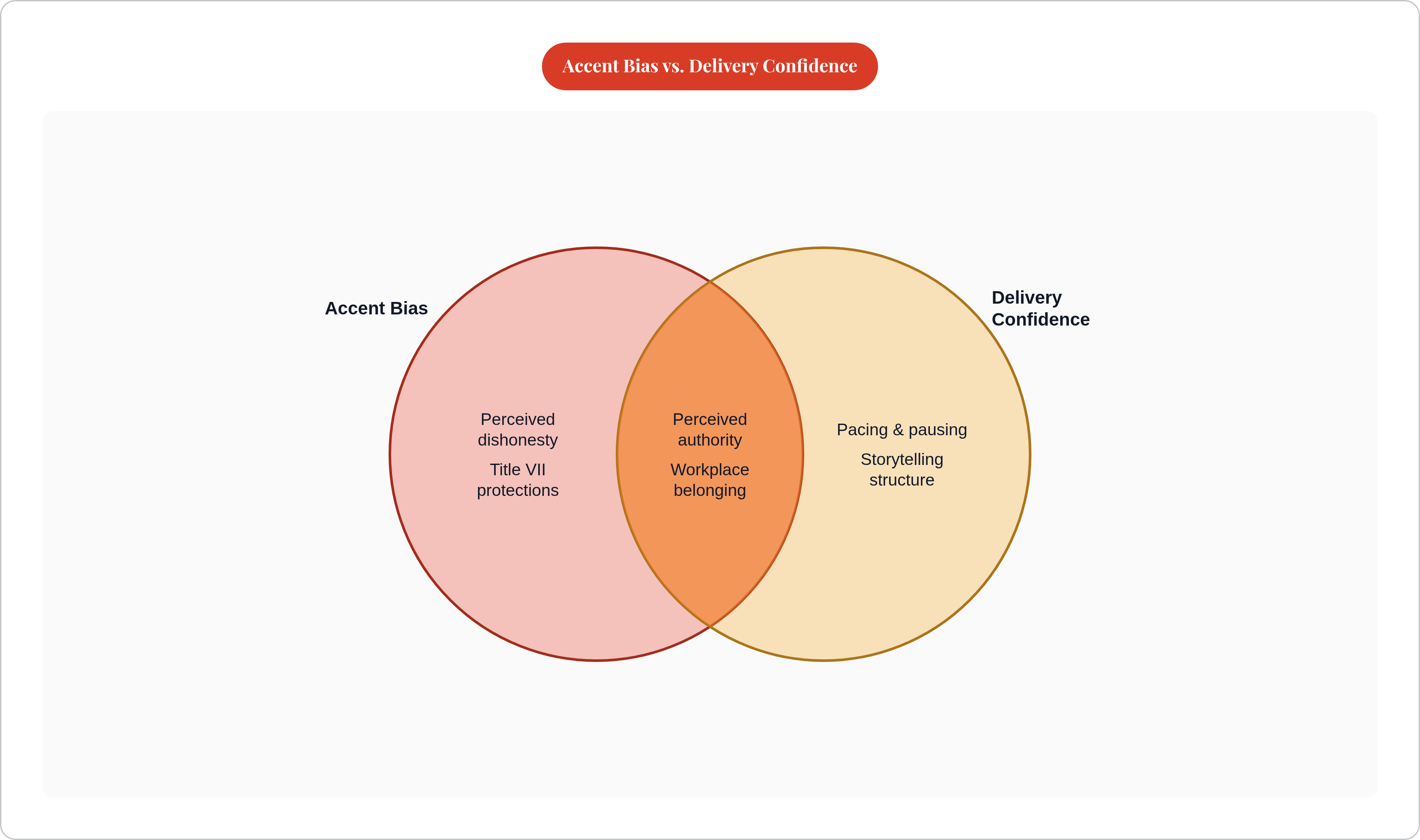
Accent bias does not wait for context. A University of Chicago study found that a foreign accent makes a speaker seem less truthful. The bias operates at the level of perceived honesty, not competence, and it activates before a listener has processed a single substantive claim. Studies using HR professionals found that as perceived accentedness increased, employability scores dropped. The discrimination is structural, not incidental.
Bias triggers downstream assumptions about education, cultural fit, and performance potential, all within the first few sentences. Accent discrimination falls under language-related protections in Title VII of the Civil Rights Act, and the research consistently ties it to diminished career progression and reduced workplace belonging.
What the research cannot settle is whether bias is fixed in its severity. Delivery, confidence, and perceived authority shift how listeners respond. The same accent lands differently depending on how it is carried. That is an uncomfortable observation because it puts some of the burden back on the speaker. But it is also the only part of this equation a speaker can do anything about, so that is where this argument goes.
Why Formal English Education Leaves Speakers Underprepared for the Moment That Counts
Fifty-four percent of respondents in Pearson's 2023 survey of 5,000 non-native speakers said their formal education failed to equip them with sufficient English to communicate properly. Fifty-six percent said instruction had concentrated on grammar and vocabulary rather than real-world situations. Half had not had enough opportunity to use English outside the classroom. The system optimized for tests, not for thinking out loud under pressure.
The result is a particular kind of speaker who knows the language but seizes mid-sentence: fixating on tense, rechecking pronunciation, losing the point in the machinery of correctness. Understandable, given what the system rewarded. Counterproductive in a live room with something at stake.
Stephen Krashen's Affective Filter Hypothesis explains why the training gap compounds. When anxiety is high and self-confidence is low, language input does not reach the acquisition centers of the brain; the filter blocks it. Fluency stalls not from lack of knowledge but from emotional state. The grammar is there. The pathways are there. The anxiety closes the gate, and more grammar study does not reopen it.
What Actually Builds Spoken Confidence: The Mechanics Behind Improvement with a Second Language
"Breakdown fluency," the degree to which speech flows without pauses or repairs, is the metric SLA researchers use to capture what listeners actually hear as confidence. It improves through practice, not through additional study. Research published in a peer-reviewed medical sciences database found that students' self-efficacy for both accuracy and fluency increased through structured, scaffolded practice. Confidence is a byproduct of repeated, supported attempts; it is not the entry fee.
Motivation and low anxiety accelerate acquisition at every stage, often more decisively than aptitude. The less talented but less anxious speaker frequently outperforms the more capable but more frightened one. Anxiety is the only language barrier that fluency alone cannot dissolve.
Here is the piece most non-native speakers waste years on: accent reduction. Delivery (meaning pace, pause, emphasis, and structure) is trainable in weeks. Accent reduction is a years-long project with diminishing returns on the one thing the speaker actually wants, which is to feel commanding. One of these has a clear payoff timeline. The other produces self-consciousness and a refined sensitivity to one's own vowels.
Individual practice performance also does not automatically transfer to live conversation. Reps need to approximate the actual moment, rather than rehearse a controlled, frictionless version of it.
Specific Techniques That Give Non-Native Speakers a Delivery Edge in High-Stakes Moments
Slow down first. Anxiety accelerates speech, which compounds comprehension problems and strips out the pauses that signal authority. Deliberate pacing is one of the fastest delivery gains available. It costs nothing except the willingness to feel slower than you think you should.
Script the opening and closing, not the whole thing. Stumbling is most likely at the highest-anxiety moment, which is the first thirty seconds, so that is the one place a script earns its keep. The middle should be structured but improvised; audiences can tell when someone is reading versus when someone knows what they are talking about, and that distinction matters more in the middle of a presentation than at the beginning.
Use storytelling as structure, not decoration. A clear narrative arc reduces the real-time cognitive load of constructing a message on the fly; the speaker follows a shape rather than improvising architecture mid-sentence. A three-level method developed by a University of Maryland researcher applies this to professional contexts: break the message into three sections, each with a brief introduction. If a listener loses the thread, the section introduction re-anchors them without requiring the speaker to backtrack or apologize.
Bridging phrases in Q&A do real mechanical work. Something as simple as "that's a great question, let me explain further" buys processing time without signaling uncertainty. The pause reads as deliberate.
One asset non-native speakers routinely undersell is word-choice precision. Translation demands exactness. Native speakers reach for the nearest available word; non-native speakers often reach for the right one. That is a delivery advantage most people with it never notice.
Vocal variety (adjusting pitch, pace, and emphasis across a presentation) is what holds attention and prevents the monotone delivery that loses rooms quietly. It is mechanical and trainable. Not a personality trait. The goal is to be commanding, not to pass as something else.
What Changes When a Non-Native Speaker Stops Trying to Sound Different and Starts Training to Sound Confident
The inflection point is not a grammar breakthrough. It is the moment a speaker stops measuring themselves against a native-speaker standard and starts measuring themselves against their last rep. Almost no one arrives at that frame naturally because the cultural pressure runs in the opposite direction, consistently and loudly.
The research on this is consistent: speaking with a non-native accent correlates with feeling excluded and devalued at work. The same research shows that perceived fluency and performance ability are shaped by how a speaker carries themselves, not only by the accent itself. Confidence and eloquence are inseparable, and neither materializes without reps.
I worked with a speaker who came into coaching with severe anxiety around live presentations. She could not complete a short livestream without freezing. Her accent was not the variable we worked on. Pacing, pausing, opening structure, the physical experience of slowing down and not apologizing for it. The accent did not change. What changed was the authority with which she carried it. That shift did not come from a realization. It came from accumulated attempts, most of them imperfect, some of them genuinely rough, until the pattern held under pressure.
The training loop is not preparation for the real thing. Done right, it is the real thing.
Why Daily Short Reps Outperform Periodic Intensive Practice for Building Spoken English Confidence
Breakdown fluency and processing speed improve through accumulated exposure and output. The brain needs repeated activation of the same pathways under low-stakes conditions to make high-stakes delivery automatic. This is not controversial; it is how motor skills develop, and spoken language under pressure is as much a motor skill as it is a cognitive one.
Short, low-anxiety reps lower Krashen's affective filter consistently, which means acquisition can actually occur during the session rather than being blocked by the stress of performing. Sporadic, high-pressure sessions keep the filter elevated. The format that most resembles formal education (periodic intensive effort) is also the format least suited to building spoken confidence.
The Pearson finding completes the loop: 56% of non-native speakers said they did not get enough real-world practice. Daily reps are the specific absence. Grammar instruction, vocabulary lists, and standardized tests are not the answer.
Feedback matters as much as volume. Knowing where pace collapsed, where a pause created authority, or where the room lost the thread is what drives the next attempt forward. Without a specific signal, high volume of practice produces high volume of repetition. Those are not the same thing.
The person who records one response and receives specific, actionable feedback every day for 90 days is doing something categorically different from someone who takes an accent reduction course once a year. Some daily-prompt apps for improving public speaking score each recorded response on a 0–100 scale and are built around exactly that loop. One is building a skill through iteration. The other is collecting a credential and hoping something changed in the interval.