Confident Speaking at Work Without Seeming Aggressive
Silent employees get overlooked for promotions, but aggressive ones get routed around eventually.

The 2025 Axios HQ State of Internal Communication Report found that 18% of employees said poor communication had directly cost them a promotion or career growth opportunity. That number is almost certainly conservative, because it only captures the cases where someone made the causal connection themselves. The promotions never offered, the project leads never assigned, the opinions no one thought to solicit: those don't surface in surveys because they're invisible to the people they're happening to.
Invisibility compounds. When you don't speak up consistently, colleagues assume you have nothing to say. That assumption eventually stops being an assumption and becomes the operating logic for how work gets distributed. You get managed around rather than included. Nobody decides to cut you out; it just becomes the path of least resistance.
Aggression produces a symmetrically bad outcome, just on a longer timeline. The aggressive communicator gets heard, usually, but gets routed around eventually. People stop inviting them into difficult conversations. The reputational damage accumulates quietly, and the person often never sees it coming until the room is already empty.
There's a third failure mode that rarely gets its own section: passive aggression. Psychologist Dr. Nick Bach has described it as something that "undermines trust and creates ambiguity, making conflict resolution and decision-making nearly impossible." It's what happens when someone can't be direct but also can't stay quiet. Neither release valve opens. The result serves no one, least of all the person caught between them.
The upside of getting this right is not abstract. Research links strong team communication to productivity gains in the range of 20 to 25 percent. More concretely: the person who communicates with clarity and composure becomes the one others want in the room when things get complicated. The people in those rooms tend to be the ones who make decisions, accumulate credit, and build influence. That accretes the same way silence does. Just in a better direction.
What actually separates assertive from aggressive in the words themselves
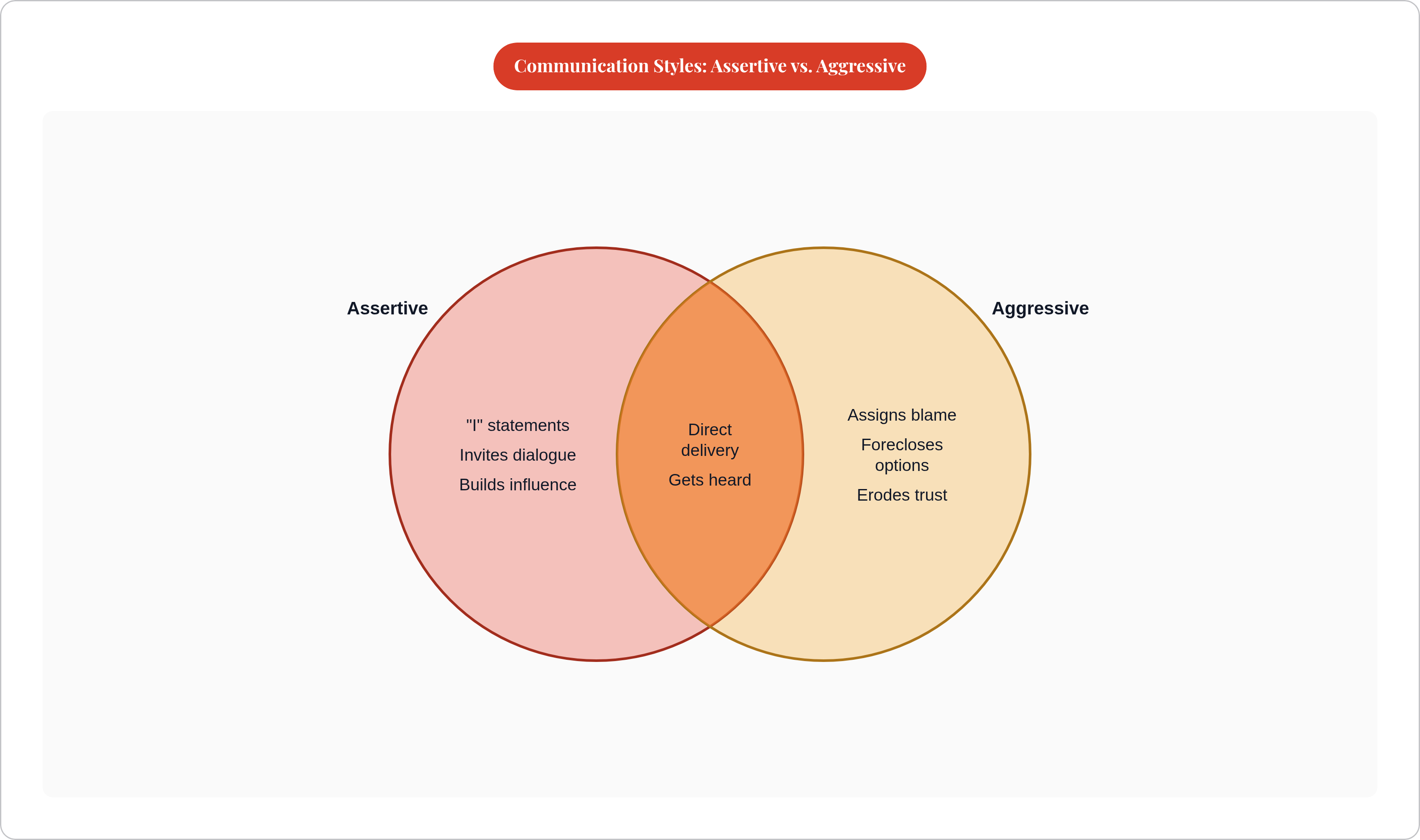
The core verbal distinction is structural, not tonal. Assertive language names what you think and leaves the door open for response. Aggressive language assigns blame or forecloses alternatives. The difference isn't about softening your position; it's about where the claim lands in the sentence.
"I" statements are the foundational mechanism, and they're boring to talk about and genuinely important to use. "I disagree" and "You're wrong" convey the same position with entirely different social architecture. One locates the disagreement in your own perspective; the other makes the other person the problem. The practical gap between "I'd like your help with this" and "You need to do this" is significant even though both sentences accomplish the same operational task.
What assertive language actually sounds like in a real meeting: "I'm concerned this timeline is too aggressive given our resource constraints. Help me understand what I'm missing. What makes you confident we can deliver?" That's honest, specific, grounded in a clear point of view, and it invites dialogue instead of ending it. It doesn't hedge. It asks a genuine question.
Over-explanation is worth naming because it feels like caution and functions like self-sabotage. The impulse to pad a strong position with caveats, qualifications, and pre-emptive apologies produces the opposite of confidence in the listener. Brevity isn't aggression; it's respect for the other person's intelligence. When you spend three sentences qualifying the sentence you actually mean, you train people to discount you. That's a slow process with an unambiguous endpoint.
Passive aggression on the same issues looks like indirect comments, vague agreement that commits to nothing, or ambiguous compliance that leaves the underlying problem untouched. Assertive communication resolves the issue. Passive aggression preserves it somewhere between the lines, where it waits patiently to cause more damage later.
How voice mechanics shift the read from confident to combative
The words can be exactly right and the delivery can still wreck them. A clipped, throat-driven projection reads as combative regardless of actual content. A steady voice supported by diaphragmatic breath signals authority without threat. This isn't stylistic preference; it's a physiological fact about how the nervous system processes incoming communication before the conscious mind has time to weigh in.
Pace matters more than most people account for. Speaking too fast registers as nervousness or defensiveness, and that interpretation happens before the words are consciously processed. Research suggests a target of 140 to 160 words per minute as a reasonable range for both comprehension and credibility. Slowing down is not weakness. It signals that your point is worth waiting for.
The pause is a precision instrument that almost everyone underuses. Pausing after an important point lets it settle. Pausing before one builds anticipation and signals that what follows is worth attention. A two-second pause sounds more confident to listeners than a filler word does, even though it feels considerably more uncomfortable to the speaker. That dissonance is the entire problem, and also the entire solution.
The credibility cost of filler words is documented. Research published in Communication Studies found that higher filler-word use correlates with lower perceived professionalism and credibility regardless of speaker gender. Per Preply, 43% of people report struggling with speaking too fast. Pace and fillers feed each other: when you accelerate, you reach for fillers to maintain the feeling of verbal continuity, which accelerates things further. It's a coherent little downward spiral.
Stress physiology is the underlying saboteur. When the nervous system is dysregulated, pitch rises, pacing accelerates, and clarity breaks down. This happens precisely in the high-stakes conversations where delivery matters most. You can know all of this cold and still watch your cortisol make its own decisions the moment the room gets quiet. Preparation narrows the gap; it doesn't close it.
Body language broadcasts before you say a word. Eye contact held for three to five seconds reads as engaged; too little signals hesitance, too much signals confrontation. Open posture versus crossed arms sends a message before any language arrives at all. The body has been making an argument the whole time.
The gender double bind and what it demands of assertive communication
The asymmetry is well-documented and stubborn. Assertive men are read as leaders. Assertive women, exhibiting equivalent behavior, are more frequently labeled bossy, difficult, or aggressive. The behavior doesn't change; the reception does. Pointing this out is not a complaint about fairness. It's a description of the actual terrain.
The numbers are worth sitting with. Women who are assertive are 30% more likely to be labeled "abrasive" in performance reviews compared to their male counterparts. Research shows that when women communicate at assertiveness levels equivalent to men, their perceived deserved compensation drops by up to $15,088 annually and their perceived competency drops 35%. Sixty-eight percent of American women report experiencing professional double binds, and 80% report that the experience leaves them exhausted. The numbers are blunt about what the stakes are.
This is not a reason to code-switch permanently. It is a reason to be strategic about context. Those are distinct positions with different implications. Research on women directors serving on publicly traded U.S. company boards identified a deliberate pattern: warmth-based tactics, including asking questions and establishing connection, were used to open conversations, while competence-based tactics, including asserting positions and qualifying claims, were deployed selectively based on goal and audience. Situational calibration, chosen deliberately, not a permanent identity reduction.
Men interrupt women 33% more often than they interrupt other men in group discussions. No single communication technique solves that, because it is a structural problem, not a personal one. What it demands practically is heightened awareness of when to re-enter, how to reclaim the floor without escalating, and when the environment itself is worth naming aloud. Sometimes the most assertive thing in the room is refusing to perform normalcy around a dynamic that isn't normal.
The parallel trap for men deserves acknowledgment. Aggression is not penalized symmetrically (it is still tolerated more) but it still erodes collaboration, trust, and the quality of the working environment over time. The headwinds are asymmetric. The target behavior is not.
Using structure and storytelling to make your point land without pushing
A well-structured argument doesn't need to be pushed. When a listener can follow the logic, they are considerably less likely to experience it as pressure. Structure does work that tone cannot.
The PREP framework is a practical tool for any high-stakes verbal moment: Point, Reason, Example, Point restated. In practice: "I think we should move standups to 9 AM because they interrupt deep-work blocks. Last Tuesday, three people had to stop mid-task to join the call. Moving them earlier would protect everyone's most productive hours." The example makes the point concrete without making it personal, and the structure carries the argument so the speaker doesn't have to perform conviction. The logic lands on its own.
Storytelling is underused as a tool in professional disagreement, probably because it's associated with keynotes rather than with moments when you need to hold a position without triggering defensiveness. Dr. Uri Hasson's 2010 Princeton research on neural coupling found that when one person tells a story, the listener's brain begins to mirror the storyteller's neural patterns. Stories don't just inform; they synchronize. A first-person account with genuine stakes is often more persuasive than a direct assertion, and it registers less as confrontation.
I learned this the slow way. Early in my career, I sat in a meeting with real concerns about a product launch timeline and said nothing, partly because I wasn't confident I had the standing to push back, partly because I didn't want to be the difficult one. Two weeks later, the launch stumbled in exactly the way I'd anticipated, and a colleague who had voiced nearly identical concerns was pulled aside and thanked for their foresight. We had the same read on the situation. I just never surfaced mine, and watching someone else get credit for a concern I'd filed away quietly was its own specific kind of frustrating. You can't even be angry at anyone else about it, which somehow makes it worse.
Dr. Paul Zak's research adds a biochemical dimension worth noting. Emotionally engaging stories can boost oxytocin levels by up to 47%, increasing trust and openness in listeners. The person who leads with a personal experience is not softening their position; they are making it harder to dismiss.
The practical skill is knowing when to lead with structure and when to lead with story. PREP earns its keep in decision-making contexts where people want the logic laid out cleanly. Story generates buy-in where logic alone produces pushback. The most effective communicators switch between these modes based on what the moment requires, not what they happen to be most comfortable delivering.
The daily practice that actually moves the needle on assertiveness
Assertiveness doesn't consolidate through insight. It consolidates through repetition under real conditions. Understanding the mechanics is necessary but insufficient; the nervous system needs the reps. Knowing how to throw a punch and being able to throw one under pressure are categorically different things, and no amount of reading about punching closes that gap.
Start with the filler-word drill because it produces honest data in a way most self-assessment does not. Record two minutes of yourself explaining something (anything) and count every filler. Set a weekly target to halve the count, replacing fillers with intentional pauses. Meaningful improvement shows up within two weeks of daily practice. The drill works not because it's sophisticated, but because most people have no accurate picture of their own filler frequency until they hear it played back. The gap between self-perception and reality is, in my experience, fairly humbling.
A six-day progressive schedule covers the primary mechanics without requiring you to overhaul everything simultaneously. Paraphrase before responding in every conversation on day one. Count your own interruptions and target zero on day two. Observe three skilled communicators and identify one specific technique each uses on day three. Maintain eye contact for 70 to 80% of a conversation without crossing into a staring contest on day four. Listen to a podcast and summarize the argument in three sentences on day five. Ask five open-ended questions across your conversations on day six. None of these are intellectually demanding. All of them are behaviorally uncomfortable, which is precisely the point.
VR simulation research demonstrates that real-time feedback substantially accelerates skill acquisition, and the same logic applies to self-recording. You cannot accurately assess your own pace, pitch, or filler frequency in real time. Playback creates the external vantage point the brain genuinely cannot generate from inside the moment. A 2025 ERIC publication on structured experiential learning showed significant improvements in self-confidence for public speaking alongside meaningful reductions in anxiety. The mechanism is exposure combined with structured reflection. Exposure alone does not suffice; simply talking more does not make you better at it.
Brief journaling belongs here, not as therapy but as performance data. Logging daily communication wins and failures over a few weeks produces pattern recognition that retrospective introspection doesn't: the contexts where delivery holds, the ones where it collapses, the specific triggers that compress the nervous system and corrupt the execution. You start to see yourself as a system with identifiable failure modes, which is considerably more actionable than feeling vaguely bad about how a conversation went.
The assertive-aggressive line does not move based on personality. It moves based on preparation. The communicators who stay on the right side of it consistently have simply practiced being there until it stopped feeling like an effort and started feeling like a baseline.