Glossophobia Causes and Symptoms
The clinical definition is narrow, but millions of people qualify for the genuine anxiety disorder.
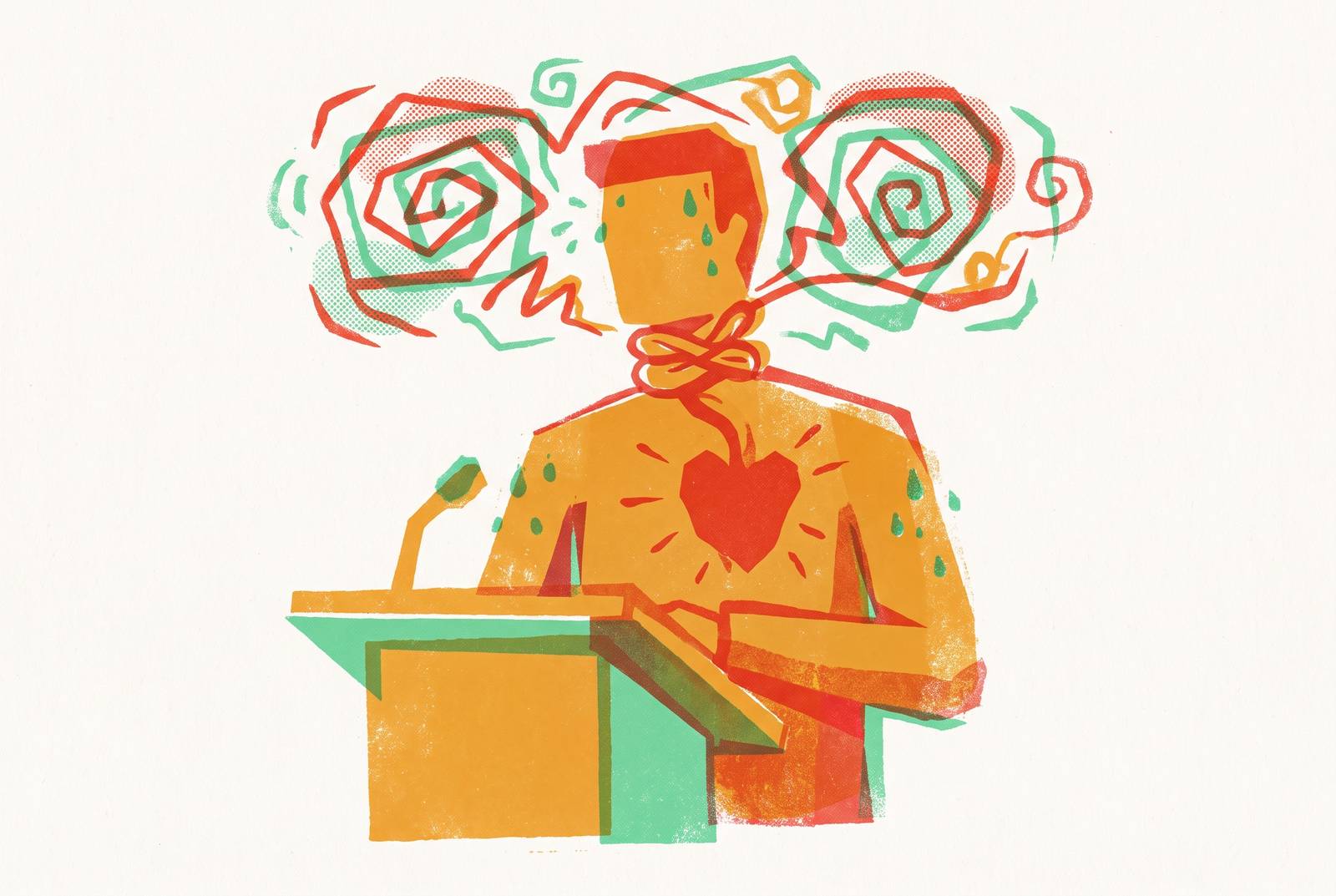
Glossophobia is the clinical term for public speaking anxiety, built from the Greek glossa (tongue) and phobos (fear). Not everyone who gets nervous before a presentation actually qualifies, though. To meet the clinical bar, the fear has to be intense, persistent, and disproportionate to the actual risk of standing up and talking, which is, biologically speaking, almost none. The DSM-5 files it under social anxiety disorder, and it can present in people whose anxiety centers specifically on speaking situations. The word "phobia" sounds like a diagnosis reserved for the dramatic few, but a meaningful chunk of the population clears that bar without ever calling it by name, and most of them think they're just "bad at public speaking."
How widespread glossophobia is, and why the numbers vary so much
Start with the number everyone quotes: up to 77% of people report some fear of public speaking. Then Chapman University's Survey of American Fears complicates things. In the 2025 edition, only 33.7% of Americans said they were afraid or very afraid of public speaking, placing it 46th out of more than 65 fears surveyed, well behind sharks and heights. That gap isn't a contradiction. It's a measurement problem: ask "do you fear public speaking?" and you get the high number. Force people to rank it against sharks and mortality, and it drops by half.
The number that actually matters, and the one most coverage skips past, is this: somewhere between 15% and 30% of people meet the threshold for a genuine anxiety disorder around public speaking, not just discomfort. Estimates suggest around 15 million people deal with glossophobia-level anxiety on a regular basis. That's the population this piece is about. Not everyone who gets butterflies before a toast. The ones for whom the butterflies never leave the building.
So glossophobia sits in a strange middle zone: common enough that ignoring it is silly, specific enough that treating it as a universal condition everyone just muscles through is lazy. It's a well-defined slice of the anxiety spectrum, and it runs on specific, identifiable mechanisms. That's what makes it worth taking apart.
Why the brain treats an audience like a predator
Three systems run this show: the amygdala, which flags threats, the HPA axis, which floods the body with stress hormones once a threat gets flagged, and the prefrontal cortex, which is supposed to talk everybody down and often just doesn't show up to the meeting. Adrenaline kicks in the moment the brain registers a social threat, and for a public speaker that can happen before a single word gets said. Walking toward the podium is enough to trip the wire.
What's well established about amygdala activity in socially anxious people is that the fear response doesn't wait for the speech to start — the dread arrives early and overstays its welcome. A speaker who's been dreading a talk since Tuesday has already run the fear response for days before anyone hears a word of it.
The evolutionary logic underneath is blunt: in early human groups, getting rejected by the tribe wasn't an ego bruise, it was a death sentence. No tribe meant no food, no protection, no odds. The brain never updated that math, and it still treats a room full of judging faces the way it once treated a genuine threat to survival, because for most of human history, that's exactly what it was.
That reframes the entire physical experience. The heart rate spike, the sweat, the dry mouth: none of that is the body malfunctioning. It's a defense system doing precisely what it evolved to do, aimed at a threat that can no longer actually hurt anyone. Wrong target, correct machinery. Blaming the machinery is where most people go wrong.
The other causes: genetics, past experience, and the loops they create
Social anxiety runs in families, and glossophobia is no exception. Inherited overactivity in fear-processing brain regions sets a higher baseline, so some people start the race a few steps behind before a single bad speech ever happens.
Then there's conditioning, and this is the most commonly reported origin story: one bad experience, one moment of being laughed at, freezing mid-sentence, or getting torn apart by criticism, and the brain files public speaking under "genuine danger" permanently. Social anxiety broadly tends to be first noticed between ages 8 and 15, which means a lot of adults dreading a boardroom presentation are actually still flinching from a sixth-grade book report.
The fear doesn't even need to be personal to take hold. Watching someone else freeze, stammer, or get humiliated in front of a room installs the same wiring by observation alone, no direct experience required. The brain takes notes even when the notes aren't its own.
Research backs this up at the neural level: people with social anxiety show a stronger response when negative comments are read aloud to them, specifically in brain regions tied to self-evaluation and emotional processing. That heightened reaction doesn't show up in people without the disorder. Same words, different wiring, different consequence.
Then the loop takes over. Replaying a bad speaking memory doesn't dull it the way replaying most memories does. It sharpens it, makes it worse with each pass, with zero new evidence to justify the escalation. Add perfectionism, low self-esteem, and a habit of treating a talk as a performance under judgment rather than a conversation with a room, and the stakes the brain perceives balloon well past what's actually on the line.
Who is most likely to develop it: the demographic picture
Age matters more than most people assume. People between 16 and 24 report glossophobia more than any other age group, which tracks with adolescence and early adulthood being peak years for self-consciousness generally. Among Gen Z specifically, a large majority report fearing public speaking, and the vast majority of college students say they feel anxious before class presentations. The group most likely reading an article like this one is also the group most likely living it.
Gender plays a role too, and a fairly large one. Women are roughly twice as likely as men to meet the clinical threshold for a specific phobia: 12.2% versus 5.8%. At the broader, less severe level of general public-speaking anxiety, the gap narrows but doesn't close, at 95% of women reporting some anxiety versus 89% of men. Nobody has a clean single explanation for that gap; it's some mix of hormonal, social, and cultural pressure, and the research doesn't separate cleanly which does the most work. Anyone offering a tidy one-cause answer is selling something.
Confidence climbs with age and experience, which sets up a cruel bit of timing: the fear peaks precisely when people have had the fewest chances to prove it wrong. And the exit ramp people take, avoidance, is exactly what keeps the whole cycle running. Fifty-seven percent of people say they'd do almost anything to dodge giving a speech to a large audience. Skipping the talk feels like relief in the moment. It's actually the mechanism keeping the fear alive, because the brain never gets the corrective data it needs, and next time the fear shows up exactly as strong, maybe stronger.
What glossophobia feels like from the inside: the physical symptoms
None of this is random. It's a direct, predictable cascade from the fight-or-flight response described above, and it shows up in a fairly consistent order: sweating leads at 67%, trembling follows at 58%, a racing heartbeat comes in at 52%.
The fuller symptom list reads like a body in open revolt: dry mouth, shortness of breath, nausea, dizziness, blushing, a tightening throat, a shaky voice, stiff neck and upper-back muscles, dilated pupils. Heart rates can spike dramatically — up to 150 beats per minute — in a significant share of sufferers.
The cruel joke is that the symptoms sabotage the very thing they're supposedly protecting against. Dry mouth makes words harder to form. A shaky voice broadcasts nerves to the exact audience the speaker was hoping to impress. Shortness of breath chops sentence rhythm mid-thought. The body, trying to shield the speaker from judgment, ends up manufacturing the very awkwardness it feared, which is a bit like a smoke alarm that starts the fire.
Verbal symptoms deserve their own mention: a weakened tone, trembling or stammering delivery. Stumble over a sentence, feel the embarrassment land, and that embarrassment doesn't stay contained to the moment. It feeds straight into the psychological symptoms waiting in the wings.
The psychological and behavioral layer that keeps the fear in place
The mental side shows up early and lingers late: anticipatory anxiety that can start days before the event, a steady undertow of negative self-talk ("What if they don't like this?", "I'm not actually good enough to be up here"), and trouble concentrating once the speech is underway.
One of the stranger findings in this space is what researchers call the illusion of transparency: speakers consistently believe their anxiety is far more visible than it actually is. The internal experience feels like standing on stage in flames. The external reality, to the audience, is usually a person talking who looks a little stiff, at worst.
Avoidance takes over from there, and it gets structural fast. People turn down job offers, skip classes, hand presentations off to colleagues, whatever it takes to dodge the moment. Research suggests 30% of people avoid jobs specifically because of a fear of public speaking. That's not a quirky personality trait costing someone an awkward afternoon. That's a career built around a fear nobody ever addressed.
Over-preparation deserves a mention too, because it masquerades as diligence when it's often the same fear wearing a different coat. Scripting every syllable in advance isn't building confidence, it's trying to engineer away the possibility of judgment entirely, which isn't possible, and the anxiety just relocates to worrying about deviating from the script.
The loop closes here. Avoidance blocks the exposure that would otherwise teach the brain the threat isn't real, and most people, the roughly 80% sitting somewhere between "loves the stage" and "terrified of it," stay stuck in that holding pattern indefinitely. Only about 10% of people with public speaking fears ever seek professional help for it. That gap, between how much this disrupts actual careers and how rarely anyone does anything about it, is the most telling fact in the whole condition.
Why understanding the mechanism is the precondition for changing it
Glossophobia isn't a personality trait. It's a learned threat-response running on outdated software, and outdated software gets patched, not accepted as permanent. Every cause on this list, conditioning, rumination, avoidance, perfectionism, is a behavior or a thought pattern. None of it is a fixed feature baked into someone's identity, whatever it feels like at 2 a.m. before the talk.
The distribution backs this up. In studies measuring anxiety levels during public speaking, roughly 50% report high anxiety, 30% moderate, 20% low. That's not three species of people. It's one continuum, and where someone lands on it moves with exposure and practice, not fixed destiny.
Even the physical symptoms deserve a second look. The pounding heart and shaky hands feel like proof of incompetence in the moment, but exposure-based treatment reframes them as activation: the body gearing up for a real event, not evidence the body is failing. That reframe alone changes what a racing pulse means to the person standing there living it.
Glossophobia is well-defined, well-studied, and responsive to deliberate practice. That puts it about as far from "fixed fate" as an anxiety gets, and treating it like a life sentence is the actual mistake here, not the fear itself.