Habit Reversal Training for Nervous Speech Patterns
A structured therapy with five components trains you to catch the urge before the filler emerges.

The word is already forming before the decision to say it. That is the signature of the premonitory urge, the clinical term for the sensation that precedes a semi-involuntary behavior, and it applies as cleanly to nervous fillers as it does to motor tics. The fix is not willpower or eloquence training. It is a structured behavioral therapy called Habit Reversal Training, and its five components map onto speech anxiety with surprising precision. The framework gives anyone a repeatable system for replacing reflexive filler with deliberate pause.
Barbara Coffey, a clinical expert quoted by the Child Mind Institute, describes tics as "semi-involuntary," preceded by a premonitory sensation the person can learn to detect. The same structure governs the anxious impulse to fill silence with "um" or "like." A speaker feels a physical rush or a fear of silence, and the filler arrives as a reflex response to that sensation. Most people recognize the filler after it happens. Almost none catch the urge before it fires.
The American Speech-Language-Hearing Association classifies fillers and avoidance behaviors, such as substituting words, inserting unnecessary words, and circumlocution, as avoidance behaviors related to stuttering. That is a fluency disorder. The same body also notes, with useful precision, that filler use in all speakers constitutes typical disfluency, not a disorder. Nervous fillers are not pathological. They are conditioned, semi-involuntary behaviors with a detectable trigger, which makes them trainable.
The underlying mechanism is prediction, not willpower. Extinction does not erase the original anxious memory. It builds a competing one that eventually wins. The active ingredient is expectancy violation: a speaker goes in expecting a bad outcome, the outcome does not occur, and the mismatch between prediction and reality is what gets encoded. One mismatch is a fluke. Many mismatches become a rule. Effort alone cannot produce that mismatch. Structure can.
What Habit Reversal Training actually is and why it was built for exactly this problem
Habit Reversal Training, or HRT, is a behavioral therapy that eliminates unwanted behaviors by replacing them with other actions. The Cleveland Clinic describes it in exactly those terms. Developed in the 1970s, the method has accumulated decades of supporting studies across a range of habits, from nail-biting to tics. Nervous speech is not a stretch application. It is a native use case.
The framework consists of five components: awareness training, competing response training, contingency management, relaxation training, and generalization training. Each one addresses a distinct failure point in behavior change. A person cannot try harder without first knowing what to notice. Awareness without a replacement leaves a person stuck observing a behavior they cannot redirect. Neither survives real-world pressure without social reinforcement and environmental practice.
The clinical evidence is substantial. A 2025 NOCD study of 167 patients with tic disorders treated via therapist-delivered video HRT showed substantial symptom reduction that was maintained and further improved over extended treatment. That study is a preprint and has not been peer-reviewed, a caveat worth holding. The broader pattern in the literature points the same direction.
The framework's power is structural rather than motivational. Generic advice fails because it addresses only one part of the problem. HRT succeeds because it addresses all of them at once, in sequence, with each component reinforcing the next.
Step one: awareness training, or learning to catch yourself before the filler leaves your mouth
Most people know they use filler words. Almost none can detect the specific urge that precedes each instance. That gap between vague awareness and precise detection is where self-improvement attempts usually collapse. Awareness training closes it.
The Cleveland Clinic breaks the process into three layers. Response description means identifying the behavior in detail, including the associated sensations, which for speech might be a rush to speak or a catch in the throat. Response detection means acknowledging each instance as it happens, ideally with external feedback. In a self-directed practice, a recording serves that role. Early warning training targets the earliest signal, the urge itself, before the behavior fully executes, and maps the situations and emotional states that increase frequency.
Coffey notes that children as young as nine or ten can learn to describe these premonitory experiences. The signal does not need to be in the same location as the behavior. A child might feel a neck sensation before a head tilt. Applied to speech, the urge often manifests as a physical rush or a fear of silence, not as a word-level thought. The person who learns to notice that rush has gained a head start on the filler before the vocal cords move.
The practical entry point is a recording habit. Record a two-minute verbal response to a prompt. Count every filler. That count is the baseline, and the act of counting is itself the detection training. Revisit recordings over time, month after month, and the improvement becomes difficult to argue with. The evidence accumulates in a form no inner critic can dismiss.
Step two: competing response training, or replacing the filler with something the brain can actually use
The competing response is not a better habit layered on top of a bad one. It has to satisfy three conditions: it must be physically incompatible with the unwanted behavior, sustainable for at least a minute, and unobtrusive enough for any real-world speaking situation. A replacement that fails any of these tests will not survive contact with actual conversation.
For filler words, the competing response is deliberate, held silence. The pause before speaking is physically incompatible with vocalizing a filler. The mouth cannot produce an "um" while it is deliberately not producing anything. The two-second pause feels longer to the speaker than to the audience, and that asymmetry is the key reframe. What feels like an eternity of awkward silence to the person speaking registers as a natural breath to everyone listening.
Coffey notes that in clinical practice, the child and therapist choose the competing response together. Ownership of the replacement behavior is part of what makes it stick outside the practice environment. The same principle applies to self-directed work. The speaker who chooses held silence as their response, rather than having it assigned, is more likely to deploy it when the pressure rises.
The distinction matters. This is not the generic advice to "just pause." It is a trained response, held deliberately, selected in advance, and practiced until it becomes the default move when the premonitory urge fires.
Step three: contingency management, or why you need someone else in the room
Behavior change in HRT is socially scaffolded by design. The contingency management phase, sometimes called intensive training, relies on family members or friends to reinforce the competing behavior. The Cleveland Clinic describes this component in those terms. A support person observes, reinforces the replacement behavior, and provides the external signal that self-monitoring cannot sustain under real speaking conditions.
The logic is straightforward. Under stress or cognitive load, in an actual conversation, a presentation, a job interview, the self-monitoring resources that awareness training depends on get consumed by the task itself. The speaker is managing content, tone, eye contact, and audience response all at once. The mental bandwidth for detecting a premonitory urge simply is not there. An external observer covers that gap.
The NOCD video HRT study built contingency management into its delivery format. Between-session support included therapist messaging, digital support tools, and peer community access. The social layer was continuous, not confined to scheduled sessions. A University of Utah HRT trial structured the component as fifteen practice sessions with a study team member over three weeks. External presence at that volume creates enough repetition for the competing response to become automatic.
For self-directed practice, the function can be served without a clinic. Share the recording with one person whose opinion carries weight and ask for one specific piece of feedback. Alternatively, use a scoring system that externalizes the judgment. A 0–100 rubric across clarity, engagement, and anxiety management creates the feedback signal a support person would otherwise provide. The point is that some external anchor exists. The brain does not grade its own homework honestly under stress.
Step four: relaxation training, or defusing the anxiety that fires the filler in the first place
Fillers and verbal tics spike under stress because anxiety compresses the cognitive space available for deliberate speech. Relaxation training in HRT does not aim to eliminate arousal but to lower it enough that the competing response can still execute. The goal is not calm. The goal is functional.
The Cleveland Clinic lists the standard tools: mindfulness, meditation, deep breathing, guided imagery, progressive muscle relaxation, physical activity, reading or writing, listening to music. These are not soft additions to the protocol. They reduce the frequency of stress-state triggering of the unwanted behavior, which is the precise mechanism that keeps fillers firing.
Harvard Business School associate professor Alison Wood Brooks offers a reframe that aligns with this goal. People who reappraised anxious arousal as excitement felt more excited and performed better than those who tried to calm down. Anxiety and excitement are physiologically very similar. Both are high-arousal states characterized by increased heart rate. Reappraisal requires only reinterpreting the feeling. Calming down requires changing both the physical state and the interpretation, a far heavier lift in the moment before speaking.
This is clinically consistent with HRT's relaxation rationale. Zero arousal is neither achievable nor desirable before a high-stakes conversation. A manageable arousal level, one where the competing response stays accessible, is the target. The speaker who interprets a racing heart as readiness has conserved the bandwidth that the speaker trying to meditate away the same sensation has already spent.
Step five: generalization training, or why the practice room is not the point
Generalization training is what separates HRT from ordinary rehearsal. It deliberately moves the competing response into escalating real-world contexts until the replacement behavior becomes automatic across all speaking environments, not just the ones where it was trained. The Cleveland Clinic frames it as practicing the competing behavior in various situations and environments until it eventually becomes automatic and replaces the habit.
The research on risk-taking and oral communication supports this structure. Skills increased when students regularly spoke without fear, took initiative to practice, and viewed mistakes as learning opportunities. The environment where mistakes are safe is the training ground for generalization. Low-stakes practice formalizes failure as data, which is exactly what the nervous speaker needs before stakes are real.
The meta-analysis of cognitive and behavioral interventions shows a sleeper effect. People kept improving after treatment ended. The competing response continues being reinforced by real-world speaking situations once it has been established. Generalization does not stop at the boundary of formal practice. It compounds.
The practical structure is an escalation ladder. Solo recording gives way to peer conversation. Peer conversation moves to small group. Small group moves to unfamiliar audience. Unfamiliar audience moves to high-stakes context. Each step is a generalization layer, not a new skill. The skill is the same. The environment is what changes. At the top of the ladder, the speaker is no longer someone working on fillers. The default speech pattern has changed.
Why the five components only work as a system, not as individual tips
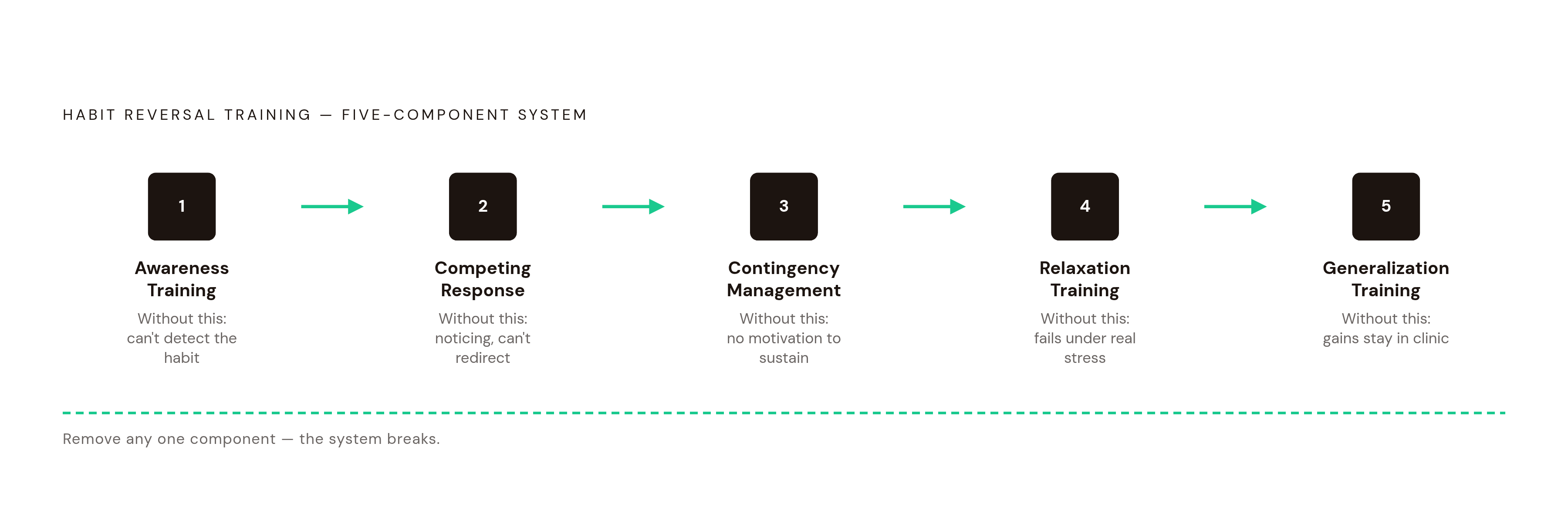
Every component of HRT addresses a failure mode that the others cannot cover. Remove any one and the system leaks at exactly that point. Awareness training without a competing response leaves a person stuck noticing a behavior they cannot redirect. That is a recipe for heightened self-consciousness and worse performance, not better. Competing response training without relaxation training fails under real stress, when the arousal load consumes the working memory needed to execute the replacement. Both of these without contingency management degrade under cognitive load, because the moment a speaker is managing the content of what is being said, self-monitoring slips. All three without generalization produce skills that live only in the practice room.
This is why generic advice like "just pause" or "record yourself" produces inconsistent results. Each suggestion contains one component of the system. None contains the surrounding structure that makes the component work. A single gear does not make a transmission.
The NOCD video HRT study embedded all components simultaneously. Therapist sessions delivered awareness and competing response training. Messaging support provided contingency management. Digital tools and peer community scaffolded generalization. The observed improvement continued past the formal treatment window. The system, not any individual piece of it, carried the load.
How to start the HRT loop today without a therapist or a clinic
The framework scales down to a self-directed daily practice loop that covers all five components without clinical infrastructure. Build the loop deliberately and the components show up whether they are named or not. Record a two-minute verbal response to a prompt. Count every filler. Log the count. That number is the baseline, and the act of counting is the detection training. This is awareness training in its rawest form.
Choose one replacement behavior for the filler urge. Held silence, a slow nasal breath, a deliberate pause. Commit to it exclusively. Consistency matters more than which response is chosen. This is competing response training.
Share the recording with one person whose opinion carries weight and ask for one specific piece of feedback. Or use a scoring system that externalizes the judgment. A 0–100 rubric across clarity, engagement, and anxiety management creates the feedback signal a support person would otherwise provide. This is contingency management.
Before each practice session, spend a moment reframing the anxiety as excitement rather than trying to eliminate it. The arousal is physiologically the same. The interpretation is what changes performance. This is relaxation training.
After two weeks of solo recording, move one session per week into a live conversation with a friend, then a small group, then a stranger. The escalation is the training, not a test of whether the training worked. This is generalization training.
The research on measuring progress supports tracking specific, observable behaviors over time. Revisit recordings from months earlier alongside current ones. The shifts in pacing, posture, and nervous habits become visible in ways that were invisible in the moment. The reader who runs this loop daily will have data that proves it works. Nervous speech is a trainable skill with a measurable score, not a personality trait fixed at birth. The loop is the difference.
Sources
- Habit Reversal Training for Tic Disorders: Clinical Outcomes from a Large Sample of Youth and Adults Treated with Therapist-delivered Video Therapy
- Habit Reversal Training: What It Is & How It Works
- Review of habit reversal training for tic disorders - PMC - NIH
- How Habit Reversal Therapy Works for Tics - Child Mind Institute