Enunciation vs Pronunciation Explained
Fixing your accent won't help if you're mumbling.
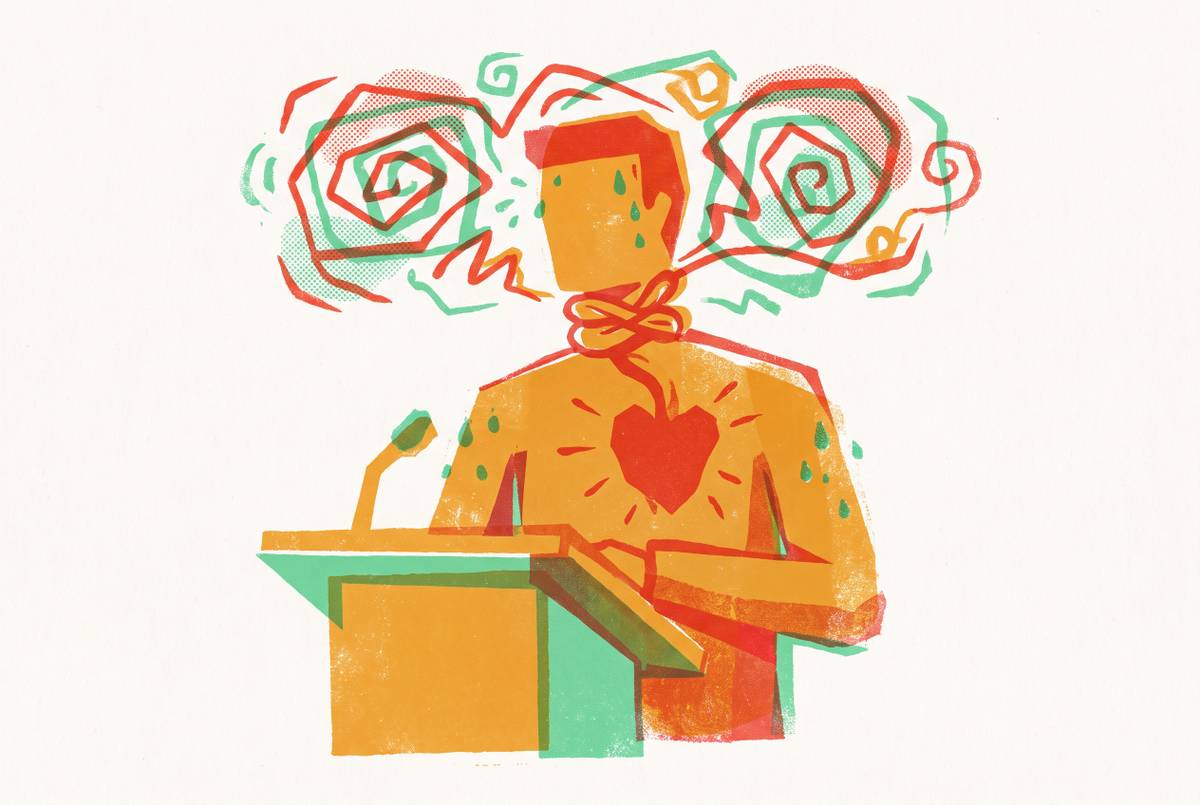
A speaker gets told, again, that a meeting had to pause so someone could ask "sorry, what was that?" The instinct is to blame the accent, the vocabulary, the phrasing, and to spend a long stretch of time trying to sound like someone else. That instinct is usually wrong. Pronunciation and enunciation are two different mechanical systems, and a speaker who drills accent for years but still gets asked to repeat themselves in meetings is almost certainly fixing the wrong one. One governs which sounds a word is supposed to contain. The other governs whether those sounds actually arrive at the listener intact. Confusing the two wastes years of effort on a problem that was never the one causing the trouble.
What pronunciation controls
Pronunciation is a linguistic fact about a word. It rests on three components: the individual sound units a word is built from, the syllable that carries the stress, and the rhythm and intonation that shape a sentence as a whole. Swapping one sound unit for another changes the word, so a mispronounced consonant can turn one word into a different one. Stress placement carries its own weight: "CON-tent," stressed on the first syllable, is a noun, while "con-TENT," stressed on the second, is an adjective, and the grammatical category flips with the emphasis. None of this is universal across English, either. Pronunciation is specific to a language and often varies by region or dialect, and British and American speakers pronounce "tomato" differently while both stay correct inside their own norms. What pronunciation does not touch is the physical cleanliness of the delivery. A speaker can have every phoneme and every stress mark exactly right and still be unintelligible, because pronunciation only promises the blueprint is correct. It says nothing about whether the builder showed up sober.
What enunciation controls
Enunciation is the physical coordination of lips, tongue, and jaw that turns a correctly specified sound into a sound a listener can actually catch. It is mechanical, applying the same way regardless of the language being spoken. Picture someone with flawless pronunciation of the word "statistics," hitting every phoneme and stress mark exactly right, who then mumbles the word so badly that the syllables collapse into each other and the listener loses the point. That is a pure enunciation failure, and it can happen to a word the speaker pronounces perfectly in isolation. Because enunciation is a physical skill rather than a set of language-specific rules, it holds steady across dialects in a way pronunciation never does: a speaker with any accent can have excellent or terrible enunciation independent of how "correct" their pronunciation is judged to be. The diagnostic is simple: if a speaker knows how a word is supposed to sound and still trips over it physically, the fix is articulation training, not another round of phonetic drills. Pronunciation is a script. Enunciation is whether the actor can actually deliver the line without swallowing half of it.
How the two fail independently
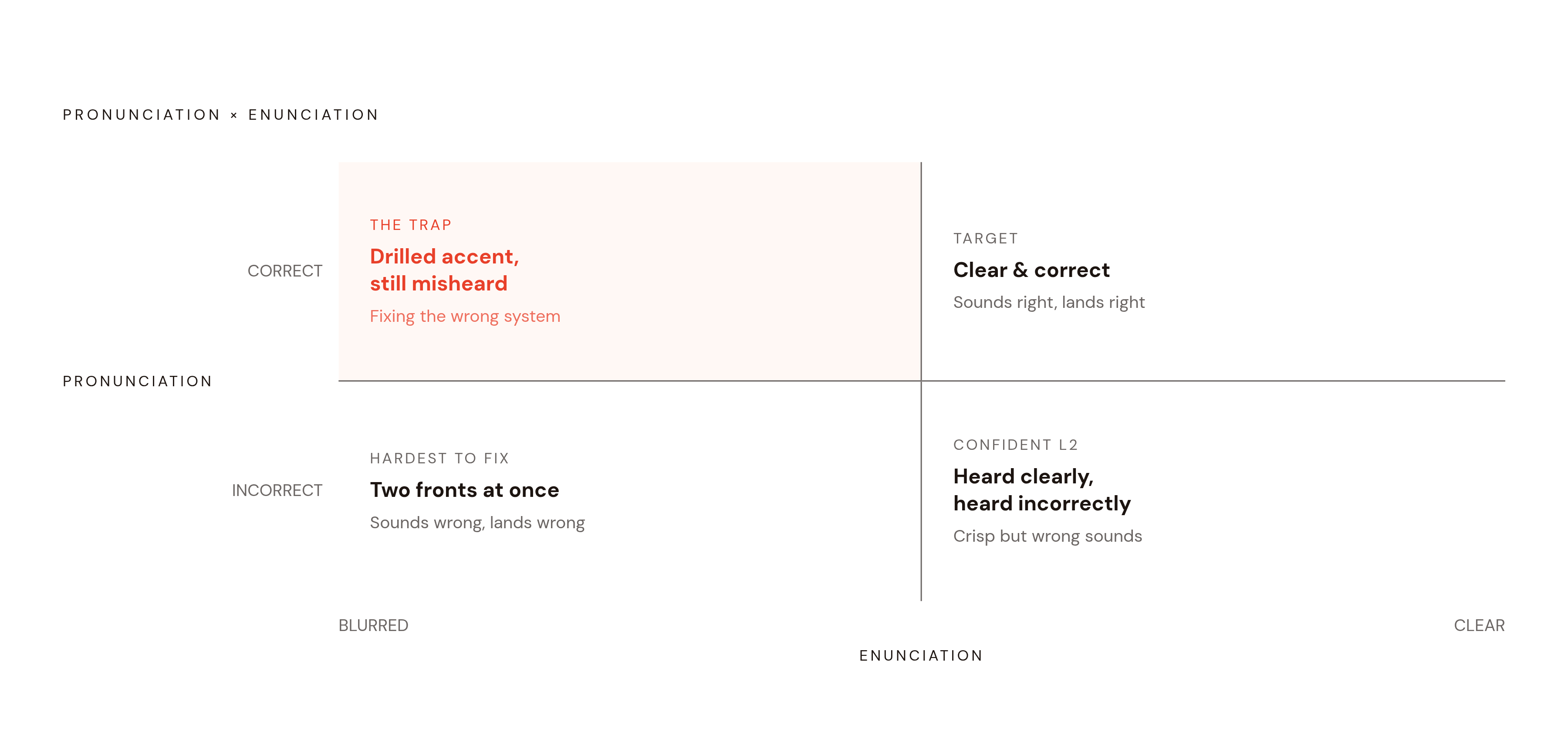
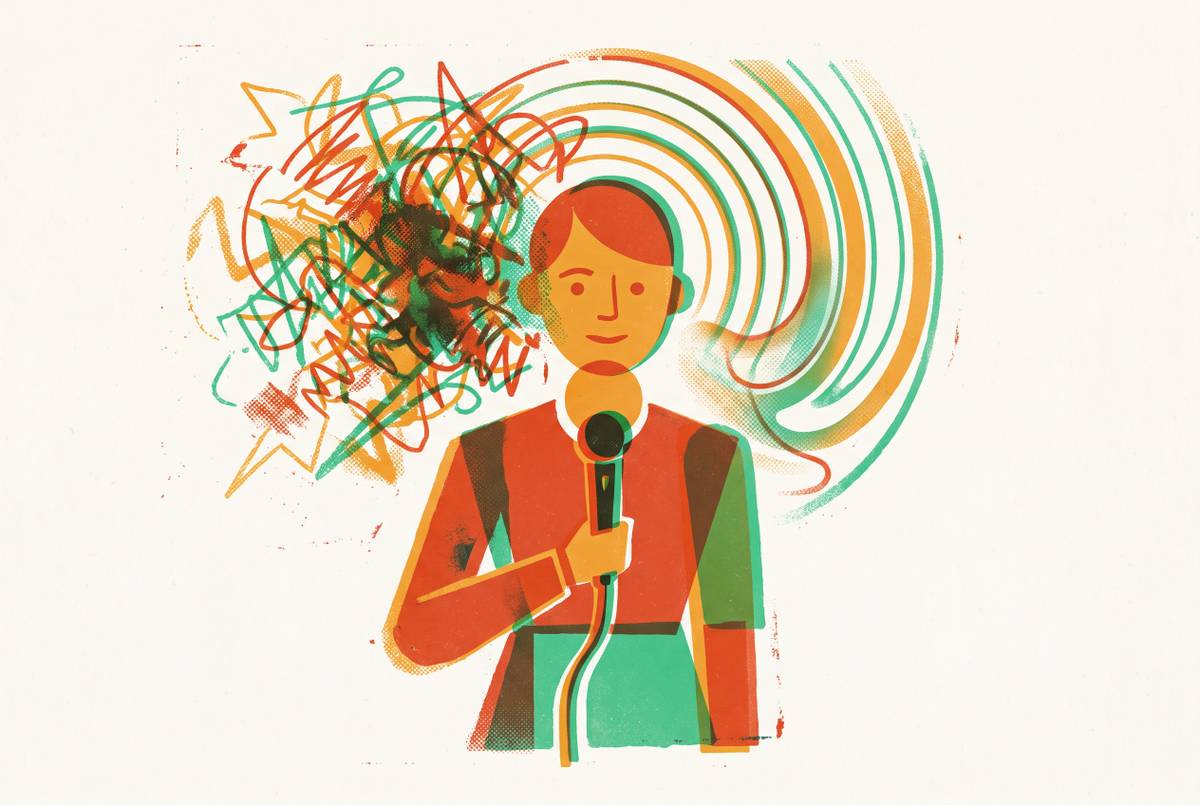
Because pronunciation and enunciation are separate systems, good performance on one does not rescue failure on the other, and a speaker can land in one of four distinct positions. The first is the target every speaker is presumably aiming for: correct sounds delivered with physical clarity, where nothing gets lost and nothing gets mistaken. The second is the trap that catches career professionals who have spent years working on accent reduction, where the sounds are all technically correct but the delivery mumbles, rushes, or swallows consonants, so the audience strains even though no individual word is wrong, which is precisely the failure mode of the speaker who drills accent for years and still gets asked to repeat themselves in meetings. The third flips the problem: the delivery is crisp, every syllable lands cleanly, but the underlying sound is wrong, so the listener hears the word with total clarity and still receives the wrong information, a pattern common among confident second-language speakers whose articulation is excellent but whose phonemes are off. The fourth combination stacks both failures at once, phonemically incorrect and physically blurred together, and it is the hardest to recover from because it requires separate work on two separate fronts rather than one fix addressing both. The lesson from all four combinations is that clarity and correctness are independent variables, so a speaker diagnosing their own trouble needs to identify which axis is broken before choosing a fix, because the wrong fix, however diligently applied, will not touch the right problem.
Where each skill is trained
Pronunciation and enunciation require separate training regimes because they are separate skills, and most language instruction is built almost entirely around one of them. Pronunciation training runs through phonetic drills targeting specific substituted sounds, pronunciation dictionaries, phonetic transcription, and language-specific instruction, the dominant approach in language education generally. Enunciation training looks completely different in practice: tongue twisters and articulation exercises that build muscle memory, deliberately slowed and exaggerated speech that gets rebuilt back up to normal speed without losing crispness, and recorded playback of short practice runs. The playback approach has real grounding: it reflects Effective Presentations' documented coaching method, built on K. Anders Ericsson's research into expertise, which holds that habits durable enough to survive actual pressure come from repeated, coached practice across multiple sessions rather than a single moment of awareness. Structured frameworks can help enunciation indirectly too. The gap between these two training paths and what the market actually offers is stark. A 2024 audit of speech and pronunciation apps found that not one offered any assessment of intelligibility, with most feedback addressing accent, a pronunciation feature, and almost none using visual cues for prosody like stress emphasis. The field has built an entire industry measuring pronunciation while a large share of its users are walking around with an enunciation problem nobody is testing for.
Why this distinction matters more now
The settings where verbal clarity gets tested hardest have multiplied, and enunciation is the skill those settings expose. Hybrid and remote work strip out the compensating cues that used to paper over muddy speech: no body language to read, audio often compressed, listeners frequently half-attending while multitasking on a second screen. An enunciation failure that would have been partly masked by presence in a room becomes fully audible, and fully disqualifying, on a call, and platforms built around AI speech coaching, such as Yoodli, have positioned themselves squarely around this exposure, aiming feedback at confidence and clarity in video presentations. The cohort most exposed to this shift also happens to be the cohort that had the least opportunity to build the underlying habits. A Harris Poll found that most managers report their Gen Z hires need additional support developing soft skills, a pattern tied to many of them entering the workforce remotely and missing the in-person mentorship settings where verbal habits normally get built up over time. The gap is a structural consequence of when and how a cohort happened to start working. A 2025 study of pre-service teachers found the same split inside a single group of speakers, the exact fault line the distinction predicts: scripted, structured presentations were handled competently, while impromptu speaking and question-response situations, the moments where enunciation has to hold up under real cognitive load, contained significant gaps. Scripted delivery gives a speaker time to plan pronunciation in advance; spontaneous speech gives enunciation nowhere to hide. Deloitte's 2025 Gen Z and Millennial Survey backs up that the demand for this kind of skill is already recognized, even without precise naming: a large majority of respondents said soft skills are somewhat or highly required, outpacing the share who rated AI skills as important. Employers are asking for something they usually call "communication." What they are frequently describing, in operational terms, is enunciation.
The identity objection
The strongest pushback against enunciation coaching is that "clearer" and "more professional" can function as coded demands for cultural conformity, asking speakers to strip out the shortened words, internet slang, and informal rhythms that carry real identity and social meaning. That tension is not hypothetical. Gen Z communication style, shaped by digital fluency and meme culture, tends to prioritize emotional accuracy and authenticity over formal polish, and speakers have good reason to resist a framework that treats their natural register as a defect to be corrected. The evidence complicates that resistance in a specific way rather than simply dismissing it. A UCLA sociolinguistics study found that both Millennial and Gen Z listeners consistently rated Gen Z conversationalists who used slang and casual speech lower on professionalism, with slang, filler words, and stretched vowels driving the lower ratings, and the study's own hypothesis, that Gen Z listeners would rate their own generation's speech more favorably, did not hold up. Gen Z participants in the study described speakers using minimal slang as more professional, and separately flagged filler words and slang as signals of unintelligence. The objection to enunciation standards, in other words, turns out to be held more strongly in theory than in felt practice, including among the people it claims to protect. The skill split resolves this more cleanly than it might first appear to. Enunciation is about physical clarity, not linguistic conformity, so a speaker can keep their vocabulary, their rhythm, and their cultural register fully intact and still work on delivering those exact words more crisply. The ask is to be heard saying who you already are, not to sound like somebody else.
Diagnosing and closing your own gap
The first move is identifying which axis is actually failing, and the test for that is more accessible than most speakers expect. Record a short stretch of spontaneous speech on a topic already familiar, then play it back without rushing to judge it. Two questions do the diagnostic work: are the wrong sounds coming out of the words, or are the right sounds arriving blurred, trailing off, or getting swallowed? A listener who asks "what did you say?" is flagging enunciation. A listener who says "I didn't recognize that word" is flagging pronunciation. The two complaints sound similar but point at entirely different fixes. Coaches at Effective Presentations note that playback often surprises speakers in a specific way: the moments a speaker assumes were their worst, a small stumble, an unplanned pause, are frequently the moments an audience connects with most, while the overly polished stretches read as rehearsed rather than human. That is useful information before assuming every rough patch needs fixing. For an enunciation gap specifically, the training logic favors volume of short reps over the occasional marathon rehearsal. Short, frequent reps beat long infrequent rehearsals, as clarity gains peak in the 20-to-59-second rep window and decline on longer runs. Tongue twisters and consonant drills do the rest of the work, building physical muscle memory the same way repetitions build muscle anywhere else. None of it asks a speaker to change who they are or what they say. It asks the mouth to finish the job the brain already did correctly.