Tongue Twisters and Articulation Drills for Clearer Speech
Repeated practice with tongue twisters rewires your mouth and brain for crystal-clear speech.
Getting asked "sorry, what?" twice in one meeting tells you something: your mouth is losing a race your brain thinks it already won. Tongue twisters fix three specific failures behind that moment: talking too fast so sounds run together, jaw and tongue tension, and a mumbling pattern that drops word endings before they're finished. These are motor habits, and motor habits respond to the same fix as any bad physical habit: targeted, repeated correction. Per research cited by teleprompter.com, a speaker has roughly 27 seconds to land a strong first impression at the start of a presentation. Most of what fills those 27 seconds is the gap between what you meant to say and what people actually heard.
What tongue twisters are actually doing to your mouth and brain
Talking is a small miracle of timing that nobody appreciates until it breaks. Your brain coordinates vocal cords, diaphragm, tongue, and lips within fractions of a second, thousands of times a day, without you noticing any of it. Tongue twisters take that same choreography and cram similar sounds together on purpose, so your brain's error-correction and sequencing systems have to work overtime just to keep up. They load the exact system that produces clear speech, well past the level of a cute warm-up for loosening your lips.
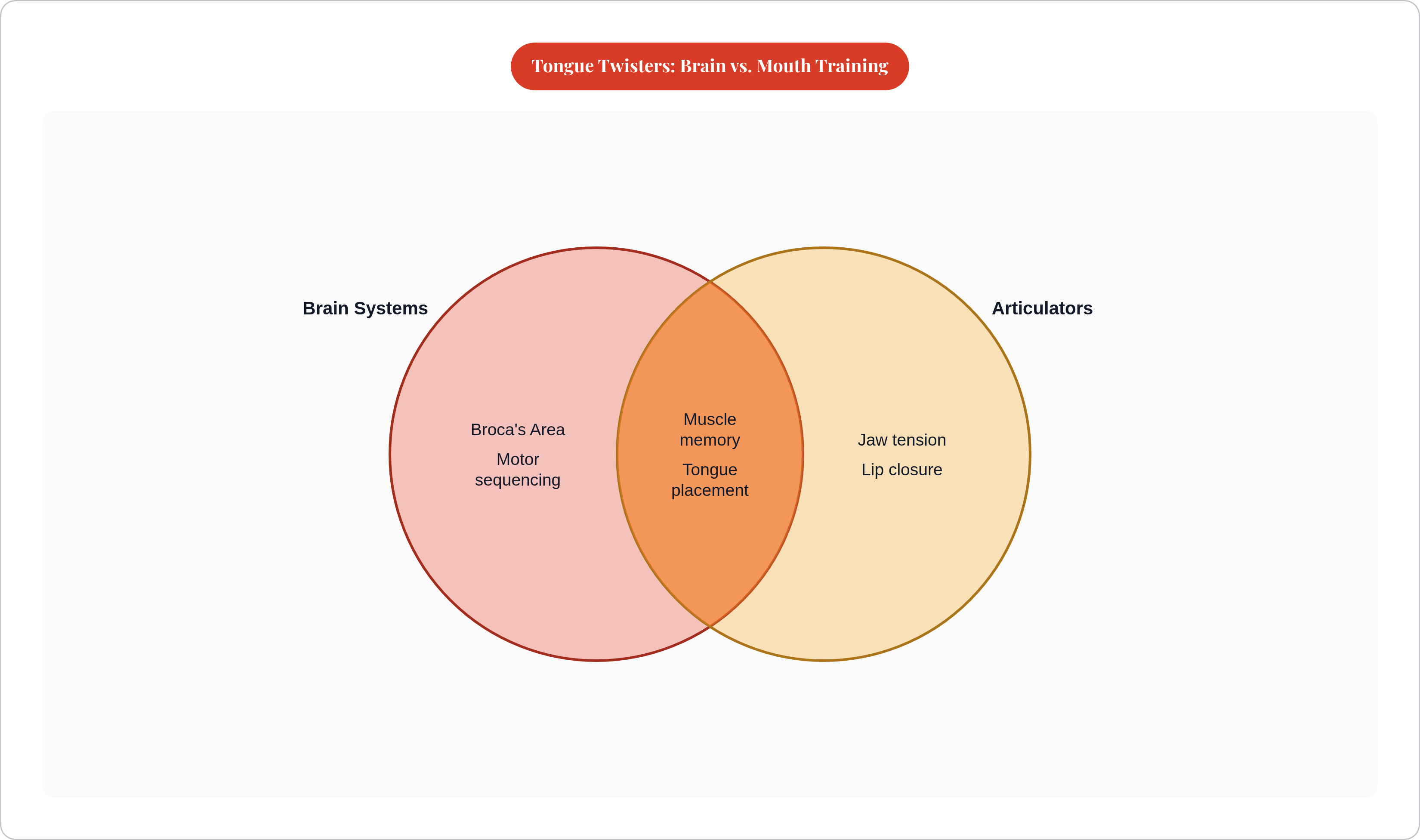
Neuroimaging backs this up. Complex speech tasks light up Broca's area, which handles speech production, the supplementary motor area, which plans movement, and the cerebellum, which handles motor timing. Researchers at MIT, presenting at the 166th meeting of the Acoustical Society of America, used tongue-twister-induced speech errors to study how the brain sequences and monitors sound, and the now-famous "pad kid poured curd pulled cod" (considered one of the hardest tongue twisters in English) came out of that same line of work. A study in Frontiers in Psychology suggests that repeated practice with hard phoneme patterns sharpens both awareness and control of the muscles doing the talking.
Here's the mechanism, stripped down: repetition builds faster wiring between your brain and your articulators, the parts of your mouth doing the physical work. People call that wiring muscle memory. It's the same principle that lets a pianist's fingers find the right keys without a glance down.
The four articulators and what goes wrong with each
Four structures shape air into words: lips, tongue, jaw, and soft palate. Each has a job, and each fails in its own specific, recognizable way when nobody's trained it.
The tongue does the most work and gets the least credit. A lazy tongue is behind most blurred consonants and most of those half-finished word endings that make people sound like they're trailing off mid-sentence, even when they don't mean to. Lazy lips cause a different problem: swallowed vowels and muddy b, p, and m sounds, the ones that need a full close-and-release to land clean. Jaw tension is its own animal. It clamps down your resonance and gives your voice that tight, strangled quality that makes you sound nervous even when you're not.
Nobody teaches you to train these muscles on purpose, and that's the actual gap. Nobody stretches their hamstrings until a coach points out the hamstrings are why they keep pulling something; the same blind spot applies here. Good articulation drills isolate the load to these four structures specifically and keep your neck and shoulders out of it entirely. That isolation is what makes the training work instead of just tiring you out.
The specific tongue twisters and drills that fix the most common clarity killers
Sort these by the problem they solve, not by how hard they are to say.
Mumbling and dropped endings respond well to "red leather, yellow leather," a phrase speech therapists use because it forces the tongue to fully finish each word before starting the next. Drills bouncing between /l/ and /r/ work the same way: sloppy endings cause an immediate stumble, so the feedback is instant and impossible to ignore.
Rushing and blurred consonants show up fast in the classic sibilant twisters, the "Sally sells seashells" family, where the difference between /s/ and /sh/ collapses the moment you speed up. Peter Piper-style drills, built on hard consonants like p and b, train your lips to fully close and release on each one instead of letting them mush together.
Tongue tension and sloppy placement get exposed by "Unique New York," a staple warm-up in professional voice training that demands precise tongue-tip placement on every rep. Shorter phrases like "toy boat" or "she sells" do the same job in fewer words; they're dense enough that a poorly placed tongue falls apart within two or three tries.
Run all of it through the slow-to-fast method. Start almost comically slow, exaggerating every syllable, and only add speed once you can do it clean, because speed that costs you clarity is just noise with better posture. Articulation training generally moves through stages: first you learn to hear the error, then you isolate the sound, then syllables, then full words, then phrases. Tongue twisters sit at the very end of that chain as a finishing tool, which is why skipping straight to them without the groundwork tends to build bad habits faster than good ones.
Vendor survey data from intonetic.com found that 78% of voice instructors at top conservatories build articulation drills into daily warm-ups, spending five to ten minutes a session. Among professional singers surveyed, 63% use tongue twisters before performing, and 72% say the practice sharpens their articulation and cuts down on vocal strain. People whose entire career depends on being understood clearly do this every single day. That should tell you something.
Why daily short sessions beat occasional marathon practice
Motor learning has a well-established rule: the same total practice time produces faster, more durable results spread across many short sessions than crammed into one long one. This isn't unique to speech. It's true of a golf swing, a musical scale, a new language, and speech follows the exact same logic, because you're building the same kind of automatic, non-conscious skill.
Daily reps wire in new articulatory patterns faster than occasional ones, and the whole point is to get clarity out of your conscious attention so it just happens under pressure. You don't want to be thinking about tongue placement while you're also trying to remember your talking points. A few minutes a day produces a real, noticeable change in how clear and confident you sound. The bar to start is low; the bar to keep going every day, without skipping, is where most people actually fail.
Recording yourself speeds up the whole process, because errors invisible while you're talking become obvious the second you play them back. That's the gap between not knowing you have a problem and knowing exactly what to fix. Tracking practice, whether that's a streak, a calendar, or a daily score, keeps people showing up in a way vague self-improvement goals never do. Nobody sticks with "get better at speaking," but people stick with a streak they don't want to break.
Some tools are built on exactly that loop: one recorded rep a day, scored 0 to 100, giving you a concrete feedback signal that deliberate practice needs and that most people never get anywhere else.
What clearer speech does in high-pressure moments
Anxiety makes every one of these problems worse. Rushing gets faster, mumbling gets mumblier, tension gets tighter, exactly when you can least afford any of it. High-stakes moments amplify the very habits the drills exist to correct.
Automated patterns survive that pressure in a way conscious effort never does. When articulation is built into muscle memory through repetition, nervous energy has nowhere to collapse your clarity, because the mouth is running on rails instead of improvising in real time. Public speaking anxiety touches roughly three-quarters of people to some degree, and among 16- to 24-year-olds, only about a quarter feel confident speaking in front of an audience. That's a strange pairing: the group with the least practice is also the group carrying the most anxiety about the exact skill it never trained.
Confidence and clarity build each other. Research on structured articulation therapy links the physical gains to confidence gains as well. Delivery genuinely changes how content lands, too; in a negotiation, a pitch, or a client call, how something is said carries real weight alongside what's said. People who warm up before high-stakes moments walk in with lower baseline tension and more spare attention, because the mouth isn't fighting to form words, which frees the mind to focus on the actual message.
The competitive gap that clear speech opens up
Communication has ranked among LinkedIn's most in-demand skills, and employer surveys consistently find that a large majority consider it a critical hiring attribute. The single skill employers value most is also the one almost nobody trains on purpose. Everybody wants it; almost nobody works for it.
That gap is exactly what makes it valuable. In a meeting, a classroom, or a group of new acquaintances, the person who speaks clearly and without hesitation ends up running the conversation, often before anyone's weighed a word of the actual content. Clarity is a skill built through repetition, so the advantage goes to whoever actually shows up and does the reps.
The mouth is a muscle, and training it takes reps.