Building a Daily Speaking Practice Routine
Short daily sessions outperform longer, infrequent ones through spaced repetition.
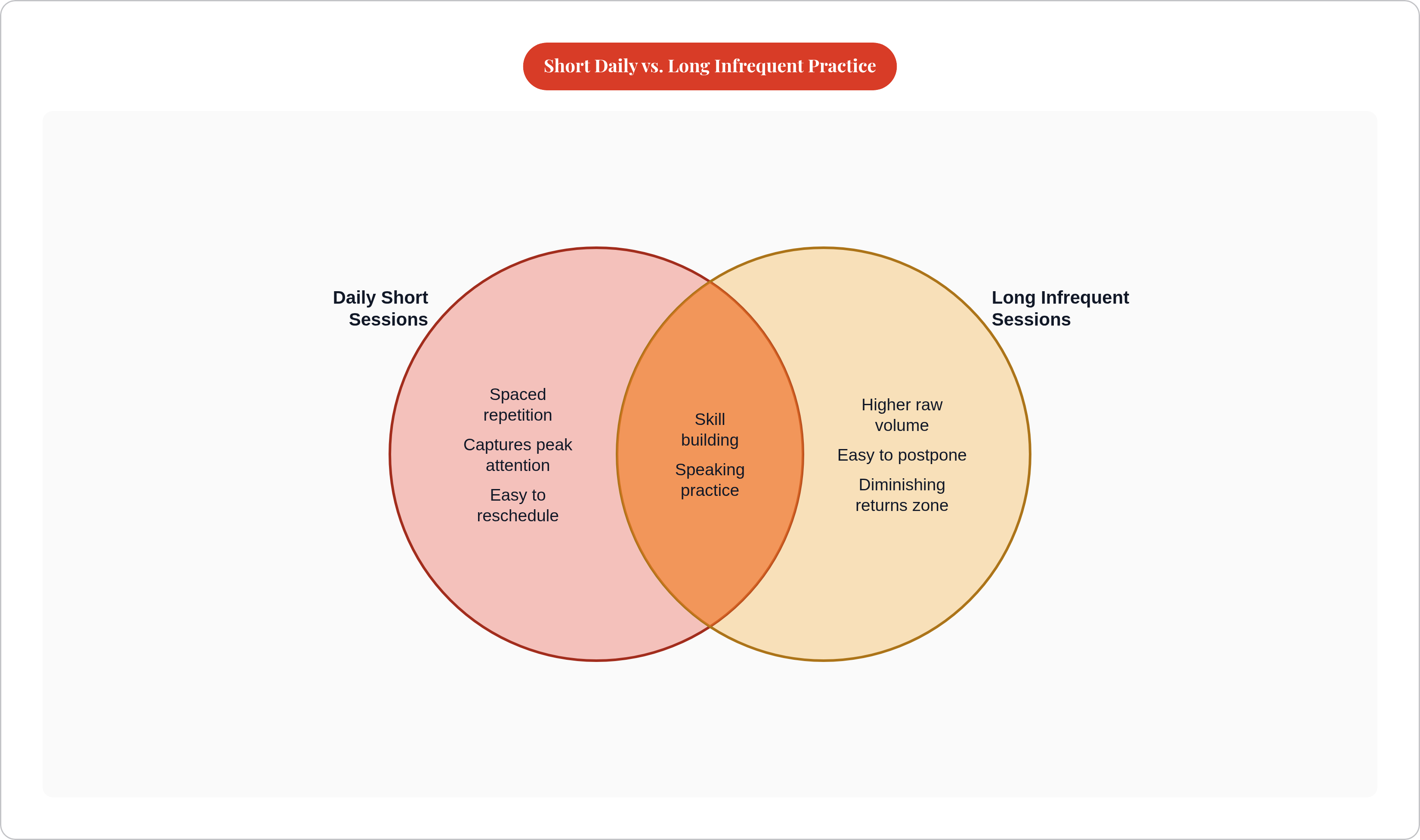
Learners practicing fifteen minutes daily tend to outperform those doing ninety-minute sessions twice a week, even when they accumulate less total practice time. The intuition most people carry, that more hours equals more progress, is often simply wrong.
The mechanism is spaced repetition. Distributing practice across days forces the brain to retrieve and reconstruct, reinforcing neural pathways each time. A single long session rehearses the same pathways in rapid succession, without the consolidation that sleep and elapsed time provide. A meta-analysis of 48 studies involving over 3,400 language learners found spaced practice produces retention advantages as high as 240% compared to massed practice. That is not a marginal difference.
But what if you need raw volume? The research does not say longer sessions are worthless, only that they are harder to schedule, easier to cancel, and neurologically less efficient per minute. A ninety-minute block is trivial to postpone. And postponement is where most speaking practice quietly dies.
There is also the attention question. Focused cognitive engagement peaks somewhere in the first fifteen to twenty minutes of a session; returns diminish steeply after that. Short daily sessions capture the high-value window most days. Longer sessions spend half their time in the diminishing-returns zone. The math tends not to favor them.
How to Anchor a Daily Practice So It Actually Happens
The most common failure in self-directed practice is not laziness. It is practicing at random times, which turns starting into a fresh decision every day, and fresh decisions are easy to defer.
Same time, same place, every day. Boring on purpose.
Why does timing matter beyond simple scheduling? Because the energy you arrive with shapes what you can actually do. High-energy periods, typically morning or just after exercise, suit unfamiliar speaking challenges. Medium-energy windows are better for dialogue exercises and review. Low-energy stretches work for passive listening or revisiting familiar material. Forcing effortful work into exhausted time slots is like trying to sprint through wet concrete — you exhaust yourself and barely move.
Habit stacking removes the friction of deciding to start. Attach practice to an existing anchor: morning coffee, the ten minutes after lunch, the walk home. The decision is already made; you are just following the anchor.
Missing a day and doubling up the next sounds reasonable and mostly does not work. The better protocol is simpler: record a thirty-second voice message the evening you miss, then move on. Consistency is the mechanism. Volume is a distraction from it.
One subtler barrier that does not get enough attention: perfectionism. For a lot of people, anxiety around public speaking does not wait for an audience. The thought of practicing alone, at home, with no one watching, is enough to trigger avoidance. Starting badly and iterating is not a consolation prize. It is the method.
A 15-Minute Daily Structure That Covers the Full Arc of a Practice Session
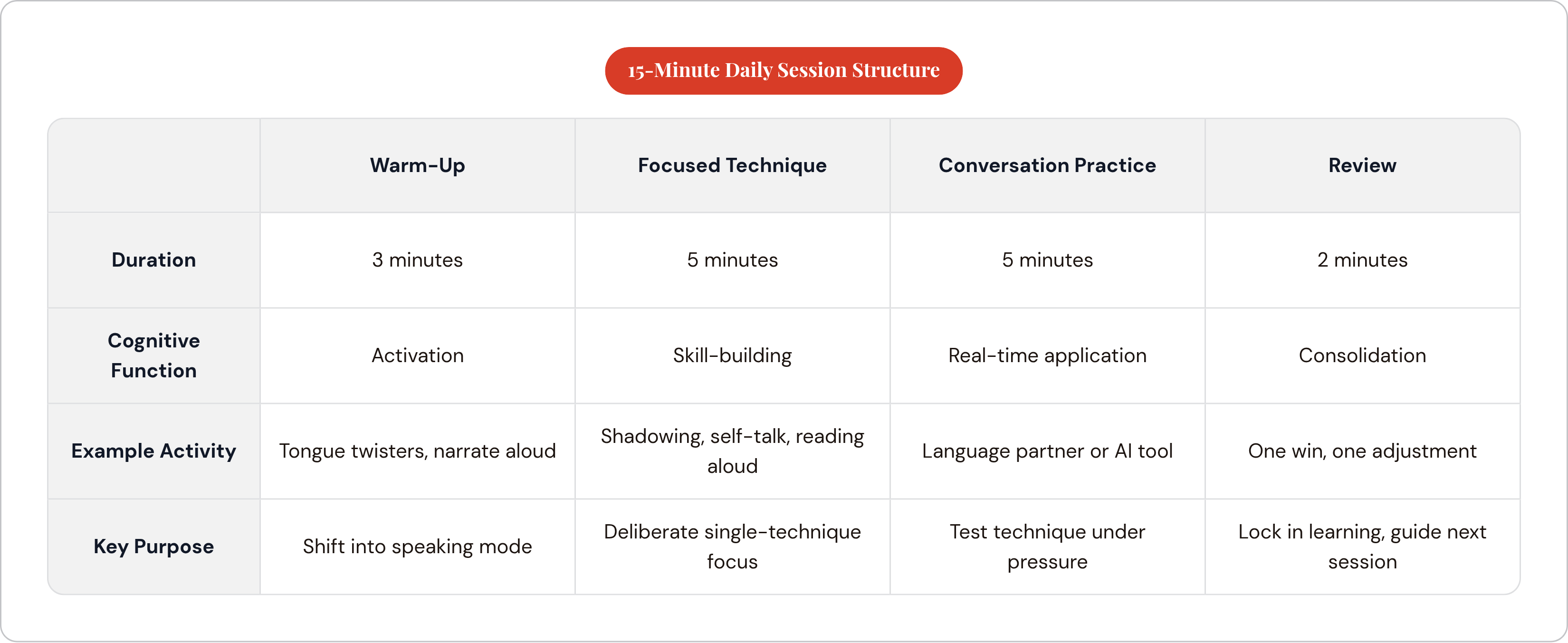
The structure below is a scaffold, not a prescription. The goal is to move through four distinct cognitive functions in each session: activation, skill-building, real-time application, and consolidation.
Warm-up: three minutes. Voice activation before speaking practice is the equivalent of stretching before a run, which most people skip and then wonder why the first few minutes feel wooden. Tongue twisters, narrating whatever you are doing, reading a paragraph aloud: all of it works. The point is shifting into speaking mode before the real work begins.
Focused technique practice: five minutes. One technique, practiced with intention. Specific choices rotate across the week.
Conversation practice: five minutes. Live application. A language exchange partner, an AI conversation tool, or a structured self-directed exercise. This is where the technique from the previous block gets tested under something approximating actual conditions.
Review: two minutes. One thing that worked. One thing to adjust tomorrow. Brief, specific, forward-facing. University of Cambridge research found learners following organized practice routines progressed at roughly double the rate of those using unstructured approaches. The review block is a meaningful part of why structure compounds.
For thirty-minute sessions, expand the focused technique and conversation blocks. The warm-up and review stay proportionally the same.
The Core Techniques Worth Rotating Through the Focused Practice Block
The focused block is only as good as what fills it.
Shadowing. Find a two-to-three minute clip from a podcast or a TED Talk. Play it and repeat simultaneously, matching rhythm, stress, and intonation as closely as possible. Research suggests shadowing improves pronunciation accuracy, listening comprehension, and naturalistic speech patterns. It is especially useful for speakers without regular access to native-speaker conversation, because it directly trains the prosodic features, the cadence and music of language, that text-based study tends not to reach.
Self-talk and voice journaling. Narrate your morning aloud. Describe making breakfast. Walk through your schedule. The value is twofold: it builds tolerance for hearing your own voice without audience pressure, and it forces real-time vocabulary retrieval in a low-stakes context. Active production tends to consolidate grammar and vocabulary faster than passive reading, for the same reason that writing something down helps you remember it.
Deliberate reading aloud. Not silent reading. Aloud, with intention. Reading aloud surfaces unfamiliar words in context, trains pronunciation and fluency simultaneously. Works best with material pitched slightly above your current comfort level: challenging enough to generate learning, not so difficult that you spend the session staring at a wall.
Thinking in the target language. The translation bottleneck, where a speaker mentally converts from their native language, formulates a response, and converts back, is what makes speech feel slow even when vocabulary knowledge is solid. Practicing direct thought in the target language can bypass that bottleneck over time. It is a slow-build technique. But it tends to produce a qualitative shift in fluency that mechanical drills cannot fully replicate. That shift is worth waiting for.
A useful calibration across all of these: aim for content at roughly 95 to 98% comprehension. Enough familiar to stay engaged; enough new to generate learning.
How Feedback Accelerates Improvement and Where to Get It
Practice without feedback is mostly just rehearsing existing habits. That raises an obvious question: what kind of feedback, and how much of it?
More corrections are not better. Flagging every minor slip disrupts flow and generates anxiety rather than improvement. The more effective pattern is addressing critical errors in real time and deferring minor ones to end-of-session review. The goal is a clear signal about what to adjust next, not a flawless record of your mistakes.
AI conversation tools have become genuinely useful here, and I say that as someone who was skeptical for longer than was probably warranted. The better speaking apps now provide real-time pronunciation flagging, rhythm and stress coaching, and open-ended conversational practice. Tools like Talkio AI, ELSA Speak, and Speak.com offer high-repetition, low-pressure environments that anxious speakers benefit from disproportionately. The privacy matters. So does the patience of an interlocutor that will not visibly wince.
But the AI ceiling is real. These tools miss subtle patterns, do not build accountability, and lack the responsiveness of a human who is genuinely listening. Toastmasters builds in exactly the structured peer evaluation that AI cannot provide. The two approaches serve different functions, and the better question is not which to choose but how to use both without pretending either one covers everything.
Managing the Anxiety That Derails Practice Before It Begins
Speaking anxiety affects roughly 75% of people. It is not a personal failing; it is a near-universal starting condition.
The most evidence-backed reducer is gradual exposure. Research has found structured gradual exposure can reduce anxiety levels by up to 50%. Among the most actionable levers within that framework is preparation itself: a substantial majority of pre-presentation anxiety has been attributed to insufficient practice, which means the daily routine is simultaneously a skill-building system and an anxiety-reduction system. Those two things are not separable.
There is also a simpler cognitive reframe worth trying. Saying "I'm excited" before a session, rather than acknowledging nervousness, can convert anxious arousal into performance energy. Anxiety and excitement share the same physiological signature: elevated heart rate, heightened attention, anticipatory tension. The label you attach to that state influences how you use it. Absurd as it sounds, it has decent empirical support.
The practical progression: start in private, no audience. Record yourself. Share a recording with one trusted person. Practice in front of a small group. Graduate to a larger setting. The graduated exposure matters because the social evaluation trigger, the actual source of most speaking anxiety, is absent in solo practice and can be introduced incrementally. Skipping ahead tends to collapse the whole structure.
Perfectionism resurfaces here too. A session does not need to go well to count. Showing up consistently is what builds tolerance; the quality of any individual session is beside the point.
What Consistent Practice Looks Like Over Weeks, and When to Expect Results
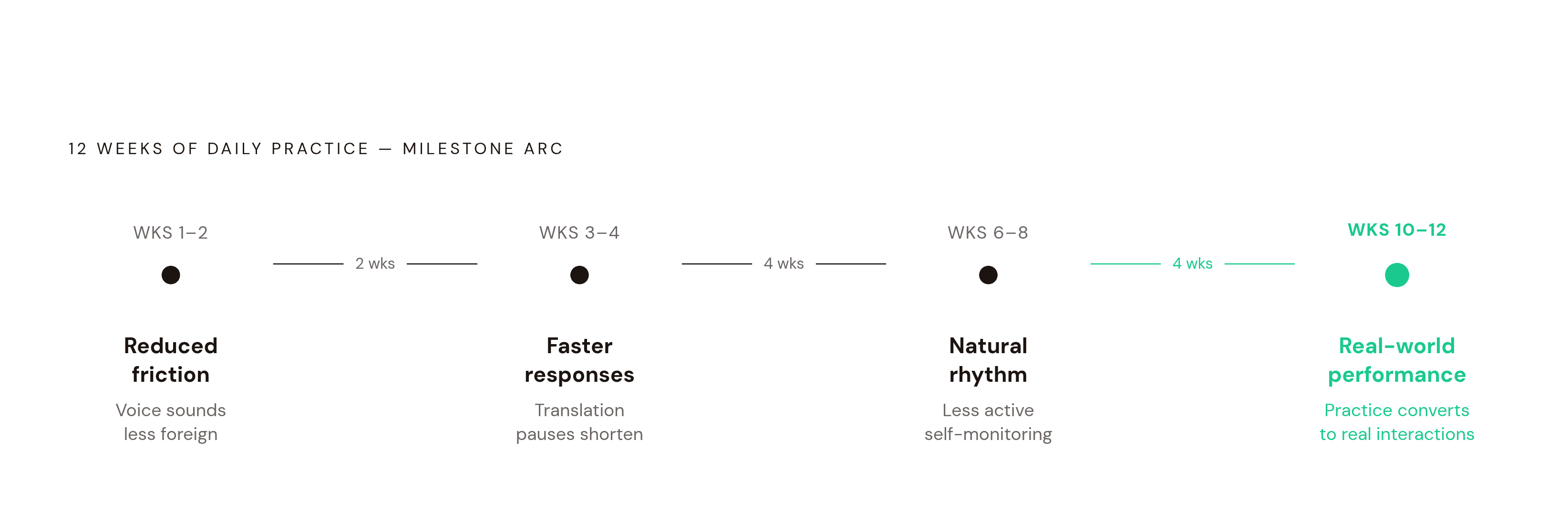
Results from structured daily practice are not linear, and the early weeks are not dramatic. But they are real.
In weeks one and two, the primary change is reduced friction in starting. Your voice starts to sound slightly less foreign to yourself. That sounds trivial. It is not. Self-consciousness about the sound of your own voice is a genuine barrier for many people, and its reduction is an early signal that something is working.
By weeks three and four, responses come faster. Translation pauses shorten. Vocabulary that previously required deliberate retrieval begins arriving without effort. You could say the words start coming to you — rather than you going to the words.
Weeks six through eight bring something more qualitative: a more natural rhythm, less active self-monitoring during conversation. The sense that language is moving through you rather than being assembled from parts.
By weeks ten through twelve, the foundation built in solo sessions tends to begin converting into observable performance in real interactions.
One honest note on all of this. Solo practice builds the foundation; real-world conversation is where it converts. Fifteen minutes a day of structured private practice will not, on its own, make you a confident speaker in front of an audience for most people. What it does is build the underlying competence and tolerance that make real-world exposure productive rather than traumatic. The routine is the groundwork. You still have to walk out into the room.
Missed days, awkward recordings, sessions that felt like a waste of time: none of that is evidence the process is failing. It is the process. One of the most reliable ways to fail is to stop showing up.