What to Expect at Your First Toastmasters Meeting
Learn the fixed structure and you'll navigate your first meeting without confusion.
I got dragged to my first Toastmasters meeting by a coworker who'd been going for three months and wouldn't shut up about it. I remember exactly one thing from that night: I had no idea what was happening for the first twenty minutes, and that confusion was worse than any speech I gave later. This piece exists so you don't have that problem. Toastmasters runs on a fixed format, the same skeleton in every one of its 13,800-plus clubs across nearly 150 countries, and knowing that skeleton before you walk in is the whole trick.
The organization has been running this format for about a century. Meanwhile the fear that keeps people from ever showing up hasn't budged: glossophobia affects something like 75% of people to some degree, and the first visit is usually where it peaks. Over 265,000 people currently show up regularly anyway, and they come from everywhere: students, retirees, a guy who bombed a client pitch two weeks ago and needs a place to fix that, someone who just wants to survive dinner party small talk without sweating through his shirt. More than half of members now live outside North and South America, and women outnumber men in the organization, a demographic mix worth knowing before you walk in.
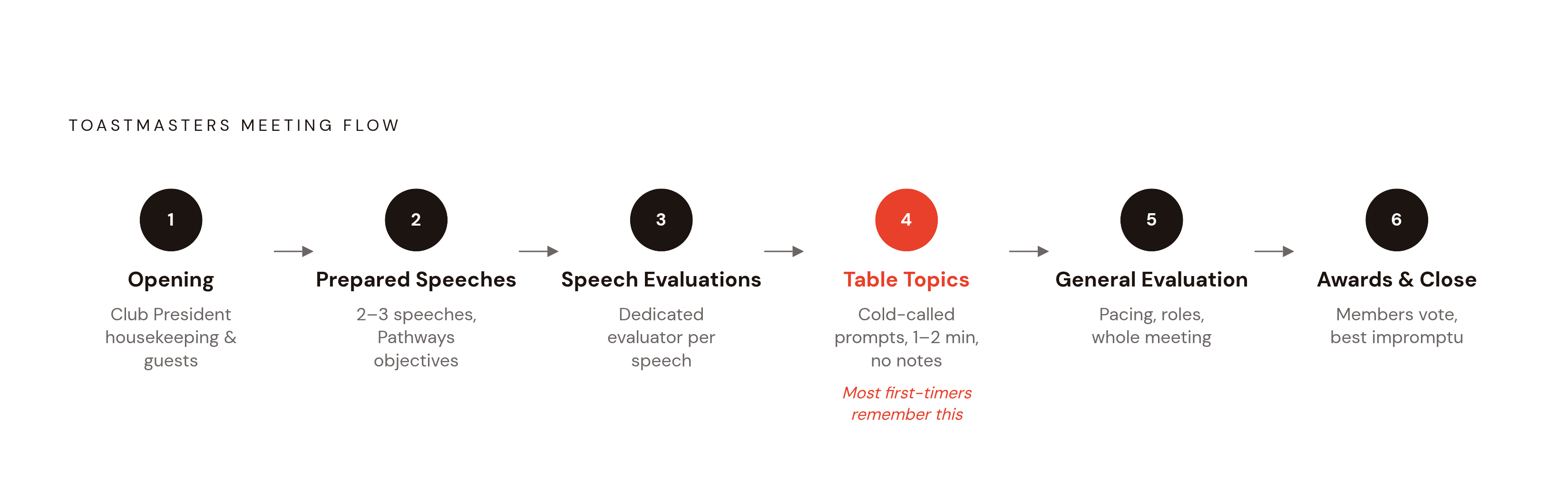
The first five minutes: how the meeting opens and what guests are asked to do
The Club President opens with housekeeping, welcomes any guests, then guests introduce themselves. Name, what brought you here, maybe how you found the club, all in thirty seconds or so, and nobody's expecting polish. The room is structurally and culturally rooting for you to get through it fine, because everyone in it remembers being you.
Then the Toastmaster of the Day takes over and doesn't let go until the meeting ends: explaining the agenda, introducing each segment, keeping the whole thing on schedule. This role is earned by working through the club's education program, so the person running your first meeting sat in the guest chair once too, possibly terrified, possibly last year. The agenda stays consistent meeting to meeting; the culture stacked on top of it varies wildly by club, and that variance matters more than most guests expect.
Prepared speeches: what members are trying to accomplish when they stand up
Most meetings run two or three prepared speeches. Each one targets specific objectives inside Toastmasters' Pathways program, which offers separate tracks for humorous speaking, persuasive influence, dynamic leadership, and several others, so two speakers on the same night are often chasing entirely different skills without you knowing it.
Every member's first speech is called the Ice Breaker: introduce yourself, nothing more, treated as a milestone rather than a test. As a guest, here's the useful reframe: the person up front is drilling one specific thing, maybe eye contact, maybe vocal variety, maybe just getting through a speech with a beginning and an end that don't blur together. Once you know that, you stop watching for polish and start watching for progress, which turns out to be more interesting anyway. There are timing lights too, green, yellow, red, so nobody's guessing how much runway is left.
How feedback works and why the evaluation format is the mechanism that makes practice stick
Every prepared speech gets its own evaluator, a member assigned to watch that speech and deliver feedback right after, and the structure is always the same: public, specific, consistent. The evaluator gives a short evaluation speech on what worked and what needs sharpening, then hands over written notes too.
The General Evaluator reviews the whole meeting, not just the speeches, covering pacing, role execution, and anything that could run tighter next week. The Ah-Counter tracks filler words, every "um," "uh," "like," "you know," for every speaker, all meeting, and reports the count out loud, which is somehow both hilarious and mortifying depending on whether it's your count. The Timer logs how long each segment actually ran against its target.
A 2025 ScienceDirect study found that repeated practice paired with a continuous feedback loop builds automaticity and confidence while cutting physiological tension. That tracks with something Toastmasters' own 2024-2025 program-year survey found: 74.90% of members reported less fear of public speaking than before they joined. Nobody's proven the evaluation system causes that number by itself, but it's the only mechanism in the room running week after week, so it's a reasonable bet. A guest sees a room full of people handing around opinions. Underneath that sits a measurement system, running quietly every single week.
Table Topics: the impromptu segment that will probably be the most memorable part of your first visit
The Table Topicsmaster sets a theme, then cold-calls members one at a time with a prompt, giving them no notes, no warning, and one to two minutes to build a coherent answer out of thin air.
This isn't a recent gimmick. Table Topics has been part of the standard agenda since at least 1936, when a club officer training manual prescribed it specifically to get every member on their feet every meeting. The skill is narrow but transfers everywhere: listen fast, find an angle, speak in complete thoughts instead of trailing off into the void. One District 101 Toastmaster described a job interview as "pretty much a series of 10 to 15 Table Topics," which is less a metaphor than an accurate job description.
Guests can pass. Before you do, consider what Harvard's Alison Wood Brooks found: people who reframed pre-task anxiety as excitement, instead of trying to talk themselves down, got rated more persuasive and more competent by observers watching them. Most first-timers who take the plunge discover the two minutes move faster than the dread promised. The room claps regardless of how it went, and there's an award for best impromptu response of the night, voted by members, which turns the whole thing into a game.
What the meeting's supporting roles reveal about how Toastmasters actually teaches
Nobody in that room just sits there. Timer, Ah-Counter, Grammarian, General Evaluator, Table Topicsmaster, Toastmaster of the Day: every member holds a role, and new members start with the simpler ones before working up to running the whole meeting.
Each role trains a different muscle. Timing sharpens attention to pacing, while the Ah-Counter role trains real-time listening under pressure. The Grammarian tracks language across the entire meeting and flags both the vivid phrasing worth stealing and the awkward constructions worth fixing, which makes the whole room quietly more careful with word choice, not just whoever's at the podium. Most speech classes teach you to talk, but few teach evaluation, timing, or listening with this kind of precision, and that gap is basically the entire product.
You don't need to be on the agenda to get something out of your first night. Watching the machinery underneath the speeches is its own education, and nobody in that room is purely an audience member, which is the whole point of the design.
How to pick the right club when there are thousands to choose from
Clubs vary enormously even though the meeting skeleton stays identical everywhere. Culture, demographics, cadence (weekly versus biweekly), format (in-person, virtual, hybrid): all of it shifts from club to club.
Some clubs lean corporate. Others pull in students, creatives, or a specific niche entirely, university clubs, industry-specific clubs, clubs that meet on military bases before the workday starts. Meeting times run from early morning to lunch break to evening; locations run from office conference rooms to public libraries to a Zoom link you click from your couch in sweatpants. Toastmasters actively encourages visiting several clubs before committing, and showing up as a guest carries zero obligation, so treat your first few visits like club shopping, because that's exactly what they are.
Pay attention to whether the feedback in the room is substantive or just perfunctory clapping dressed up as critique. Notice whether members actually know each other or whether everyone's a stranger reciting the same script weekly. Virtual clubs have widened the map considerably, so if nothing near you fits, a club three time zones away might.
What Toastmasters gives you that self-study doesn't — and where daily practice fills the gap
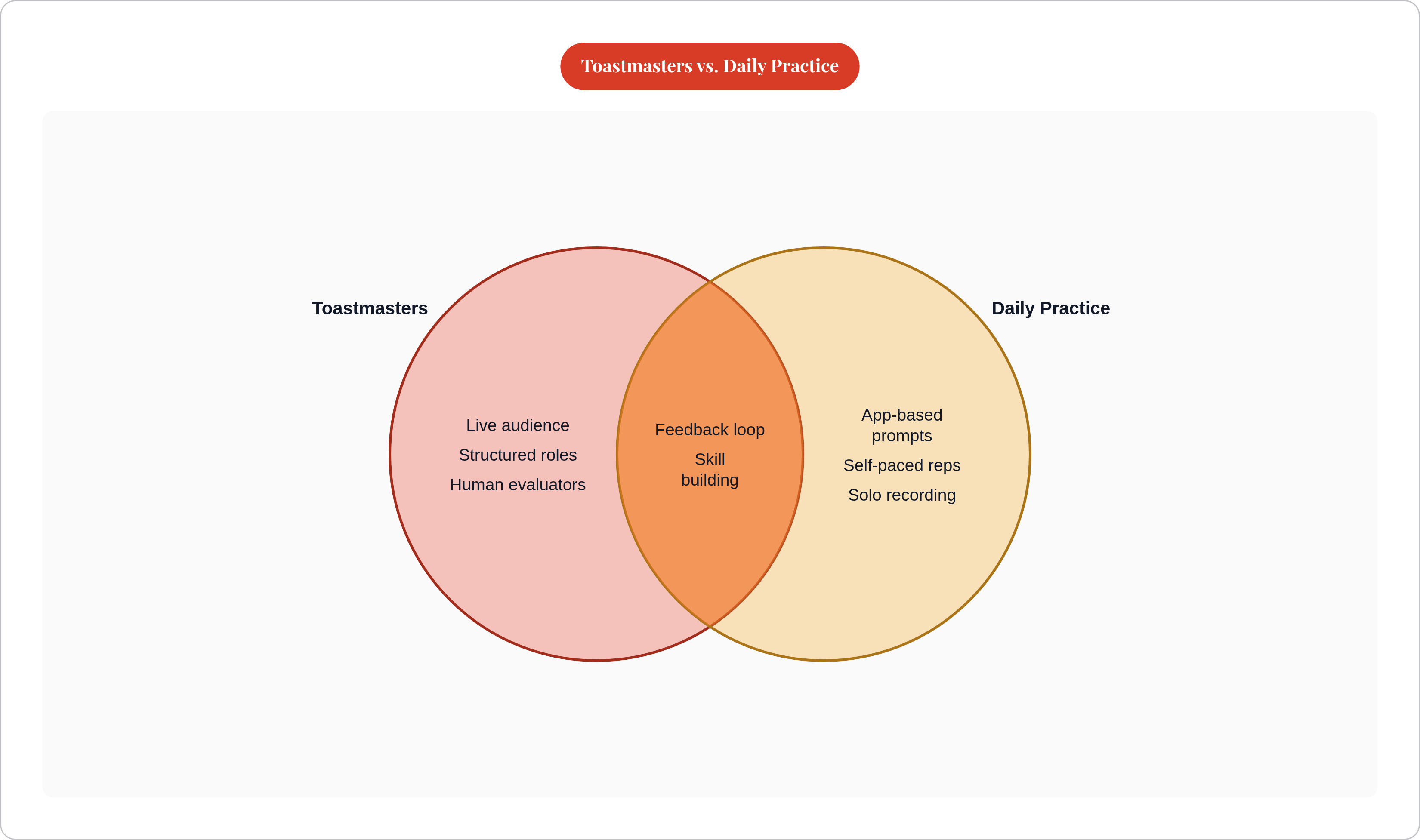
Toastmasters gives you live reps in front of real people with structured feedback attached to every single attempt. That's genuinely hard to fake solo, no matter how disciplined you are with a mirror and a phone camera.
Most clubs meet once a week, some less, and the days between meetings are where habits either take root or don't. Communication research on public speaking breaks impact down roughly as 55% nonverbal, 38% vocal, 7% words, which means delivery and vocal command are the dimensions that respond to sheer rep volume, not the occasional Tuesday night.
I know a guy, we'll call him Jason because that's his name, who solved this by committing to speak at every single meeting and folding each round of feedback straight into his next attempt, essentially running a self-imposed daily habit inside a structure that only meets weekly. Other people close that same gap with apps; Yapp is one, built around a daily prompt, a recorded response, and a score from 0 to 100, which is the same feedback-loop mechanic as a Toastmasters evaluation compressed into five minutes before coffee. Toastmasters gives you the live audience and the human sitting across the room reading your body language, while daily practice builds the fluency that makes the live moment worth showing up for. The two complement each other rather than compete.
That 74.90% figure cuts two ways. Most members get measurably less afraid after joining, and roughly a quarter still have real room to grow, with frequency of practice sitting right there as the obvious lever nobody's pulled yet. Know the format before you walk in, so the unknown stops being the thing you're actually scared of. The rest is just showing up enough times for it to stick.