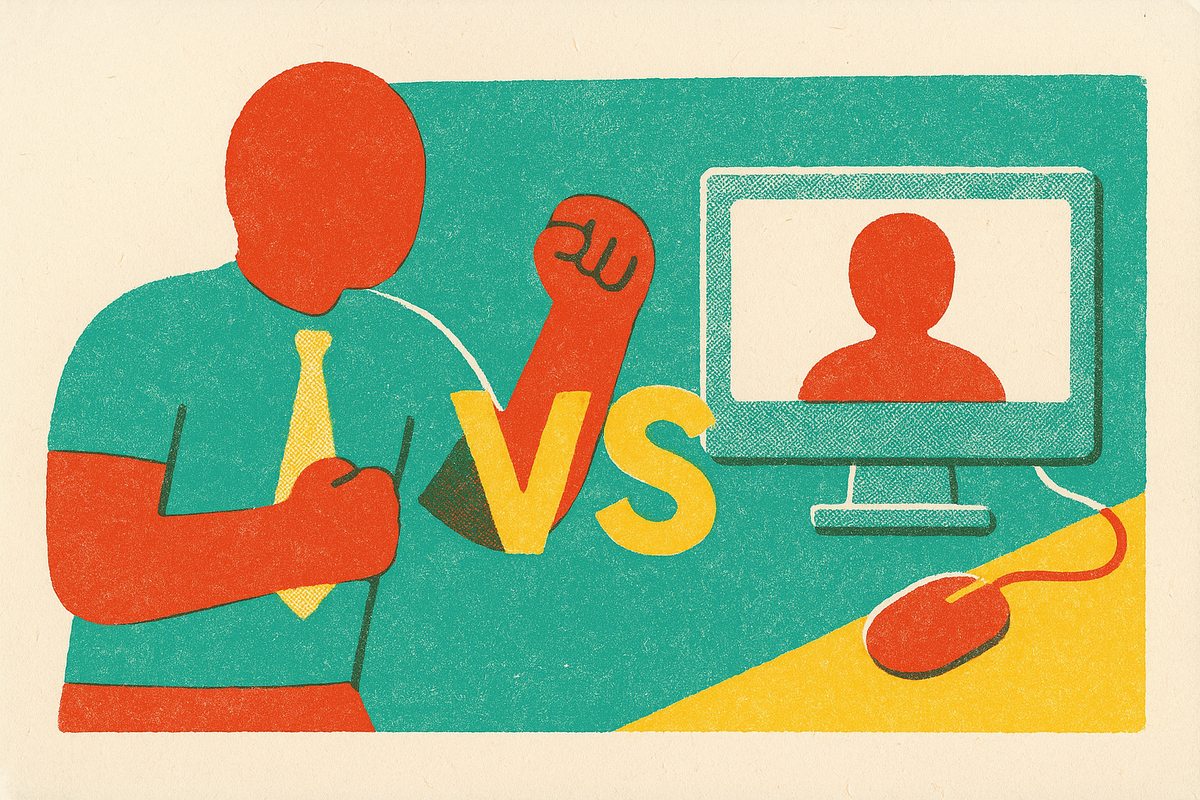
Online Toastmasters Clubs vs In-Person Chapters
Online clubs train screen presence while in-person chapters build nerve under real-world pressure.
I joined my first club in a rented conference room above a Denny's, and I've since sat through Table Topics on Zoom with a cat walking across my keyboard mid-answer. Both counted. That's the thing about Toastmasters International that took me longer than it should have to understand: same curriculum, same sixty bucks a term, same roles rotating through every meeting (Toastmaster of the Day, Table Topics Master, Ah-Counter, Evaluator), and the room itself still decides what kind of speaker walks out the other side. The organization has run since 1924 and now counts over 265,000 members across nearly 14,000 clubs in 150 countries. Every one of them, online or in person, is running the same drills, and yet they turn out noticeably different speakers.
The split is younger than most people guess. As of early 2020, only 5% of clubs met online. Six months into the pandemic, that number hit 75%. Today it hovers around 80% online or hybrid, which means the "alternative" format simply is the format now. Online clubs weren't even a pandemic invention: the Online Presenters club in Coral Springs, Florida chartered in 2017, years before Zoom became a verb, on the bet that speaking to a camera is its own discipline, one worth building deliberately rather than settling for by accident.
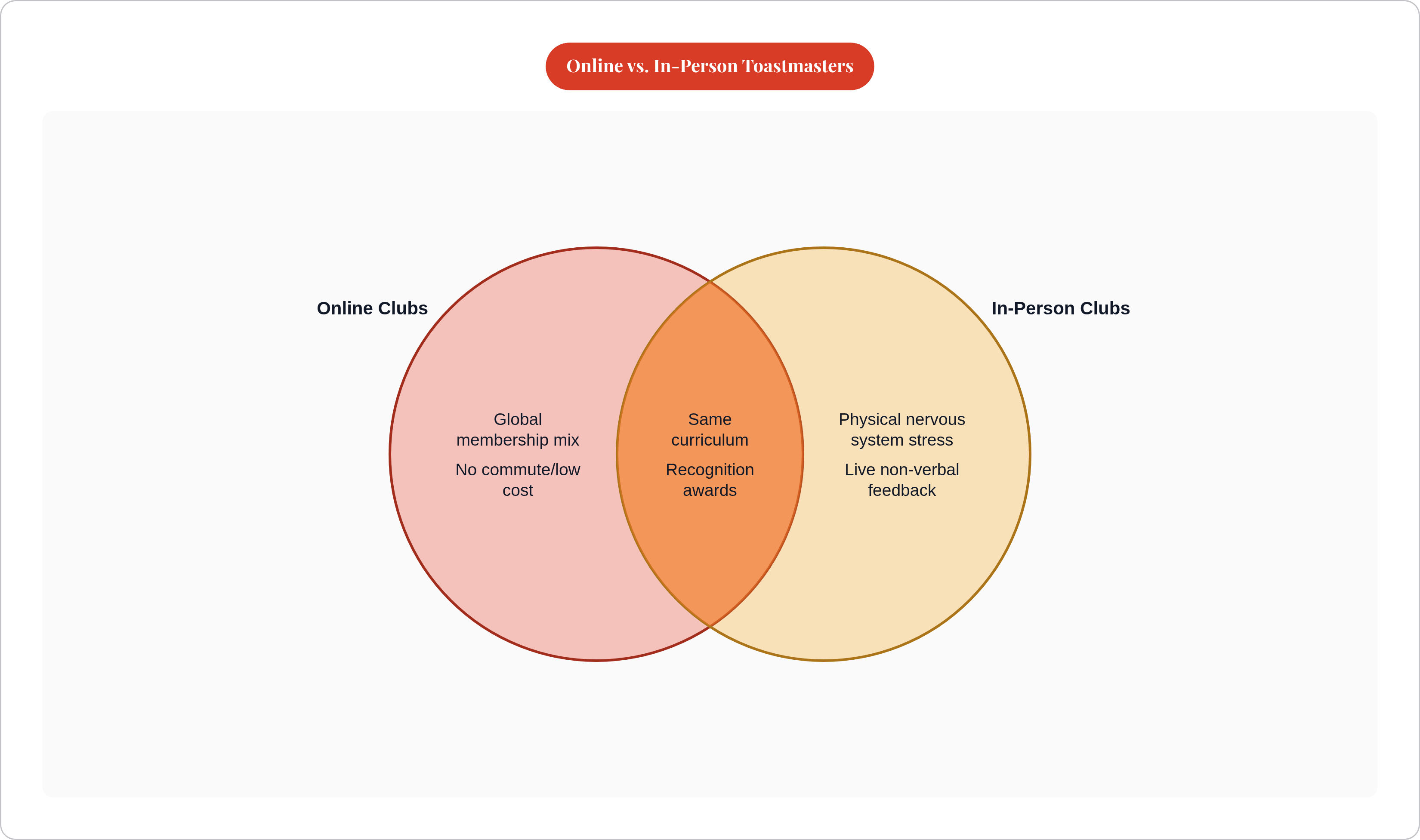
What online clubs do better (and why accessibility is a real skill advantage, not just a convenience)
Geography stops mattering, first and most obviously. One Online Presenters meeting pulled members dialing in from the US, UK, Chile, Australia, Japan, and The Bahamas, in a single sitting. No rented room in Ohio does that. That mix brings exposure to accents, pacing, and cultural rhythms that a homogenous local chapter struggles to manufacture no matter how welcoming the sign on the door claims to be.
Frequency is where the real gap opens up, though people tend to wave this off as a minor logistics point. Cut the commute and you cut the single biggest reason members skip a meeting. Fluency comes from reps, not from one heroic Tuesday-night performance. A member who logs in forty times a year because it takes ninety seconds is going to outpace the member who makes it eight times because the drive across town kept losing to traffic and dinner plans.
Talking to a webcam carries its own real difficulty, worth taking seriously on its own terms. Holding eye contact with a lens instead of a face, reading a chat window mid-sentence, staying composed while a grid of thumbnails could mute you and wander off to check email: this is a different muscle, and it happens to be the exact muscle most white-collar jobs now demand of you. Attention research on virtual audiences backs this up: focus holds for the first 5 to 8 minutes of a talk, then drops off a cliff around minute ten. Learning to build a message around that window is training for anyone whose Tuesday includes a client call on Teams.
Money's the quiet part of this. No venue rental, no gas, no Saturday morning surrendered to a drive across town. For anyone early in a career, light on time and lighter on cash, online carries real practical appeal. And the recognition structure (Best Speaker, Best Table Topics, Best Evaluator) runs every meeting regardless of format, so the feedback loop that makes the whole program work survives the move to a screen fully intact.
What in-person clubs do better (the physical pressure that online cannot fully replicate)
A screen can't fake what a room does to your body. Stress measurably changes how people talk: word count, fluency rate, pacing all shift under real physical scrutiny. Standing in front of eight people who can watch your hands shake is a different animal than talking to a webcam in a room you have entirely to yourself. Your nervous system knows the difference even when your slide deck doesn't.
Non-verbal feedback is the other half of it, and it's the harder one to fake your way around. A live room hands you silence you can actually feel: posture shifting in the third row, an eyebrow going up in the back. Little of that survives compression into a grid of muted rectangles. The old Mehrabian statistic (the one claiming communication runs 55% non-verbal, 38% vocal, 7% words) gets misquoted constantly and technically only applies to narrow questions of emotional congruence. Even so, the instinct underneath it holds: physical presence lights up more channels at once, and a speaker calibrating off a live room in real time is training a sense a screen simply can't touch.
Toastmasters International's own leadership seems to agree with this, which is worth pausing on. In 2025, the Board reversed course and mandated that Area, Division, and District contests return to in-person format after years of running hybrid. That's the people who run the entire system concluding that high-stakes competitive evaluation needs bodies in a room to mean anything.
Community is the last piece, and it's easy to underrate until you've lost it. A club tied to a physical address builds a cohort that shows up together, week after week, in a way that sticks harder than the loose, drop-in accountability of a recurring Zoom invite you can decline without anyone noticing. Habit research keeps landing on the same conclusion: social accountability in shared physical space beats social accountability at a distance. Confidence also lives partly in the body itself, in posture, in breath, in knowing how to cross a stage and actually occupy it. That's hard to train from a desk chair, no matter how flattering your ring light is.
Table Topics as the test case (how the same drill lands differently in each format)
Want to watch the tension in miniature? Sit through a Table Topics session. The drill traces back to a 1936 club officer training manual: no warning, no prep, someone calls your name, and you've got one to two minutes to say something coherent about a prompt you've never seen before in your life. The Ah-Counter tallies every "um," "uh," "like," and "actually" while you flail, which is its own particular flavor of public humiliation, one I've personally supplied material for on more than one Tuesday.
The skill under construction is organizing a thought under pressure, one with a real opening, body, and close, instead of trailing off and hoping the room takes pity on you. Frameworks like PREP (Point, Reason, Example, Point), the Pendulum method (pros, cons, recommendation), and Story Banking (a mental drawer of anecdotes ready to deploy on cue) work identically on Zoom and in a church basement. The framework stays constant. What shifts is whether the pressure actually forces you to use it.
In person, the walk to the front of the room does something to you before you've said a word. Standing up, facing people who are facing you, knowing there's no mute button between you and the silence: these are small rituals, but they raise the stakes just enough to force real adaptation. Online, the pressure shows up sideways instead. The camera demands its own composure: stillness, controlled expression, sustained eye contact with a piece of glass instead of a room of faces. And getting cold-called mid-Zoom-meeting mirrors how impromptu speaking actually happens at most jobs now, arguably more than a live ambush ever did.
Matt Abrahams at Stanford GSB, who wrote Speaking Up Without Freaking Out, suggests reframing Table Topics as conversation rather than performance. That reframe works in both rooms. It probably does more work online, where the "performance" framing was already shakier and easier to talk yourself out of in the first place.
Here's the real tension underneath all of this: online Table Topics can run low-stakes enough that a nervous member never confronts the discomfort the drill exists to manufacture. In-person Table Topics can run high-stakes enough that the same member just never raises their hand. Neither produces growth on its own. What growth actually needs is pressure that's real but survivable, and that balance takes deliberate effort to find in either format. You have to go looking for it.
Who is actually choosing each format, and what the numbers say about the fear each format is supposed to fix
The program works, at least by its own members' account. Nearly three in four surveyed Toastmasters between July 2024 and June 2025 said they felt less afraid of public speaking after joining. Fine, that part isn't up for debate. What's actually worth arguing about is which format gets someone through the door in the first place, and which one keeps them there once the novelty of a new hobby wears off around week six.
Age changes the calculus considerably. Only a quarter of 16-to-24-year-olds report feeling confident speaking to an audience, against a much higher share of adults over 45. That gap opens up right when career visibility starts to matter, right when one shaky presentation can cost a promotion or a client. Separately, close to three-quarters of Gen Z report a fear of public speaking, and more than half of university students say the same. That's the population actually weighing online versus in-person right now, and they're making that decision from a place of real dread, not idle curiosity about a Tuesday-night hobby.
Most of them do nothing about it, which is the more damning number. Only 8% of people with public speaking fear seek any kind of professional help; the other 92% avoid the podium or grit their way through it and hope nobody notices the shaking hands. Toastmasters, in either format, is a cheap, low-barrier intervention for that overwhelming majority. This is where online earns its keep: a format that lowers the entry cost enough to get a scared 22-year-old into a weekly habit can produce real, measurable growth over time.
One catch, though. Research on virtual training and VR exposure shows both genuinely cut anxiety and build confidence, but only if the gains eventually get tested in a live, high-stakes room. Online practice that never escalates is exposure without transfer. You get comfortable in the controlled environment and never find out whether that comfort actually goes anywhere once the stakes are real.
How to actually choose (the variables that should drive the decision)
Start with the actual goal, not whichever format sounds better on a resume. Somebody gunning for a remote-first job where every presentation happens over video should lean online, because that's the exact muscle getting built. Somebody who needs to command a conference room or survive an in-person interview panel should lean physical, for the identical reason: train for the room you'll actually be in.
Then look hard at your own constraints. If your schedule or your zip code makes consistent in-person attendance a long shot, the online club you actually show up to beats the in-person club you keep meaning to try next month. Frequency is the engine here. A club you make it to eight times a year isn't building anything, no matter how good the room feels the two times you're actually in it.
Plenty of members split the difference anyway: online for the weekly reps, in-person or the contest circuit for higher-stakes calibration when it counts. The 2025 mandate pulling District contests back in-person basically builds that forcing function in for anyone chasing the competitive track. Whichever you pick, watch for the comfort trap. If one format feels noticeably less scary than the other, that's usually a sign it's doing less for you, not more.
One more flag, specifically for hybrid clubs. A lot of them backed into hybrid during the pandemic without planning the equipment, the logistics, or the culture shift it actually demands, and they tend to shortchange both their online and their in-person members as a result. Ask how long a club has run hybrid, and whether remote members get the same roles and the same quality of feedback as the people sitting in the room. A vague answer is itself the answer.
And one last gap neither format solves. Toastmasters meets weekly or biweekly at best, and the skills built in a two-hour meeting compound fastest with daily reps in between, reps the meeting cadence structurally cannot provide. Pick your club for the room it gives you, and find your daily practice somewhere else, since that piece falls outside what any club meeting, in any format, was ever built to cover.