Toastmasters vs Online Public Speaking Courses
Toastmasters builds comfort through live practice; online courses teach technique through video.
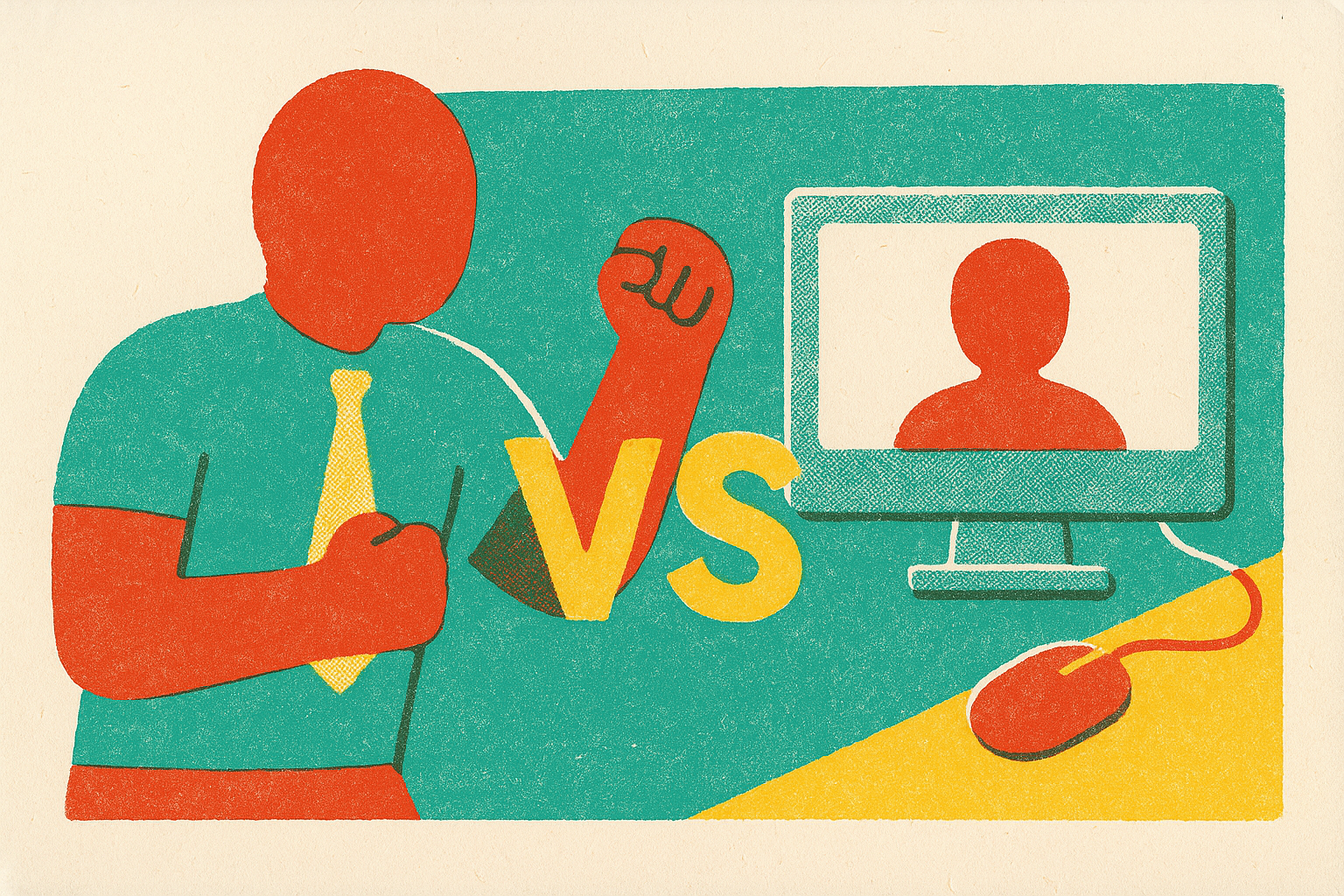
Most comparisons between Toastmasters and online public speaking courses get stuck on price and scheduling. That framing treats them as interchangeable routes to the same destination, which they are not. Each format trains a fundamentally different cognitive and behavioral system. Choosing without understanding that distinction is like picking between swimming laps and watching swim tutorials: both are technically "swimming training," but only one gets you wet.
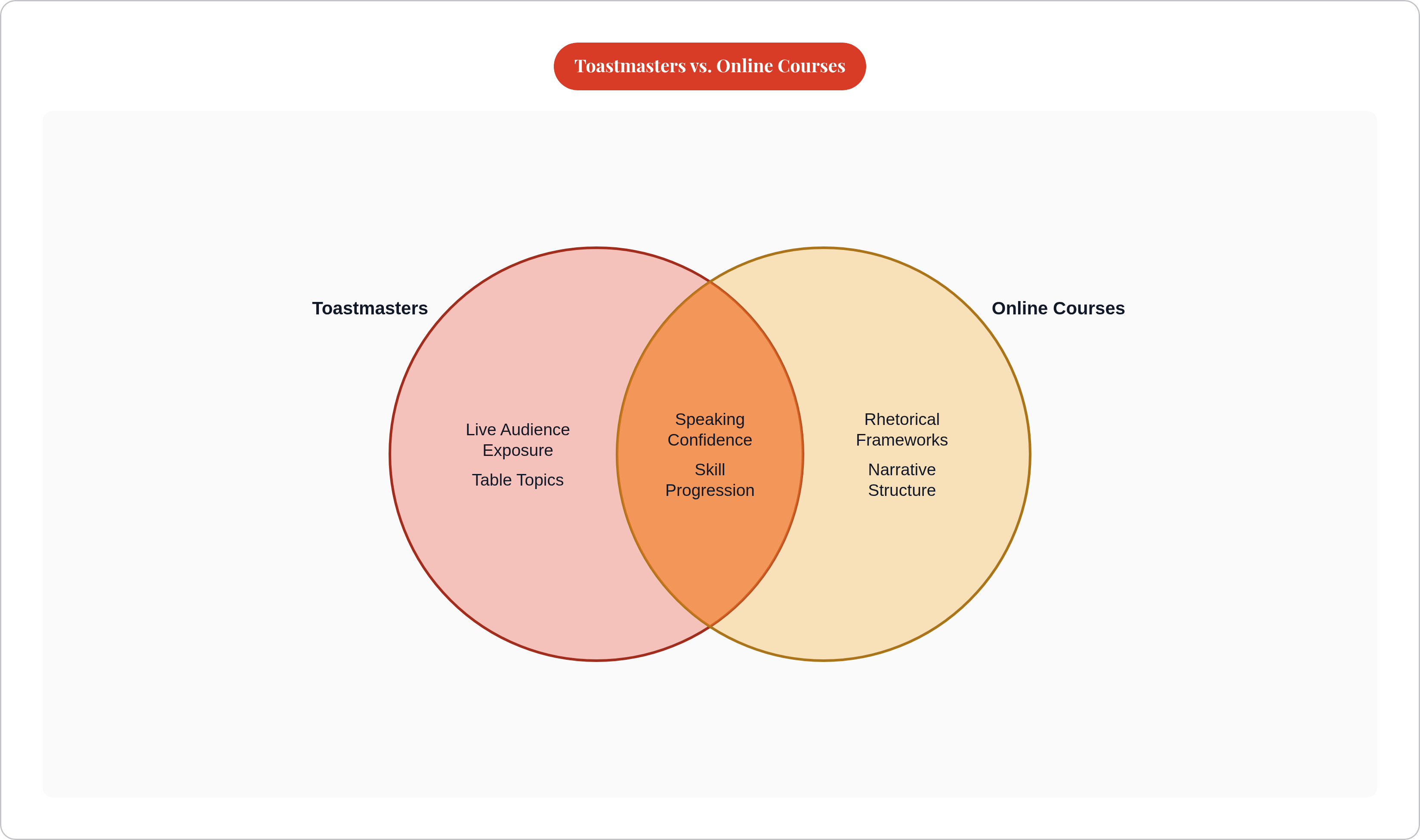
What Toastmasters Actually Trains: Live Discomfort, Peer Accountability, and Real-Time Recovery
The core mechanism of Toastmasters is exposure, not instruction. Weekly meetings place members in front of a live audience, and the psychological dynamics of that audience shift in interesting ways over time: strangers become familiar, which lowers certain anxieties and raises others. You stop worrying about what these people think of you in the abstract and start worrying about what they'll remember next Tuesday.
Two structural features make Toastmasters difficult to replicate. The first is the Ah-Counter: a designated member who tracks filler words during the meeting and reports the results aloud to the group. It is a small accountability mechanism with an outsized psychological effect. The second is Table Topics, an exercise where members deliver unscripted, one-to-two-minute responses to surprise prompts. Table Topics trains something most speaking programs ignore entirely: the recoverable moment. The ability to organize thought under social pressure, in real time, without a script. That is a muscle, and it only grows under load.
Peer feedback in Toastmasters is real but imperfect. Evaluator quality varies by club and by individual; feedback can be inconsistent, and experienced members sometimes give newer ones a generosity of evaluation that borders on useless. But the social stake created by being evaluated by people you'll see again next week is not something a recorded video exercise can reproduce. That social recurrence is the accountability structure.
The Pathways curriculum provides a structured ladder of difficulty across six distinct learning paths, including Presentation Mastery, Persuasive Influence, and Engaging Humor. Each path comprises at least fourteen projects. The progression is deliberate and, to members who arrive with a specific problem they want to solve immediately, maddeningly slow. A member who needs to sharpen narrative technique has to wait for the curriculum to get there.
Toastmasters' own survey data found that 74.9% of members reported experiencing less fear during public speaking after joining. That figure deserves interrogation. Fear reduction through repeated live exposure is real and well-supported in behavioral research; habituation is a documented mechanism, not a marketing claim. But fear reduction and technical improvement in delivery are not the same thing, and they can diverge significantly. A speaker can feel less terrified and still be structurally disorganized.
What Online Courses Actually Train: Conceptual Frameworks, Structural Technique, and Self-Directed Repetition
Online courses live in the domain of concept transfer. Narrative structure, rhetorical technique, vocal variety principles, slide design: these are areas where a well-produced course can go deeper and faster than a weekly club meeting allows. Platforms like Coursera, edX, LinkedIn Learning, and Udemy deliver this material competently. The University of Washington's Dynamic Public Speaking Specialization on Coursera, free to audit, and Harvard's Introduction to Rhetoric on edX are credible starting points for learners who want substantive frameworks rather than motivational scaffolding.
The watching-versus-doing gap, however, is categorical, not incidental. Public speaking is closer to learning to swim than to memorizing vocabulary. Watching someone explain breath support does not train your diaphragm. The physiological experience of standing in front of people with your heart pounding is not present in a video lesson, and no amount of conceptual clarity compensates for its absence. This is not a flaw in online courses; it is a category difference, and treating it as a design oversight misunderstands what these courses are built to do.
The completion problem compounds everything. Traditional online courses see completion rates in the low teens; programs with coaching or structured accountability mechanisms reach completion rates several times higher. The training effect of a course you abandon in week three is approximately zero. Toastmasters' weekly commitment model sidesteps this structural vulnerability by building attendance into a social contract rather than leaving it to individual motivation, which, as most of us know from lived experience, is a depletable resource.
Where online courses outperform: deliberate, targeted skill work. If the problem is structuring an argument, building a narrative arc, or understanding the mechanics of rhetorical devices, a self-paced course can address that specific problem immediately. A Toastmasters member with the same goal has to wait for the curriculum to arrive at the right project. That lag is a real cost.
The Anxiety Question: Why the Fear of Speaking Deserves Its Own Analysis Before Choosing a Format
Fear of public speaking is a social threat response, not a skill gap. The racing heart, the shaking voice, the blank mind mid-sentence: these are downstream effects of the brain's judgment-detection circuitry activating under perceived social evaluation. Knowing how to structure a speech does not switch that circuitry off. Research consistently attributes the preponderance of pre-presentation anxiety to insufficient practice rather than insufficient information, which means the path through it is exposure, not study.
This distinction matters enormously for format choice because the two formats address anxiety through fundamentally different mechanisms. Toastmasters delivers gradual desensitization through repeated live exposure, which is the mechanism that actually rewires the threat response over time. Online courses can teach cognitive reframing strategies and preparation techniques, and those strategies have genuine value, but the courses cannot deliver the exposure itself. Teaching someone to reframe anxiety as excitement is useful. It is not the same as standing up in front of fifteen people every week until it becomes unremarkable.
Emerging tools occupy an interesting middle ground here. A study published in Scientific Reports in 2023 found that public speaking training conducted in front of a supportive audience in virtual reality improved performance in real-life settings. AI feedback systems build confidence through a different mechanism: shifting a speaker's attention away from audience evaluation and toward task mastery. Neither fully replicates the social stakes of live practice, but both are meaningfully more than passive video consumption.
The practical implication is sequential: if anxiety is the primary obstacle, live practice with real-time social feedback should come before self-paced video study. Starting with an online course when anxiety is the actual problem is like reading about open-water swimming when what you need is to get in the water.
What the Research on Storytelling Reveals About Where Both Formats Fall Short
Storytelling is the highest-leverage transferable speaking skill, and both formats handle it imperfectly. Toastmasters' own analysis of widely-watched TED Talks found that nearly all of them open with a story or deploy one immediately after an opening question. Neuroscience research explains why: stories activate multiple brain regions simultaneously, making information more persuasive and more memorable, partly because narrative bypasses the defensive cognition that direct argument tends to trigger. A speaker who cannot tell a story well is leaving the most powerful tool in the room on the table.
Toastmasters touches narrative in paths like Engaging Humor and Presentation Mastery, but storytelling is not the organizing principle of the curriculum. Peer evaluators, doing their best under time pressure, frequently default to feedback on filler words and eye contact before engaging with whether the story actually landed. That is not a criticism of evaluators; it is an observation about where the curriculum's center of gravity sits.
Online courses offer the inverse problem. The theoretical frameworks for story structure, the hero's journey, problem-resolution arcs, anecdote-first openings, are well-taught in this format. A learner can finish a module with a sophisticated understanding of narrative mechanics. But the feedback loop for whether a story actually lands emotionally requires a live audience, not a rubric. Structure and resonance are different things, and a score on a worksheet cannot measure the latter.
The gap this reveals is consequential: a speaker can understand narrative structure completely and still not feel it in front of people. Bridging that gap requires a different kind of practice: low-stakes, high-frequency, iterative delivery. Recording yourself responding to a prompt, reviewing your own verbal coherence, building a felt sense of pacing and rhythm through repetition. Neither format, as typically practiced, provides this at the cadence it requires.
How to Read Your Own Situation and Match It to the Right Format
The decision reduces to three questions, asked in order.
Is your primary obstacle fear, or is it craft? If the problem is anxiety, live exposure comes first. Online study can run in parallel, but it cannot do the primary work. If the problem is craft, structured conceptual study can advance in parallel with whatever live practice you have access to.
Do you need external accountability to sustain practice? If the honest answer is yes, a format with a built-in social commitment, Toastmasters' weekly meetings or a live cohort course, is not optional; it is the mechanism that determines whether any practice actually happens. If you are self-directed and have demonstrated it, self-paced formats can work. Most people overestimate which category they belong to.
Do you have a specific context or are you building a general foundation? A high-stakes pitch in six weeks calls for targeted, context-specific preparation, not a fourteen-project curriculum. A person building a general speaking foundation over the long term benefits from Toastmasters' progressive structure precisely because it resists shortcuts.
Toastmasters serves adults who benefit from peer community and social stakes, people who want long-term affordable practice with no fixed endpoint, and those whose primary goal is confidence built through live repetition. Online courses serve people who already have some speaking experience and want to sharpen specific technique, learners with scheduling constraints that make weekly commitments impractical, and those who want a structured conceptual foundation before doing live practice.
The strongest evidence for format combination comes from a 2024 study in the Journal of Applied Communication Research, which found that participants in blended learning programs demonstrated meaningfully greater retention of core speaking techniques at six months compared to participants in purely virtual programs. Neither format alone produced the same result. The implication is not subtle.
Both Toastmasters and online courses are periodic by design: weekly meetings, course modules completed in batches. The daily gap between sessions is where skills either consolidate or atrophy. This is the structural vulnerability that neither format directly addresses. A daily practice layer, such as a single daily prompt, recorded response, and scored delivery feedback, creates the tight feedback loop that fills that gap. It is not a replacement for live audience exposure or structured curriculum; it is the daily rep that makes both more effective. The verbal reflex is built in ordinary moments, not in weekly meetings.
The Skill Both Formats Are Ultimately Competing to Develop — and Why Daily Reps Determine Who Wins It
Both formats are, at their core, trying to produce the same outcome: the ability to speak clearly, confidently, and persuasively under real conditions. Harvard Business Review reported in 2024 that executives now rank communication as the number one leadership skill that AI cannot replace. The stakes for developing this skill are rising, not stabilizing.
Research on stress and verbal fluency makes the frequency argument concrete. Stress measurably degrades verbal performance parameters, including fluency rate and total coherent output, meaning the skill regresses under pressure unless it has been practiced to automaticity. Automaticity is not produced by depth of study. It is produced by volume of reps, accumulated over time, at a pace that feels almost unremarkable.
This is where the format debate becomes secondary. A Toastmasters member who attends twice a month and does nothing between sessions is outpaced by someone doing daily deliberate verbal practice in any format. An online course participant who watches every video but never records themselves is accumulating knowledge without building the physical skill. The gap between understanding speaking and being a speaker is measured in hours of practice, not hours of instruction.
The people who get heard are not the ones who picked the right program. They are the ones who kept practicing when the program ended. The daily tools, the daily prompts, the recorded responses, the scored feedback, exist precisely for the days between meetings and the months after the course finishes. Fluency is built in ordinary moments. Both formats know this in theory. The ones who internalize it in practice are the ones who actually improve.