AI Speech Coaching Apps for Beginners
Gen Z faces a confidence gap that AI apps can help close through daily, judgment-free practice.
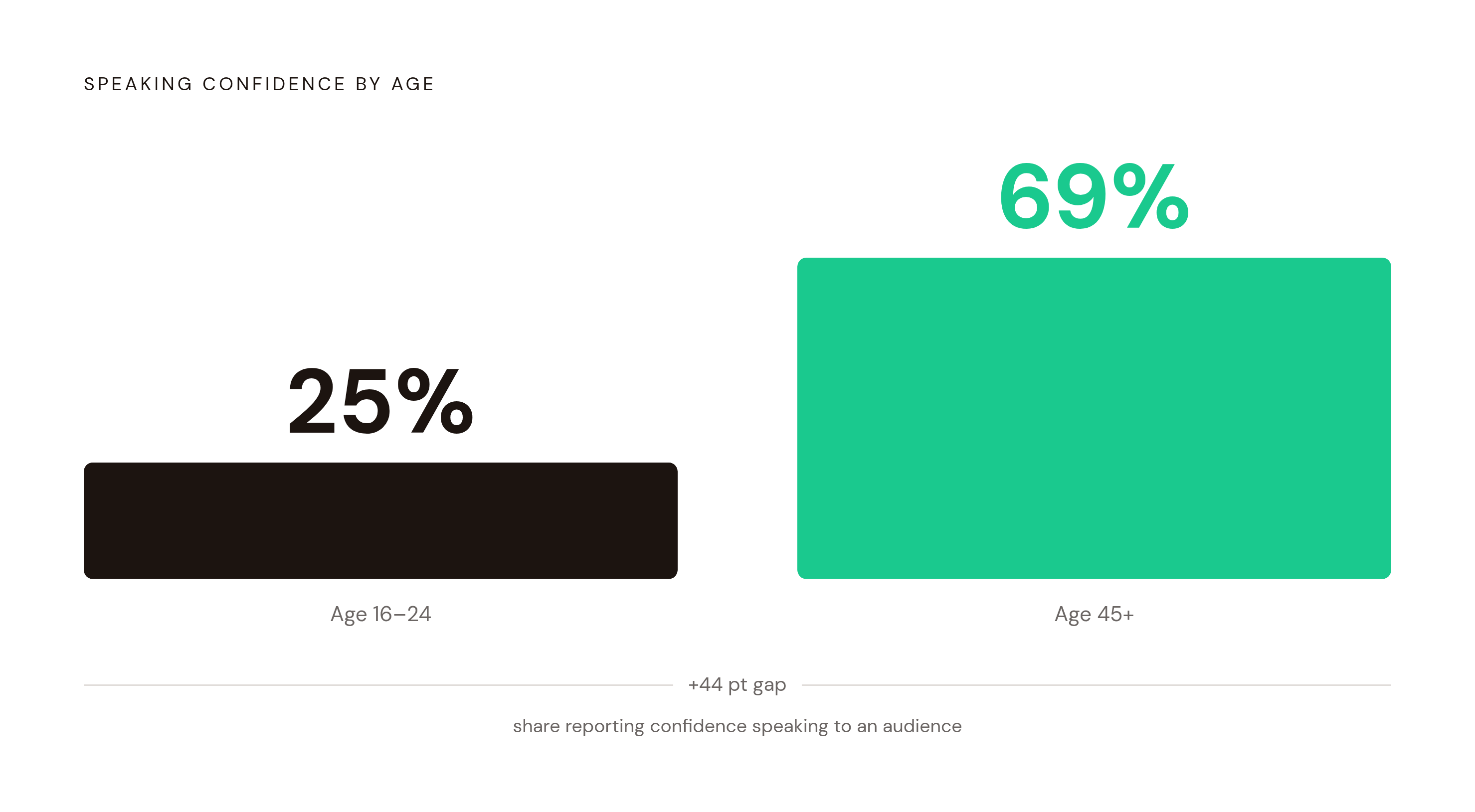
Only 25% of people between 16 and 24 report feeling confident speaking to an audience. Among adults over 45, that figure climbs to 69%. The confidence gap is widest precisely at the career moment when visibility matters most, and the structural reasons for it are not character flaws.
Gen Z is now the largest generational cohort in the workforce, surpassing Baby Boomers as of Q2 2024. They arrived having lost formative years of in-person practice to pandemic-era schooling, then spent those years in communication environments that are fast, asynchronous, and editorially forgiving: text threads, voice notes, Slack. These formats reward concision. They are thin preparation for live, high-pressure speaking. A 2024 Harris Poll found that 82% of managers say Gen Z hires need additional support developing soft skills, and 65% of Gen Zers themselves admit to struggling to make conversation with colleagues, while also describing themselves as eager to learn. Communications researchers frame this as a different skill set, not a deficiency.
That eagerness, alongside the gap, points toward low-barrier tools that can produce daily practice without requiring a room, an audience, or a scheduled appointment with someone who charges by the hour.
What Verbal Communication Skills Are Actually Worth in the Market
Communication is not a soft skill in the sense that it is optional. Fifty-seven percent of global employers rank it as the single most desirable quality in a new hire, above technical ability. Fifty-nine percent of hiring managers say public speaking skills factor specifically into candidate evaluation. Confident public speakers are 70% more likely to be promoted to management positions. These figures require sourcing to verify; readers should confirm them against primary labor market research before treating them as established benchmarks.
Technical skills depreciate. Frameworks change, languages evolve, certifications expire. Communication skills compound. They also remain distinctly human in a workplace increasingly saturated with AI-generated output, which means their relative scarcity is quietly increasing. Forty-five percent of people have declined a promotion or avoided applying for a job because of speaking anxiety, and that fear carries a documented wage penalty that accumulates over decades. Improvement in this domain has a measurable financial return — reframing the cost of any coaching tool from hobby expense into something closer to infrastructure investment.
How AI Coaching Apps Actually Work — What They Measure and How
Every AI speech coaching app operates on the same core loop: you record yourself speaking, an algorithm analyzes what it captured, you receive scored or annotated feedback, and you repeat. What varies, and what actually matters, is what each app can measure with any reliability.
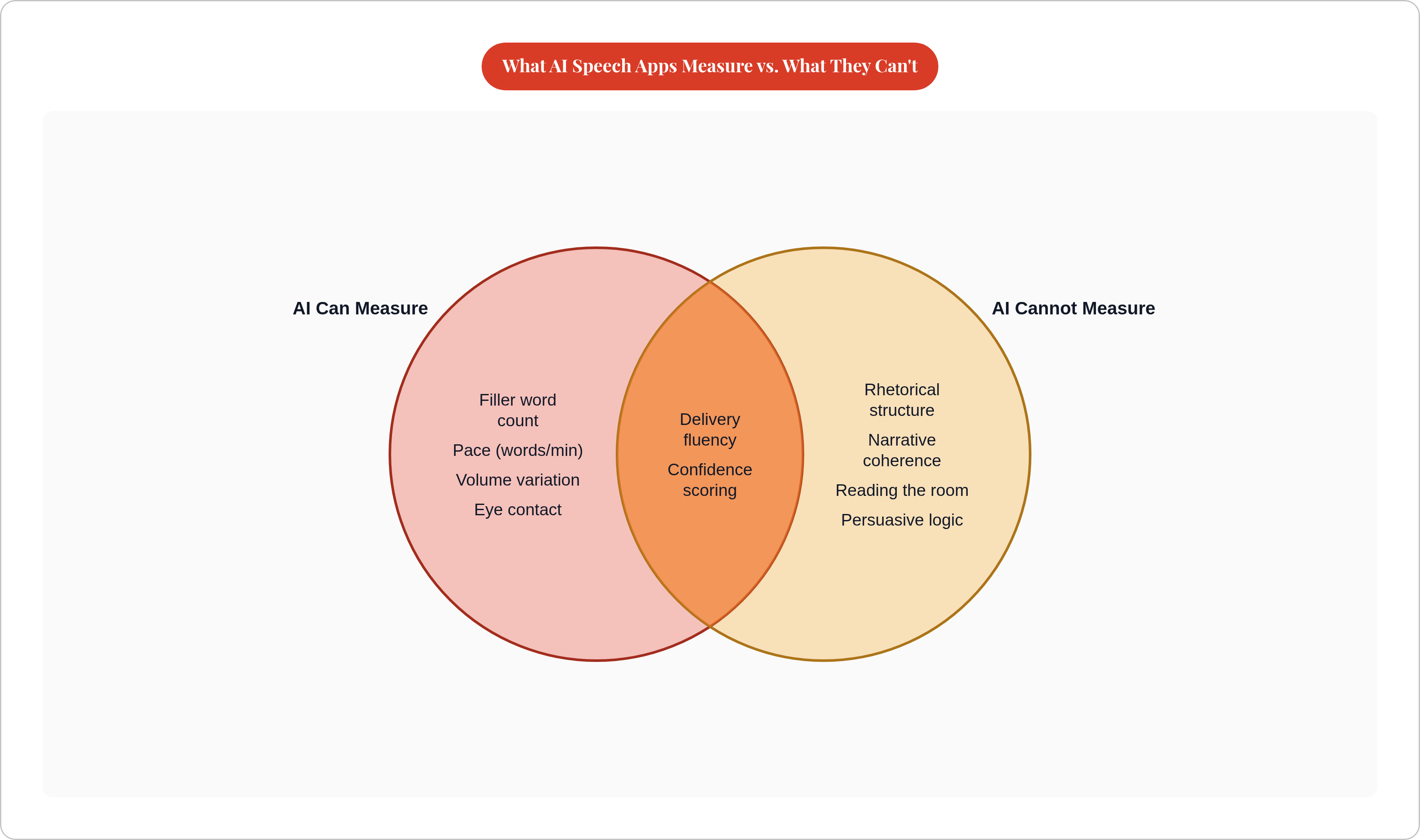
AI does several things well. It counts filler words, specifically "um," "uh," "like," and "you know," tracking both frequency and density within a response. It measures pace in words per minute and can identify variation across a session. It detects articulation clarity, often using speech recognition confidence scores as a proxy for how cleanly your words are landing. It captures energy and volume variation through amplitude patterns. Apps that incorporate video input add a non-verbal layer: facial expression analysis, eye contact tracking, the visible signals an audience reads before you finish your sentence.
What AI cannot reliably score is equally important to internalize before you start. No current app measures rhetorical persuasiveness. None can assess whether your argument structure was coherent, whether your story connected emotionally, or whether the room trusted you. Context-specific appropriateness — knowing when humor serves and when it deflates, knowing how to read a room and recalibrate mid-sentence — remains entirely outside algorithmic reach. That is not a temporary limitation. It is a structural one.
Two delivery modes exist across the landscape. Asynchronous practice is the record-and-review model: you speak alone, watch playback, absorb feedback on your own schedule. Real-time live coaching runs during actual video calls, delivering prompts while you are mid-sentence. Both have legitimate uses; neither substitutes for the other.
The beginner benefit that often goes unstated is straightforwardly mechanical. Practicing alone removes the audience, which is precisely the stimulus triggering the anxiety, while still generating honest feedback that a mirror or a supportive friend cannot provide. A mirror does not tell you that you said "basically" eleven times in four minutes. A friend probably will not either, at least not to your face.
A number on a 0-to-100 scale tells you direction. Prose suggestions tell you how. The tools worth using give you both.
The Main Apps a Beginner Will Encounter and What Each One Actually Prioritizes
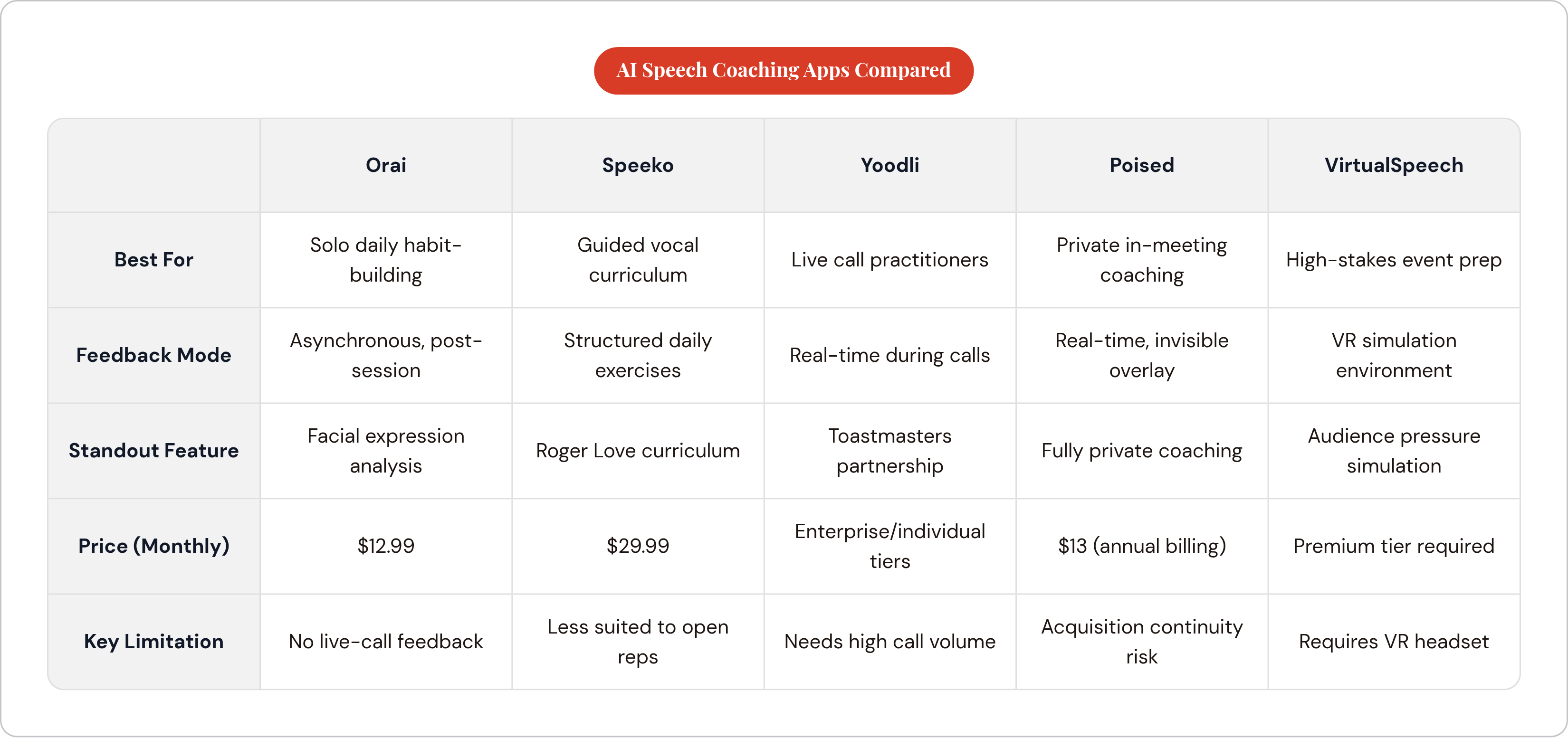
The error most beginners make is treating these apps as interchangeable. They differ not just in price but in what they are architecturally designed to develop, and choosing the wrong one means practicing the wrong thing.
Orai
Orai is designed for solo beginners who want to build a daily habit. It scores filler words, pace, clarity, and energy immediately after you finish a recording; its facial expression analysis and confidence scoring add a non-verbal layer that similarly positioned competitors do not offer. The model is essentially a pocket coach: short daily sessions, instant feedback, designed for repetition over performance. At $12.99 per month, it is priced for the individual user, and the friction to start a session is low enough to sustain the habit.
Speeko
Speeko positions itself as a complete communication coach, with particular emphasis on tone and voice quality. Its curriculum was developed with input from Roger Love, a vocal coach with a documented track record working with performers and executives. That differentiates the content from apps that rely solely on algorithmic feedback. Rather than open-ended recording sessions, Speeko delivers personalized two-minute daily exercises calibrated to your speaking patterns and stated goals. It is better suited to someone who wants a guided program than someone who wants unstructured reps. Pricing runs $29.99 per month, with annual and lifetime options available.
Yoodli
Yoodli is enterprise-grade software that also serves individuals, and understanding that distinction matters. It runs during live Zoom, Google Meet, and Teams calls, delivering real-time prompts while you are actually speaking: slow down, reduce filler words, pause here. It has raised significant venture funding and maintains partnerships with Toastmasters and major organizations. For a beginner, the live-call feature is useful, but it requires an existing volume of video calls to practice on. If you are not yet in meetings regularly, the tool's core functionality sits idle.
Poised
Poised operates similarly to Yoodli in that it delivers real-time feedback during video calls across Zoom, Slack, Teams, and Google Meet, but its distinguishing feature is invisibility. The coaching is entirely private; no one in the meeting knows you are using it, and the interface is designed to be non-distracting. At $13 per month on annual billing, it is accessibly priced. One flag worth raising: Poised was acquired by Deepgram in June 2024. For readers who factor product continuity into their tool choices, that acquisition is worth monitoring.
VirtualSpeech
VirtualSpeech takes a different approach entirely, using VR to place users in simulated conference rooms, boardrooms, and auditoriums. The logic is sound: audience simulation replicates the physiological response of real speaking pressure without the reputational stakes of an actual presentation. Research on VR-based public speaking training suggests meaningful improvement rates among users who complete such programs, though readers should consult primary studies for specific figures. The friction is correspondingly higher. A VR headset is required, and at a premium monthly price, it is the most expensive option in this category. VirtualSpeech is less suited to casual daily practice and more appropriate for someone preparing systematically for a specific high-stakes event.
Speakio
Speakio is a newer entrant built for individuals preparing for interviews, pitches, and general confidence-building, rather than for enterprise sales teams or call-heavy professionals. It has less accumulated track record than the apps above. Its presence here reflects the reality that the landscape is expanding quickly, and readers who explore this category over the next twelve months will encounter tools that did not exist when the established names launched.
How to Pick the Right Starting Point Based on Your Actual Situation
More features do not produce more improvement; more relevant reps do. The most common beginner mistake is choosing the most feature-rich app rather than the one that fits the actual practice context.
Start with when and where you will practice. If you are drilling solo on your own schedule, asynchronous apps are the appropriate starting point; Orai and Speeko are the right options. If you are already on video calls daily, live-coaching apps convert existing meetings into practice reps without requiring incremental time; Yoodli and Poised are designed for exactly this. Preparing for a specific, defined, high-stakes event is a different problem, and VR simulation adds audience pressure without real audience risk.
Then consider what you most urgently need to fix. Filler words and pace are addressable with almost any app here, though Orai is the most beginner-accessible entry point. Voice tone and delivery quality are better served by Speeko's structured curriculum. Non-verbal presence on camera points toward apps with facial expression and video analysis built in.
Finally, look at what the feedback loop actually looks like. Scored numerical feedback makes progress visible and measurable. Qualitative notes alone leave too much room for rationalizing stagnation. An app that tracks your metrics longitudinally across weeks and months is worth more than one that evaluates each session in isolation and offers no memory of where you started.
Price should be the last filter applied, not the first. The inexpensive app you open twice is a worse investment than the slightly pricier one that becomes a daily habit. One practical test worth applying: commit to one app, one prompt, every day for thirty days. The compounding effect of that consistency substantially outperforms occasional long-form preparation.
What the Apps Don't Measure — and Why That Gap Matters for Real Improvement
AI scores what it can hear and see. It cannot score whether your argument landed.
A high pacing score is fully compatible with thin, forgettable content. Fluent delivery of weak ideas is not the goal, but no current app can distinguish between the two. Filler word counts drop naturally with rehearsal and repetition, but rehearsed speech and spontaneous, unscripted speaking under live pressure are different cognitive tasks; strong performance on one does not guarantee strong performance on the other. No app in the current landscape scores rhetorical structure, narrative coherence, or persuasive logic — the elements that make skilled speakers memorable rather than merely smooth.
The real-world transfer problem deserves more candor than it typically receives in coverage of these tools. Practicing in a low-stakes solo environment builds mechanical habits, and those habits are genuinely valuable. Converting them under live audience pressure requires something different: actual conversations, real presentations, moments that carry consequence. The apps prepare you for those moments. They do not substitute for them, and conflating the two is where most people stall out.
Building a Practice Routine That Actually Produces Improvement Over Time
The research on skill acquisition is consistent: daily short-form practice compounds faster than occasional long-form preparation, and the habit structure matters more than the session length. This is especially true for verbal communication, where gains are incremental and cumulative rather than sudden.
A beginner routine that works with any of the apps described here requires less than five minutes per day. One prompt, one recording. Review the score, identify the single metric that moved most, or least, in that session, then adjust one variable on the next attempt: pace, filler reduction, or energy, not everything simultaneously. Once a week, pull up a recording from four weeks prior. Hearing your own measurable growth is a more durable motivator than any dashboard graphic, because it is real rather than aspirational.
Stack the AI reps with real-world application. Use the app to drill mechanics; use every meeting, call, and conversation to test them under actual conditions. Nominate one moment per week where you intentionally apply what the app flagged. The specificity of that intention matters considerably: "I will slow down when I transition between points in tomorrow's team meeting" produces genuine transfer in a way that "I'll try to be better" categorically does not.
Confidence is not a prerequisite for practice. It is a byproduct of visible, measurable progress, which is precisely why quantitative feedback is more valuable to beginners than encouragement. One app, one minute of recording, one honest score. That is a sufficient place to begin.