Virtual Reality Public Speaking Simulators
VR exposes your nervous system to realistic speaking conditions without real stakes.
About 75 to 77% of people carry some level of public speaking anxiety, putting it right up there with heights and other people's opinions of you on the list of universal human dreads. Roughly 5 to 10% have it bad enough to qualify as severe glossophobia, another quarter sit at a moderate level, and the rest get the familiar dry mouth and shaky hands but push through anyway. The real damage is behavioral: about 20% of people with this fear steer their careers away from anything that requires standing up and talking. An estimated 90% of that anxiety traces back to a single, boring cause: not enough practice. Virtual reality simulators exist to fix exactly that, by closing the gap between a rehearsal that feels safe and a performance that doesn't.
The standard fixes fail for predictable reasons, and most people are using all of them wrong. Practicing in a mirror splits attention between performing and watching yourself perform, like trying to drive while staring at the rearview mirror. Friends give feedback that's kind but useless, because they don't know what good delivery looks like and won't mention that your hands are doing something strange even if they notice it. Coaches cost money and require scheduling, which for most people means never. And the bedroom, where all of this practice happens, doesn't feel remotely like a stage: one cough, one checked phone, one raised eyebrow from a real audience member can derail someone who has only ever rehearsed to an empty room and a sock drawer. A lack of information about how to give a good speech was never the problem. It's the absence of realistic, repeatable exposure to the actual conditions of performing one.
What VR simulators are actually doing to the brain when you step into them
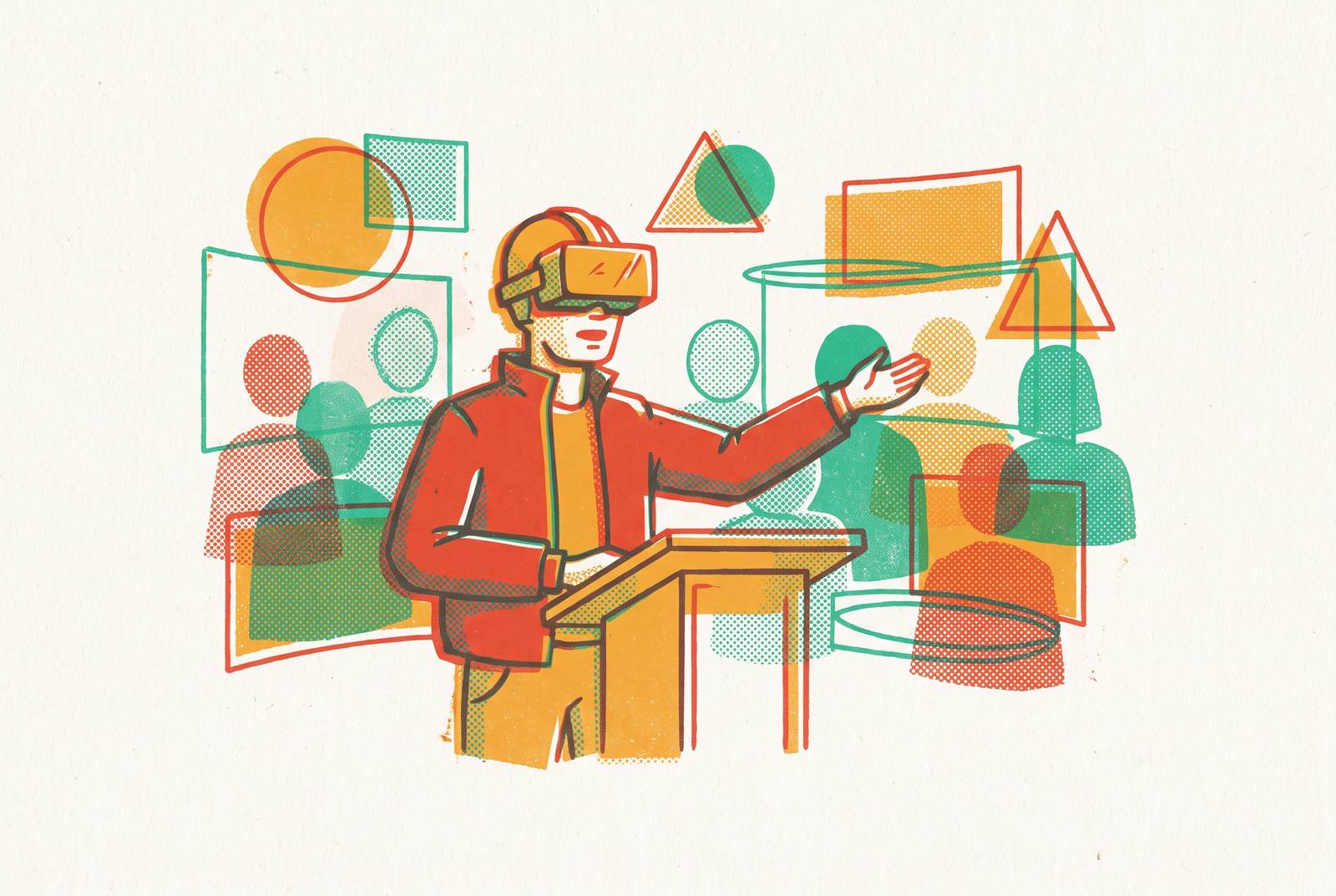
Put a headset on and look out at a photorealistic crowd that reacts to you in real time, and the nervous system stops caring that the audience is made of polygons. Heart rate climbs, palms sweat, focus narrows, the whole stress response fires as if the threat is real, because as far as the older, faster parts of the brain are concerned, it is. That's the same physiological loop that makes public speaking fear so sticky when people avoid it over and over. VR doesn't get rid of that loop. It hijacks it and turns it into training data.
The clinical name for this is Virtual Reality Exposure Therapy, or VRET, the same approach long used to treat PTSD and phobias, applied here to the specific fear of standing in front of people. A 2024 literature review out of the University of Freiburg, covering 20 separate studies, found VRET performs about as well as traditional in-person exposure therapy for public speaking anxiety and Social Anxiety Disorder. Fewer people quit partway through VRET compared to some traditional formats, and the preference many patients show for VR over sitting in a room with a stranger may itself explain why they stick with it. Self-guided VRET sessions have also been linked to measurable physiological changes consistent with reduced social anxiety.
How much exposure is actually needed is still an open question. A 2024 feasibility study published in JMIR tested a single VR session against the usual multi-session format and a no-treatment control. Their setup compared a single VR session against the usual multi-session format, and it held up against the multi-session comparison. A separate randomized controlled trial, also running through JMIR, started recruiting participants in January 2024 and had screened 101 of them as of November 2025, comparing one session of VRET against three. Results go to publication in March 2026, so the science on dosage is still getting worked out in real time, not settled.
The mechanical fact underneath all of it is simple: VR renders more than a convincing room. It puts the speaker back into the internal state, the racing pulse and narrowed focus, that they actually need practice managing. A photorealistic crowd is set dressing. The adrenaline is the product.
The feedback layer that separates VR from every other practice method
None of that immersion matters much without something measuring what happens inside it. A stress response with no feedback attached is just stress. What separates VR from a mirror or a nervous friend is that motion tracking turns vague impressions into numbers.
Where a speaker is looking, whether their eyes are scanning the room or locked onto one exit sign, gets tracked and reported. Filler words like "um" and "anyway" get counted in real time instead of politely ignored. Hand movement, gesture patterns, and in some scenarios even microphone positioning get logged as data points instead of memories. AI models trained on audio pick apart pacing, pitch, and hesitation the way a sports analyst breaks down a swing. Sessions get recorded in full and can get reviewed from multiple angles afterward, and in enterprise setups, a coach can pull all of that up through a web portal without ever putting a headset on.
Configurability matters just as much as the tracking. A speaker can import their actual slides, notes, and talking points, so the rehearsal isn't a generic warmup exercise, it's the actual presentation due Thursday. The AI coaching layer needs careful calibration, though, or it backfires. Cambridge's platform, for instance, found early versions of its AI coach were brutally over-critical, the kind of feedback that makes someone quit rather than improve. It got dialed back to focus on high-impact notes and to preserve a speaker's own natural style rather than sanding everyone into the same conference-keynote cadence.
Encouragement versus criticism isn't the real fork in the road. Vague versus specific is. "Good job" teaches nothing. "You made eye contact with 12% of the room and spent the rest of the talk staring at the exit sign" is something a person can actually go fix. Most feedback fails the second test, not the first.
Four VR public speaking simulators worth knowing in 2025 to 2026, and what each one actually does
Cambridge University's open-access VR platform, built by Dr. Chris Macdonald out of the Immersive Technology Lab at Lucy Cavendish College, went free to anyone worldwide on March 15, 2025, timed to World Speech Day. The underlying research, "Improving virtual reality exposure therapy with open access and overexposure," published December 15, 2024 in Frontiers in Virtual Reality, describes its central idea plainly: overexposure therapy. The platform throws users into a stadium environment with 10,000 animated spectators, panning lights, crowd noise, walkouts, and interruptions, conditions well beyond what most speakers will ever actually face. Macdonald has compared it to running with ankle weights, so the real thing feels like a step down in difficulty rather than a step up. In the Cambridge and UCL trial, a single 30-minute session raised confidence and enjoyment for most users, and a week of self-guided practice benefited everyone who tried it. The platform has logged over 50,000 practice presentations from beta users worldwide, and it's doing that for free, which puts real pressure on any competitor still charging for the basics. This is a free, single-session alternative sitting right next to traditional behavioral therapy for public speaking anxiety, which can take over 20 weeks to access and finish.
VirtualSpeech carries the corporate resume: CPD-accredited, used across Fortune 500 companies, with more than 50 environments and over 30 training modules built around AI roleplay avatars. It supports hand tracking and mixed reality, lets users bring in their own slides and notes, and runs on Meta Quest, VIVE Focus 3, VIVE XR Elite, and the Pico Neo and Pico 4 headset lines. Its AI tracks hesitations and delivery patterns, and reviews body language through recorded footage. On SideQuest it sits at 3.7 stars, with 68% positive reviews against 27% negative, and the complaints cluster around price and a learning curve that punishes first-time users.
Ovation VR, founded in 2016, builds for educators, corporate teams, and individuals, with a range of environments and every element of the audience, its size, behavior, mood, fully adjustable. Users can import notecards, teleprompter text, PowerPoint or PDF slides, and images for a whiteboard, alongside virtual props to simulate realistic presentation conditions. It tracks filler words, gaze, mic positioning, and hand movement in real time, then hands over a full recording with post-speech analytics that coaches can review through a cloud portal without a headset, clearly built with enterprise rollout in mind. A July 2024 review from an Australian learning institution flagged its AI avatars as capable of something it called "instantiation," multiple generative AI characters conversing with each other and with the user at once, which is either an impressive technical trick or a genuinely strange thing to witness depending on your tolerance for talking to several robots simultaneously. The tradeoff for all that depth is setup time. This isn't something a person opens and uses in five minutes.
Virtual Orator is built around one specific sensation: standing in front of a crowd that behaves unpredictably, available on demand, as often as needed. Venue, audience size, and audience mood are all adjustable, from friendly to actively distracting, and every session generates a new randomized crowd. Its standout feature is programmed audience interruption, a virtual attendee that asks a pre-set question or pushes back mid-presentation, forcing the speaker to handle live Q&A pressure rather than deliver a monologue to a passive room. Proprietary AI governs how that audience behaves. The platform is explicit about its four use cases: getting past fear, drilling a specific skill, rehearsing one particular presentation, and running repeated scenarios to check whether speaking ability is actually improving over time.
A handful of adjacent 2025 apps round out the space without competing head-on. VoiceVista serves as an audio navigation tool for blind and low-vision users. oVRcome keeps its focus narrowly clinical, built around anxiety therapy rather than general speaking practice.
What VR still cannot do, and where the remaining gaps sit
Presence is fragile even on the best platforms. If the brain clocks, even briefly, that the crowd isn't real, the stress response softens, and a softened stress response means a weaker training signal. This is a structural limit, not a bug waiting on a patch: it comes from simulating something the nervous system is specifically built to tell apart from reality.
Hardware is its own gate. Cambridge's platform is free, but a decent headset isn't, and that cost sits between a lot of interested people and their first session. Usability isn't evenly distributed either. Ovation's enterprise depth means real setup time before an organization gets any value out of it, and VirtualSpeech's 27% negative review share suggests plenty of solo users hit friction well before they hit fluency.
More fundamentally, VR solves the room problem, not the content problem. A speaker who freezes mid-sentence because the right words simply aren't there will freeze exactly the same way in a headset as on a real stage, because the room was never the bottleneck. Verbal fluency, the raw cognitive ability to pull words out quickly and put them in the right order under pressure, draws on memory, vocabulary, and executive control, and none of that gets built by changing the scenery. One rough benchmark treats something like 10 to 15 words in 30 seconds as a reasonable floor for verbal fluency. Getting meaningfully past that floor, into speech that's fluent, persuasive, and recognizably someone's own style, takes vocabulary depth and habituated delivery patterns built from producing language over and over, not from standing in front of a more convincing crowd. That's the gap VR leaves wide open: the short, frequent, unglamorous verbal reps that happen between the big immersive sessions.
Why daily verbal practice is what turns VR exposure into lasting ability
VR is very good at building tolerance to pressure and handing back data about what happened while that pressure was on. What it can't manufacture is repetition. Confidence and fluency don't get installed in one 30-minute session, however well designed. They accumulate the way a lifting routine builds strength: through frequency, not intensity spikes.
The comparison to sports isn't decorative. A sprinter uses race simulation to prepare for competition, sure, but the actual improvement happens in the daily interval sessions, the unglamorous repeats nobody films. The simulation doesn't build the speed. It tests whether the training already built it. VR public speaking platforms occupy the same role: a stress test, not a training program by themselves, and anyone treating a headset as the whole solution is skipping the part where the actual work happens.
Fluency, presence, and the instinct to speak clearly under pressure behave like habits of the nervous system, which means they respond to short, frequent, high-repetition practice far better than they respond to one long session a month. None of that repetition works without a scorekeeper, either. Feedback that amounts to "you did great" gives a person nothing to act on, while a concrete score, on filler words, on pacing, on a single 30-second verbal response, creates a feedback loop tight enough that daily practice actually shows up as measurable progress over weeks. The two tools aren't competing for the same job. VR is where a speaker finds out exactly what's broken. Daily verbal practice is where it gets fixed, one repetition at a time, long before the next headset session or the next real audience shows up.