The Speaking Metrics Worth Watching on a Weekly Progress Chart
Track these five metrics to distinguish fluent speech from genuine improvement.
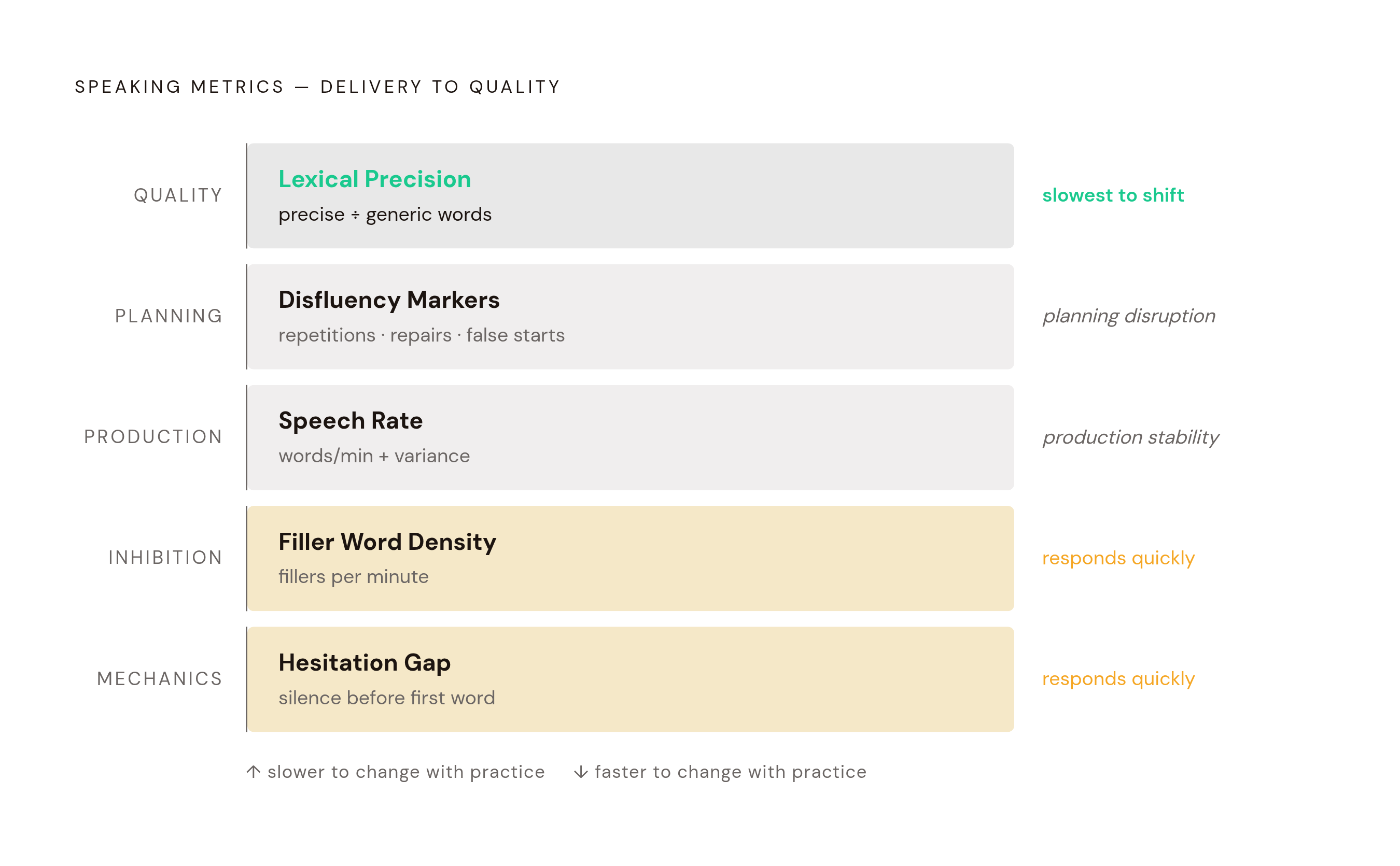
A useful daily speaking prompt app with AI scoring should give a daily grade and show how speaking changes over time. The speaking metrics on a weekly progress chart are hesitation gap, filler word density, speech rate, lexical precision, and disfluency markers beyond fillers. Together, they distinguish faster retrieval from better control and smoother delivery from more precise language.
Why weekly speaking progress charts fail without the right metrics
It is frustrating to practice hard when a progress chart barely moves. So is discovering that a rising chart has been measuring the wrong thing. Confidence ratings and grammar quiz scores can go up, and speakers can attend more practice sessions, while speaking live is still hard. A speaker can ace a quiz and still struggle through a negotiation. The chart has recorded preparation.
A single word count or global self-rating compresses several abilities into one number, hiding which improved and which stalled. Confidence may rise without faster word retrieval, while better control may develop before the speaker feels any different. A useful chart therefore needs separate performance signals that point toward different parts of speech production, rather than a more decorative version of “felt quite good.”
What verbal fluency actually measures, and why it requires more than one number
Fluency is the visible output of several processes running together. Lexical access retrieves words quickly enough to keep speech moving. Working memory helps hold and organize ideas until they reach a conclusion, while inhibition helps suppress fillers and unnecessary repetitions. Cognitive flexibility also contributes to this coordination. Like an athlete’s movement, fluent speech looks like one action from the outside because its parts work together.
Knowing the mechanics does not make them automatic. The Declarative-Procedural model distinguishes explicit knowledge of language from the practiced ability to produce it in real time. A speaker may know a word perfectly well and still search for it under pressure. Repetition helps turn that deliberate search into more automatic production.
The measurement also depends on which layer is being assessed. Planning fluency concerns how speech is prepared, surface fluency concerns the audible result, and perceived fluency concerns the listener’s impression. Weekly charts should target measurable surface signals. Those signals offer clues about planning and retrieval, but they are not direct readings of the brain. The five metrics work as complementary indicators.
Hesitation gap: the metric that exposes the gap between knowing and doing
Hesitation gap captures the delay before speech begins. In a timed prompt exercise, it is the silence between the end of the prompt and the speaker’s first word. A long gap can indicate that language still requires conscious retrieval under pressure. A shrinking gap suggests that automaticity is developing. Unlike a confidence rating, the recording does not depend on how capable the speaker felt.
To track it, record responses to timed prompts and measure that opening silence for each response. Average several responses for the weekly chart. This keeps the time it takes to start a response separate from how fast the speaker talks once started. It also makes the measurement repeatable enough to follow across a practice block.
The gap may stay the same for two to three weeks before dropping sharply with more practice. Recording that plateau helps distinguish a pause in visible progress from a reason to abandon the exercise. The speaker may begin promptly and then fill the rest of the answer with audible searching.
Filler word density: why cutting "um" is a symptom of a deeper fix, not the fix itself
Fillers make some of that searching audible. Sounds and words such as “um,” “uh,” “like,” and “so” can occupy processing pauses that might otherwise remain silent. Their frequency therefore reflects more than retrieval speed. It also offers a signal of inhibition control, or the ability to avoid voicing every moment of uncertainty. A speaker can get started faster without gaining that control.
For the weekly chart, count fillers per minute in each recorded response and track the average. The trend shows whether lower filler use persists beyond one session with unusually few fillers. In basic communication, speakers often use many fillers as they search for words. At a plateau, fewer obvious “um” sounds may give way to repeated “so” and “you know.” The habit’s function may persist through the change in sounds and words.
My Speaking Score’s 2026 TOEFL guide describes how to replace a filler with a brief silence. The target is a low-density flow that tolerates pauses cleanly.
The trap is rushing to avoid those pauses. Fewer fillers can look like progress even as faster speech makes the answer harder to follow. For that reason, filler density needs to sit beside speech rate on the chart.
Speech rate: what words per minute actually signals and where it stops mattering
Speech rate is a stability metric. Consistent pacing across familiar and unfamiliar prompts suggests that production is becoming less dependent on easy subject matter. A rate that stays high on easy prompts but collapses on difficult ones reveals a different pattern. Fluency is still conditional.
To measure it, count the words in a recorded response and divide by its duration in minutes. Track the weekly average, but also the variance across sessions. That spread shows what the average hides. Two weeks can have similar averages while one contains much wider swings between fluent answers and laborious ones. A narrowing spread can therefore be a useful sign even without a rising average.
The guide treats “stable rhythm” as a fluency signal, emphasizing consistent timing. This also gives the filler count a safeguard. When fewer fillers coincide with an upward drift in rate, the speaker may be compensating by rushing. When pacing stays steady across different prompts, the evidence for improved control is stronger.
Lexical precision: the metric that separates fluent from actually compelling
A speaker can keep a steady pace and still say very little. Lexical precision assesses whether a speaker selects specific, accurate words instead of relying on generic ones such as “good,” “bad,” and “thing.” It shifts the chart from the mechanics of delivery toward the quality of the language. Smooth speech gets an answer out.
The progression can be described in three levels. Basic vocabulary leans heavily on broad, familiar words, while plateau-level vocabulary includes serviceable but often underspecified choices such as “effective” and “issue.” More developed speech can reach for “strategic,” “friction,” or “leverage” when those words fit the intended meaning. These are not automatic upgrades. A more specialized word earns its place through accuracy.
For tracking, review a recorded response and tag generic words that could have been replaced with more precise choices. Then compare precise vocabulary that fits the context with generic vocabulary in the samples from each week. The aim is a declining generic-word rate. Speak & Improve Corpus 2025 combines language-error annotation, disfluency labels, and holistic proficiency scores, keeping language quality distinct from smooth delivery.
Precision can initially slow an answer down. Familiar generic words are easier to recall, while the speaker may still have to search for more exact words. The harder vocabulary calls for deliberate daily repetition. This metric rewards practice that makes useful words easy to call on during speech as well as recognize during study.
Disfluency markers beyond fillers: tracking repetitions, repairs, and false starts separately
Not every interruption is a filler. Repetitions, self-repairs, and false starts reveal how a speaker plans and revises an answer while producing it. Treating them all as another version of “um” discards useful information. They expose disruption in the construction of speech.
A repetition repeats a word or phrase before continuing, buying time for the next unit of language. Frequent repetition can point toward inhibition or planning difficulties. A self-repair changes course after a phrase has begun, either because production has outrun planning or because the speaker has detected an error. Occasional correction is normal. Frequent repairs suggest that language is not yet being organized into manageable units before delivery.
A false start begins a phrase and abandons it before completing the thought. It belongs in a separate tally, even though it can overlap with the pattern seen in repairs. The corpus uses disfluency labels as a distinct annotation layer from grammatical errors. That separation is useful because a disrupted sentence and an incorrect sentence are not necessarily the same thing.
To apply it, mark repetitions, repairs, and false starts with different tags in each recording, separate from filler words. Count each category on its own. If fillers go down while repairs go up, the speaker may be talking before the words are planned. A single count of all disfluency markers could hide that shift completely.
How to read movement across all five metrics together, not one at a time
When hesitation gap shrinks but filler density stays high, faster retrieval is developing without equivalent inhibition control. The next practice block should therefore focus on choosing to pause in silence. These results identify a mismatch that a single grade would conceal.
There is a different warning when speech rate goes up along with repetitions, repairs, or false starts. If fillers have also fallen, the speaker may have replaced audible pauses with rushed production. The cleaner filler score then needs to be read against the less stable planning. Improvement in one column is not permission to ignore the others.
Lexical precision improving while speech rate drops tells another story. The speaker is reaching better vocabulary before retrieval has become automatic. That can be a temporary cost of useful practice. Continued repetition is the appropriate response in this pattern. The distinction is between slowing because language is becoming more exact and slowing because production is breaking down.
The guide models a multidimensional approach by scoring fluency, intelligibility, language use, and organization separately before aggregation. For a daily scoring app, that detail is more informative than a composite grade alone. Good scores on all five metrics reflect the foundations of competent delivery, with content strength remaining a separate consideration.
How to practice public speaking at home and track progress with daily short reps
Short daily responses paired with weekly review put this approach into practice. The Declarative-Procedural model explains why repeated production is needed to make explicitly learned language available automatically. A long session now and then offers practice, but gives fewer chances to return to retrieval. Knowing what good speech sounds like remains different from producing it on demand.
Spontaneous prompts keep that demand central. Speak & Improve Challenge 2025 uses open speaking tests as well as scripted read-aloud tasks, distinguishing unscripted production from prepared language. For this training loop, the timed response is where retrieval, pacing, inhibition, and planning have to work together. The weekly chart then shows which part needs the next round of practice.
Hesitation gap and filler density are the signals expected to respond sooner to frequent repetition. Lexical precision can take longer because more exact vocabulary must become readily retrievable. That difference gives the chart a useful motivational role. Early movement in control need not be dismissed because vocabulary development is slower, and a temporary slowdown need not cancel evidence of better word choice.
The recommended routine replaces a two-hour monthly session with five minutes daily. Record a timed prompt response, track the five metrics, and read their movement together over eight weeks. Use the pattern to choose silence, steadier delivery, or repeated access to precise vocabulary as the emphasis for the next practice block. Daily practice is the engine. The weekly chart is the dashboard that shows how it is running.