The Difference Between Filler Words and Strategic Pausing
Knowing the difference prevents you from eliminating the pause that makes you sound confident.
Filler words and strategic pauses look like the same thing from the outside. Both stop the flow of speech. Both create a moment of silence or noise where a word should be. But one is the brain caught flat-footed, and the other is a speaker choosing to make an audience wait. Confuse the two, and someone spends months scrubbing "um" out of their vocabulary while eliminating the exact tool that would have made them sound sharper. That confusion is the single most common mistake in communication training, and untangling it is mostly a matter of learning what each sound is actually doing.
How linguists actually classify filler words, and what that taxonomy reveals about their origin
Linguists split fillers into two buckets. Unlexicalized fillers are sounds with no dictionary meaning: "uh," "um," "er." Lexicalized fillers are real words stripped of their normal job: "you know," "I mean," "like." Same category, completely different machinery underneath.
A 2023/2024 study out of Palangka Raya University counted 306 filler instances across recorded speech and found unlexicalized fillers made up 93.8% of them (287 out of 306), with lexicalized fillers trailing at just 6.2%.
That distinction matters more than it sounds like it should. "Like" and "um" get lumped together in casual complaints about sloppy speech, but they aren't the same problem. One is a noise the brain makes while it searches for a word. The other is a social cushion that got worn smooth from overuse until it stopped meaning anything.
A second wrinkle deserves a name. Research (Hutin et al., Interspeech 2024) found that filled pauses don't converge between conversation partners, meaning people don't pick up each other's "uh" and "um" habits the way they pick up accents or slang. That's a tell. If fillers were primarily a social signal aimed at the listener, they'd spread through a conversation the way laughter does. Instead they stay fixed to the individual speaker, which points toward something more mechanical happening inside one person's head, not a message being sent to someone else's.
What is actually happening in the brain when a filler word comes out
The speaker's brain, mid-filler, is working. A 2020 study in Scientific Reports used electrocorticography, meaning electrodes placed directly on the brain's surface, and found that filler utterances line up with a spike in high gamma activity in the association and visual cortex. Translation: the brain is actively hunting for a word, building meaning, or rifling through visual memory for the right image to attach language to.
Dr. Valerie Fridland, a linguistics professor at the University of Nevada, Reno, has made the point: "ums" and "uhs" are signs the brain is working hard to find the right words, not evidence of a character flaw. It's a processing signal, not a personality defect. The usual triggers are nerves, talking faster than the brain can retrieve words, thin preparation, and vocabulary that doesn't get used often enough to come out smoothly. Drill the retrieval process until it's automatic, and the filler rate drops on its own. That's the whole mechanism.
The listener's brain is actively engaging with the noise, too. It's using it. Research suggests listeners decode "um" as a signal that a longer pause is coming and "uh" as a signal the gap will be shorter, so the brain is quietly using filler sounds to predict what's next and pace its own attention accordingly. Useful, in small doses.
The doses stop being small fast. Once fillers pile up, the listener's prefrontal cortex has to work harder just to keep up with disfluent speech, and comprehension slips. There's also a subtler cost: excessive filler use can trigger a mild threat response in the amygdala, signaling unreliability even when nothing the speaker said was actually wrong.
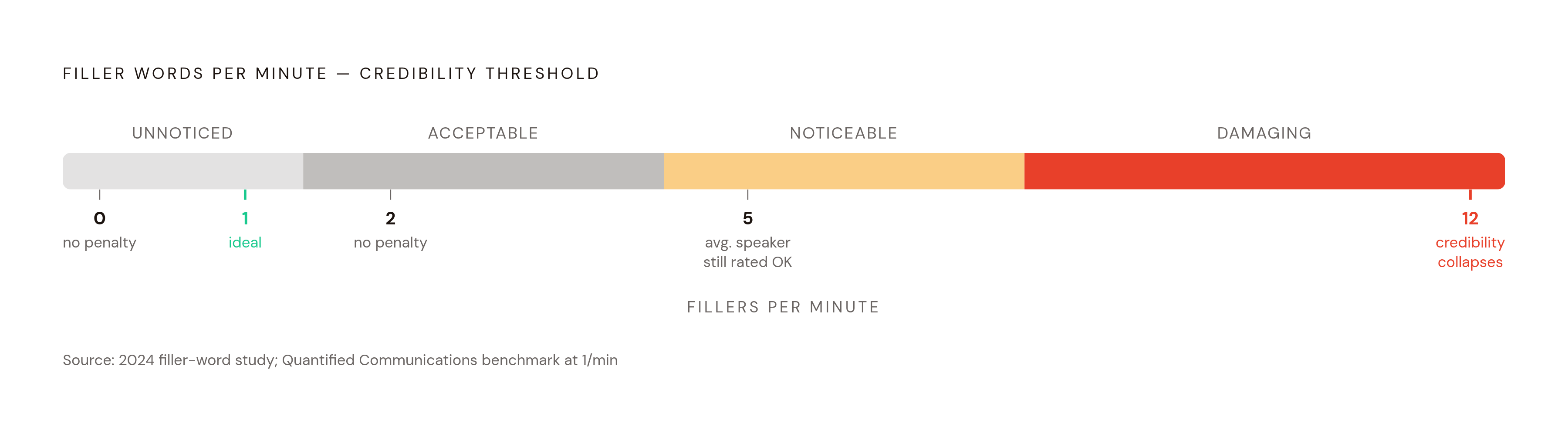
None of this means filler-free speech is the goal. Fluent, ordinary speech carries something like 5 to 7 disfluencies per 100 words as a baseline; a little static is just how talking works. A 2024 study seeded speeches with fillers at 0, 2, 5, and 12 per minute and found listeners rated the 5-per-minute speaker no less effective than the filler-free one. At 12 per minute, ratings on effectiveness, preparedness, and confidence all dropped, and the damage traced back mainly to filler sounds, uh and um, not filler words like "you know." There's a ceiling. Below it, nobody notices. Above it, everybody does.
Why filler words damage credibility even when the speaker is competent
Audiences don't hear "uh" and think "busy prefrontal cortex." They hear nervous, unprepared, unsure. That inference lands even on speakers who know their material cold, which is the whole tragedy of the thing: competence gets punished for a delivery problem that has nothing to do with what the speaker actually knows.
Research on filler use found that heavier use correlated with lower ratings on professionalism and credibility, regardless of the speaker's gender, though men tended to judge vocal fillers more harshly than women did. The scholarship isn't unanimous, to be fair. Some researchers found the majority position, that credibility drops with filler use. Others found the opposite in some cases, that fillers can actually help credibility. Other researchers found no effect either way. Contested science, real-world stakes: professional settings still punish heavy filler use whether or not the academic consensus is airtight.
Consider the benchmark. Between 1940 and 1996, a national government presidential inaugural addresses contained not one recorded "uh" or "um". Zero. At the highest-stakes microphone in the country, for over half a century, silence was the only acceptable substitute for a filler word. That's not an accident of speechwriting; it's evidence of how the calculation changes when the stakes go up.
Everyday speakers aren't close to that standard. The average speaker drops a filler word roughly every 12 seconds, while Quantified Communications puts the ideal frequency at around once per minute. That gap, five times too frequent, is where credibility quietly leaks out of a presentation. Context still matters: a casual chat with friends can absorb plenty of "likes" without anyone blinking. Job interviews, client pitches, and stage presentations are a different animal, and that's exactly where the penalty is steepest.
The case for fillers in conversation: what they actually do when used functionally
Not every filler is a liability. Linguists describe two jobs fillers do: cognitive, buying time to retrieve a word, and interactional, managing turn-taking or signaling "I'm not done talking yet." Sociolinguistic research identifies several legitimate functions fillers serve, from buying time for thought and promoting politeness to cushioning a hard statement and flagging appropriate uncertainty. That's a working toolkit, not a list of mistakes.
Michael Barbaro of The Daily has more or less built an interviewing style around the humble "hmm," using it to signal genuine listening and interest without tipping his hand on judgment, all while keeping the conversation moving. That's a sign of something other than nerves. That's technique dressed up as a grunt.
Allison Shapira, writing in Harvard Business Review, makes a similar case for entry-point fillers: a well-placed "so," "well," or "actually" can be exactly the wedge a speaker needs to break into a fast-moving conversation. Discourse markers like "I mean" and "you know" also skew younger and show up more in certain personality profiles, suggesting they function partly as identity markers, a way of signaling social belonging, not pure verbal noise.
What separates useful filler from harmful filler lies elsewhere than the word itself. It's whether the speaker is choosing it. Functional filler is conscious and situational. Habitual filler runs on autopilot and keeps firing even when it's actively working against the message. Same sound, opposite outcomes, and the only variable that changes is intent.
How strategic pausing works and what it does to an audience
Strategic pausing is intentional silence doing a job: emphasis, processing time, a transition, anticipation, authority. It's the mirror image of a filler word. Where a filler is the brain scrambling, a pause is the speaker deciding the room needs a beat of quiet.
The effect on an audience is measurable. Research cited by maptive.com (2025) describes a "cognitive bookmark effect," where information framed by a brief pause gets flagged by the brain as more important; a two-second gap after a key point gives working memory room to encode and consolidate what it just heard, lifting understanding by more than 30%. Harvard Business Review (2024) reports a related finding: presenters who pause right after a major takeaway see audience recall rise by almost 20%.
Several distinct pause types show up in the research, each doing different work. A pause before a key point builds anticipation. A pause between sections gives the audience a beat to file away what just happened. A pause after an important statement lets it breathe. A pause after a question invites the audience to actually chew on it. And a deliberate slow-down slows the whole room when a speaker needs to command attention.
Timing matters more than most speakers assume. Research suggests most effective pauses fall in the two-to-five-second range, with shorter gaps suiting emphasis and transitions and longer ones reserved for moments that need maximum weight, because past a certain point, silence starts to read as a mistake instead of a choice.
Audience research consistently finds that speakers who pause deliberately score higher on authenticity and trustworthiness. And the effect isn't limited to the stage. Different medium, same underlying principle: silence, deployed on purpose, holds attention better than an unbroken stream of words.
The hardest part of pausing: why silence feels longer to the speaker than to the audience
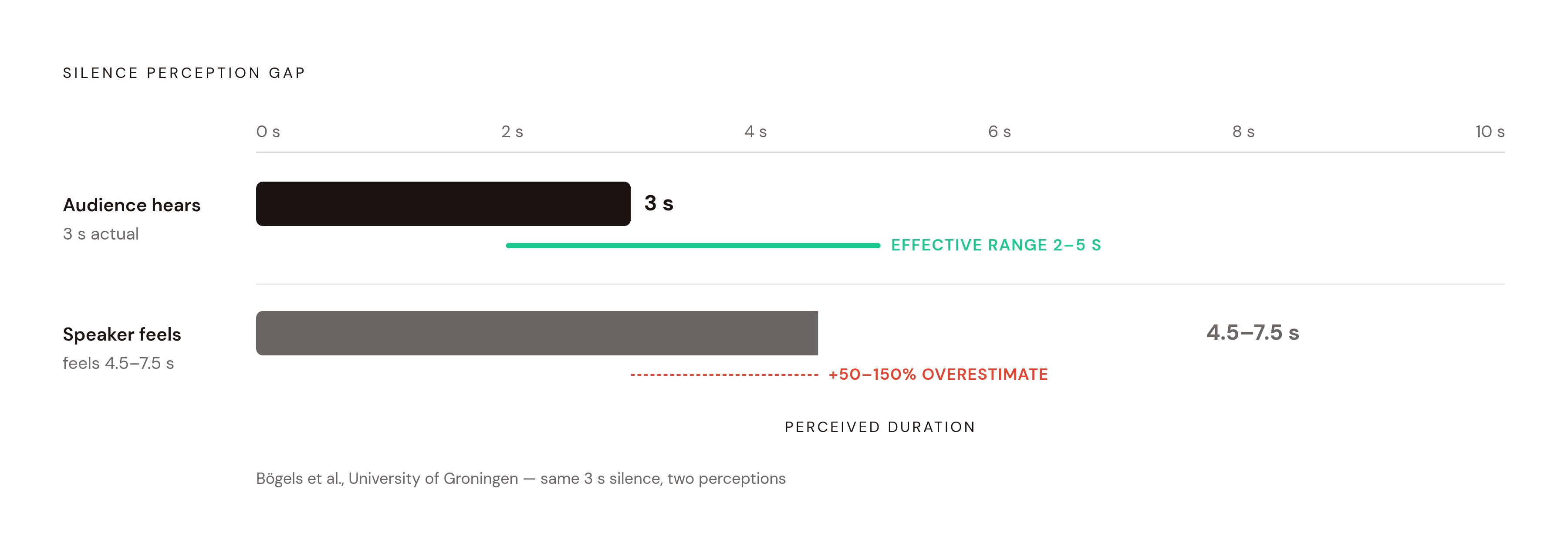
Here's the mechanical snag that trips up almost everyone who tries to add pauses on purpose. Research out of the University of Groningen (Bögels et al.) found that speakers consistently overestimate the length of their own silences by 50% to 150%. What feels like a yawning, humiliating gap to the person standing at the podium barely registers to the people sitting in the audience.
That perceptual gap is the real reason filler words survive even after a speaker has read every article on the subject and fully understands, intellectually, that a pause would land better. Knowing the theory doesn't fix the clock running too fast in the speaker's own head. Willpower doesn't fix it either. What fixes it is calibration: training the internal sense of elapsed time against real external feedback until three seconds of silence stops feeling like ten.
Speakers who pair structured pauses with deliberate breath control tend to report measurable drops in verbal fillers alongside gains in perceived confidence. The mechanism is straightforward enough to practice deliberately. Record a session and play it back, because that's the only reliable way to hear a pause the way an audience hears it. Count silently during rehearsal to build a private sense of duration. Use a controlled breath as a built-in pause marker. And rehearse the discomfort somewhere low-stakes, enough times that the pause stops triggering the same panic response that produces a string of "ums" in the first place.
A generational layer runs through this too. The Rowan Center for Behavioral Medicine recorded a 908% jump in calls from Gen Z individuals seeking treatment for social anxiety between 2019 and 2024, and a 2025 Montclair University study found more than 60% of Gen Z has received a formal anxiety diagnosis. For a generation already wired to treat silence as threat, a three-second pause on stage isn't a stylistic choice, it's a genuine physiological hurdle. None of that makes the discomfort a personality flaw. It's a calibration error, and calibration errors get fixed with repeated, deliberate exposure, not by white-knuckling through one big presentation and hoping the lesson sticks.
What daily scored practice does that one-time coaching cannot
A single workshop can explain the difference between a filler and a pause in about ten minutes. It cannot make that distinction automatic, and automatic is the only version that survives contact with real pressure. Filler words are a habit, which means they're wired into the nervous system at a level below conscious thought, and they come roaring back under stress unless a competing habit has been drilled to the same depth.
Fridland's underlying point about word retrieval applies just as directly to pausing. Practice reduces filler rate because retrieval becomes more automatic and less effortful, and the same mechanism that scrubs "um" out of a rehearsed speech can be trained into everyday conversation through repetition. Effective practice tends to share a few features. It happens in short, frequent sessions, since daily reps build habits faster than occasional long ones, the same way brushing teeth twice a day beats a two-hour dental cleaning once a year. It uses a specific prompt, so the speaker's mental energy goes toward delivery instead of toward deciding what to talk about. It includes immediate playback, because hearing a pause is the only way to recalibrate that region-specific gap between felt time and real time. And it comes with a score on concrete delivery metrics, not vague encouragement, because a number is the only feedback that makes progress visible.
Trinity College London found that 80% of Gen Z students pick up a significant share of their language skills from platforms like TikTok and Instagram, short-form and repetitive by design, which shapes verbal habits whether the viewer means for it to happen or not. That same mechanism, short reps, repeated often, works just as well pointed at a skill on purpose. Tools that deliver a daily prompt, record the response, and score delivery metrics including filler frequency and pause quality can compress a feedback loop that would otherwise take months of live speaking to build.
Treating each rep as a scored performance rather than a private journaling exercise changes the stakes just enough to matter. A tracked filler rate, watched over weeks, gives a speaker a real record of improvement that a gut feeling never could. The gap between reflexive "um" and deliberate silence was always a gap in something other than knowledge. It's a gap in automatic behavior, and gaps like that close through training, the same way any other physical habit does: not by understanding it once, but by rehearsing it until the body stops arguing with the plan.
Sources
- Why You Should Pause During Presentations & 7 Ways to Master It
- (PDF) Use of Fillers as a Communication Strategy in Oral Interactions
- isca-archive.org
- Filler Words: What They Are (Examples), Why We Use & How To Stop
- researchgate.net
- confidenceplaybook.org
- nature.com
- The Impact of Using Speech Fillers on the Adequacy of Communicative Competence in English as a Lingua Franca | Theory and Practice in Language Studies