Speeding Up When Nervous and How to Slow Down
Adrenaline floods your body during nervous speech, but understanding why helps you slow down.
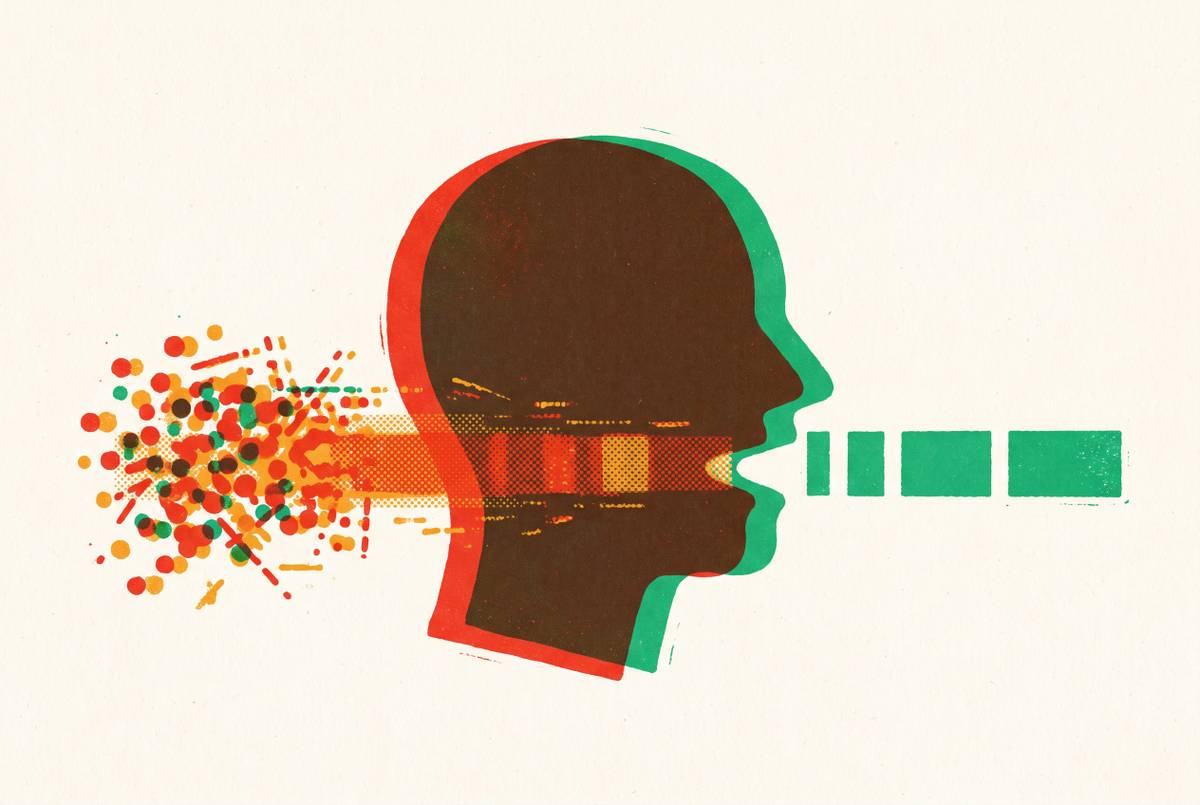
Nervousness speeds up speech because the body is getting ready to run, not talk. Adrenaline floods the system, heart rate climbs, glucose moves into the muscles the same way it would before a sprint. Nobody actually sprints away from a podium, so all that mobilized energy has to leave the body some other way, and it leaves through the mouth. Understanding that mechanism, instead of just white-knuckling through the symptom, is what actually lets someone slow down.
Three things happen at once when the sympathetic nervous system takes over a conversation or a presentation. Breathing goes shallow, sometimes it stops entirely, which cuts off the air needed to pace out a sentence. Vocal cords tighten, changing the texture of the voice before a single word gets judged for content. And the brain, flooded with stress chemicals, has a harder time organizing thought in real time. That last part explains the blanking sensation so many people describe: words start coming out before the thought behind them is finished, because waiting for the thought to finish feels unbearable. Fast speech is widely understood as the visible symptom of an internal state. Treating the symptom without addressing the state works about as well as turning down a fire alarm instead of putting out the fire.
A psychological layer sits on top of the physiological one, and it may be the stickier of the two. Speed becomes a coping strategy: get it over with, don't leave room for someone to interrupt, don't pause long enough to risk going blank. Work on speech anxiety names this pattern directly: fear of pausing becomes its own justification for never pausing. None of this makes someone a bad communicator or a nervous wreck by character. It makes them a person whose nervous system did what nervous systems are built to do, just at the wrong moment for the task in front of them.
Why the loop is hard to break on your own
Fast speech doesn't stay contained to one bad meeting. It compounds. Nerves cause faster speech, faster speech feels less controlled, feeling less controlled produces more anxiety, and more anxiety produces even faster speech the next time a microphone or a manager shows up. Scienceinsights.org has mapped this exact feedback loop, which is a big part of why "just relax" has never once worked as advice.
The damage isn't only internal. DeTolly's research finds that listeners read fast speech as a lack of confidence or gravitas, even when the content itself holds up. So the speaker walks away feeling unheard, and that triggers a kind of shame hangover: replaying the moment, cataloguing every rushed sentence, dreading the next time this has to happen. That dread isn't free. It gets deposited straight into the anxiety balance for the next presentation, with interest.
Left alone long enough, fast speech hardens from a situational habit into something closer to a personality trait. Repeated patterns entrench, appearing even in calm, low-stakes conversations, and stress accelerates them further the moment it arrives. This process of habitual entrenchment runs on a longer timeline than most people assume. Mindvoyage.in traces some of these patterns back to childhood: kids from large families or hyper-competitive classrooms often learn that speaking fast is the only way to get a word in before someone else claims the floor. That is a survival strategy from age eight, still running quietly in the background during a client pitch at thirty-eight. It's a survival strategy from age eight, still running quietly in the background during a client pitch at thirty-eight.
That's why "just slow down" fails almost every time it's given as advice. Neither the nervous system spike happening in real time nor the decades-old pattern reinforcing it produces the fix on its own; both must be addressed together. Fixing pace means working both layers at once. The rest of this piece splits into a physiological track and a behavioral one.
What this costs people who don't address it
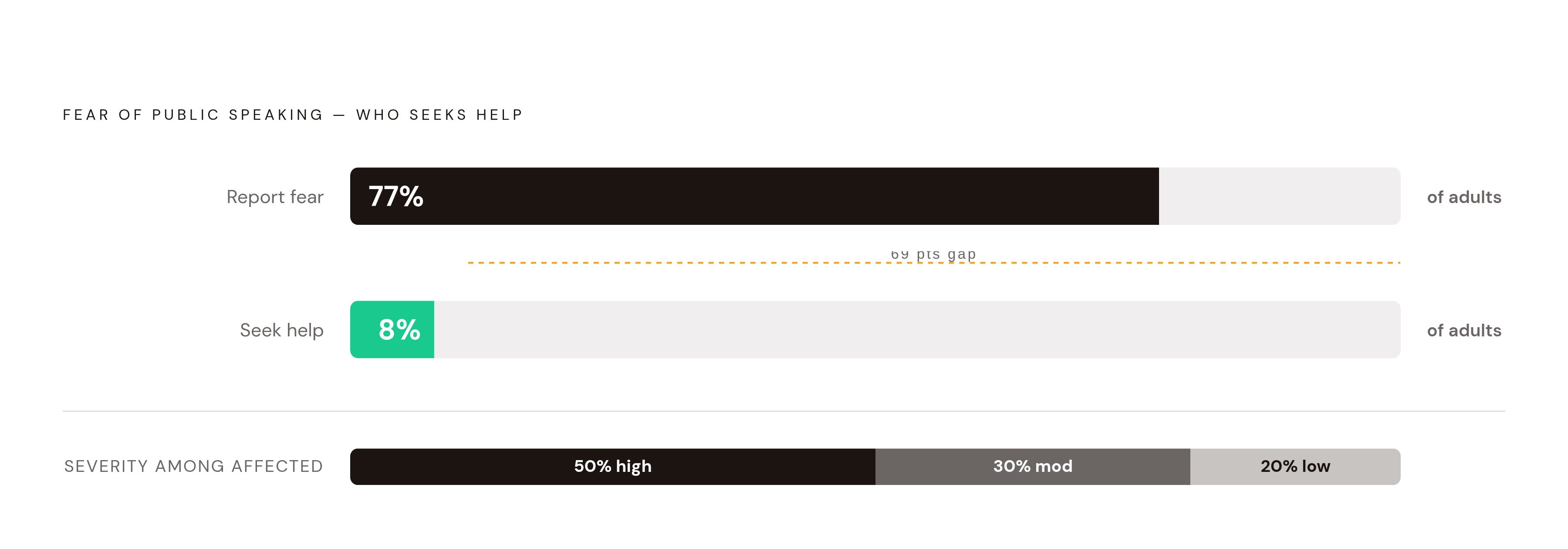
Fear of public speaking affects the vast majority of adults, not some nervous minority. Crowncounseling.com puts the figure at 77% of adults reporting some fear of public speaking, making it among the most widely reported fears. Only 8% of those affected ever seek help for it, despite proven techniques being available. That gap, 77% against 8%, is the real story here.
The same data breaks severity down further: half of people report high anxiety around speaking situations, 30% report moderate anxiety, 20% report low anxiety. Adding it up, four out of five speakers feel meaningfully uncomfortable every time they open their mouths in front of others. Discomfort at that scale changes behavior. Teleprompter.com finds that roughly 57% of people say they'd do almost anything to avoid giving a speech to a large audience, which is not the profile of a mild inconvenience. It's an active force shaping career decisions.
And those decisions carry a price. Data from talks.co, citing Passive Secrets and Ethos3, finds that 92% of professionals believe strong presentation skills matter for career success, while unaddressed speech anxiety can cut earning potential by roughly 10%. Talks.co's figures, drawn from Novoresume, show people spend an average of three to four weeks a year, cumulatively, worrying about speaking situations. Three to four weeks is a significant amount of time. That's a vacation's worth of mental bandwidth spent bracing for something that hasn't happened yet.
None of this is a moral failing. It's a competitive gap, and the 8% who close it aren't just more comfortable in meetings, they're removing a real and recurring drag that the others carry, quietly, every year.
What "slow" sounds like, and why the target rate surprises most people
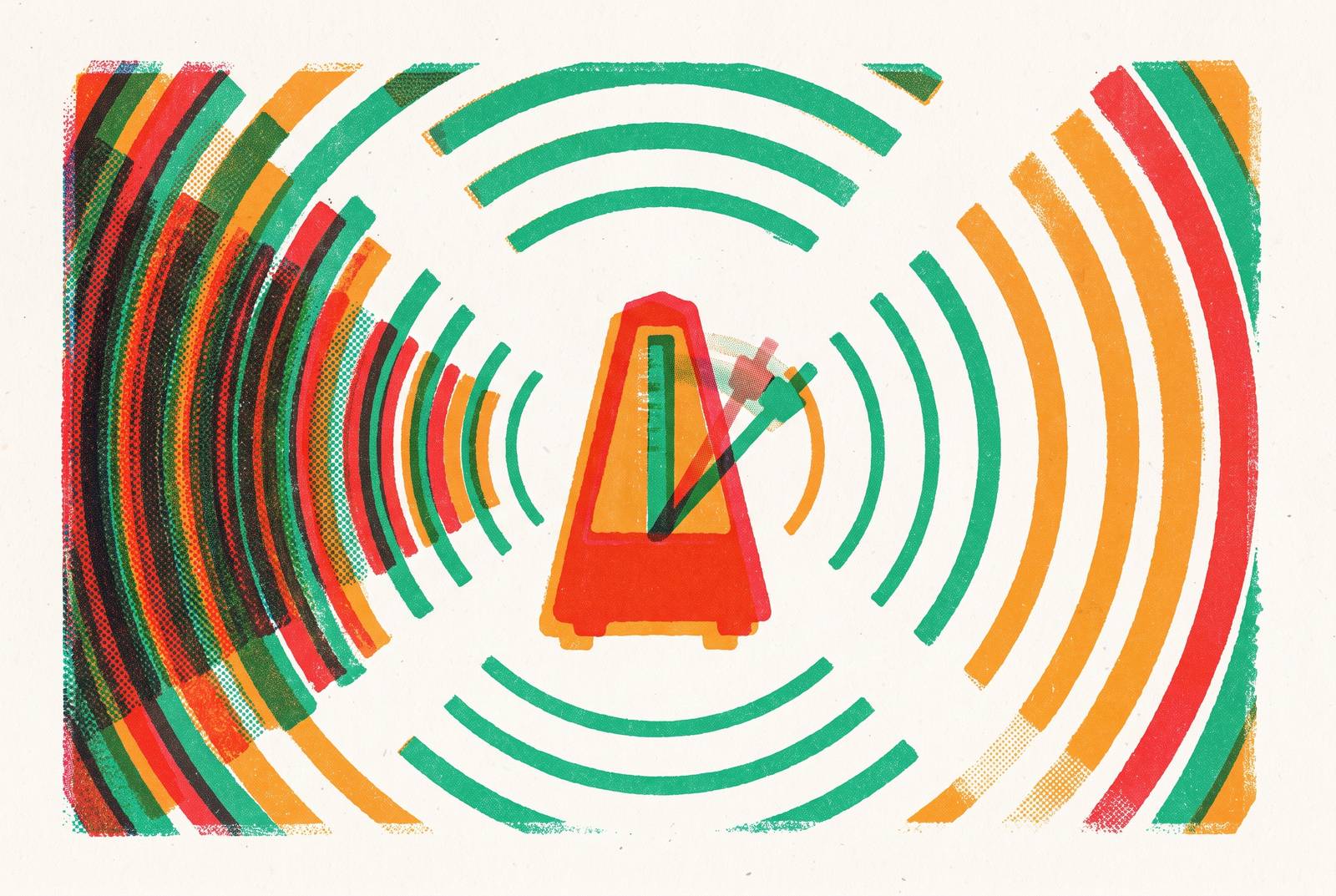
Teleprompter.works reports that the National Communication Association's research puts the ideal presentation speaking rate at 120 to 150 words per minute, with 130 wpm cited most often as the benchmark for clear, formal delivery. That range is narrower than most people expect, and it's bounded on both sides: cross above 160 wpm and comprehension drops, dip below 100 wpm and the audience starts to disengage. It's a corridor, not a finish line.
Ethos3.com places some coaching frameworks closer to 140 wpm as the rate where an audience fully absorbs what's being said. Context helps here: Steve Jobs delivered keynotes at roughly 158 wpm, right at the edge of the comprehension ceiling, while an auctioneer runs somewhere between 250 and 400 wpm. That's a different profession entirely, one built for speed rather than persuasion through clarity.
None of this means locking onto 130 wpm like a metronome and holding it for twenty minutes straight. Thespeakerlab.com makes the point directly: a speech delivered at one flat, unchanging pace sounds robotic no matter how "correct" the number is. The best speakers vary tempo on purpose, speeding up to build energy, slowing down to let a point land, sitting in silence exactly when silence does more work than a sentence would.
What surprises almost everyone who tries this the first time is how normal it sounds from the outside. What feels excruciatingly, embarrassingly slow to the person speaking usually lands as completely normal, even thoughtful, to the person listening. This gap between felt pace and perceived pace is something many speakers describe once they try it. The brain lies about how slow a person sounds, consistently, in one direction. Slowness is what control sounds like from the outside, even when it feels like free-fall on the inside.
The nervous system reset: addressing pace at the physiological level before the words come out
Racing speech is a nervous system event, and the fix has to start there, at the physiological level. Winningpresentations.com frames this clearly: techniques that work at the physiological level don't require monitoring every word in real time. That matters, because monitoring every word in real time causes the same overload that caused the racing.
Three predictable changes need countering. Shallow breathing leaves too little air to pace a sentence properly. The adrenaline spike wants physical output, and if the body isn't running, the words become the running. Attention narrows down to just getting through it, crowding out the mental space needed to pace deliberately.
Exhale longer than the inhale, pause for a single beat, then deliberately slow the first sentence out of the gate right before a call or a presentation. Winningpresentations.com calls this the 30-second reset. The logic is simple. That first sentence sets the tempo for the next five minutes, so it should start slower than feels necessary, almost uncomfortably so.
A more structured option is 4-7-8 breathing: inhale through the nose for four seconds, hold for seven, exhale through the mouth for eight. The technique is recommended specifically before high-stakes speaking moments, and the mechanism is straightforward: extending the exhale past the inhale signals the nervous system to stand down. Where that breath comes from matters too. Chest breathing amplifies the physical sensation of anxiety, while diaphragmatic breathing counteracts it. Most people breathe from the chest exactly when they need to be breathing from the diaphragm, a small mechanical detail with an outsized effect on how a voice comes out.
Strategic pausing and enunciation: the in-the-moment tools that signal control
Pausing is the single most effective pacing tool available, and it works precisely because it looks like the opposite of what a nervous person wants to do. Winningpresentations.com points to this effect: a pause gives the speaker time to collect a thought, adds weight to whatever comes next, and reads to an audience as intentional rather than uncertain. Nobody in the crowd thinks "this person is falling apart" during a two-second pause. They think the speaker is about to say something worth hearing.
Fear of silence is one of the main engines driving people to speed up in the first place, but strategic silence builds anticipation rather than discomfort. A pause tells the room that what follows was worth waiting for. Most anxious speakers accidentally suppress that exact signal by refusing to ever stop talking.
Enunciation works as a physical brake on speed, almost mechanically. Opening the mouth wider and fully finishing each word, consonants included, makes it physically impossible to blur through sentences at the same rate. There's a side benefit too: clearer enunciation eliminates the mumbling that fast speech tends to produce, so the fix for speed and the fix for clarity turn out to be the same fix.
Slower speech buys eloquence. Viveura.com argues that slowing down gives ideas time to take shape before they leave the mouth, cutting down on verbal clutter and lending the speaker more authority. A measured response beats a rapid one nearly every time, because care signals substance.
A strange data point backs this up from an unexpected direction. A 2025 preprint by Rabin, Elyoseph, Israel-Fishelson, Dali, and Nussinson tested synthetic voices from two leading AI platforms, prompting them to sound "polite and formal" versus "casual and informal." The polite condition consistently produced slower speech, with very large effect sizes, across both systems. These are models trained on enormous quantities of human speech data, and without anyone explicitly coding the rule, they absorbed it anyway: slower reads as more credible. If a machine can infer that from pattern-matching alone, it's hard to argue pace doesn't shape how a human audience receives someone.
Daily practice versus pre-speech prep for building lasting pace control
Learning a technique once and pulling it off correctly once are not the same accomplishment. The nervous system habit driving fast speech got built through years of repetition, and it only unbuilds through repetition, not through a single breathing exercise memorized the morning of a big presentation. The research on speech habits is blunt on this point: awareness of the pattern doesn't dissolve the pattern. Consistent, low-stakes practice does.
There's a useful parallel in how eloquence develops generally. Viveura.com describes pacing fluency as something built through familiarity, preparation, and repeated experience over time, a standard no one should expect to hit cold, under pressure, on the first try. Cramming pace control the night before a keynote is a bit like trying to learn to swim the morning of the triathlon.
Short daily reps beat occasional marathon prep sessions for a simple reason: the high-stakes moment is exactly when the body is flooded with adrenaline and least able to learn anything new. Practicing calm, at low stakes, builds the motor memory that later becomes automatic under pressure. A single timed speaking exercise each day, recording a minute of response to a prompt, narrating a train of thought out loud, does more for long-term pace control than one intense rehearsal the night before a talk.
Feedback matters just as much as repetition. Vague encouragement like "just slow down" gives a speaker nothing to act on. Knowing the exact point in a recording where pace spiked, and by how many words per minute, turns a vague feeling into an editable data point. That specificity is why structured, scored practice consistently beats unstructured practice.
Pace control is a measurable, trainable variable, the kind that separates people who hold a room from people who get talked over in it. Treating it the way an athlete treats a swing or a stride, with daily reps and tracked progress, turns the loop that once felt automatic into what it always was: a habit, built once, fully capable of being rebuilt.