Self-Monitoring Speech Habits Without Losing Fluency
Timing, not willpower, determines whether self-monitoring helps or hurts your fluency.
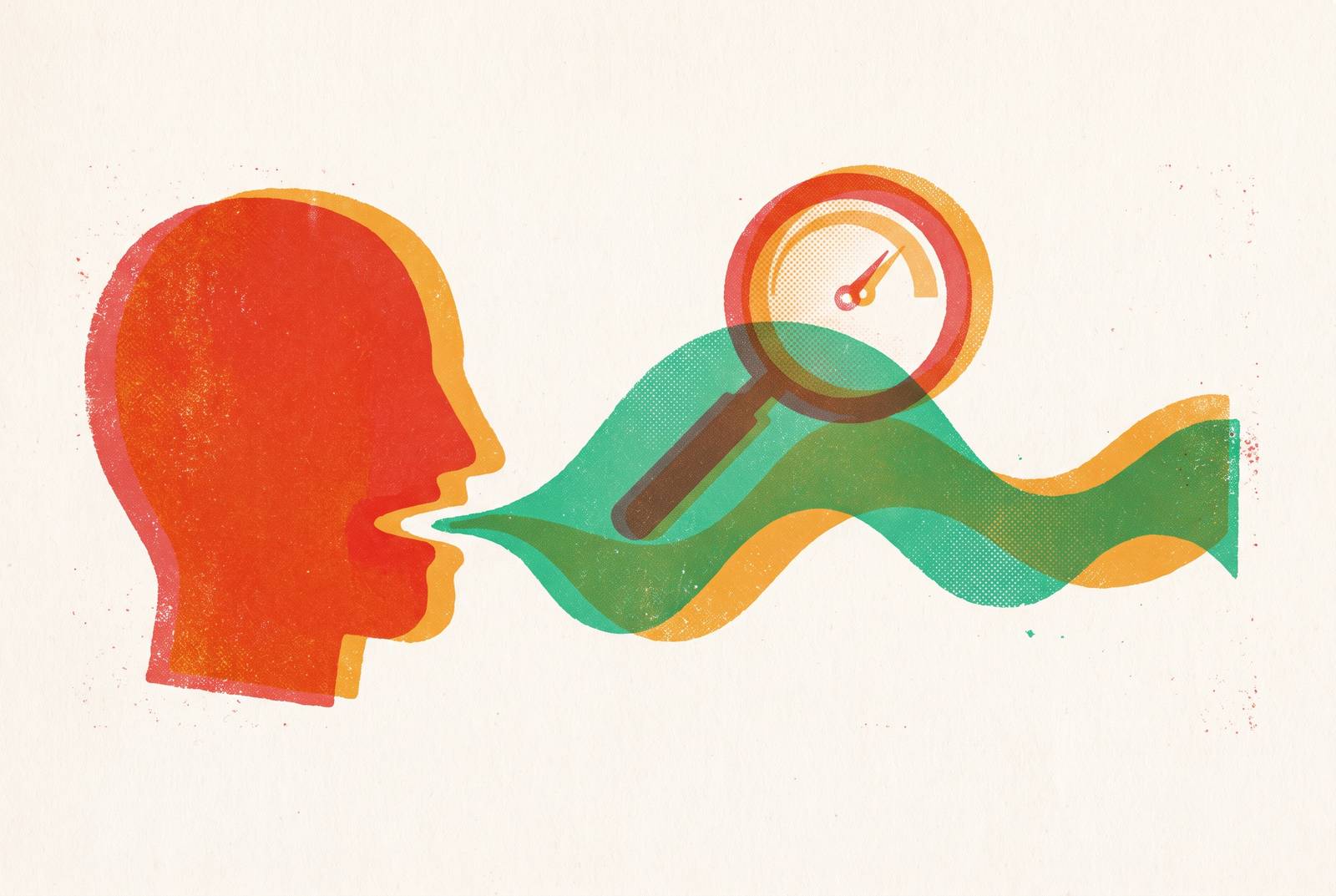
Self-monitoring is a built-in speech production process, running in every speaker, all the time, rather than a personality trait or a bad habit picked up from an anxious middle school presentation. It's a built-in speech production process, running in every speaker, all the time, whether they notice it or not. When the monitor fires during the sentence, it wrecks fluency; when it fires after, it sharpens fluency, and most advice about public speaking gets this exactly backward by treating the monitor itself as the enemy.
Two competing models explain how the system works. Ardi Roelofs' comprehension-based account, part of the WEAVER++ framework, argues the speech comprehension system listens in on phonological output before it's spoken, catching errors the way a proofreader catches a typo before it prints. The conflict-monitoring account, developed by a separate group of researchers, argues something different: the system tracks competing activation among candidate words and sounds, and the conflict itself, not a listening-in process, triggers the correction. Both camps agree on the raw material feeding the system: auditory feedback from hearing your own voice, bone-conducted feedback, proprioceptive feedback from where your articulators sit, and tactile feedback from the inside of your mouth.
Research on phonetic contrast adds a wrinkle. When the phonetic contrast between competing sounds is high, the relationship between error likelihood and repair timing shifts in ways that suggest the monitor responds to how distinct an error is. That points to a monitor responding to how distinct an error is. Monitoring runs on two timescales, one before the word is spoken and one after it's heard, and neither is a malfunction. The brain regions doing this work, the left inferior frontal gyrus and dorsolateral prefrontal cortex, also handle word retrieval and impulse control. Same hardware, different jobs, one shared budget. Overload one function and the other pays for it. Speakers who try to monitor and correct in the same instant collapse two separate loops into a single bottleneck that can't run both jobs at once.
What happens to fluency when the monitor fires mid-sentence
Real-time self-correction isn't just an uncomfortable feeling. It produces speech breakdown you can measure. Catching an error demands attention pointed backward at what just came out of your mouth, at the exact moment forward-facing attention is needed to build the next word. Lexical retrieval and inhibition draw from the same limited pool of neural resources, so a monitor firing under pressure is bidding against speech production itself for scraps.
Stress makes it worse. A dysregulated nervous system is associated with raised pitch, faster pacing, and degraded clarity, so physiological arousal tightens a loop that's already jammed. Speakers who sense they're losing their train of thought try to outrun the gap by talking faster. That backfires every time: speed produces more disfluency, not less, handing the monitor even more material to flag mid-sentence.
A related failure mode appears in speakers who memorize a script word for word. Full memorization shifts the mental task from "what do I want to say" to "what word comes next," which sounds like a small distinction until the monitor interrupts. At that point there's no backup plan, no idea to fall back on, just a blank space where a memorized string used to be. That's the opposite of resilient fluency. None of this makes the monitor the villain. Timing is the villain, and delay is the only fix that actually works.
Why zero fillers is not the goal
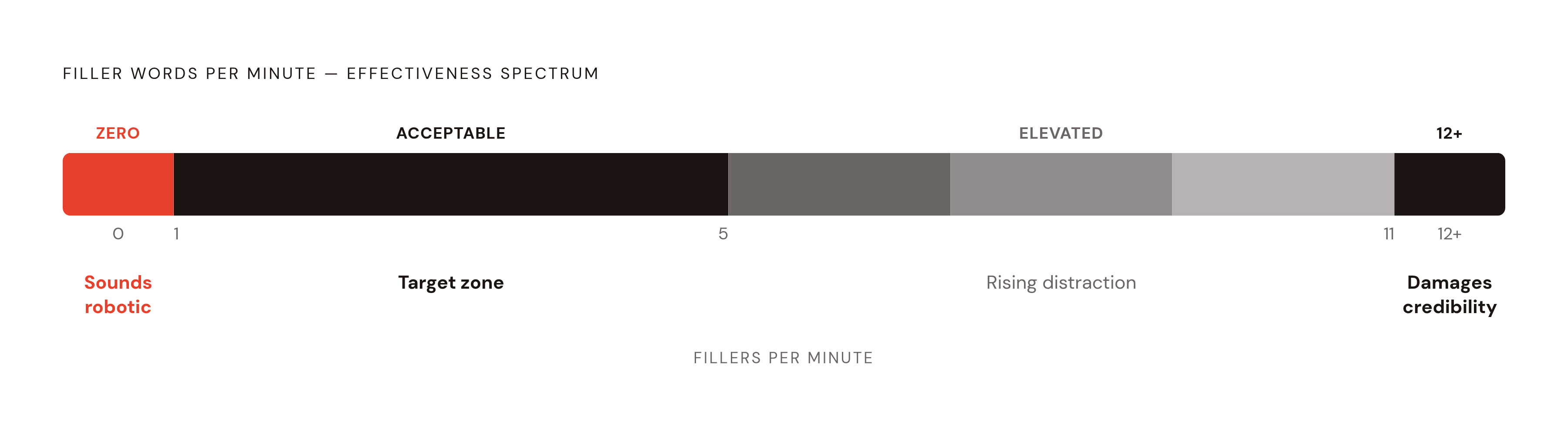
Every speaker who's watched a recording of themselves has had the same reaction: cut every "um," every "like," scrub the tape clean. Research says don't. A study by Duvall and colleagues in 2014 found that speakers who used zero vocal fillers came across as almost robotic to listeners, not polished. Zero is a warning sign that something's off. It's a warning sign that something's off.
Studies on disfluency rates found that around five fillers per minute still reads as acceptable to listeners, while climbing toward twelve per minute meaningfully damaged perceived effectiveness. The target zone is somewhere between zero and five per minute, not at zero itself, and anyone chasing zero is optimizing for the wrong number.
Fillers also carry information that has nothing to do with skill. Factor analysis splits them into two distinct buckets: filled pauses like "uh" and "um," and discourse markers like "I mean," "you know," and "like." Filled pauses occur at similar rates regardless of gender or age. Discourse markers show up more often among women, younger speakers, and people who score higher on conscientiousness. Some filler use signals personality and social style rather than deficiency, and stripping it out entirely flattens a speaker into something less human, not more competent. That's also why real-time monitoring is a limited filler-reduction strategy: tallying and judging filler count while producing the next sentence places competing demands on attention at the same time. That kind of feedback is more reliably delivered outside the moment, after the fact, rather than during it.
Pause and pace as the real fluency levers
If correcting yourself mid-sentence is off the table, silence and pacing are what's left, and they turn out to matter more anyway. Speech coach Michael Chad Hoeppner, whose client list per a January 2025 Forbes profile includes Columbia University MBA students, working attorneys, professional athletes, and executives, and who wrote Don't Say Um: How to Communicate Effectively to Live a Better Life, argues the core skill is tolerating thinking time: giving yourself a beat to pick the right word instead of rushing to fill dead air.
His example is "To be or not to be." Six words, two of them repeated, every syllable monosyllabic, arguably the most articulate sentence in a widely spoken language. Nobody needs a bigger vocabulary to sound sharp. They need the discipline to choose words on purpose instead of grabbing whatever's closest.
A deliberate pause does real physiological work. It removes the urgency signal that speeds up pacing and raises pitch in the first place, and it hands the external monitoring loop, the one that listens after speaking rather than during it, the time it needs to function. To a listener, a full second of silence reads as composure, not confusion. Lowering pitch slightly and stretching out pauses rank among the most reliable signals of authority a speaker has, and neither one requires a richer vocabulary.
Storytelling helps for a related reason. The brain retrieves and produces narrative sequences more easily than abstract argument, so anchoring a point to a story buys processing time without losing the listener's attention. When speech breaks down mid-thought, a structure like Point, Reason, Example, Point gives the speaker a known path forward, so the monitor isn't stuck improvising the whole architecture of the sentence on the fly.
Filler habits and the feedback loop outside the moment
Knowing the right technique in theory doesn't fix a filler habit, because the habit persists precisely because speakers can't reliably hear their own output while producing it. Feedback is the problem, not discipline. Nobody fixes a habit they can't consistently observe.
Research has found that simple awareness training, not technique coaching, can cut filler use in college speakers. Just noticing, consistently, was enough to move the needle. Further research has extended the finding: a computer-delivered awareness program with no live coach produced filler reduction, and participants reported preferring that format. Awareness itself does the work, not who or what delivers it.
Recording speech and reviewing it afterward gives the brain's monitoring system a mechanical stand-in for the external loop it can't run live. Pacing, filler rate, and pitch patterns stay invisible in the moment but become clearly visible on playback. A useful starting drill: record one minute of speech, count the fillers, and if the rate creeps toward the higher end of that range, start with awareness training instead of trying to muscle through it with willpower next time. Every recorded session becomes data instead of an event that happened and vanished. That distinction, treating practice as something to review rather than something to survive, separates a training mindset from a performance mindset.
What the tools available in 2026 do (and how they differ)
The market for AI speech coaching software has gotten crowded enough that feature lists have stopped mattering much. What actually separates these tools is timing: does the feedback land after the sentence is spoken, or does it interrupt while the sentence is still happening. That single design choice matters more than any feature comparison chart, because it either respects the bottleneck described above or triggers it.
Post-session tools wait until the speaker finishes talking. Ummo tracks specific sounds like "umm" and "uhh" along with custom words the user flags, and measures pace, clarity, and what it calls word power. Speakio measures pace in words per minute alongside filler usage, tone variation, clarity, and energy, aiming for a full picture rather than one isolated number. Wellspoken builds its approach on cognitive science research and targets the underlying barriers behind unclear speech through short daily sessions, aimed at interviews, meetings, presentations, and investor pitches.
Live tools interrupt in real time. Poised runs quietly during Zoom, Teams, and Google Meet calls, delivering private feedback on confidence, energy, and empathy as the conversation happens. LikeSo takes direct aim at specific verbal habits, like the words "like," "so," and "actually," using a gamified format built around interactive practice sessions. Credible, made by WearableSoft, alerts users to filler words as they happen on iPhone and Apple Watch, lets users customize which words to flag, processes all audio on-device without storing it, and tracks streaks over time.
A hardware study called WSCoach, published in July 2025, pushed the real-time approach further, and its results complicate the case against mid-sentence interruption made earlier. Smart glasses listen continuously, and when the wearer says a personally flagged filler word, the glasses deliver an immediate audio cue tied directly to the utterance. Across the study's participants, WSCoach and a comparison app both cut filler frequency during training. But after a break with no practice, users of the comparison app drifted back toward their old baseline, while WSCoach users stayed closer to where their training left them. The study's authors credit operant conditioning: an almost-instant, mildly unpleasant cue tied directly to the utterance internalizes the correction over time instead of requiring conscious effort. WSCoach produced the strongest durability result in the research using exactly the kind of mid-utterance interruption the sections above warn against. The likeliest explanation is that the correction comes from outside the speaker rather than from the speaker's own monitor; this outside correction may keep fluency intact while it changes the habit at the same time.
A separate category, apps built around a single daily prompt scored on a consistent rubric, works differently from all of the above. These don't analyze a presentation someone was already giving. They manufacture repetition, and repetition turns awareness into a habit. That format lines up with what the underlying research actually supports: short, repeated, scored sessions beat the occasional big rehearsal every time. No single tool fits every speaker, and the right pick depends on where the problem actually lives: in real-time awareness, in post-session review, or in building a daily habit from scratch.
Building a practice loop that changes the habit, not just the next speech
The evidence lines up around one structure: short sessions, repeated often, scored, and reviewed. Data from the Confidently platform, drawn from a large sample of practice sessions, found speakers scored meaningfully higher on confidence by their sixth to tenth session compared to their first, and nearly six in ten speakers who practiced at least six times outscored their very first recording. Ten short sessions is enough to produce a change you can measure.
Session length matters too. The same data found clarity scores peak on runs between roughly 20 and 59 seconds, then drop off once a session runs past a minute. A short rep, repeated several times and actually reviewed, teaches more than one long rehearsal nobody watches back afterward.
The staged path from there is straightforward, if not always comfortable. Start with recorded practice alone, to a phone or a mirror, where the only feedback loop is the external one and there's no audience to perform for. Move next to low-stakes live audiences: co-workers, friends, family. Bring in structured, scored prompts to make progress visible instead of just hoped-for. Raise the stakes on purpose as competence builds, since exposure to real pressure is what cements the skill, not a test of whether the training already worked.
A physical warm-up helps before any of this starts. Three to five minutes of humming, lip trills, and tongue stretches loosens articulatory tension, and a 4-4-8 breathing pattern, four counts in, hold four, exhale for eight, while speaking short phrases, settles the nervous system before a session even begins. That addresses the physical driver of disfluency directly, alongside the mental one. Public speaking coach Stuti Agrawal has found that most focused practitioners see measurable improvement somewhere between day 30 and day 40, a timeline short enough to keep someone motivated and long enough to demand they actually show up for it.
None of this asks a speaker to suppress or defeat their own self-monitoring. That system is the mechanism that makes improvement possible. The only real variable is when it fires: during the sentence, where it costs fluency every time, or after it, where it quietly builds the skill instead. Moving that timing is the entire job.
Sources
- internationalphoneticassociation.org
- Self-Monitoring in Speech Production: Comprehending the Conflict Between Conflict- and Comprehension-Based Accounts - PMC
- Individual differences in speech monitoring: Functional and structural correlates of delayed auditory feedback | PNAS
- diva-portal.org
- scienceofpeople.com
- pmc.ncbi.nlm.nih.gov
- arxiv.org
- forbes.com