Uptalk and Vocal Fry in Professional Settings
Women using vocal fry face steeper professional penalties than men using the same habit.
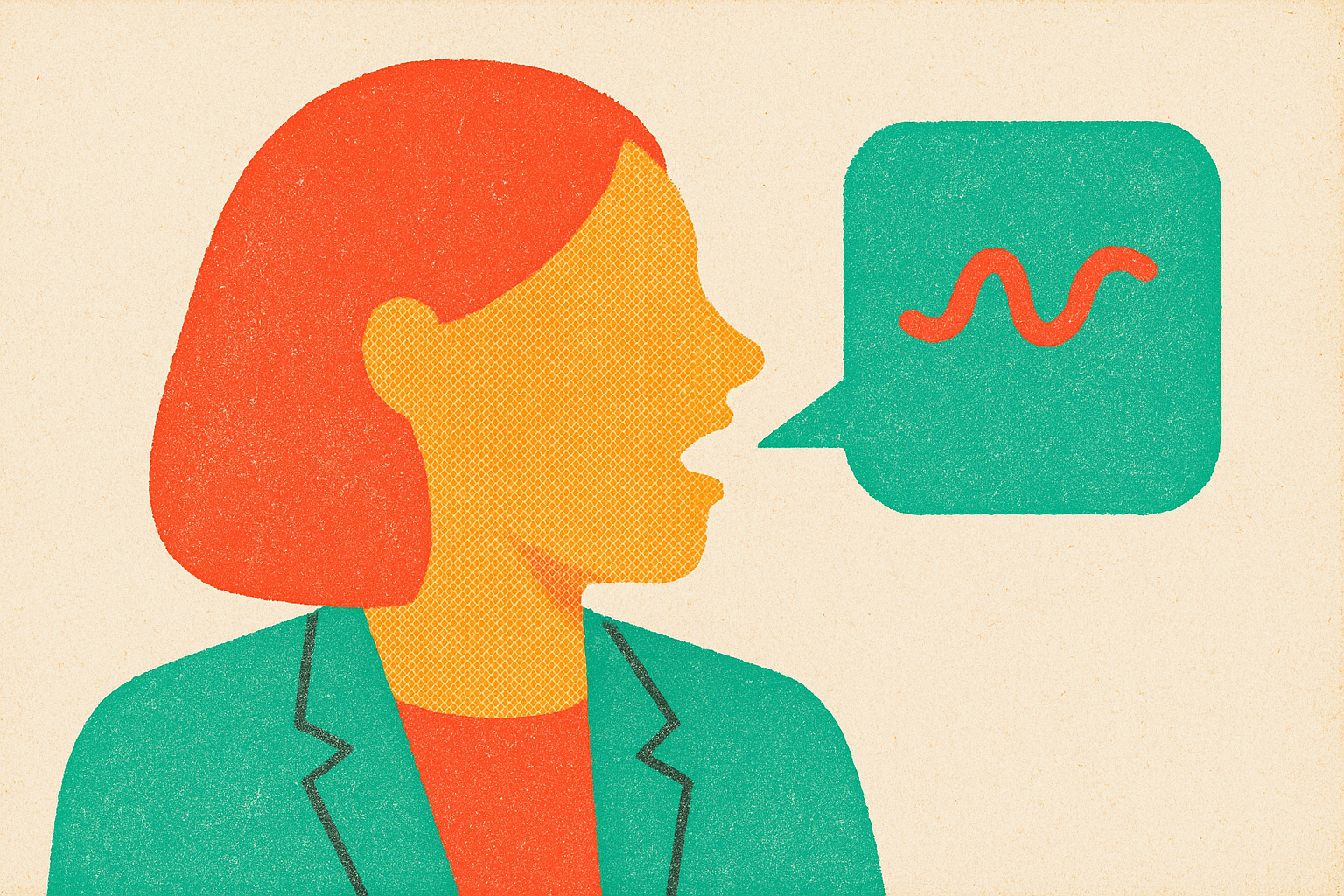
A study in the Journal of Voice found that roughly two-thirds of female college students between 18 and 25 used vocal fry, most often at the end of sentences. A follow-up read-passage study clocked female speakers using it at about four times the rate of male speakers. Separate research from a linguist found that 78.9% of American college students surveyed (a sample of 175) reported hearing creaky voice used frequently by women in their area.
Here's what the "epidemic" headlines get wrong: reviews of the peer-reviewed research have found no solid evidence that vocal fry has actually increased among young American women in recent years. What's documented is prevalence, and that distinction gets flattened every time a magazine runs another "kids these days" trend piece. The data shows a habit that's common. It does not show a habit that's spreading like a virus, no matter how the pitch decks frame it.
Uptalk follows the same map, especially among younger speakers, and both habits move through peer groups the way accents do: by contact, not by choice. Dr. Chloé Diskin-Holdaway, an applied linguist at the University of Melbourne, points out that young women are frequently the ones pioneering linguistic shifts that later spread to everyone else. Celebrity culture and broadcast media gave both patterns a visibility spike in the late 2000s, carrying them from in-group speech into mainstream awareness. Vocal fry spreads through plain proximity: spend enough time around people who use it, and the baseline shifts without anyone noticing it happen.
None of this is a personal failing. It's social reinforcement, plain and simple, and that's exactly why unlearning it takes deliberate attention instead of good intentions.
What listeners actually hear when they encounter these patterns in professional contexts
Listeners size up a speaker's competence within the first 10 seconds of hearing a voice, according to research cited by Pacific Executives, well before the content of the message even registers. One analysis found that a speaker's voice mattered twice as much as their message in shaping how an audience perceived them. That's a substantial margin. It means the sentence someone botches first is the one that decides the meeting.
A 2014 study in PLoS One, based on a large national survey sample, found that voices marked by vocal fry got rated as less competent, less educated, less trustworthy, less attractive, and less hirable than the same speaker's normal voice. Same person, same words, worse outcome, just because of how the sentence ended.
The gender split is where this gets uncomfortable: it is not a symmetrical tax. A 2022 study in ScienceDirect found that female speakers using vocal fry got rated lower on attractiveness and intelligence than female peers without it. Male speakers with vocal fry saw no meaningful shift either way. Same habit, opposite consequences, depending entirely on who's making the sound. Older listeners react more harshly than younger ones, though sentiment skews negative across every age group, which matters when the interviewer or client across the table has a decade or two on you.
A 2021 study on speech-language pathology candidates found that vocal fry made speakers seem less pleasant, less competent, less hirable, less educated, and less professional. The authors didn't flag evaluator bias as the problem worth fixing. They told the candidates to be more careful, which is a little like blaming the thermostat for the weather.
Uptalk carries its own penalty. It makes a speaker sound uncertain, indecisive, like they're fishing for approval, even when the underlying content is sharp and well-researched. Researcher Casey Klofstad calls the vocal fry bias "a cautionary tale for people in positions of authority," pointing out that listeners gravitate toward voices near the median pitch simply because they're familiar. Anything that strays too far from expected norms reads as unusual, and unusual gets penalized on the spot. Stack vocal fry, uptalk, filler words, and mumbling together, and the effect compounds: each one alone is a small crack, but combined they take out a speaker's credibility in one sitting.
Why the habits form and why they're hard to hear in yourself
Vocal fry shows up when air support runs low at the end of a sentence. It's a physiological default, not a decision, which is exactly why almost nobody catches themselves doing it in real time. Voice coach Dr. Louise Mahler describes the mechanic bluntly: fry happens when airflow drops to as little as a sixth of its full capacity. What reaches the listener is low energy, low engagement, a speaker whose breath isn't making it to the back of the room.
Uptalk started out doing something useful, and most critiques of it skip this part. Linguists studying uptalk have found that rising intonation can function as a tool of inclusion: a way to invite the listener into the conversation instead of just delivering a flat statement at them. Interculturalist Dr. Kami Anderson describes it as a "lilt commonly used to soften communication," which reads as warm and approachable among peers.
The mismatch is the whole story here. A habit built for warmth and group belonging among friends sends a completely different signal in a job interview or a boardroom, where the entire point is that someone is actively judging your authority. Peer reinforcement makes both patterns feel invisible: nobody hears their own fry or their own upward lilt because everyone around them talks the same way, so it registers as neutral. And neither pattern damages the vocal cords, according to otolaryngologists who have examined the phenomenon. These are learned habits sitting on top of a perfectly healthy voice, which means retraining them doesn't require anyone near a scalpel.
The professional contexts where these patterns cost the most
Job interviews sit at the top of the list, because the interviewer has no prior relationship with you to soften a shaky first impression. Whatever they hear in the first few sentences is the entire data set they've got, and there's no second chance to reset that read.
Client-facing work in finance, law, and consulting runs on similar logic, except the stakes never really end: the client is paying specifically for confident expert judgment, and vocal uncertainty undercuts the exact thing they're buying. Board presentations carry their own wrinkle. As millennials move into leadership roles, these vocal patterns show up more often in the boardroom, right as they're facing an audience skewing older, the exact demographic shown to judge fry and uptalk most harshly.
Public speaking is probably where uptalk costs the most. A talk laced with rising inflections makes it sound like the speaker doesn't believe their own slides, and audiences pick up on that fast, disengaging from material that might otherwise hold up fine on paper.
Then there's the plain career math, and it's not abstract. Communication ranks as the top soft skill named by hiring managers, cited at 58% in ISACA's 2023 State of Cybersecurity survey. Professionals with strong communication and collaboration skills get promoted up to 11% faster than their peers. In a separate survey, 18% of employees said poor communication had directly cost them a promotion or a shot at career growth. That's a measurable pattern. That's a number attached to a raise someone didn't get.
The gender politics underneath the bias, and why that doesn't make the bias disappear
The double standard isn't subtle, so no point pretending it is. The 2022 study found no meaningful penalty for male speakers using vocal fry, while female speakers paid for it in perceived attractiveness and related evaluations. Same acoustic pattern, entirely different verdict, depending only on who's speaking.
The 2021 speech-pathology study makes the underlying problem visible in how it framed its own findings. Instead of recommending evaluators check their bias, the authors advised students to be "cognizant of VF use" in order to compete for jobs. Wrong shoulders carrying the burden, in other words. The bias, either way, belongs to the listener, not the speaker.
There's a case this is already loosening. Canadian Business has noted that vocal fry and uptalk may carry less weight in boardrooms as the generation that grew up using them moves into leadership, and that screening candidates out over vocal habits risks cutting off good talent. Diskin-Holdaway's research backs this up more broadly: patterns pioneered by young women tend to get normalized across the wider population over time. What sounds unprofessional today may just sound like Tuesday in ten years.
None of that makes the bias optional to deal with right now, though. Knowing a rule is unfair doesn't exempt anyone from it while it's still being enforced, and waiting around for the culture to catch up is not a career strategy. Understanding the gap between how you sound and how you're perceived lets you make a deliberate choice about when to adjust, instead of getting blindsided by a rejection you never saw coming. Same logic as swapping sneakers for a blazer before a pitch meeting: not an admission that your instincts are wrong, just an acknowledgment of who's sitting in the room.
How to reduce vocal fry: the airflow and register approach
Airflow is the whole ballgame, and most advice on this topic gets it backwards by starting with "confidence" instead of breath. Vocal fry shows up when breath support collapses, usually right at the tail end of a sentence, so the fix starts in the lungs, not in a pep talk. Skip the mirror affirmations.
Dr. Mahler's advice: keep enough air moving that it can, in her words, "caress the people you're talking to." Treat breath as a physical force that actually reaches the listener's eardrum. Cut the airflow, and the connection goes with it, full stop.
Practically, that means holding breath support through the entire sentence instead of letting it fade out, and avoiding long stretches of speech down at the very bottom of your pitch range. Record an ordinary, unguarded conversation first, because almost nobody hears their own fry live. It just feels like normal talking until the playback catches the gravel showing up right where the sentence dies.
Mahler compares vocal fry to dragging your feet when you walk: a posture problem wearing a sound problem's clothes. Fixing it has less to do with performing a different voice and more to do with carrying yourself differently from the diaphragm up. Shorter sentences help too, since there's less time for the air to run dry before the period, so a decent starting drill is simply ending sentences while there's still breath in reserve. This habit runs years deep and gets reinforced by everyone within earshot, so expect the correction to take daily reps, not one afternoon of concentration. For a severe or stubborn case, a speech-language pathologist can run structured voice therapy, and since the anatomy itself isn't damaged, per Dr. Akst, the whole job is repatterning a habit, not repairing an injury.
How to reduce uptalk: the pitch descent and sentence ownership approach
The target sound is simple: pitch holds steady or drops at the end of a statement. A descending note signals the sentence is finished and the speaker stands behind it.
Mahler notes that stating a fact "in the same tone as one would for a question" makes the listener hear doubt whether or not doubt exists. Learning to let the pitch fall into the period is one of the highest-leverage habits a speaker can build, and it's a cheap fix for something that costs a lot. One catch: don't overcorrect straight into vocal fry by dropping the voice too low at the end. The fix is a controlled descent paired with steady airflow, both running at once, not one instead of the other.
Record yourself explaining something you already know cold. Uptalk tends to surface even under low pressure when it's fully habitual, so if it shows up while relaxed and confident in the material, that's the real baseline talking, not nerves. Shorter declarative sentences help here too, for the same reason they help with fry: less room for the pitch to drift upward mid-thought, and an easier ending to steer down when the sentence is short to begin with.
Rehearsing under conditions that mimic the real event matters, since anxiety pushes pitch upward across the board and uptalk gets worse exactly when the stakes are highest. Recording a run-through, practicing in front of even a small audience, or timing responses all build the muscle memory needed to hold a controlled ending under pressure.
None of this means flattening every rising inflection into a monotone, and someone will overcorrect if this isn't said clearly. Rising pitch has legitimate uses: inviting a response, signaling a list isn't finished yet, checking whether the listener followed along. The goal is control, choosing which sentences rise and which ones land.
Why consistent daily practice beats occasional awareness
Both patterns are habits in the clinical sense: built through repetition, reinforced by whoever you talk to most, and effectively invisible without outside feedback. That's exactly why reading an article about them, even this one, changes nothing on its own. Awareness is not a treatment plan.
Treat it like fixing a running gait or a tennis swing rather than memorizing a fact. The body has to physically rehearse the new pattern enough times that it replaces the old default, and vague intentions like "sound more confident" give the body nothing specific to rehearse. Feedback has to be concrete, such as a recording, a named behavior, or a score, something that turns "sound better" into a measurable target instead of a wish.
Short daily sessions beat occasional long ones. Ten focused minutes of prompted speaking with immediate playback, done every day, builds the new pattern faster than one hour-long workshop a month. And the progress is genuinely audible, which is rare for a soft skill: a recording from week one against a recording from week eight sounds like two different speakers, and that kind of proof keeps people practicing when motivation alone would've quit by day four.
Communication is a skill people build through repetition, trainable the same way a jump shot is trainable. The person doing daily reps outperforms the one coasting on natural talent in every interview, pitch, and boardroom where authority gets assigned in the first ten seconds, and no amount of talent skips that math.
Sources
- How Uptalk & Vocal Fry are undermining Your Performance — Dr Louise Mahler
- archiveprod.canadianbusiness.com
- Speaking Habits That Undermine Authority in Interviews
- Modal Register, Vocal Fry, and Uptalk: Identification and Perceptual Judgments of Inexperienced Listeners - Journal of Voice
- How Uptalk & Vocal Fry are undermining Your Performance — Dr Louise Mahler
- 'Vocal fry' hurts women in the labor market
- sciencedirect.com