Tracking Speaking Progress Without a Coach
Record yourself speaking to measure progress that feels invisible but actually exists.

Speaking improvement without a coach is a measurement problem before it's a skill problem. Most people practice by feel, and feel is a bad instrument: the same person can deliver a genuinely sharper answer in a meeting than they did six months ago and still walk out convinced nothing changed. The only fix is to stop trusting the gut check and start recording, scoring, and comparing actual speech samples over time. That's not a productivity hack. Recording, scoring, and comparing actual speech samples over time is what separates practicing from just doing the thing repeatedly and calling it practice.
Call it the fluency mirage. Someone downloads three podcasts, finishes a communication course, reads a book on persuasion, and still freezes for a beat too long before answering a hard question in a board meeting. The inputs went up. The output, measured honestly, barely moved. Grammar quizzes made this worse for decades: a person scores exceptionally high on a written test and then negotiates like a nervous intern, because a multiple-choice question about subject-verb agreement has nothing to do with response latency under pressure. Written accuracy and live performance are different skills wearing the same shirt.
Public speaking anxiety affects something like three out of four people, so the sensation of "I'm not getting better" is nearly universal and therefore useless as a diagnostic. If almost everyone feels stuck, the feeling isn't telling you about your actual trajectory, it's telling you about being human. Consuming more content doesn't close the gap. A TED Talk teaches structure. It generates zero feedback on your filler words, your pace, or your particular verbal tics. Watching a great talk is not the same as reviewing your own.
What researchers measure when they study speaking improvement
Verbal fluency research doesn't deal in vibes. It breaks a performance into components small enough to count.
The hesitation gap tracks the delay between forming a thought and saying it out loud. Filler word density counts how often "um," "ah," "like," and "so" appear per minute. Response latency measures how fast someone starts answering once a question lands. Lexical precision asks whether the vocabulary on offer is generic and high-frequency ("good," "bad") or specific and functional ("effective," "friction," "strategic"). None of these require a human judge sitting in the room. They can be counted from a recording.
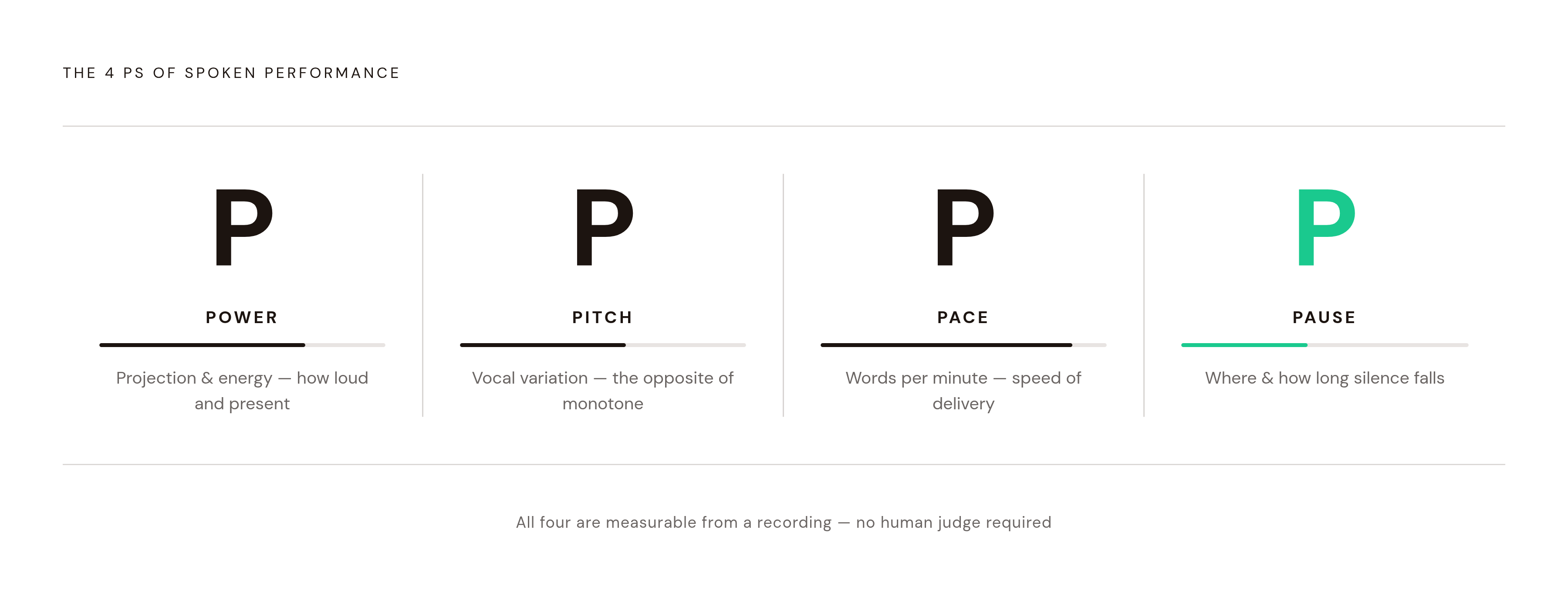
App designers building speech-coaching tools tend to organize around a related shorthand: the 4 Ps, power, pitch, pace, and pause. Power is projection and energy. Pitch is vocal variation, the opposite of a flat monotone. Pace is words per minute. Pause is where and how long someone stops. These four dimensions cover most of what a listener actually reacts to, even if the listener couldn't name a single one of them.
What does real progress sound like on tape? Someone begins their answer sooner instead of stalling. Common words arrive without that visible mid-sentence search, the one where a speaker starts a phrase and then hunts for the rest of it. Pauses relocate: they stop landing awkwardly in the middle of a phrase and start landing at the natural end of an idea, where a pause is supposed to be. All of this is audible in a recording before it is felt in confidence. Progress is audible before it's felt, which is exactly the argument for recording things instead of just feeling them.
Building a personal tracking system before touching any app
Before installing anything, record two minutes on a fixed prompt and save the file. That's the whole first step, and skipping it is the single most common reason people give up on tracking progress: without a Day 1 recording, there's nothing to measure against, and most people wildly underestimate how far they've actually come because they have no baseline to hold up next to the present.
Listen back for three things: how long the answer runs before drying up, how often filler words interrupt it, and which specific words triggered a visible pause or restart. |A person who stumbles on the word "synergy" every time has a different problem than a person who stumbles on every third sentence regardless of content, and identifying which one is happening determines what kind of practice will fix it. A person who stumbles on the word "synergy" every time has a different problem than a person who stumbles on every third sentence regardless of content.
From there, a simple weekly rubric does the job of a coach's ear. Once a week, record two minutes on a prompt and rate five categories on a 1 to 5 scale: clarity, pace, accuracy, interaction, and confidence. No app required, just a notes file and a bit of discipline. For a numeric anchor, benchmarks used by fluency coaches give concrete targets across dimensions like speech rate, filler frequency, and hesitation gap, with each dimension tiered from basic to professional-grade performance.
Then there's the loop that turns any of this into compounding data: record a live conversation or a rehearsed response, review it against the specific metrics above, adjust one thing, and go again next session. Call-review-improve. It's unglamorous, and it works precisely because it converts a fleeting five-minute conversation into a permanent, comparable data point instead of a memory that fades by dinner.
Which apps close the feedback loop, and what each one does well
A 2024 study in Communication Education found feedback helps speakers most when it's specific and when the speaker actually applies it. That single finding separates two kinds of app: one that scores a performance and stops, and one that tells the user what to change next. The second kind earns its price. The first kind is a novelty.
Speech apps generally split into three types. Feedback analyzers record a session and flag issues after the fact. Voice coaches run tone, pitch, and clarity exercises independent of any specific speech. Structured journeys teach technique in a set order, lesson by lesson, whether or not that order matches what a given user actually needs. Picking the wrong category wastes a subscription fee on a tool built for a different problem.
One well-known option in the feedback-analyzer category has built a sizable user base, reportedly in the hundreds of thousands, and claims to have analyzed several million individual speeches. It records a session and returns an instant read on filler words, speaking speed, vocal energy, clarity, and confidence, with both freestyle practice and a scripted mode for rehearsing real material like an actual presentation. It runs on iOS and Android and is about as close to a pure feedback loop as this category gets. Its limitation is that it leans harder on how someone sounds than on what they're actually saying or how the argument is structured, so once the basics are under control, the feedback can start to feel a little mechanical, like a treadmill that only tells you your pace and never your form.
A second category is better represented by tools built around voice and delivery coaching specifically, some developed with input from professional voice coaches, which adapt lesson difficulty based on prior performance rather than running a fixed playlist for every user. These tend to push past filler-word counting into tone, pitch, and overall delivery, sometimes including software-driven roleplay conversations for practicing under more realistic pressure. Several are built with privacy as a selling point, meaning recordings stay private to the user rather than being reviewed by anyone else.
What scored daily practice does that weekly rehearsal cannot
Fluency behaves like a motor skill, not a knowledge skill, and that distinction changes what actually works to improve it. A runner tracks split times and heart rate because watching someone else run a faster mile does nothing for their own legs. A speaker has to track words per minute and a clarity score for the same reason: observation doesn't transfer, repetition with feedback does.
Research has found that improving actual language skills reduced language anxiety more effectively than motivational pep talks or confidence-building exercises alone. That's a useful correction to a common assumption. Confidence isn't the input that produces skill. Skill, tracked and improved, is the input that produces confidence as a byproduct.
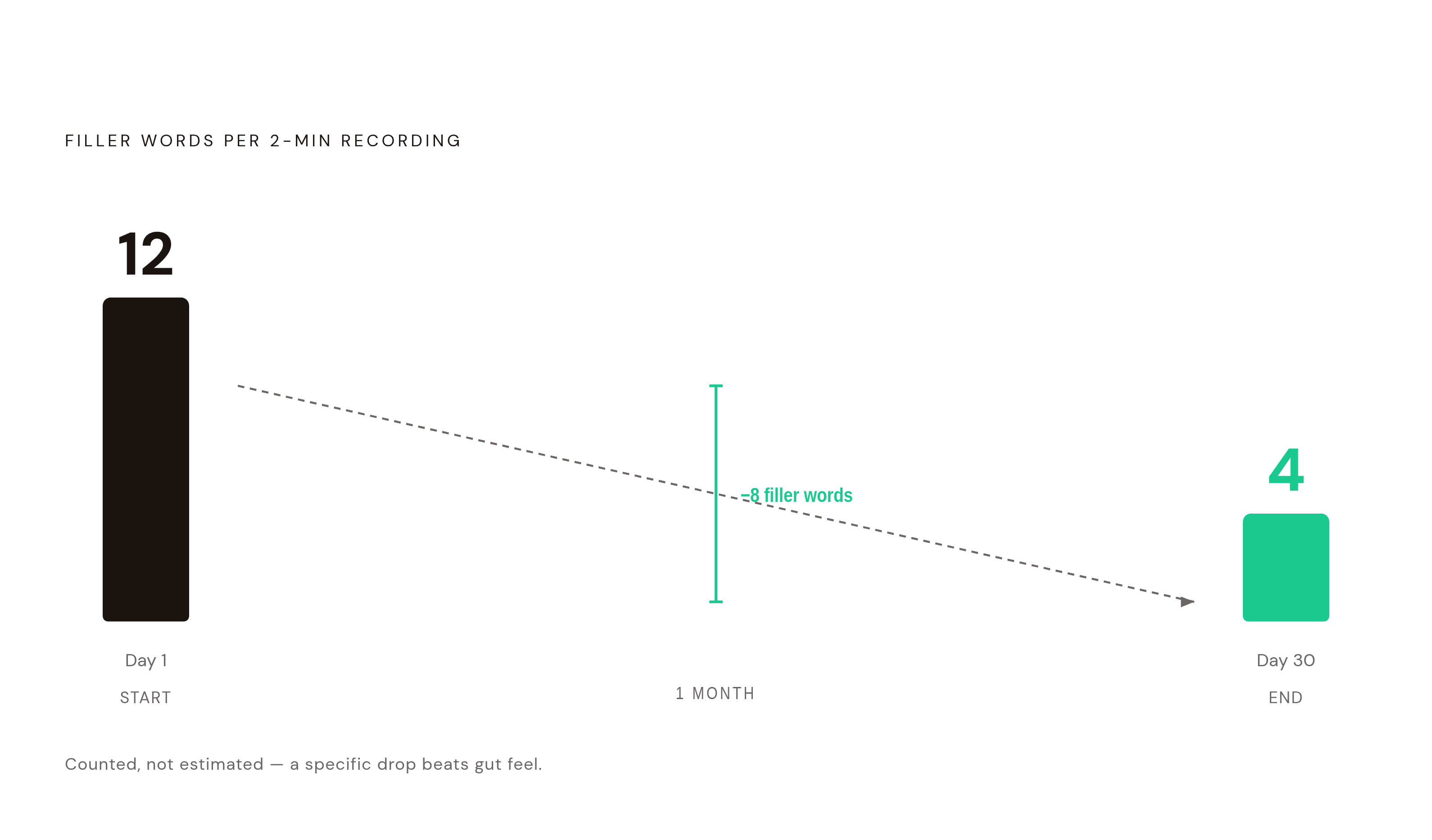
A falling filler-word count, say from twelve instances in a two-minute recording down to four over the course of a month, is a concrete, countable reward. The brain treats a falling number the way it treats any measurable win, and learners who track fluency metrics this way report staying motivated substantially longer than those relying on vague impressions of getting better. Research on AI-assisted tutoring has found that learners who tracked measurable progress reported notably higher engagement, and engagement, in this context, is really a stand-in for repetitions completed. More reps done without dread is how automatic fluency actually gets built. Nobody develops automaticity from a single well-intentioned week.
How to know when your numbers are moving, and what to do when they plateau
The signals are the same ones to listen for from day one, just easier to spot once there's a baseline to compare against. Does the response start sooner? Do common words arrive without that visible internal search? Have the pauses moved from the middle of phrases to the natural breaks between ideas? These are audible on tape well before they register as a felt change in confidence, which is the entire argument for recording in the first place instead of trusting a gut sense of improvement.
The cleanest proof of progress is embarrassingly simple: record the identical prompt on Day 1 and Day 30, same length, same device, no do-overs. Put the two files side by side. The gap between them is the evidence, and it tends to be more convincing than any subjective sense of "feeling more confident," because it can't be talked out of existing.
Vocabulary shift is a leading indicator worth tracking separately from the delivery metrics. Progress generally moves from high-frequency, generic words ("good," "bad") toward functional vocabulary ("effective," "issue") and eventually toward precise, field-specific language ("strategic," "friction"). That's the same progression the Engvarta benchmark table implies with its tiers, and it's a useful gut check independent of pace or filler counts.
When the numbers stop moving, the fix usually is more sessions, not longer ones. It's more of them. A plateau in this domain is almost always a repetition problem rather than a talent ceiling, so the correct response is running more short presentations or recorded answers per week, not stretching a single session out to twenty minutes hoping for a breakthrough. Volume beats duration here, and the data will say so before the feeling catches up.