Reading Aloud as a Speaking Practice Method
Reading aloud trains the brain machinery that live speech requires, not just comprehension.
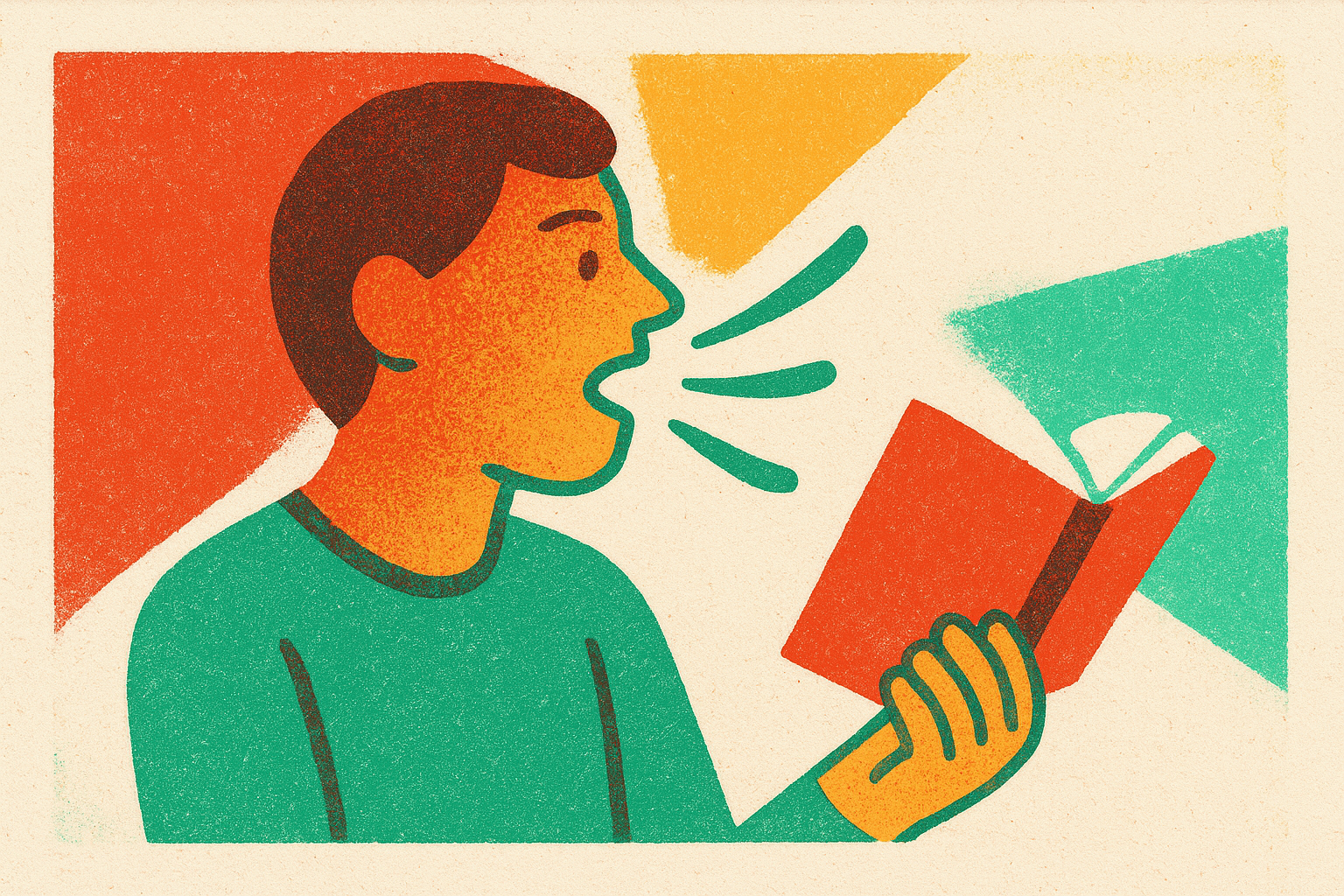
Gen Z texts more than any generation in human history and talks less. The average teenager can draft a caption, edit it twice, and delete a DM before sending, but ask that same person to leave a voicemail and watch the color drain from their face. That's not a confidence problem. It's a training problem, and reading aloud, an exercise most people associate with second grade or Shakespeare rehearsal, happens to be one of the most efficient fixes hiding in plain sight.
The numbers back this up. A 2024 Forbes report found that over half of Gen Z say their in-person social skills have gotten worse, and roughly one in four say their verbal communication specifically has declined. A 2024 Uswitch survey of 2,000 people in the UK found that a quarter of 18 to 34 year olds never answer phone calls, and close to 90% of Gen Z respondents said phone calls make them anxious. This isn't really about phones. It's about any moment where speech has to happen live, with no undo button. You can't edit a sentence once it's left your mouth. The apparatus that produces spoken language, breath, articulation, timing, tone, gets almost no deliberate practice in a world built around typing, and that apparatus is exactly what reading aloud trains.
What reading aloud is actually training, beneath the surface
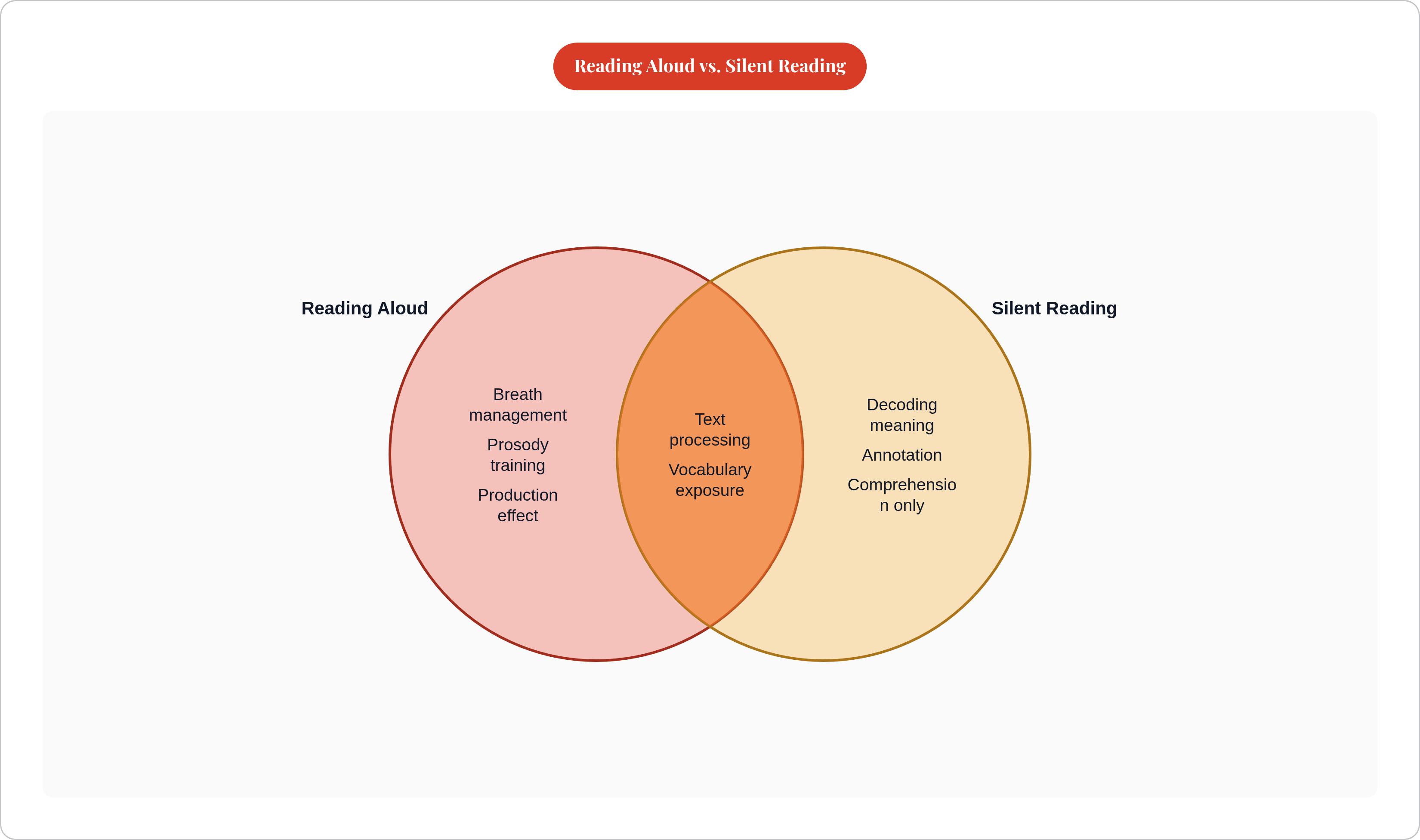
Say "reading aloud" to most adults and they picture a classroom activity, something you grew out of around age nine. That's a mistake, and an expensive one, because silent reading and reading aloud are not the same cognitive act wearing different clothes.
Silent reading asks the brain to decode meaning. That's it. Reading aloud asks the brain to decode meaning while simultaneously managing breath, shaping consonants and vowels correctly, controlling pace, and listening to itself in real time to catch errors before they compound. Four jobs running at once instead of one. Lesion studies point to the left inferior frontal gyrus as central to phonemic fluency, speech initiation, and phonological processing, and these are precisely the regions that light up when you produce speech, not when you scan it silently. Regular verbal practice engages memory and processing-speed circuits in ways silent reading doesn't touch, which means fluency has an actual neurological substrate, not just a vague "get more confident" quality to it.
Prosody is the part nobody talks about, and it's the part that separates someone who sounds fluent from someone who sounds like they're reading a ransom note. Prosody covers intonation, stress, and rhythm, the features that tell a listener where a sentence is going before it gets there. As Kailani noted back in 1998, reading aloud teaches you where the voice should rise or fall, which words carry weight, and where the pause belongs, on text you can see coming, before you ever need those instincts live. That's the whole advantage: low stakes now, so the reflex is already built when the stakes show up later. Think of it as mouth-and-brain cardio. The book or article is just the treadmill; the workout is your own machinery learning to fire in sync.
The production effect: why saying words aloud makes them stick differently
Cognitive science has a name for why this works, and it's called the production effect. Words and passages read aloud get remembered better than the same material read silently, a finding that's been replicated enough times to stop being a novelty and start being a fact you can build a training method around.
The mechanism is straightforward once you see it: producing a word out loud creates a distinctive memory trace, one that's easier to pull back out of storage because it stands apart from the general noise of everything else you've encoded that day. Ozubko and colleagues found the same advantage held up on fill-in-the-blank tests using full paragraphs, not just isolated word lists, which matters because most of what you'll ever need to say lives in sentences, not vocabulary flashcards. A 2024 EEG study confirmed the effect at the neural level: recognition memory for aloud-read words outperformed silently-read words on brain-activity measures, not just self-report. Researchers at the University of Waterloo, publishing in Memory & Cognition in 2024, extended the finding further into longer passages, reinforcing that this isn't a party trick that only works on single words.
Here's the part that actually matters for a speaker instead of a student cramming vocabulary. Language you've read aloud, the phrasing, the rhythm, the specific turns of phrase, becomes more retrievable later, under pressure, when you need it without time to think. You're not just rehearsing pronunciation. You're stocking a pantry of language you can reach into mid-conversation. That's the real argument for reading scripts and speeches aloud instead of just annotating them on the page: annotation is comprehension, and comprehension alone doesn't build a retrievable bank of spoken material.
What actually improves and how long it takes to see it
Four things move the needle fastest with consistent practice: pronunciation accuracy, speech rhythm, expressiveness and phrasing, and general fluency, meaning fewer stumbles and restarts mid-sentence. Of those four, expressiveness tends to show the largest gains in practice-based studies, ahead of raw speed.
A quasi-experimental study of 70 secondary students found speaking scores rose substantially after a reading-aloud intervention, with measurable gains across pronunciation, rhythm, and clarity (Usman & Mahmud, 2024). A separate 2024 to 2025 intervention using the Reading Aloud Strategy with sixth-grade learners in the Philippines produced statistically significant improvement between pretest and posttest scores, confirmed with a Wilcoxon Signed-Rank Test. Worth saying plainly: in the secondary-school study, most students still landed in the lower proficiency bands after the intervention. Reading aloud raises the floor. It doesn't, on its own, turn a novice into a polished speaker, and treating it as a silver bullet sets people up for disappointment.
A useful benchmark for pacing: natural, engaging speech runs around 120 to 150 words per minute, and reading aloud with a timer running is one of the cleanest ways to train toward that range without guessing. Fifteen to twenty minutes a day is enough to see change, and consistency matters more than any single long session. The gains arrive in a specific order too: hesitation and pacing improve first, prosody and naturalness improve later, and the later gains are harder to measure but worth more.
How to actually run a reading aloud practice session
Material choice is where most people cut corners, and it shows. Dialogue-heavy fiction trains tonal range and character voice. News articles and long-form essays train clean exposition and the pacing of an argument. Podcast transcripts train conversational rhythm, the register you actually use with other humans. A rough 70-30 split works well: 70% familiar material to build speed and confidence, 30% unfamiliar vocabulary or sentence structure to keep pushing growth without drowning in it.
Shadowing is the advanced version. Play a line from an audiobook or podcast, pause, repeat it back matching tone and rhythm exactly, then move to the next line. This adds a model into the loop, so the mouth is training to replicate a fluent pattern instead of inventing its own approximation from scratch.
Recording yourself isn't optional if you want real progress. Playback surfaces what you can't hear while you're performing: rushed pacing, swallowed word endings, flat delivery, audible breath. Hating the sound of your own recorded voice is completely normal, and it fades with repetition, not through some act of willpower. Start at five minutes and build to fifteen or twenty as the discomfort drops. Read a passage once for comprehension, then read it again for performance, watching pacing, stress, and pauses, and record that second pass specifically. Rereading the same passage repeatedly isn't cheating; once the brain stops working to decode the text, it's free to focus entirely on delivery, which is the whole point.
The specific speaking skills reading aloud does and doesn't build
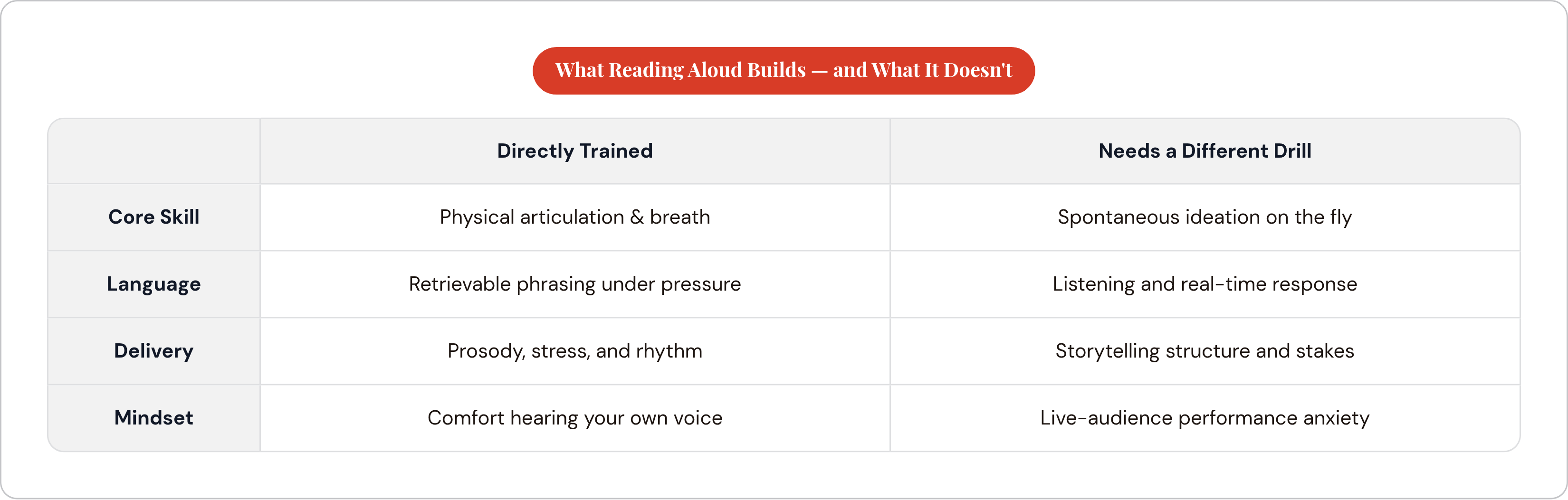
Reading aloud is direct training for five things: physical articulation, breath management, prosody, the speed at which vocabulary surfaces under pressure, and basic comfort hearing your own voice out loud. Those are real, measurable gains, and none of them are trivial.
Here's what it doesn't touch. Spontaneous ideation, meaning generating your own words on the fly instead of reading someone else's, needs a different drill entirely. Listening and responding, the actual back-and-forth of conversation, doesn't exist in a one-directional exercise. The psychological weight of a live audience, the kind that makes palms sweat, only gets addressed by actual live practice. And storytelling structure, knowing how to open with stakes and land a point, is a separate craft from the physical mechanics of delivery.
Think of reading aloud as pre-season conditioning. An athlete who lifts weights and runs sprints in the off-season doesn't skip the actual sport once the season starts; the conditioning just means they show up with more raw capacity to spend on strategy and execution. Reading aloud plays the same role for speech. It sharpens the instrument. The instrument still needs to be played, under pressure, in front of people, with feedback, for the whole loop to close.
Why this matters beyond the practice room — what fluent speakers actually gain
Fear of public speaking is common enough that most people have felt it, and a meaningful share of workers have turned down a job or a promotion specifically to avoid speaking obligations that came attached to it. That's not a minor inconvenience. That's a career decision made by the throat instead of the brain.
The cost shows up in performance data too: leadership assessments from 2024 found that people with strong interpersonal and presentation skills were far more likely to land top performance ratings. Hiring managers consider spoken communication a genuine asset in a majority of cases, and the emphasis on presentation skills in job postings has grown noticeably over the past five years. There's an academic version of this too: communication proficiency tracks positively with academic performance, so the student who can speak clearly in a seminar or a thesis defense carries a structural edge that has nothing to do with how smart they are on paper.
Then there's the social layer, which is less about careers and more about who gets to run the room. Fewer than a quarter of Gen Zers say they'd start a conversation with a stranger, according to 2024 data, compared to a much higher share of millennials, and that gap tracks closely with comfort in unscripted speech. The mechanics you build through daily reps, reading aloud, recording yourself, getting some form of feedback on it, compound the way athletic training compounds: slowly for a while, then all at once. The people who put in that work before the high-stakes moment arrives, the interview, the pitch, the toast at the wedding, are simply the ones who show up already warmed up, while everyone else is still finding their voice in real time.