Persuasive Speech Topics for Any Audience
Pick a topic that matches your audience's stakes, not just your own interests.
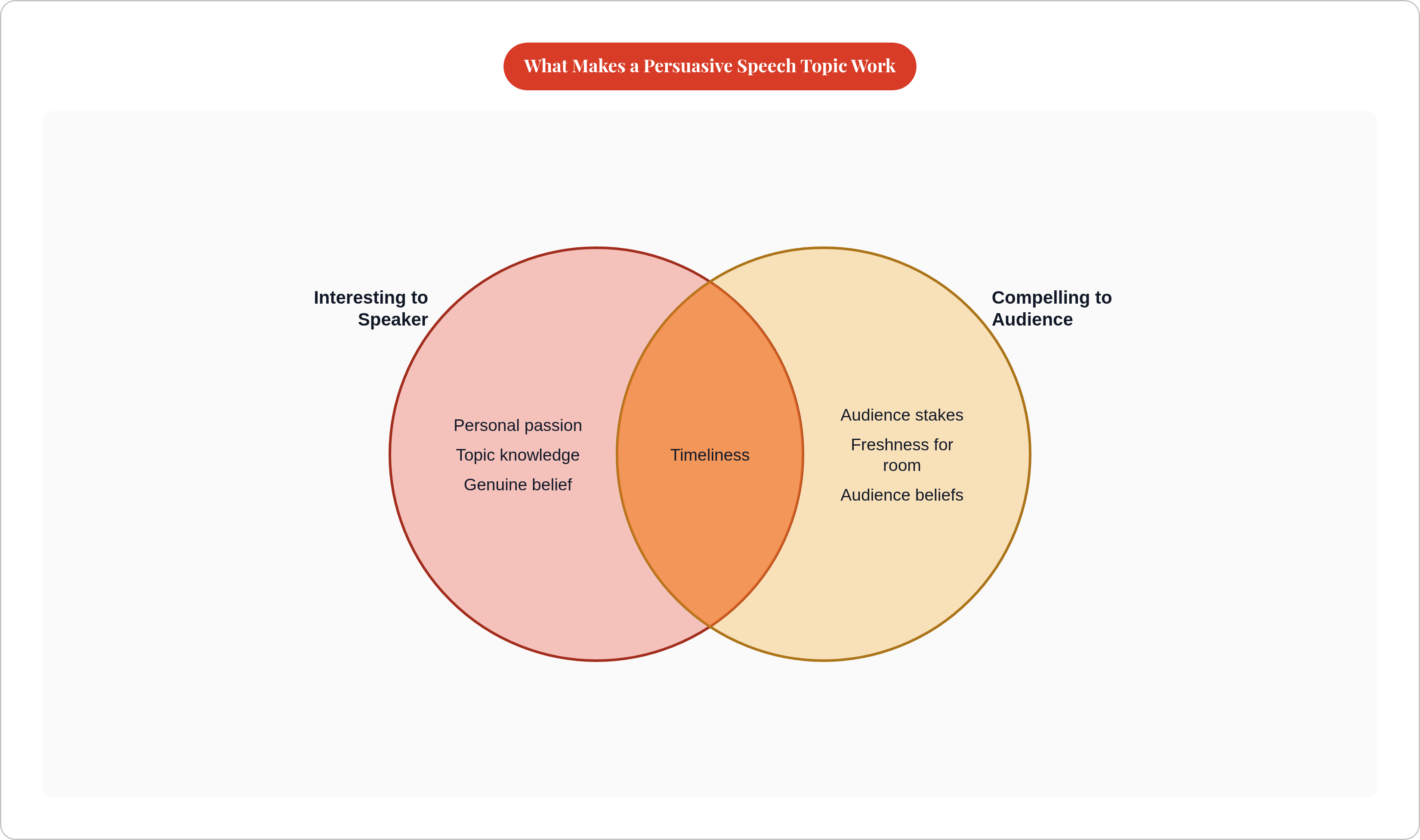
Most people pick a persuasive speech topic the way they pick a restaurant they've already decided to hate: half-heartedly, with an excuse ready if it flops. They reach for something that sounds sharp on paper, something that signals intelligence, and then wonder why the room goes cold at minute two. The topic wasn't wrong in the abstract, but it was wrong for the twenty-three people sitting in front of it, which is a different problem entirely and one most speakers never bother to diagnose. Interesting to the speaker and compelling to the room are two separate achievements, and mixing them up is the single most common reason a well-built speech dies on stage.
Topic selection is a strategic decision with real inputs and outputs, not a flourish you sort out the night before. Four filters decide whether a topic survives contact with an actual audience, and the audience's identity matters more than the subject itself. Below is a working list built for 2025, some notes on how to angle a stale topic so it doesn't sound like the fortieth version of itself, and a look at what the research on storytelling and speaking anxiety says about why any of this works at all.
The four things a persuasive speech topic has to do before you write a single word
Four filters decide the outcome, and each one should act as a veto, not a nice-to-have.
Timeliness comes first, and it's non-negotiable. If you have to convince the room the issue matters before you can convince them of your position on it, you've burned your best material on throat-clearing. Nobody wins a debate they had to schedule twice.
Debatability is second, and most speakers get it backwards. They hunt for a topic where they're obviously right, which is exactly the wrong instinct: a real counterargument forces you to prepare for objections, and it tells the audience your position was earned, not assumed. If nobody could plausibly disagree with you, you're not persuading anyone; you're just reading a weather report.
Personal passion is third. Audiences clock indifference fast, faster than most speakers think, the way a dog reads a room before the leash comes out. This has nothing to do with charisma. It's about whether you actually care, because that leaks out through tone and pacing whether you mean it to or not. A speaker who signals indifference early rarely wins the room back — the audience takes the cue and never quite re-engages.
Freshness is fourth, and it's the one that kills quietly. A strong topic can still die if the room has heard ten versions of the same argument from ten other speakers this year already. Predictability doesn't just bore people; it gives them permission to stop listening and start waiting for you to sit down.
A topic clearing all four filters beats one that aces two and shrugs off the rest, because the filters compound rather than average out. Before committing, ask three questions: could a smart person in the room talk you out of this, do you actually care how it resolves, and has this specific audience heard this exact framing already? If the answer to that last one is yes, keep looking.
Why the audience's identity is the real starting point for topic selection
The same topic can produce two entirely different outcomes depending on the room. AI job displacement is the clearest case running right now. Tell a room of college seniors that AI will reshape entry-level hiring and you're describing their next two years. Tell the same thing to a room of mid-career professionals and you're describing their mortgage. The slide is identical, but the nervous system in the room is not.
Three things worth mapping before you pick anything. What does the room already believe, because preaching to agreement isn't persuasion, it's a pep rally, and pep rallies skip the research phase. What do they have on the line: career, money, identity, a kid in the system somewhere. And what are they sick of hearing, since freshness was never a property of the topic itself; it's a property of how much a given room has already been exposed to it. A topic can be brand new in one room and dead on arrival in the room next door, same building, same afternoon.
There's a useful overlap worth naming. AI displacement, mental health, privacy, the environmental cost of how we consume: these are the live wires of 2025, and they run under almost every demographic you'll face. That's why they anchor most strong topic lists; they clear the relevance test before you've said a word. The job left for the speaker is narrowing the broad, familiar subject into an angle this particular room hasn't been handed yet. A topic can be old, but the angle can't be.
Persuasive speech topics that work across almost any room in 2025
Everything below cleared all four filters and still has cross-audience pull this year. School uniforms and the drinking age didn't make it, since those arguments retired a decade ago and nobody sent them the memo.
AI and technology ethics. Should companies be required to regulate AI development to protect jobs? Is it ethical for AI models to train on artists' work without consent? Does AI-generated art count as real creativity? Should hiring algorithms be legally transparent? These land because AI anxiety doesn't respect age or industry lines. Everyone in the room has a stake, so the speaker starts with attention half-earned before the first full sentence.
Mental health and social responsibility. Should companies face legal liability for the mental health cost of their products? Is social media addiction a public health crisis that needs government action? Should schools and workplaces mandate mental health days? Mental health crossed from taboo to mainstream a while back, and the live fight now isn't whether it matters, but who pays for fixing it — contested ground worth standing on.
Education and opportunity. Is standardized testing an outdated measure of student success? Should college be free for first-generation students? Is the school system training kids for jobs that won't exist by 2035? Stakes hit immediately for student audiences and reframe cleanly for adults into a question about generational debt.
Environment and consumption. Should governments impose binding regulation on fast fashion? Is individual consumer choice the wrong lever against climate change, with corporate accountability the one that should replace it? These pull the climate conversation out of the tired recycle-more groove into a real fight over where responsibility actually sits.
Speech, accountability, and digital culture. Does cancel culture enforce real accountability or suppress legitimate dissent? Should platforms be treated as publishers and held liable for moderation failures? These cross political lines cleanly, since almost everyone carries both an opinion and a personal story here, and that combination is exactly what a persuasive speech feeds on.
Health and access. Is telemedicine expanding healthcare access or quietly building a two-tier system? Should national health spending prioritize prevention over acute treatment?
How to angle a familiar topic so it doesn't sound like every other speech on the subject
AI, climate, mental health: strong topics, all of them, and also topics your audience has already sat through in their most generic form. The speaker who shows up with the expected argument is furniture. The one who flips the frame is the reason anyone remembers the event by Friday.
Narrow the villain. Instead of arguing social media damages mental health, argue that algorithmic recommendation systems specifically, not the category, are the actual mechanism doing harm, and that's the only piece worth regulating. Flip the assumed hero: instead of arguing individuals should shrink their carbon footprint, argue that carbon guilt is a PR invention, manufactured by oil companies to keep the conversation off systemic change. Or raise the stakes on the counterargument by steelmanning the opposing side so thoroughly the room starts leaning toward it, then dismantle it. The audience feels respected, and that respect is exactly what makes the rebuttal land harder than it would have cold.
These moves fix a delivery problem almost as a side effect. A speaker working from a genuinely fresh angle tends to be more locked into the material, and audiences read that as conviction whether the speaker meant to project it or not.
What the neuroscience of storytelling says about why some speeches actually change minds
Persuasion isn't a rational transaction, whatever debate club told you. Paul Zak's research at Claremont Graduate University found that emotionally resonant storytelling triggers oxytocin release, and that release tracks with trust and behavior change. Your brain doesn't sort a good story into "entertainment" and your argument into "facts to weigh." Both run through the same chemical pipeline — a topic is just a story wearing a suit to a meeting it doesn't want to be at.
That reframes what a good topic actually is. Subjects with built-in human stakes, jobs lost, fairness violated, potential wasted, hand a speaker more raw story material than an abstract policy fight ever will. You can build a real story around one person losing a job to automation, but try building one around a marginal tax rate — it's a slog.
Surprise does its own work here. A counterintuitive angle, the kind the "flip the hero" move produces, hits the same reward pathways that make a plot twist stick in memory. The brain treats a sharp reframe the way it treats a twist ending: worth the extra attention, worth carrying out of the room.
Passion earns its spot on the filter list for a physiological reason too. When a speaker actually means what they're saying, that sincerity registers with the room in ways that go beyond conscious perception. That's not a soft personality trait but a measurable shift in how listeners engage, and it makes the room track your argument more closely than it otherwise would.
None of it survives bad delivery. Vocal tone carries a large share of communication impact — research puts it at around 38% — and handing a great topic to a flat, checked-out voice squanders that. Hand a great topic to a flat, checked-out voice and you've built a car with no engine.
Why topic choice matters more if the speaker is already anxious about speaking
Fear of public speaking is a cliché at this point, but the research behind it is more useful than the joke: most pre-speech anxiety traces back to under-preparation, not some fixed trait baked into your personality. That's the good news buried in the statistic, since preparation is a variable you actually control.
Topic choice sits right inside that variable. Speaking on something you know and care about cuts sharply into the fear of getting caught out as unprepared, which is most of what makes hands shake behind a podium. Passion doubles here as an anxiety reducer for one simple reason: when you believe the argument, you're communicating instead of performing, and your body responds to that shift even if the words on the page look the same.
The stakes aren't abstract, either. A LinkedIn survey cited via novoresume.com found that 59% of hiring managers rate public speaking as an important candidate skill. A well-chosen topic is the cheapest way to start racking up the reps that wear the fear down, because daily low-stakes practice beats one white-knuckle speech a year every time — trying to fix stage fright with a single big speech is like trying to fix a fear of water by jumping off a cliff into the ocean once and calling it swim training. Apps that hand you a daily prompt, record the response, and score it exist for exactly this reason: they turn "practice more" from vague advice into something you can actually track.
Choosing the topic is step one — what separates the speakers who improve from those who plateau
Knowing what to say and saying it well are two different skills, and picking a good topic only handles the first. Delivery, structure, and reading the room are where persuasion is actually won or lost, and no amount of clever topic engineering covers for weak work there.
Deliberate practice isn't rehearsing one speech until it's memorized. It's generating fresh responses to new prompts, repeatedly, building fluency rather than familiarity with a single script. Most people practice in a vacuum, no signal on what landed and what didn't, and a friend saying "that was good" is encouragement, not feedback, and encouragement doesn't build a skill.
Scoring against a fixed rubric is what actually separates improvement from repetition; knowing precisely what changed, and why, beats a vague sense that today's version "felt better." A daily prompt-and-score format closes exactly that gap: one prompt, one recorded response, a score out of 100, repeated often enough that the feedback loop becomes the practice itself.
The right topic gets you into the room. What you build in the weeks before you walk in decides whether the room moves at all.