The Five Forms of Verbal Communication
Understanding why five distinct forms of communication require fundamentally different skills.
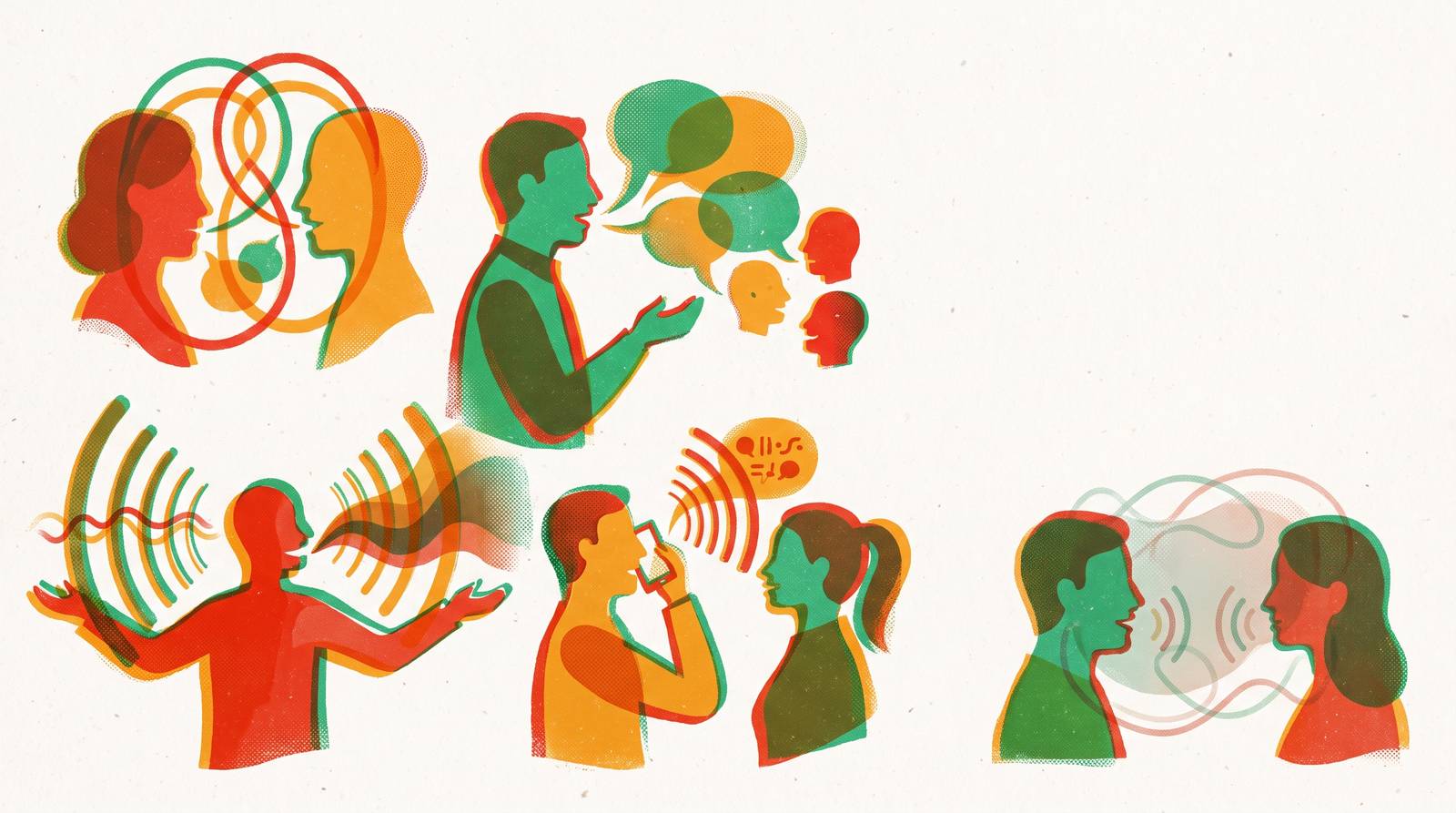
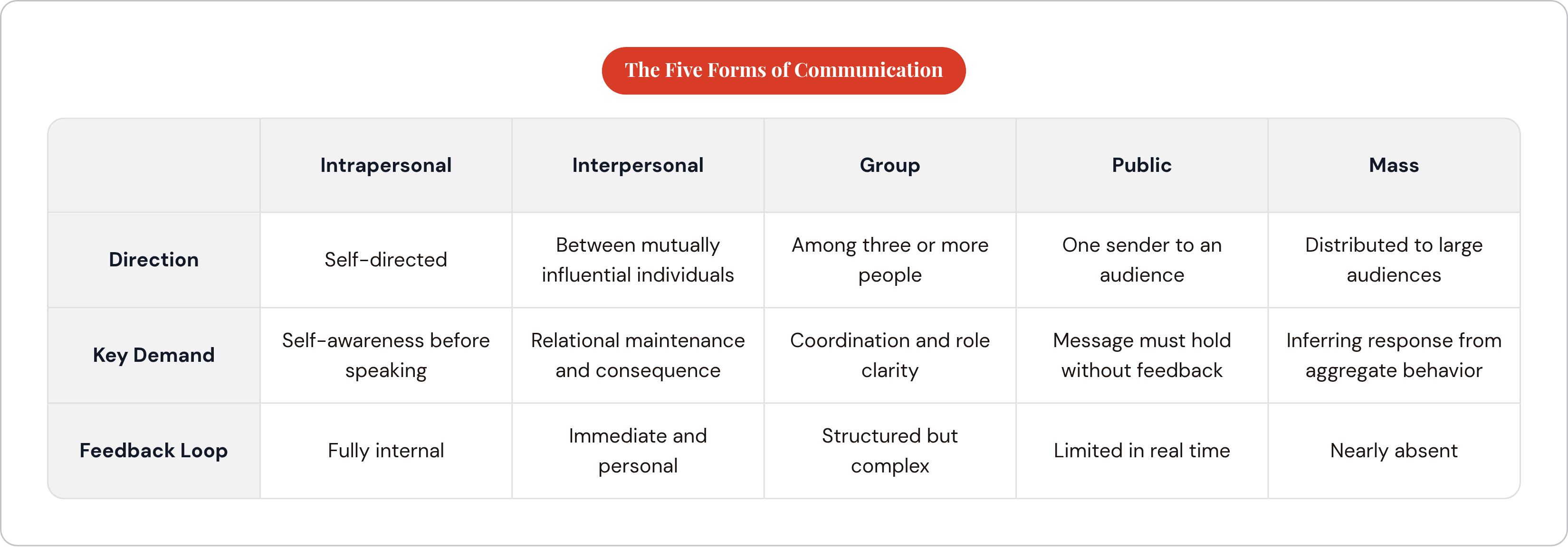
Most communication scholars identify five distinct forms, and the distinctions matter more than they first appear.
Intrapersonal communication is the internal kind: self-directed vocalization, the rehearsal before a hard conversation, the running commentary most people maintain about their own performance. It rarely appears in workplace communication guides because it produces no observable output — which is precisely why it gets underestimated. Every external communication begins here. How someone frames a situation to themselves before speaking shapes what they actually say, sometimes completely.
Interpersonal communication is where people spend most of their time. It operates between individuals whose lives are mutually influential, which distinguishes it from simply talking at someone. It builds relationships, maintains them, and ends them. It also carries the most personal consequence, which is why breakdowns at this level feel less like process failures and more like betrayals.
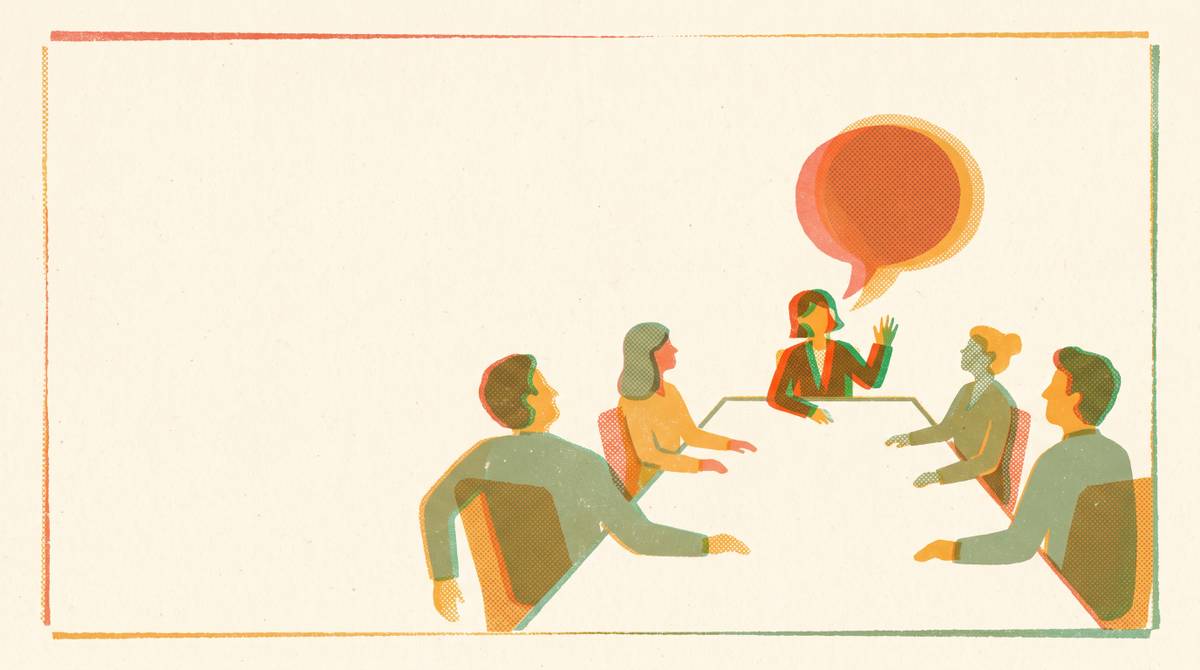
Group communication introduces a different set of problems. Three or more people working toward a shared goal need coordination mechanisms that one-on-one conversation doesn't require. Role clarity becomes structural. Without it, information gets repeated to some people and withheld from others, and what presents as a communication problem is often a structure problem wearing communication's clothes.
Public communication is sender-focused by design. One person conveys information to an audience that largely listens. The unique demand is that the message must hold without the back-and-forth that would otherwise catch misunderstandings in real time. Everything has to be built into the original construction.
Mass communication extends that challenge to scale: messages distributed via print or broadcast reach large audiences with the feedback loop nearly absent. The communicator is, practically speaking, transmitting into a void and inferring response from aggregate behavior after the fact.
The digital environment has blurred these boundaries in ways that create genuine confusion. A single social media post can function simultaneously as interpersonal communication (directed at one person), group communication (within a defined community), and mass communication (visible to anyone with a connection). The platform doesn't tell you which rules apply — figuring that out falls to the communicator, often mid-sentence. The skills that make someone effective in each form differ enough that conflating them is a reliable path to underperforming in all of them.
How verbal and nonverbal communication actually relate
Most professionals have encountered the "7-38-55" rule, usually in a leadership training or a presentation skills workshop: only 7% of communication is conveyed through words, 38% through tone of voice, 55% through facial expression. It is cited everywhere. As it is almost universally applied, it is wrong.
Albert Mehrabian's original research applied only to situations involving the expression of feelings or attitudes, specifically to cases where verbal and nonverbal cues conflicted with each other. His findings were never meant to describe communication generally. An analysis of 79 websites found that only one correctly characterized the research as limited to "emotional meaning." The other 78 treated a narrow experimental finding as a universal law. This particular error has been repeated so often it has achieved the status of folklore, which is a distinct and more intractable problem than simple ignorance.
Ray Birdwhistell estimated that nonverbal channels account for at least 60 to 70 percent of what humans communicate overall. Even that is a rough heuristic. The more useful insight is simpler: when verbal and nonverbal cues align, they reinforce each other and increase perceived responsiveness. When they conflict, people believe the nonverbal over the verbal, almost without exception.
What this means practically is that verbal and nonverbal communication do different jobs. Nonverbal cues carry emotional tone, relational signals, and the meta-message about how to interpret what is being said. Verbal communication carries explicit, structured content: the argument, the instruction, the precise idea. A raised eyebrow cannot substitute for a well-constructed explanation.
Why strong verbal communication is treated as a workplace priority
The business case for verbal communication is unusually well-documented. This is both reassuring and a little embarrassing, given how many organizations still categorize it as a soft skill and budget accordingly.
In 2024 and 2025, 55% of employers ranked strong verbal communication as a top candidate skill; 47% valued presentation skills; 36% prioritized active listening (National Association of Colleges and Employers, 2024). Those figures reflect what hiring managers actually weight — a more reliable signal than what they say they weight. Knowledge workers spend up to 38.9 hours per week communicating, and business leaders clock approximately 47.1 hours (Grammarly, 2024 State of Business Communication). Communication is not a task adjacent to work. It is structurally the work.
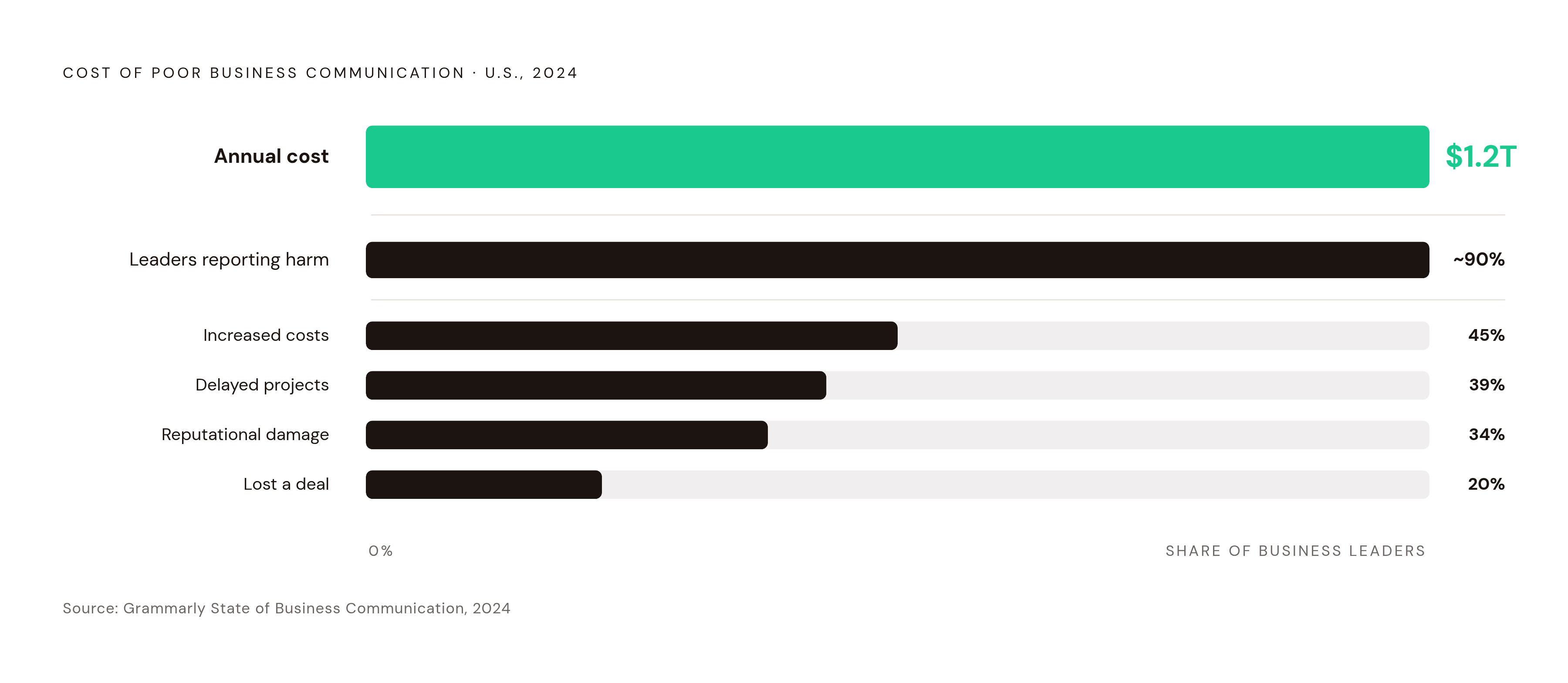
When that activity is done poorly at scale, the costs are concrete. Grammarly's 2024 State of Business Communication report put the annual cost of miscommunication to U.S. businesses at $1.2 trillion. Almost 90% of business leaders report communication failures producing tangible harm: increased costs in 45% of cases, delayed projects in 39%, reputational damage in 34%. One in five business leaders has lost a deal they could trace directly to poor communication.
The inverse holds with similar consistency. Forty-three percent of leaders reported gaining new business through effective communication in 2024, a 10-percentage-point increase from the prior year. Seventy-two percent cited effective communication as a direct driver of increased team output. The data here has stopped being an argument; it is a verdict that keeps getting reissued while organizations proceed more or less as before.
What poor communication does to individuals inside organizations
The organizational cost figures are striking, but they flatten something more granular and, by most measures, more consequential. The damage poor communication does to individuals inside organizations tends to be invisible until it isn't.
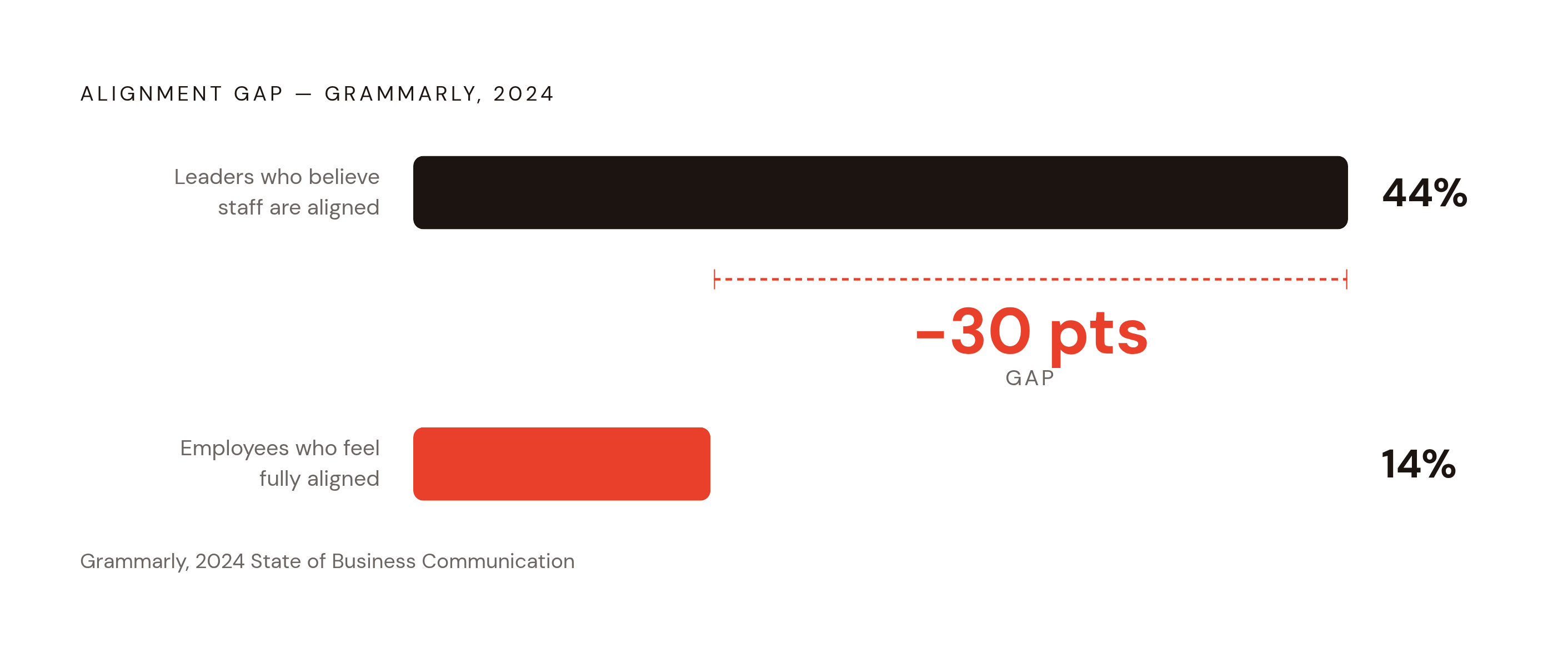
Consider the alignment gap. A 2024 survey found that 44% of leaders believe their staff are fully aligned with company goals; only 14% of employees agree (Grammarly, 2024 State of Business Communication). That 30-point divergence is a communication failure disguised as a strategy failure. Leadership believes the message has landed. Employees experience something else entirely. Because neither group is necessarily aware of the other's perception, the gap compounds over time, quietly, without anyone formally acknowledging it.
Individuals experience that gap primarily as invisibility. Approximately 70% of employees report feeling unheard in their roles, per research published in the International Journal of Listening. Whether organizations intend that outcome is beside the point.
Downstream effects are measurable and not subtle. Roughly 51% of knowledge workers report increased stress attributable to poor communication. The confidence data is more concerning: 31% of knowledge workers reported a lack of confidence in 2024, up from 20% just two years prior (Grammarly, 2024 State of Business Communication). Poor communication erodes self-efficacy, not just output. Employees who feel unheard and misaligned eventually stop raising problems, and that is precisely how organizational blind spots get installed and persist unchallenged for years.
One additional data point: approximately 31% of workers spend 16 to 25 hours per week on digital communication platforms, and 59% still experience miscommunication in written form at least weekly. Communication volume does very little work. Quality is the only variable that reliably moves outcomes.
The core skills that make verbal communication work in practice
A checklist of verbal communication skills risks sounding like advice to 'just be better.' The difference between useful framing and trite framing is specificity about mechanism: how, exactly, does each skill change an outcome?
Clarity is foundational. Word choice determines whether the message lands at all, and it shapes how the speaker is perceived simultaneously. Precision reduces ambiguity; plain language serves the listener better than jargon in almost every context where the speaker feels tempted to deploy jargon. The exception is when technical vocabulary is genuinely the shared language of the room and plain alternatives would slow comprehension — but it gets invoked far more broadly than it deserves.
Tone must match the situation. A performance critique delivered too casually will go unheeded. A routine process update delivered with urgency manufactures anxiety that didn't need to exist. The same words in the wrong register undermine the message, sometimes entirely.
Conciseness is the discipline of treating the listener's attention as finite, because it is. More words rarely add more clarity; they almost always add more noise, and listeners intuitively know the difference.
Adaptability means adjusting register, vocabulary, and framing to the actual audience in the room, rather than the imagined one. A technically sophisticated explanation delivered to a non-technical stakeholder is not clear communication — it is technically accurate communication that failed its purpose, a distinction most speakers underestimate.
Active listening is the skill most professionals nominally claim and fewest actually practice. It involves paraphrasing the speaker's message, asking relevant questions, and maintaining genuine conversational involvement rather than waiting for a turn to talk. Approximately 85% of what people learn comes through listening, yet most retain only about 25% of what they hear, per International Listening Association research. Work from UMN's REACH Lab links active listening to higher conversational satisfaction, greater perceived understanding, and what researchers describe as the social attractiveness of the listener. A 2025 peer-reviewed study in the International Journal of Listening found that targeted training improved active listening, cultural competence, and communication quality among medical interns. That matters because 'dispositional' is how organizations quietly excuse not developing it.
Effective verbal communication requires clarity, efficiency, and empathy simultaneously, not sequentially. Sacrificing any one of them produces something that works in limited conditions and fails in most.
The barriers that break verbal communication down
Barriers to verbal communication operate at three levels. Solutions that address only one will underperform predictably, because the remaining barriers simply absorb whatever slack was created.
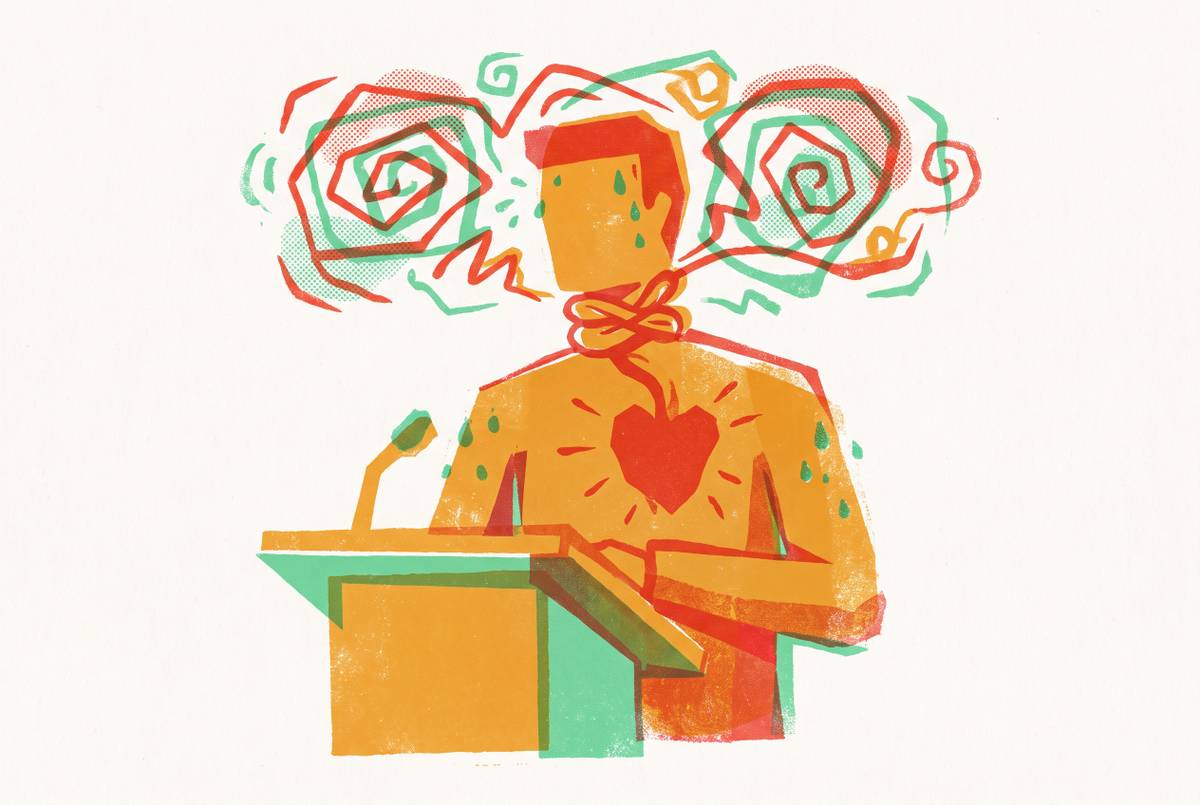
At the individual level: emotional state is probably the most underestimated barrier in professional settings. Anxiety and anger reduce the ability to listen and process; even technically skilled communicators lose effectiveness under acute stress, which is particularly inconvenient given that acute stress is exactly when communication stakes are highest. Approximately 7.5% of the global population experiences some form of communication disorder (World Health Organization), meaning any organization with more than a dozen employees almost certainly includes people navigating verbal communication in ways the default system wasn't designed to accommodate. Treating this as an edge case is both statistically indefensible and organizationally costly.
At the language level, jargon and slang create in-group and out-group dynamics within organizations, sometimes deliberately. Differing interpretations of the same words produce false agreement — often worse than acknowledged disagreement — which goes undetected and quietly misdirects effort while looking like alignment.
At the systemic level: 63% of workers report missing messages from leadership entirely, per Microsoft's Work Trend Index Special Report. Separately, 69% of frontline managers say messages from their superiors are not effectively communicated downward through their teams. Power dynamics compound this further; subordinates often hesitate to push back or raise concerns, producing communication that appears functional from above and is visibly broken from below.
Communication failures are overdetermined: multiple causes operate at multiple levels simultaneously, and fixing one is rarely sufficient because the others absorb the slack.
How culture and context reshape what "clear" verbal communication means
There is no universally clear verbal communication — only communication that works within a given cultural and contextual frame, and those frames vary considerably.
The high-context and low-context distinction, developed by anthropologist Edward T. Hall in his 1976 book Beyond Culture, captures one axis of that variation. In high-context cultures, including Japan and Saudi Arabia, a great deal is conveyed through implication, tone, silence, and relational context. Explicit verbal statements carry less of the interpretive load because the surrounding context carries more. In low-context cultures like Germany and the United States, the message is expected to be stated explicitly and in full detail. These aren't better or worse approaches; they are different systems, and they break down in predictable ways when they collide.
A communicator optimized for a low-context environment who enters a high-context one will often be experienced as blunt or obtuse. The reverse communicator gets experienced as vague or evasive. Neither perception is accurate, but both produce real consequences for professional relationships, and the people inside the interaction rarely have the vocabulary to name what's actually happening.
Gender, age, and cultural background also shape the nonverbal behaviors that accompany verbal exchange, which in turn affects how spoken words land. Research identifies patterns here, not determinisms, but those patterns interact with spoken content in ways frequently invisible to the people inside the interaction.
Adaptability, identified earlier as a core skill, is especially critical across cultural contexts. Global workplaces and multicultural teams are not simply contexts where the standard communication playbook applies with minor adjustments. They are contexts where the playbook needs active revision, often in real time, with incomplete information about the other person's frame.
How verbal communication functions differently in high-stakes specialized settings
The same core skills, applied in different domains, carry different consequence structures. Getting tone wrong in a casual team meeting produces awkwardness; getting it wrong in a clinical encounter produces something measurably worse.
In healthcare, the verbal exchange between physician and patient encompasses language selection, dialect awareness, and tonal calibration, each of which affects trust and comprehension independently. Effective communication in clinical settings is directly linked to improved health outcomes; the quality of that verbal exchange is not incidental to care but constitutive of it. Penn State University launched a clinical study in November 2024, with estimated completion in early 2029, specifically designed to evaluate verbal communication in structured clinical interactions. The fact that this research is still in progress signals that the field hasn't resolved its own foundational questions here, which remains a concerning position for medicine to occupy.
In education, verbal framing in the classroom shapes not only what students learn but how they develop cognitive habits. The teacher's verbal choices model the structure of thought itself, giving classroom communication an unusual lever over long-term outcomes that extends well beyond any individual lesson.
In the workplace, approximately 88% of the workweek is spent communicating in some form (Grammarly, 2024 State of Business Communication). Meetings, instructions, feedback, negotiation, alignment — these are the substance of professional work, not the packaging around it.
The pattern across all three domains is consistent and not coincidental: consequences scale with the vulnerability of the person receiving the message. A patient who misunderstands a treatment plan, a student who internalizes a misfired piece of feedback, a frontline employee who never receives the message from leadership — the damage accrues at the individual level first, then aggregates outward into the institution.
What AI and conversational technology are changing about verbal communication
The conversational AI market is projected to reach $14.29 billion in 2025 and expand to $41.39 billion by 2030, at a compound annual growth rate of 23.7% (MarketsandMarkets, 2024). By 2026, 80% of customer service and support organizations are expected to deploy generative AI to improve agent productivity and customer experience (Gartner, 2023). Voice-based interaction is expected to grow faster than text as natural language processing improves and latency drops. In 2024, 67% of companies introduced new asynchronous communication or project management tools, redirecting volume away from synchronous verbal exchange toward managed information flow (Grammarly, 2024 State of Business Communication).
AI reduces communication friction and absorbs routine volume — real gains. What it cannot do is close the human gaps, and the human gaps are where the actual problems live.
The 44% versus 14% alignment split between what leaders believe and what employees experience is a human problem, not a technology problem. Organizations that deploy AI communication tools still encounter the same misalignment between what leaders believe has been communicated and what teams actually understand. The 70% of employees who feel unheard are unheard because of failures in human skill and organizational culture; inserting AI into the channel addresses neither.
As AI takes on more routine, high-volume communication work, the distinctly human capacities become the differentiating layer: empathy, nuanced interpretation, real-time adaptation, the slow accumulation of trust. These are also the capacities that remain hardest to replicate. They determine whether a given verbal exchange accomplishes anything worth accomplishing — and no one has automated that yet.