Interactive Presentation Tools for Live Audiences
Most presenters shop in only one category when three exist, each solving different problems.

The market for interactive presentation tools divides into three meaningful categories, and most decision-makers act as though only one exists — an oversight that costs them.
The first category is audience polling and engagement platforms: Mentimeter, Slido, Kahoot, AhaSlides, Poll Everywhere, Vevox. Purpose-built for real-time interaction, they either overlay existing slide decks or replace them entirely. This is where most event planners, corporate trainers, and conference organizers are shopping, often exclusively.
The second is design-first interactive platforms: Prezi, Genially, Canva. Interaction features exist in all three, but they are subordinate to the visual authoring environment. Nobody opens Genially because they need robust Q&A upvoting.
The third is venue and hardware-specialized tools: Intuiface, FlowVella. Built for kiosks, touchscreen exhibits, and unattended digital displays, their deployment model has almost nothing in common with the first two categories. They solve a fundamentally different problem, which is why web-based polling tools fail so conspicuously when someone tries to use them in their place.
Over 62% of digital presentations globally now integrate some form of interactive response functionality, per 2025 research from 360researchreports, and the audience response software market was valued at roughly $1.2 billion in 2024. The growth is real. Most people picking tools are still shopping in one aisle of a three-aisle store.
The Core Interactive Features and What Each One Actually Does in a Room
Every interactive presentation tool offers some combination of the same six or seven features. The feature checklist matters less than understanding what each one actually does when you're standing in front of a room full of people who would rather be checking email.
Live polls create an immediate shared data moment. Results appear simultaneously for everyone, which produces a specific social effect: the room suddenly has a collective opinion, and the presenter has something concrete to respond to rather than projecting into a void. The dynamic shifts from broadcast to conversation.
Q&A with upvoting removes the microphone queue and the social theater that comes with it. Participants submit questions from their devices; others vote the best ones to the top. Anonymous submission consistently increases question volume, sometimes dramatically, because it removes the calculation of whether a question is worth the public exposure of asking it.
Live quizzes and gamification are competitive by design. Leaderboards and point scoring trigger a fundamentally different psychological register than polling: participants are not sharing opinions, they are performing. This distinction matters enormously. Forcing a leaderboard into a sensitive feedback session is like bringing a foghorn to a library.
Word clouds surface dominant language from open-ended responses in real time. They are especially effective as session openers; ask a room what word comes to mind on a topic and you have something to actually work with before you have said anything of consequence.
Surveys and rating scales are less visceral than polls but more analytically useful. The data is structured, exportable, and comparable across sessions, which is what makes them defensible to the person who eventually asks whether any of this was worth doing.
The wrong feature for the context produces friction instead of engagement, and the room notices immediately.
Polling and Engagement Platforms Compared on the Features That Separate Them
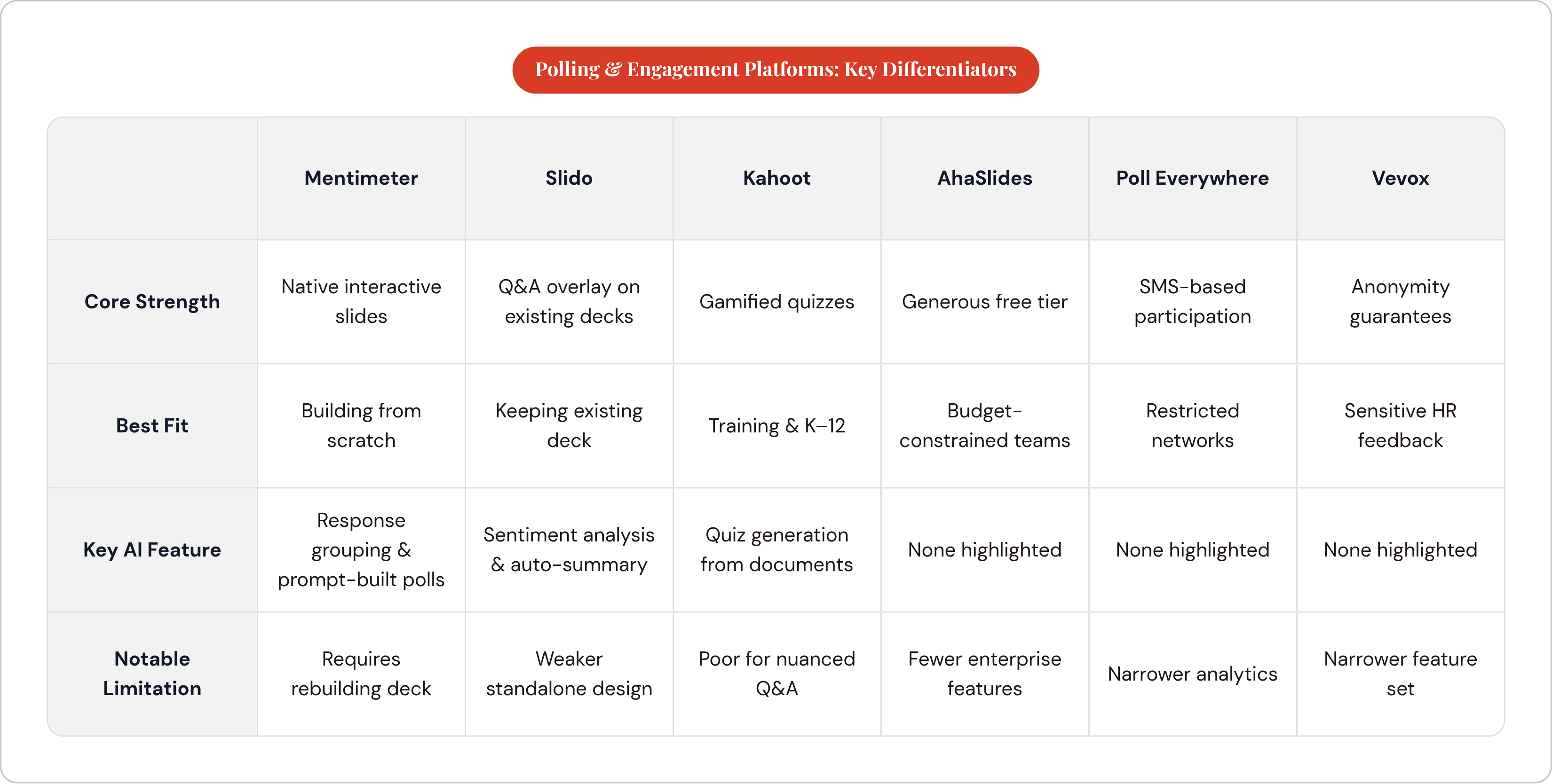
Mentimeter versus Slido is the most common decision point for corporate and conference use, and the distinction between them is not cosmetic.
Mentimeter builds the entire presentation inside the platform. Polls, word clouds, Q&A, and quizzes are native slide elements; the interaction is not an overlay on a separate deck, it is the deck. G2 ease-of-use score: 9.2. If you are building from scratch and want interaction embedded throughout, Mentimeter is the natural home.
Slido works differently. It overlays on existing PowerPoint, Google Slides, Webex, Zoom, and Teams presentations. You keep your deck; Slido adds the interaction layer on top. G2 ease-of-use score: 9.4. Its differentiator is Q&A management: moderation tools, duplicate filtering, upvoting, and, as of June 2024, AI-powered sentiment analysis and auto-summarization. If your deck already exists and you are not rewriting it for this session, Slido fits that workflow without requiring you to rebuild it.
Kahoot dominates K-12 and corporate onboarding where gamification is the explicit goal. More than 9 billion participants across 200 countries since 2013 means something, even accounting for the fact that a significant portion were middle schoolers who would have preferred recess. Kahoot is poorly suited to settings requiring nuanced sentiment or substantive open-ended Q&A.
AhaSlides is functionally comparable to Mentimeter and is consistently cited for the most generous free tier in the category. For budget-constrained educators or small teams, that can be the whole conversation.
Poll Everywhere's differentiator is SMS-based participation. Audience members respond via text message without an app or a data connection. Corporate networks that block external URLs, participants who won't switch apps mid-session, mixed-device audiences — these failure modes appear more often than anyone who hasn't run one of these events would expect. Poll Everywhere addresses that structurally.
Vevox earns the call when anonymity guarantees are non-negotiable. Its protections exceed most competitors, which matters specifically in sensitive HR or organizational feedback contexts where participants need certainty, not assurances.
When Design-First Platforms Make More Sense Than Dedicated Polling Tools
Design-first platforms belong in a specific scenario: when visual storytelling is the primary deliverable and interaction is supporting evidence rather than the whole point.
Genially offers more than a thousand customizable templates and a Live Presentation feature that allows audiences to vote and play from a phone or computer. The platform suits educators and marketers who want a heavily polished visual experience and are willing to invest the authoring time it requires. That trade-off is worth naming upfront: Genially takes longer to build in.
Prezi's non-linear zooming canvas fits pitches and keynotes where narrative structure and visual impact are the dominant concern. The interaction features are there, but they are not why anyone chooses it.
Canva supports clickable links, embedded video, polls, and quizzes inside its drag-and-drop interface. For a presenter already in the Canva ecosystem, adding light interaction there avoids a second platform — a reasonable call when interaction needs are genuinely modest. The key word is modest.
None of these match Slido or Mentimeter on Q&A depth, analytics, or moderation. For sessions where real-time audience data is a primary deliverable, they fall short — a gap that becomes obvious around fifteen minutes in when questions start arriving and there is no infrastructure to manage them.
When the Event Context Requires Hardware-Integrated or Venue-Specific Tools
There is a category of use case that polling platforms simply do not address, and the people who try to solve it with Slido or Mentimeter usually realize their mistake in front of a crowd.
Intuiface is purpose-built for kiosks, digital exhibits, retail displays, and executive briefing centers. It deploys natively on eight operating systems, including Windows, Android, Samsung Tizen, and BrightSign. The audience interacts with the installation independently, without a presenter directing traffic.
FlowVella is designed for Apple devices and allows audience members to navigate presentations on their own terms. It suits iPad kiosks at events or self-directed product demonstrations where someone needs to hand a device to a prospect and walk away.
The key distinction: the presenter is not always a person. These tools serve scenarios where content must guide interaction without a human in the room. No amount of Q&A configuration in a web-based polling tool solves a hardware integration problem. The categories are orthogonal.
How AI Features Changed What These Tools Can Do in 2025 and 2026
AI is present across all the leading platforms, but it has been applied to different parts of the workflow in each case. That specificity is what determines whether it is useful or decorative.
Mentimeter's Menti AI Creator builds polls, word clouds, and Q&A sessions from a text prompt. More practically useful is the AI Grouping feature, which clusters open-ended responses into named themes live during the presentation, reducing post-session synthesis work that previously meant manually sorting through hundreds of text submissions. I have done that manually at midnight before a morning debrief. The time savings are not marginal.
Slido's June 2024 AI additions, integrated with Cisco Webex Events, include Q&A moderation, auto-summarization, and sentiment analysis. These features earn their cost at scale, specifically in large webinars where a single moderator reading and prioritizing every incoming question in real time is a fantasy rather than a plan.
Kahoot added AI quiz generation from uploaded documents in 2026. A trainer uploads source material; Kahoot produces a quiz from it. For corporate trainers who previously built quiz questions by hand from a 40-page policy document, this is a significant time saving.
What none of the AI additions do is replace the core interaction model. Slido's AI strengthens Q&A management; Mentimeter's strengthens content creation; Kahoot's strengthens quiz authoring. The relevant question is whether the AI feature addresses a genuine bottleneck in your specific workflow. Authoring time, moderation at scale, and post-event reporting are legitimate bottlenecks. AI as a general quality signal, regardless of how the marketing frames it, is not.
Matching Tool to Context: Audience Size, Event Format, and Presenter Workflow
Audience size is a meaningful filter, not a formality.
For small teams and classrooms under 50, the free tiers of AhaSlides, Kahoot, and Mentimeter cover most needs. The economics do not justify paid plans at this scale unless specific requirements like anonymity guarantees or SMS participation are in play.
For mid-size corporate events and conferences between 50 and 500 participants, Slido or Mentimeter paid plans are the standard choice. Slido's Q&A upvoting and moderation features earn their cost here; several hundred participants generating simultaneous questions makes manual management genuinely impractical. Poll Everywhere becomes relevant when device access is mixed or the venue network is the kind that blocks anything it was not explicitly configured to allow.
For large webinars and town halls above 500, Slido's enterprise Q&A management and Cisco Webex integration are the appropriate infrastructure. Mentimeter's enterprise analytics suite, launched January 2025, is relevant for hybrid audiences where both in-room and remote engagement data need to be captured and compared, not just acknowledged.
Event format adds another dimension. For fully in-person events, any web-based polling platform works; a QR code join flow on the opening slide eliminates most friction. Hybrid deserves its own consideration: 83% of 2025 meetings included an in-person component, which means fully virtual or fully in-person are now the edge cases, not the norm. Mentimeter and AhaSlides integrate cleanly with Zoom and Teams. For self-directed venue installations, the category remains Intuiface or FlowVella; nothing else belongs there.
Presenter workflow is often the actual tiebreaker. Keeping an existing PowerPoint or Google Slides deck points clearly to Slido. Building a new presentation with interaction native to every slide points to Mentimeter. Running training from uploaded source content points to Kahoot. Needing guaranteed anonymity for sensitive feedback points to Vevox. Prioritizing visual design above everything else points to Genially or Prezi.
One finding from the 2024 LinkedIn Workplace Learning Report is worth sitting with: 94% of employees prefer learning while working rather than in a dedicated separate session. Any tool that requires participants to download an unfamiliar app, create an account, or navigate an interface they have never seen raises the participation floor before the first poll opens. That is a warning about what happens to your engagement numbers, and it deserves attention before you finalize your tool choice.
On pricing: Slido's free plan limits three polls per event, with paid plans from $12.50 to $150 per month billed annually. Mentimeter's Pro plan starts at $11.99 per month. Kahoot's 360 Starter plan runs $120 per year, with enterprise pricing at $5 per employee per month.
Setup and Facilitation Details That Determine Whether Interaction Actually Lands
The tool is infrastructure. Facilitation design determines whether the interaction feels like a natural part of the session or like a surprise quiz nobody agreed to take.
Join flow friction is where most live interaction fails — before the presenter has said a word. Participants who must download an app, navigate a corporate firewall, create an account, or find a URL that was mentioned once and then skipped past will drop off before the first poll opens. A QR code on the opening slide, tested on the venue network before anyone is in their seat, solves most of this. Poll Everywhere's SMS fallback is a structural answer to a problem that surfaces in corporate venues with enough regularity that you should plan for it, not around it.
Placement within a session matters and is not arbitrary. An opening poll or word cloud establishes from the first minute that participation is expected, which changes how people sit in their chairs. A mid-session quiz or comprehension check breaks a long content block through retrieval practice — the cognitive mechanism behind the documented 2x retention improvement in active versus passive learning. A closing Q&A with upvoting surfaces what the room actually wants addressed rather than what the presenter assumed they would want.
Q&A moderation at scale involves a trade-off worth naming directly. Anonymous submission increases question volume and surfaces ideas people would otherwise keep to themselves; it also introduces noise and, occasionally, submissions that have no business appearing on a projected screen in front of several hundred people. Slido's AI moderation addresses this for large events. For smaller sessions, a designated co-host handling the moderation queue is usually sufficient and keeps the presenter in the room rather than watching a dashboard.
Post-session data is consistently underused, and that is a real cost. Mentimeter's enterprise analytics and Slido's automated reporting produce exportable engagement data that, for corporate trainers who need to demonstrate ROI or iterate on content between cohorts, is part of the core value proposition. Treating it as a bonus feature means leaving the most defensible argument for continued investment in a dashboard nobody opened — a waste that compounds every time the budget conversation comes around.