Public Speaking Groups Beyond Toastmasters
Finding the right alternative depends on whether you need reps, instruction, or spontaneity.
The numbers are real. As of 2025: 265,261 members, 13,833 clubs, 149 countries, roughly $120 per year plus local dues. Nearly 75% of surveyed members reported less fear after joining, per Toastmasters International's 2024–2025 program data. That outcome earned Toastmasters its reputation.
But membership peaked in 2020 at over 364,000 and has since contracted by more than 11%. Club count followed. When a category leader loses share steadily for five consecutive years, something structural is usually at work, not a bad quarter or a post-pandemic blip.
The structural issue is peer-to-peer design. There is no instructor. Feedback quality is determined by whoever attended that particular Tuesday, and that variance is enormous. The standardized curriculum builds general comfort effectively because it was engineered for exactly that purpose. What it was not engineered for: executive presence at the board level, clinical anxiety reduction for speakers whose fear is severe enough to require graduated exposure therapy, structured persuasion and argumentation, or the unscripted fluency that only accumulates when you are repeatedly thrown into situations you cannot rehearse your way out of.
There is also the architecture of the thing. Weekly commitment, fixed schedule, group setting. For someone with significant social anxiety or an unpredictable calendar, that structure is the obstacle, not the onramp. None of this makes Toastmasters bad. It makes it specific. Specific things have edges. Knowing where the edges are is the only useful starting point.
How to Match a Speaking Goal to the Right Kind of Alternative
Before evaluating any option, a speaker needs to be honest about five things: what kind of goal they're actually pursuing (general confidence versus a discrete coachable skill), where they are in their career (a beginner who needs reps versus someone already monetizing the stage), how they actually learn (peer feedback, expert instruction, self-paced repetition, or full immersion), what their schedule can realistically sustain week over week, and what budget they have access to. The options in this space run from free to well north of $2,000.
What follows moves through a rough continuum: community and peer formats for low-barrier entry, structured instructor-led programs for faster and more accountable progress, improv and theater training for presence and spontaneity, AI coaching for private delivery work, a professional association for speakers already earning from their craft, and one-on-one coaching for targeted or clinical-level needs.
The question isn't which option is superior. The question is which one closes your specific gap.
Peer-Led and Community Groups: Low-Barrier, Flexible, and Underrated
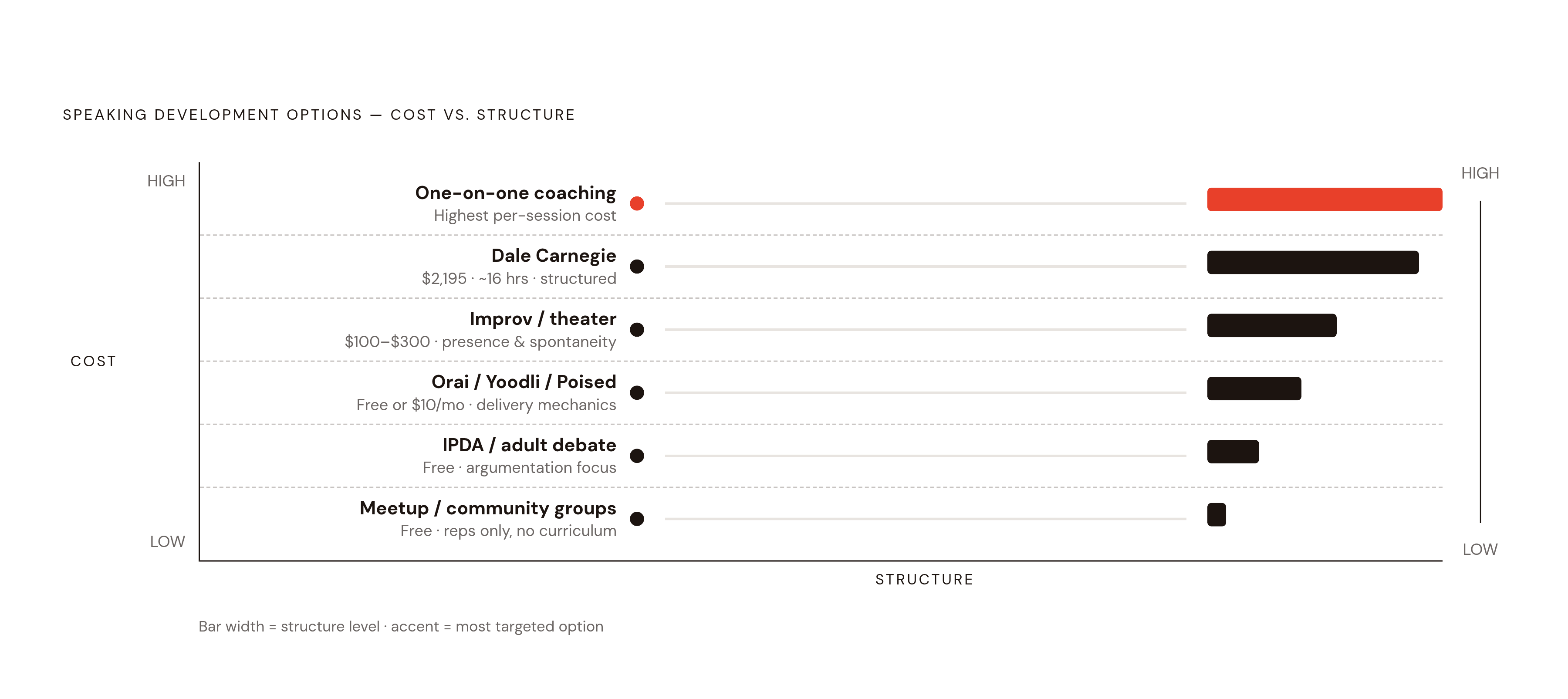
Meetup.com is the most accessible entry point after Toastmasters. Searching "public speaking" in most mid-sized cities surfaces groups spanning multiple formats: prepared presentations, impromptu rounds, rehearsal feedback, storytelling circles. Cost is typically free or nominal. The specialization available here is a real differentiator that Toastmasters' standardized structure cannot replicate. There are communities specifically for women speakers, non-native English speakers, business presenters, and narrative storytellers. Finding the right subcommunity frequently matters more than finding the most polished curriculum.
The limitation is equally plain: no curriculum, no structured progression, no guarantee the feedback is any good. These groups offer reps, not instruction. For someone who needs volume, community, and niche relevance without the weight of a formal program, that is often exactly right.
Adult debate clubs occupy a different niche worth knowing about. The Public Speaking and Debate Association runs its IPDA format around persuading real audiences rather than winning procedural points. Their first-Saturday-of-the-month format is a low-commitment entry point. If your actual problem is argumentation under pressure rather than delivery polish, this is a more targeted intervention than most speaking groups will ever attempt.
Structured Instructor-Led Programs for Faster, More Accountable Progress
Dale Carnegie's High Impact Presentations is the most recognizable option in this category. Approximately 16 hours, $2,195, trainers with more than 150 hours of developmental preparation, and ISO 9001:2015 certification across 90-plus countries. That last credential matters less for its prestige than for what it signals: a real institutional commitment to consistent delivery regardless of which facilitator shows up.
Two criticisms deserve naming before anyone writes a check. Some recent participant reviews describe the curriculum as dated. At least one 2025 review specifically flags the cost as difficult to justify against newer alternatives. Both critiques are fair. What newer competitors have not matched: hybrid delivery that mixes in-person and live online sessions week-by-week, which actually accommodates travelers and people with unpredictable schedules in a way most cohort-based programs structurally cannot.
Speakeasy Inc. sits at the more executive end of this tier, focusing on messaging, empathetic listening, and strategic storytelling for organizational leaders rather than general professional development.
The cost and time commitment here are substantially higher than peer-led options, often three or more hours per week across eight to twelve weeks. The returns are proportionally higher, but only for people with concrete professional stakes. If the goal is a major board presentation or a high-stakes sales cycle, the math looks entirely different than if the goal is less anxiety during the weekly team standup.
Improv and Theater Training: The Fastest Route to Spontaneity
Here is the gap that neither peer groups nor structured courses address. Most speakers who complete a formal program can deliver a competent prepared speech. Fewer can handle a hostile question, a derailed agenda, or a room that turns cold without physically stiffening in ways the audience registers immediately.
Improv works on exactly that layer. The transferable skills are specific: thinking faster under pressure, adapting in real time, and shedding the performance quality that makes technically competent speakers sound like they are executing a plan rather than having a conversation. The "yes, and" principle restructures how a speaker listens, which turns out to be the real deficiency most of the time. You cannot adapt to a room you are not actually receiving.
Peer-reviewed research into improv-based communication training has shown reductions in speaking anxiety and measurable improvements in social interaction, though the evidence base is newer than more established modalities. Second City in Chicago and Toronto, Upright Citizens Brigade, Improv Asylum in Boston, and local theater troupes in most cities offer courses typically between $100 and $300.
One caveat, and it matters: improv builds presence and adaptability. It does not teach content architecture, persuasion structure, or professional delivery conventions. It is a complement, not a substitute. The ideal candidate is someone who is technically capable but sounds rehearsed, or someone whose anxiety spikes specifically in unscripted moments rather than uniformly across speaking situations.
AI Coaching Platforms: Useful, Cheap, and Kind of Limited
The structural appeal of AI coaching is legitimate. Private, available at midnight when that is actually when you practice, inexpensive, immediate feedback, no audience to perform for. For speakers whose primary barrier to repetition is social exposure, removing the audience makes the practice happen. That is not a trivial thing.
The platforms worth knowing: Yoodli offers real-time coaching on pacing, filler words, and tone; its enterprise adoption by organizations including Google and Korn Ferry suggests a mature product rather than a venture-backed experiment approaching its runway. Orai focuses on filler word detection, pace, and confidence scoring with a mock presentation mode, at $10 per month. Poised takes a different architectural approach, integrating directly into Zoom, Teams, and Google Meet to provide feedback during actual meetings rather than isolated practice sessions. VirtualSpeech combines AI coaching with VR environments; per WorldMetrics (2024), 34% of users reported improvement in public speaking after VR-based training.
The limitation is significant and rarely stated plainly enough. AI feedback is context-blind — like a music teacher who can tell you every note you hit but has no idea whether the song made anyone feel anything. A platform will coach you to smile more during a speech about declining quarterly revenue. It cannot read the room, assess whether the argument is landing, or distinguish between a pause that builds tension and a pause that signals you have completely lost the thread. These tools address delivery mechanics almost exclusively. Content structure, argument quality, and audience responsiveness still require a human being present.
Best use: high-repetition private practice, systematic delivery tracking over time, or any situation where scheduling constraints make group formats impractical.
NSA Membership for Speakers Who Are Already Getting Paid to Speak
The National Speakers Association, founded in 1973, is the largest and oldest of the 13 associations in the Global Speakers Federation. National membership runs $988 per year, with chapter fees varying by location. The benefits include a digital resource library, monthly peer exchange calls, and weekly webinars covering both craft and the business mechanics of a speaking career.
The distinction that determines whether NSA belongs in your decision set: NSA requires documented professional speaking experience. Minimum income thresholds or a minimum number of paid engagements annually are part of the membership criteria, per NSA's published requirements. This is not a practice forum. It is a professional association for people already earning from speaking who want to grow that into a real business.
NSA appears constantly in "Toastmasters alternatives" searches, which is the only reason it is addressed here at this point in the continuum. Most people encountering it in that context will find it answers a question they are not yet asking. If you are already on the professional circuit and want the network, the business education, and the credibility that comes from operating inside the right professional community, NSA is the right room.
One-on-One Coaching: For Targeted Work and Anxiety That Has Not Responded to Groups
Private coaching fills the gap every group format leaves open: a curriculum built around one person's specific deficit, not a standardized progression engineered for median needs. This plays out in two distinct contexts worth keeping separate.
Communication and presentation coaching addresses vocal tone, pace, resonance, inflection, and narrative structure at a precision level that peer feedback rarely reaches and almost never makes actionable. Group members can tell you something felt flat. A skilled coach can tell you why, what it sounds like from the outside, and exactly what to do about your breath support, your sentence endings, or your habit of rising inflection on declarative statements. Those are categorically different interventions.
A speech-language pathologist or clinically trained anxiety coach addresses a different problem: speaking anxiety severe enough that it has not responded to group exposure. The exposure model that group formats rely on works for a substantial portion of the population. It does not work for everyone. For some speakers, the group setting itself reinforces the fear cycle rather than gradually attenuating it. In those cases, individual clinical-style work is not a premium option. It is the correct clinical intervention, and treating it as a luxury is a diagnostic error.
Cost per session is higher than any group alternative. Total investment is often lower than it appears, because a well-defined specific goal typically requires fewer sessions than an open-ended group commitment demands. Best fit: a specific imminent high-stakes event, anxiety that has resisted group practice, or a plateau you cannot account for on your own.
Where You Actually Land Given All of This
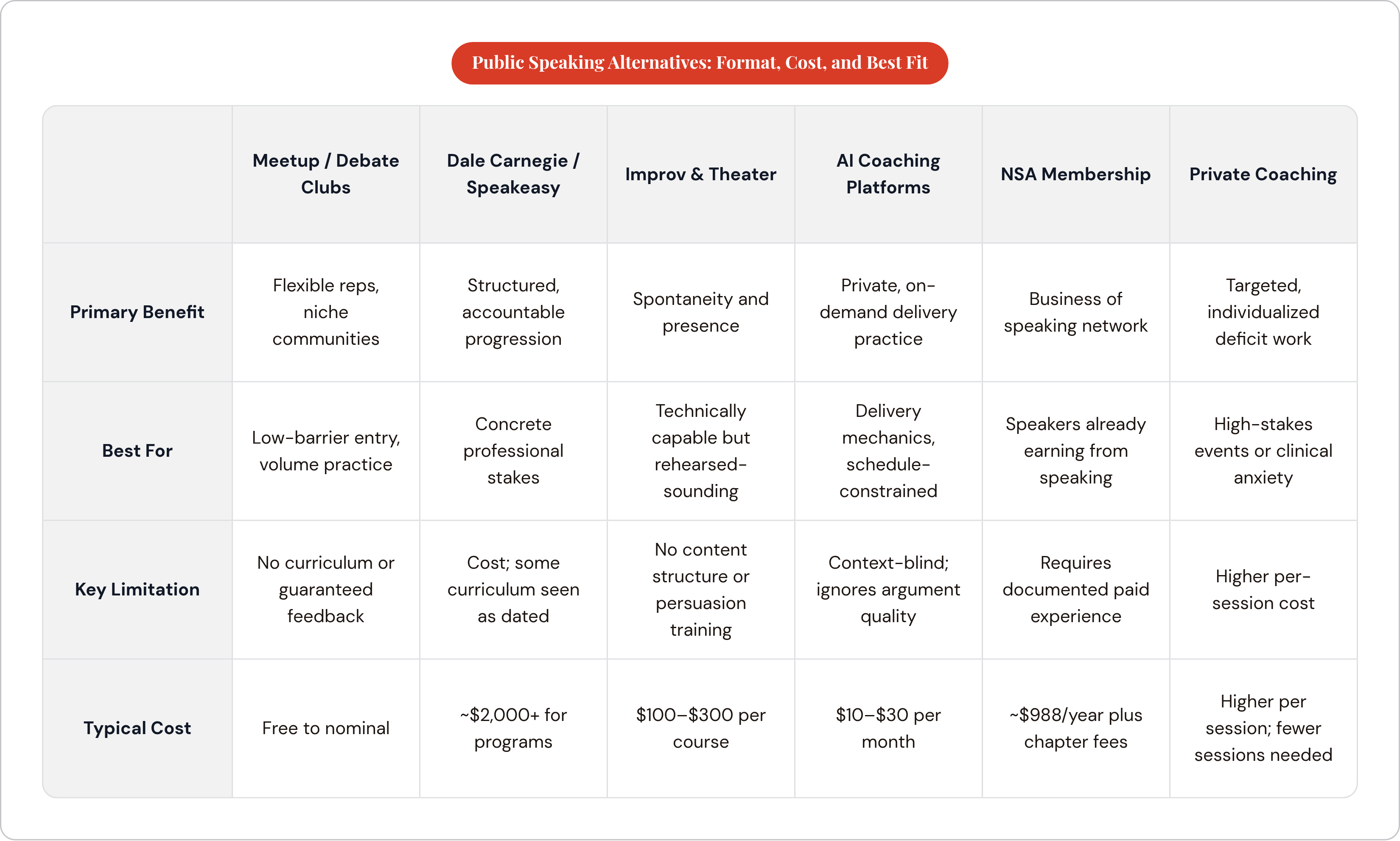
The short version, without the hedging. If you need low-cost, flexible, social practice without curriculum pressure, Meetup groups or adult debate clubs are the correct answer. If you need structured progression with professional credibility embedded in the process and have concrete professional stakes to justify the cost, a Dale Carnegie-tier instructor-led program makes sense. If you are technically capable but sound rehearsed, or if you freeze specifically in unscripted situations, improv belongs in your rotation, most likely alongside a structured format rather than instead of one. If you want high-repetition private practice with delivery metrics you can track over time, Orai, Yoodli, Poised, or Yapp, a daily-prompt AI speaking coach that scores each recorded response from 0 to 100, are the tools. If you are already earning from speaking and want to scale it as a business, NSA. If you have a specific high-stakes event approaching or anxiety that has not responded to group practice, private coaching is the more direct path.
Combinations work, and usually work better than any single format in isolation. Improv alongside AI practice. A structured course followed by a peer group for maintenance reps. One-on-one coaching to break a specific plateau, then back to a group format for volume.
Toastmasters remains a reasonable starting point for many people. The argument here is narrower: know what you actually need before defaulting to the first thing someone recommends. The options above exist because Toastmasters was designed to solve one problem well, and most speakers eventually discover they have several.