Improv Comedy as a Public Speaking Training Method
Improv drills the spontaneous speaking skills that planned training entirely ignores.
Improv comedy training works as a public speaking method because it drills the exact skills that separate a good speaker from a great one: spontaneity, presence, and recovery. It builds those skills through repetition, and that mechanical distinction is why most public speaking advice misses the point entirely.
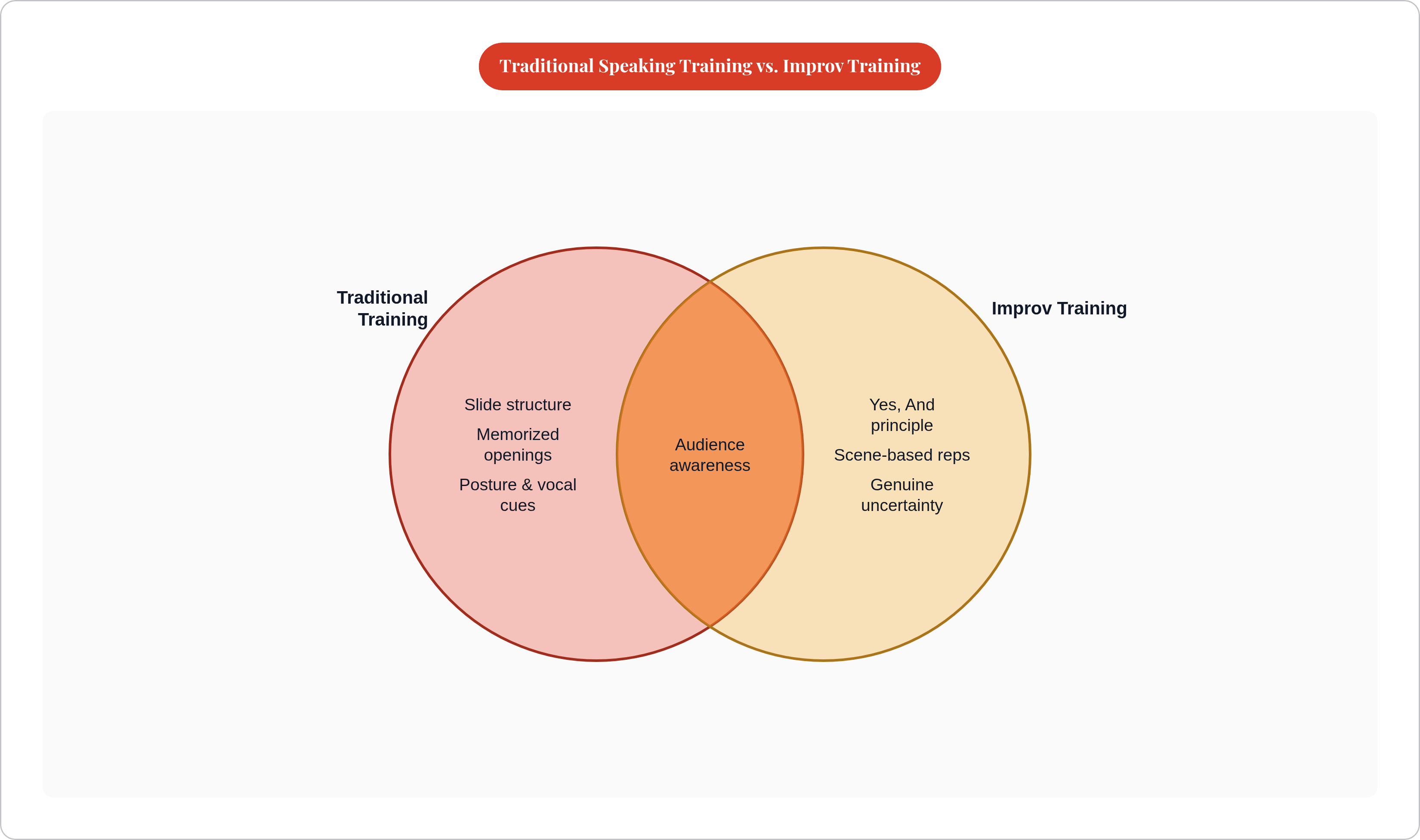
Almost everything taught in a public speaking course targets the planned parts of a performance. Slide structure, memorized openings, posture cues, vocal warmups. All of it assumes you know what you're about to say. But the moments that actually make or break a speaker are the ones nobody rehearses for: a Q&A that veers sideways, a lost train of thought mid-sentence, a room that laughs when it should nod and nods when it should laugh. Spontaneous speech is a different animal from prepared speech. It's emergent, it can't be edited before it leaves your mouth, and it demands that you think and talk at the same exact moment, which is a much harder trick than it sounds.
Here's the mechanical problem. Trying to consciously monitor your delivery, your content, and the audience's reaction all at once overloads working memory, and working memory has a ceiling. Hit that ceiling and performance falls apart, not gradually but all at once, the way a table collapses when you've stacked one book too many. This is why people who talk a mile a minute at dinner parties turn into deer in headlights behind a podium, and it's why rehearsal doesn't fix it. Rehearsal only trains the planned-speech mode. It never touches the gap where spontaneous speech lives, which is exactly the gap improv was built to close.
What improv actually trains — and why it's not about being funny
Say the word "improv" and most people picture a guy in suspenders shouting "Freeze!" while a Chicago audience heckles him into a corner. That image is the reason so many capable, serious professionals write off improv training before they've tried it. Nobody wants to sign up for a comedy class if they don't consider themselves funny.
Improv is built on presence, listening, acceptance, and forward motion, and every one of those is a core speaking skill with the comedy stripped out. The foundational rule of the discipline, "Yes, And," has nothing to do with punchlines. It's a rule about accepting whatever just landed in front of you and adding something to it instead of blocking it, deflecting it, or waiting for your turn to redirect the conversation somewhere safer.
What improv actually trains for a speaker: thinking on your feet without seizing up, listening in full instead of half-listening while you draft your next line, recovering from a mistake without letting it swallow the rest of your talk, and staying with the audience instead of retreating into your own head to hide. None of that requires a personality transplant.
Introverts, in my experience, often make the fastest gains, and that surprises people every time. Active listening rewards patience and close observation, and those are traits a lot of introverts already have in spades; they just never had a format that rewarded them for it. The structured exercises remove the open-ended ambiguity of normal social performance, the not-knowing-what's-expected-of-you feeling that makes small talk exhausting. Improv asks for attention above everything else. And attention, unlike charisma, is trainable.
How the "Yes, And" principle rewires how speakers listen
Strip "Yes, And" down to its mechanics and it's a two-step rule: accept what was just said, then build on it. No redirecting the topic, no qualifying it into oblivion, no dismissing it to make room for your own agenda.
The hidden mechanism is what makes it useful off the stage. You cannot build on something you didn't actually hear. Partial attention shows up immediately in this exercise, because the moment you're not fully listening, your "and" doesn't connect to anything; it just sits there, orphaned. Improv teachers will tell you their students are trained to listen, because listening is the prerequisite for every other skill in the discipline. Speaking is just what happens after you've done the listening correctly.
The payoff for a public speaker is concrete. A speaker who's genuinely listening to the room, to a question, to a shift in energy after a bad joke, responds to what's actually happening instead of reacting on autopilot. That difference is audible. It's the difference between someone who sounds present and someone who sounds like they're running a script that got interrupted.
Compare that to what passes for listening during most Q&A sessions. The speaker starts drafting an answer the second the question begins, sometimes before it's finished, and the response that comes out feels canned, or worse, answers a question nobody asked. There's a real cost to that habit beyond looking unprepared: it also keeps the spotlight locked on yourself. Turning your attention outward, onto the question, the room, the person in front of you, is one of the few things that reliably lowers self-monitoring anxiety, because the spotlight physically can't be in two places. "Yes, And" applied to speaking means treating every unexpected moment onstage as something to accept and work with.
Six improv exercises that build specific speaking skills
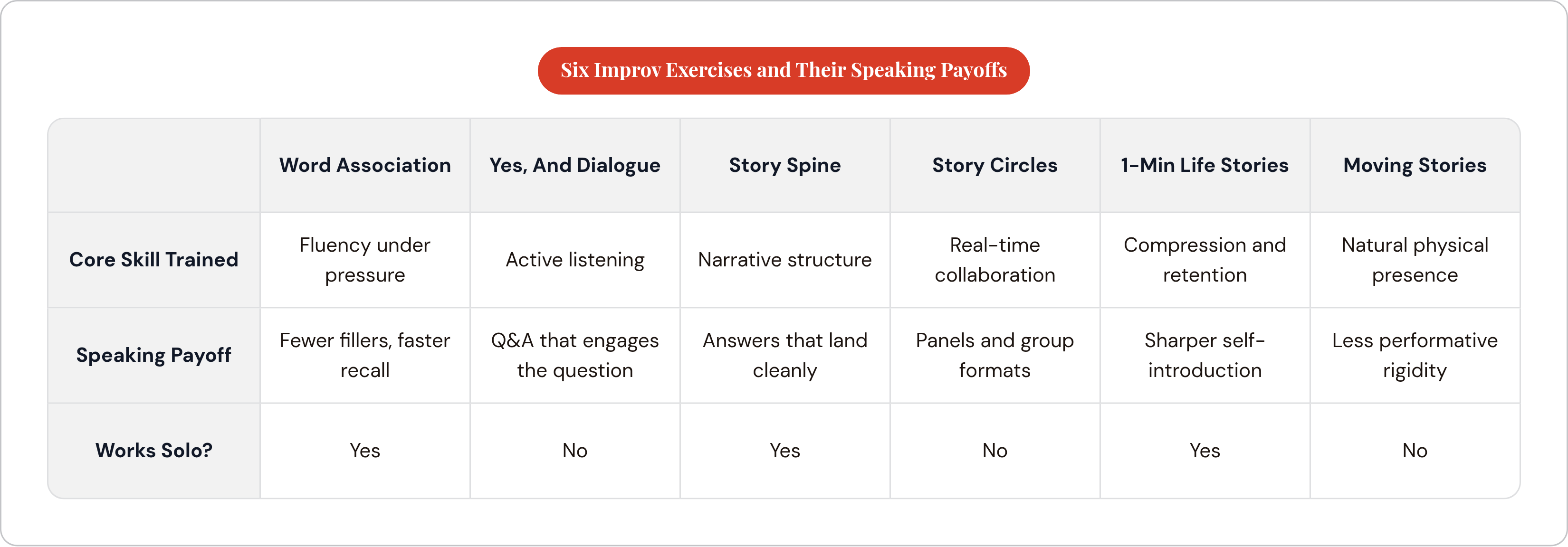
Each of these targets one discrete gap. None of them are about being clever, and the translation to real speaking situations isn't a stretch; it's built into the exercise.
Word Association. Respond instantly with the first word that surfaces, no filtering. This builds real comfort with whatever comes first and reduces the habit of over-editing before you speak. On stage it shows up as fewer filler words, less trailing off mid-sentence, and faster access to vocabulary when you're under pressure and your brain wants to go blank.
Yes, And Dialogue. Two people plan something together, first by denying each other's ideas, then by saying "yes, but," then finally by saying "yes, and." The contrast is almost uncomfortable to sit through, and that's the point; it makes the principle physically obvious rather than theoretical. This builds active listening as a habit rather than an intention, plus real momentum in conversation. The speaking payoff is Q&A that actually engages with the question instead of talking past it.
Story Spine. A scaffold: once upon a time, every day, until one day, because of that, until finally, ever since then. It builds narrative architecture under pressure, meaning you know where the story is headed before you've said the ending out loud. This is what separates a strong answer to "tell me about a time when" from a rambling one that never quite lands.
Story Circles. A group builds a story together, each person adding a piece and passing it along. It trains you to build on someone else's idea in real time and to let go of controlling exactly where the narrative goes. That skill translates directly to panels, group presentations, and any format where you're not the only voice in the room.
1-Minute Life Stories. One person tells their life story in sixty seconds; the listener repeats back as much as they can remember. It forces compression and forces you to prioritize what actually matters, and for the listener, it's a workout in retention. The payoff is obvious: it's the exercise that finally makes "so, tell me about yourself" less of a trap.
Moving Stories. Participants walk while telling a short personal story to a partner, movement and narration happening at once. It cuts down performative self-consciousness, because the body being occupied with movement seems to lower the threshold for personal disclosure and loosens physical rigidity that usually comes with standing still and being watched. The result is a more natural presence, a voice that sounds like a person talking rather than a person performing.
Why reps — not insight — produce the actual change
Here's the neuroscience in short form. The goal of any of this is to move a skill out of working memory, where conscious monitoring lives, and into procedural memory, where it runs without supervision. Working memory has a hard ceiling; overload it by monitoring your voice, your content, and the audience simultaneously, and performance craters. Procedural memory has no such ceiling, which is exactly why it's the target.
That transfer happens through repetition with feedback. Understanding the theory doesn't produce it, no matter how well you can define "active listening" on a whiteboard. Knowing the concept and having the skill are two entirely different things, and only one of them gets built by doing the exercise dozens of times. Repeated practice strengthens the relevant neural pathways, which is the same mechanism behind every trained skill from playing scales to throwing a curveball; the behavior gets less effortful the more times you run it.
Improv accelerates this specifically because it strips away every safety net. You can't prepare for what a scene partner is about to say. You can't edit your line before it comes out. You can't wait for a better moment. The uncertainty itself is the training stimulus.
Frequency beats duration here, which is a less intuitive point than it sounds. Short daily reps outperform occasional long sessions, because pathways consolidate through repetition, not through the total number of hours logged in one sitting. Habit research generally points to somewhere around two months of consistent practice before a new habit stabilizes into something automatic. A ten-minute daily practice sustained for that stretch will beat a single all-day workshop, every time.
What formal research on improv training has found in high-stakes fields
Improv-based communication training left the comedy club a while ago, and its deepest research base now sits in healthcare education, which tells you something about how seriously the field takes it.
A 2024 study by Fekete and colleagues, published in European Psychiatry, ran interprofessional workshops using applied improvisation for nurses, midwives, physicians, and speech therapists, tracking communication skills, resilience, and empathy before the workshop, immediately after, and again at three months out. A systematic review published in Advances in Health Sciences Education screened nearly two thousand published articles on medical improvisation and selected the strongest for synthesis; the recurring curricular goals across that body of work were interpersonal communication, interprofessional communication, and empathetic response.
The reason healthcare leads on this comes down to stakes. The cost of a communication failure in that field is immediate and visible. A physician who can't listen through a difficult conversation, who freezes when a patient says something unexpected, or who can't recover after a tense exchange produces measurably worse outcomes for the person in front of them. Medicine adopting improv training is a signal about how real the skill gap is.
The workplace evidence runs on a parallel track. Communication-skills training, of which improv is one applied form, has been shown to improve employee competence, confidence, and adaptability in workplace interactions, according to Hamlin and colleagues (2024). The through-line across every field that's studied this: improv works in high-stakes communication precisely because it trains the unscripted moments, the exact moments that formal training tends to skip entirely.
How to build an improv-based speaking practice without a class or a troupe
The most common objection I hear is "I'd need a group for that." That's true for scene work, but the exercises that actually build the underlying speaking skill adapt easily to solo practice.
Word Association adapts fine to solo practice: set a timer, speak out loud continuously on any topic, no pausing to think ahead. The constraint of no pausing is what forces the fluency. Story Spine works solo too: use the prompt structure to tell a spontaneous story into a voice recorder, then listen back and mark exactly where you hedged, where you stalled, where the thread got dropped. The 1-Minute Life Story format works the same way, applied to a prompt you've never seen before: record sixty seconds, then review for compression, for clarity, and for whether you actually landed somewhere or just wandered until the timer went off.
The daily prompt is the whole mechanism, honestly. A single new prompt each day recreates the exact condition improv depends on, which is genuine uncertainty about what you're going to say until the moment you say it. And the scoring, the playback, is what turns a rep into training rather than just talking to yourself in a room. Hearing the recording back is what reveals the hesitations, the filler words, the places where your thought and your language came apart mid-sentence; skip that step and the reps stop compounding.
One prompt, one recording, one score, repeated daily is a tight rep with immediate feedback, which is structurally identical to what a good improv class produces, minus the requirement of finding a troupe and a rehearsal space twice a week. Tracking a score over days and weeks also does something workshops rarely manage: it makes the progress visible, which gives the whole practice a direction instead of a vague sense that you're "working on it."
The speakers who improve fastest were never the ones who collected the most workshops. They're the ones who put themselves in front of genuine uncertainty every single day and actually paid attention to what came out of their mouths when they did.