Introverts Speaking Up in Meetings
Speaking up in meetings is a learnable skill that boosts career visibility and compensation.
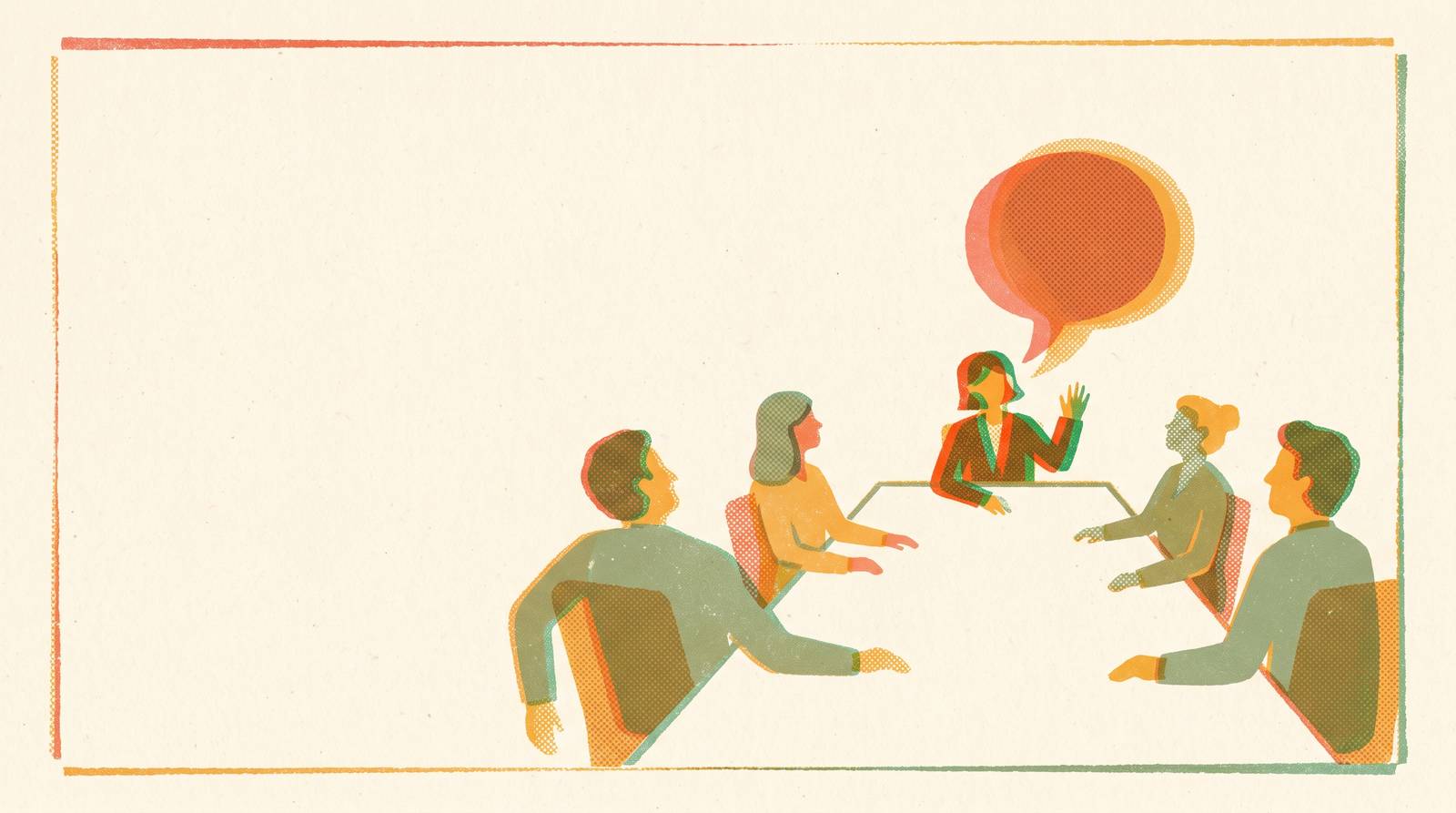
Only 70% of introverts find meetings effective, compared to 90% of extroverts. That 20-point gap does not reflect a difference in preparation, competence, or intellectual contribution. It reflects a design problem that organizations have spent decades misdiagnosing as a people problem, and the people absorbing that misdiagnosis are, quietly, paying for it.
Silence gets misread. Managers cannot see the thinking happening internally, so they see disengagement instead, and that perception compounds over quarters and years into consequences you find in compensation reviews and promotion cycles. Eighteen percent of employees have missed a promotion specifically because of poor communication, not poor performance. Separate categories. Routinely conflated.
The stakes are not abstract. LinkedIn's 2024 Workplace Report ranked communication as the single most in-demand skill for the second consecutive year, with 57% of global employers placing it above technical ability. That is a striking inversion of how most introverts have historically been rewarded, where depth of expertise was the primary currency and being the quietest person in the room who knew the most was, frankly, a viable career strategy. It is less viable now. Meanwhile, the Myers-Briggs Company reports that 56.8% of people globally identify as introverts, which means the quiet person in the room is not an outlier. The room is full of them, most of them underpaid relative to what they actually know.
This piece is not arguing that introverts need to become extroverts. It is arguing that the work they are already doing deserves credit, and credit, in most professional contexts, requires visibility.
How speaking up in meetings is actually a learnable skill, not a personality trait
The most obstructive belief introverts carry about themselves is that quietness is fixed, a feature of identity rather than a habit accumulated over years of reasonable-seeming avoidance. Understandable. Also neurologically inaccurate.
Verbal fluency under pressure is mediated in part by the prefrontal cortex, a region that brain-scanning research consistently shows is responsive to training. The introvert who finds real-time speech laborious is not working with a defective apparatus; they are working with an underused one. There is a meaningful difference, and the difference has implications for what is actually changeable.
Neuroscientist Dr. Ian Robertson has argued that confidence reduces to two core beliefs: "I can do this" and "this can happen." Both are built through accumulated small evidence, not through some prior endowment of charisma that you either received at birth or did not. Each time you push yourself to speak in a meeting, even briefly, even imperfectly, you are depositing a data point: speaking happened, something useful followed, no one visibly recoiled. The brain updates accordingly. Confidence and fluency develop in parallel, and both are products of repetition rather than innate wiring. This is not motivational rhetoric; it is how skill acquisition works.
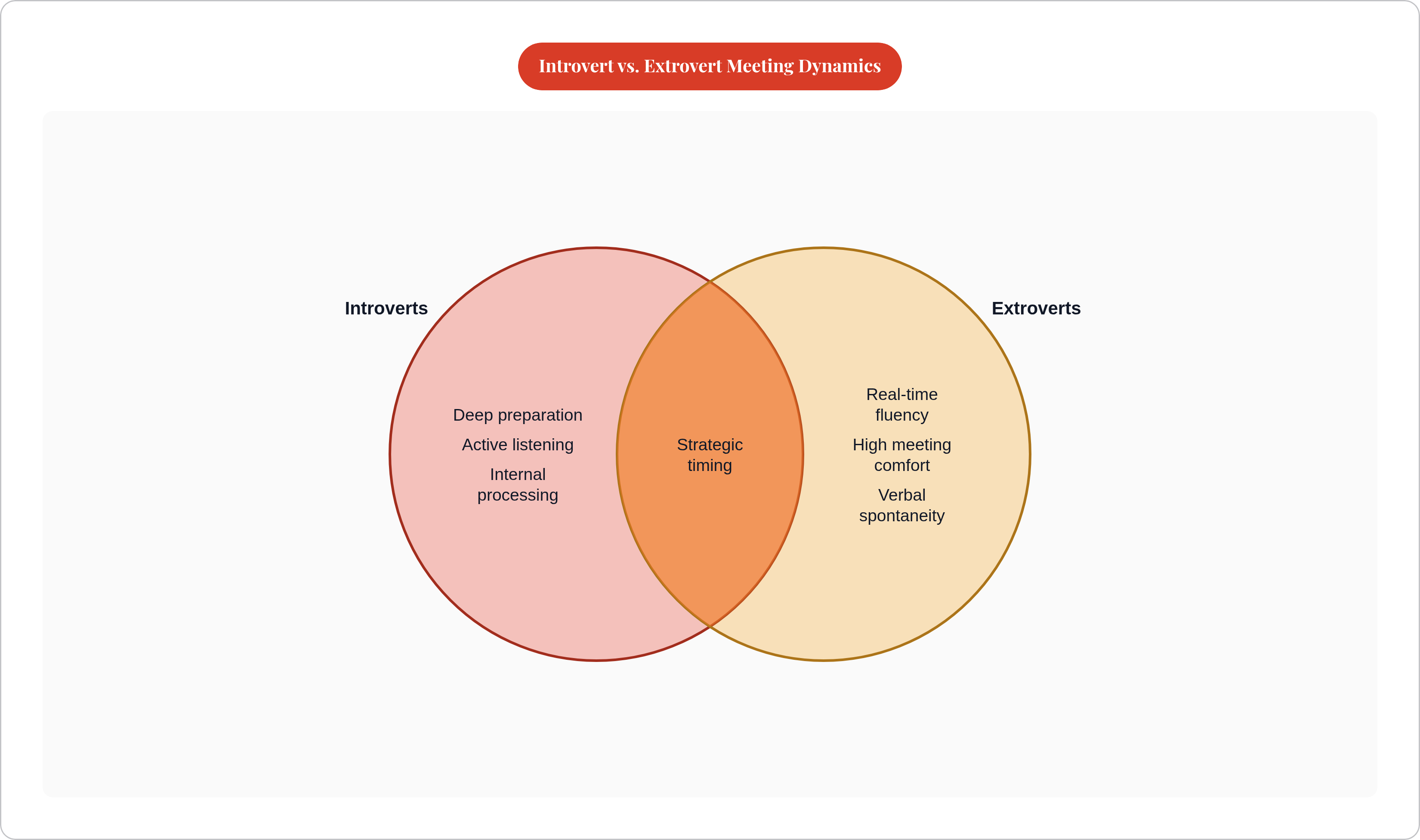
The reframe this piece is built on: introverts do not need to speak more. They need to speak more strategically. Quality over volume is not a consolation prize for people who find the room exhausting. It is the more sophisticated objective, and it plays to a genuine structural advantage.
Speaking in the first five minutes and other timing moves that change how you're perceived
Timing, in the context of meetings, is not a peripheral detail. It is where the leverage actually lives, and most people waste it.
Comments made in the first five minutes function as anchors. They create an impression that shapes how others interpret everything you say, or choose to withhold, for the rest of the session. An early contribution establishes presence before the hesitation spiral has time to begin. For introverts specifically, it also removes the mounting obligation to keep re-earning your seat at the table; one comment early defuses that pressure entirely, which is worth something even if the comment itself is unremarkable.
What you say does not need to be fully formed. A clarifying question about scope, a brief observation on the agenda, a restatement of the objective as you understand it: all of these count. The point is to signal that you are there and paying attention. The insightful contribution can come later once you have settled.
Before the meeting begins, identify the first agenda item you feel anything about, and commit in advance to saying one thing about it. That is the whole tactic. One thing. The micro-goal compresses performance pressure down to something manageable and begins building a track record of presence, which compounds faster than most people expect because the baseline they are comparing against is often close to zero.
The hesitation spiral, the familiar loop of waiting for exactly the right moment and watching it pass while someone else says something almost identical to what you were holding, becomes harder to break with every rotation. Breaking it early, when stakes are lowest and the floor is most open, is categorically easier than attempting it mid-conversation when the room has already developed its own momentum. The first five minutes are the path of least resistance. Use them before you have time to talk yourself out of it.
Preparation as the introvert's structural advantage
Preparation, in this context, is not about memorizing a script. It is about reducing cognitive load so that more mental capacity is available for the actual act of speaking, rather than being consumed by the real-time processing that makes fast-paced discussion genuinely exhausting for people who think before they talk.
Knowing your material two layers deeper than you intend to speak changes the confidence with which you deliver the surface level. If you plan to make three points, understanding enough to make thirty means you feel structurally supported in a way the audience never sees but almost always senses. You stop trying to remember and start trying to communicate, which sounds like a minor distinction until you are in the room and notice the difference.
Anticipating likely objections before the meeting converts surprise into recognition. Surprise demands real-time improvisation, which is precisely the condition introverts find most destabilizing. Preparation reframes the unexpected question as something you already thought about. That shift changes not just what you say but how it sounds when you say it, and the composure registers as expertise even when the question itself caught you slightly off guard.
Having the first two sentences of any intended contribution memorized is a tactic from professional communication coaching that is genuinely underused. The hardest moment of any spoken contribution is the beginning, that particular pause before the first word when the impulse to just let someone else talk is strongest. Pre-loading those two sentences bypasses that moment. What follows comes more naturally than you would predict from how difficult the beginning felt.
Pre-meeting outreach is also underutilized. Sending a question or a key point by email before the meeting means your idea already exists in the conversation when you walk in; you are referencing something established rather than introducing it cold. The reduction in pressure is immediate, and the idea gets the benefit of low-stakes prior consideration rather than live judgment.
Fluency in skilled communicators is, more often than not, the result of familiarity and preparation rather than natural talent. Introverts have been doing this instinctively in every domain except the one where it would help them most.
Three specific verbal moves that work in any meeting
These three techniques share one design principle: they let you contribute quality rather than volume. None of them require holding the floor for an extended period, and none of them require you to perform a kind of extroversion you do not actually possess.
Ask a question instead of making a statement. A well-constructed question signals critical engagement without requiring a fully formed position. "What would this look like if we prioritized X instead?" is not really a question; it is a contribution wearing the grammatical form of one. It invites others to respond to your framing, which means you shape the direction of the conversation without dominating it. Questions also land without the social friction of direct assertions, which matters considerably in rooms where hierarchy or politics complicates direct speech.
Synthesize the room. After a dense or contested exchange, stepping in with "If I'm tracking this correctly, we've landed on three things: X, Y, and Z. Does that capture it?" is a move with disproportionate impact. Introverts are often the sharpest listeners in any meeting precisely because they are attending to what others say rather than composing their next statement. Synthesis turns that listening into visible leadership and positions you as the person who holds the whole conversation together. That is, functionally, a form of intellectual authority, and it is one that rewards the very habits introverts already have.
The deliberate pause. Rather than filling silence with filler language, stop briefly before continuing. A pause does not signal hesitation; it signals composure. It gives you time to ensure precision before committing to phrasing, and it lends a quality of weight to what follows. Practiced communicators use this intentionally. It reads as confidence. Use it accordingly.
Reframing the purpose of speaking up so it doesn't feel like self-promotion
The self-promotion trap is real and it is specifically an introvert problem. Many introverts stay quiet not because they have nothing to say but because speaking feels like putting themselves forward, which conflicts with a self-concept built around substance over visibility. The discomfort is principled, which makes it harder to argue with, and which is probably why it persists so stubbornly.
Susan Cain has made the most useful reframe available on this point: public speaking is about serving the audience, not submitting yourself for judgment. Applied to meetings, this means speaking on behalf of a team, a client, an idea, or a project that needs a voice. You are representing something that cannot advocate for itself. That is a different internal posture than self-promotion, and it feels different in practice, not just as a conceptual framing but as a physical experience in the room.
Authenticity is not incidental here; it is the mechanism. The most persuasive quality in any room is genuine conviction, and introverts, who characteristically speak only when they mean it, carry a natural advantage that they routinely underestimate. The statement made with real belief outperforms the fluent one made out of habit or performance more often than most people assume, and the difference is usually legible to the room even when no one can articulate why.
Before contributing, ask: "Who does this help if I say it?" That shift in framing, from exposure to purpose, changes the emotional valence of the act and makes the decision to speak easier to execute without requiring you to resolve the underlying discomfort first.
How storytelling turns a single comment into something people remember
Data points delivered as plain statements are retained poorly. Stories are retained well. This reflects how the brain encodes and retrieves information: emotional resonance is the mechanism, and information without emotional context rarely sticks. Most high-stakes meeting moments, pitching an idea, navigating pushback, summarizing a recommendation, are really requests for people to see something differently. Facts alone rarely accomplish that.
I watched this play out in a way I have not forgotten. An analyst had spent three weeks building a model that exposed a critical flaw in her company's pricing strategy. She knew the numbers cold. At the meeting, she opened not with the data but with a customer her team had spoken to the previous month, a small business owner who had quietly switched to a competitor because the pricing felt unpredictable. She described what the customer said. She mentioned what she felt when she heard it. Then she showed what the model confirmed. The room, which had been doing the polite half-listening that characterizes most meetings where data is about to be presented, went quiet in a different way. The numbers had been available for weeks. The story made people feel the weight of them.
The meeting-ready story does not require length or theatrical delivery. Three beats: what you wanted, what you faced, how you resolved it. Contrast between a before and after, a clear cause-and-effect sequence, the rule of three for organizing details: these are compression tools. They make a narrative easier to follow and more persuasive without requiring additional time. A two-minute story built before the meeting requires almost no real-time improvisation, and for introverts, that is where the structural advantage lives.
Building the habit so these techniques become automatic
No single technique produces durable change on its own. The goal is to make speaking up feel less effortful over time, and that only happens through accumulated small exposures. A single meeting where you decide to reinvent yourself, then spend the drive home replaying everything that felt slightly wrong, will not move the needle.
Start with the lowest-friction version: one early question in a small meeting with a familiar group. Then graduate deliberately toward harder formats, larger rooms, more contested discussions, higher-stakes presentations. Comfort expands incrementally. Noticeable shifts in ease are commonly reported within one to two weeks of consistent small contributions; lasting change develops over several months of deliberate practice. That timeline feels slow until you consider that the alternative is another year of the same dynamic.
Deliberate practice is not mere repetition. It is repetition with feedback. Recording yourself, asking a trusted colleague what landed, noting which moves generated a response: without that loop, you are practicing in the dark and optimizing toward nothing in particular. The loop needs to close, which means you have to be willing to look at the data even when the data is uncomfortable.
Self-talk matters more than most people acknowledge. Negative internal framing, the chronic anticipation of embarrassment or irrelevance, activates the same fear response as a physical threat. Evidence-based self-talk, anchored in specific prior successes rather than abstract reassurance, activates the reasoning brain instead. "I made a useful synthesis last Thursday" is more effective than "I can do this" because the brain actually uses the specificity; the vague encouragement slides off. Your own track record is the most credible argument you have access to.
Taking deliberate note of positive feedback after speaking is not vanity. It is the data required to build a new association between speaking and safety. The techniques are the vehicle. The new association is where you are actually trying to go, and it is built not through insight but through evidence, one meeting at a time.