Projecting Confidence When Speaking in Public
Concrete vocal and physical techniques rewire how audiences perceive your authority.
Audiences are not passive. The moment a speaker enters a room, steps in front of a camera, or joins a video call, the reading begins. It draws on posture, pace, voice, and eye contact long before the first substantive claim lands, and it happens faster than conscious deliberation on either side of the room.
This matters because the phenomenon is behavioral, not mystical. The signals audiences respond to are concrete and learnable. When tone, pace, and body language reinforce the words, the message arrives with amplified authority. When they contradict it, even a well-structured argument loses its footing before it finds its legs.
One distinction needs establishing early: projecting confidence is not synonymous with feeling fearless. Carol Dweck's research on mindset identifies fear of failure and fear of rejection as the dominant drivers of public speaking anxiety, and none of that dissolves on command. What changes is the execution of the outward signals, which can be trained independent of how the speaker feels internally. The sections that follow cover the specific categories: voice, deliberate silence, physical presence, eye contact, and pace.
How your voice carries authority. Or gives it away
Voice is frequently the only instrument a speaker has. Without slides, props, or visual aids, the voice does all the work, which means its deficiencies are also fully exposed.
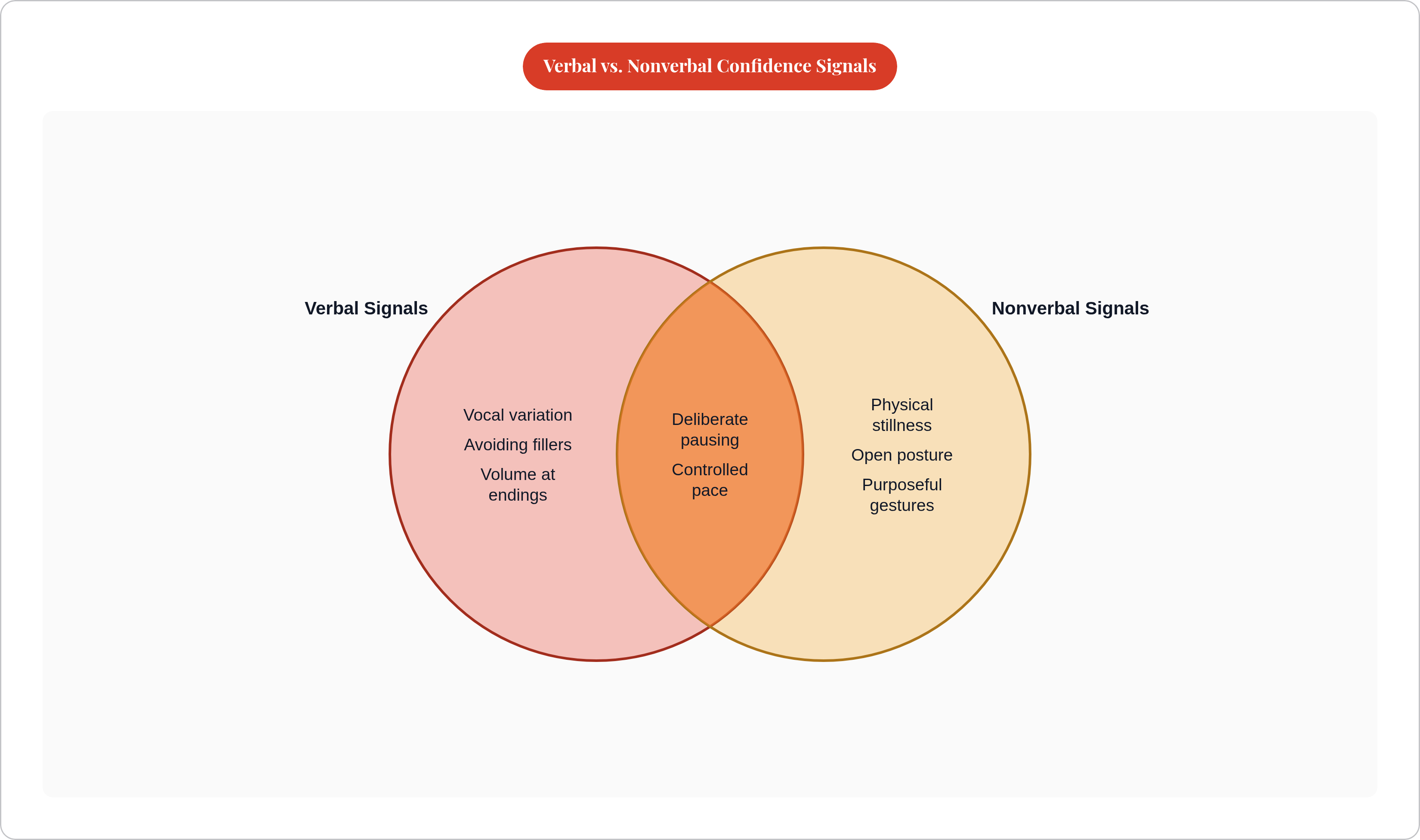
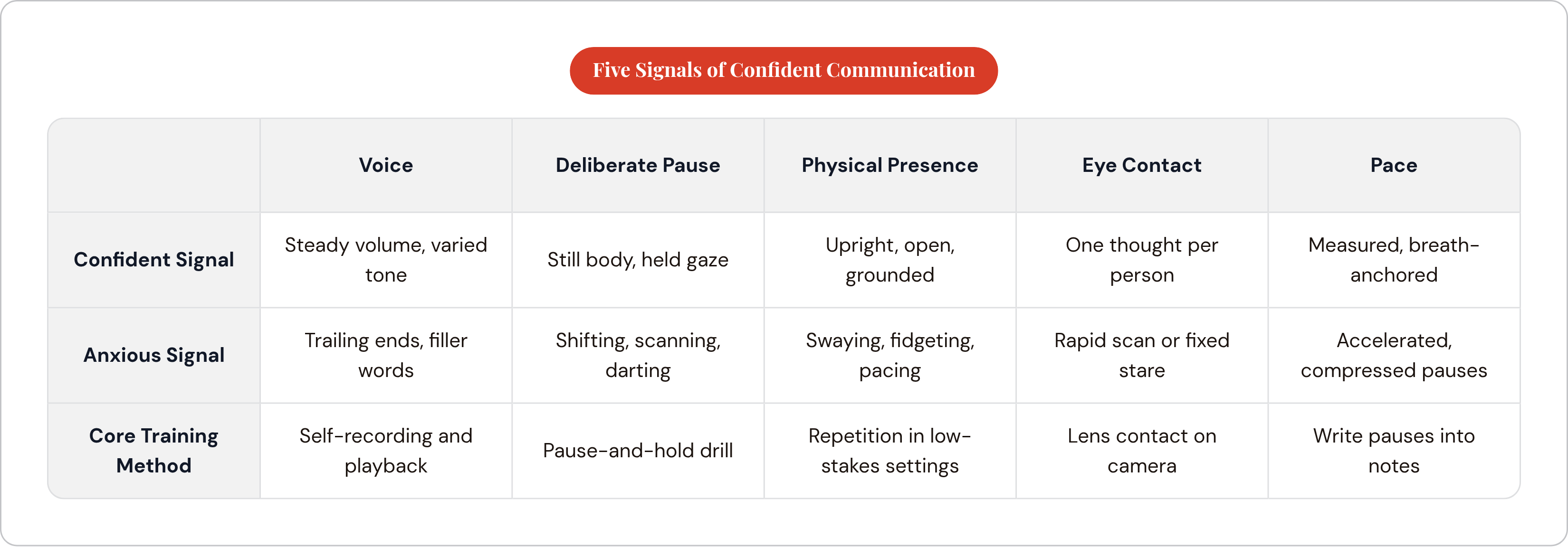
Four vocal levers bear most directly on perceived authority. Pace: slowing down signals control; rushing signals anxiety, and audiences register the difference without being told to look for it. Volume at sentence endings: dropping off at the close of a statement reads as uncertainty, as if the speaker is withdrawing from the claim the moment it leaves their mouth. Vocal variation: monotone delivery flattens authority irrespective of how strong the content is; a speaker who sounds identical from sentence to sentence sounds, above all, disengaged. And verbal fillers: the ubiquitous "um," "uh," "like," and "you know" signal unpreparedness with impressive efficiency. The listener's brain flags them as evidence the speaker is searching, not delivering.
Here is the inconvenient mechanism underneath all of this. Verbal fluency under pressure depends on cognitive speed, working memory, and emotional regulation. Anxiety constrains all three simultaneously. The goal is not to banish nerves; it is to manage the physiological state well enough that retrieval stays smooth and the fillers stay down.
Self-recording is among the highest-leverage practices available. Vocal habits are notoriously difficult to perceive in real time. Playback surfaces filler patterns, pace problems, and volume drops that feel completely invisible while speaking. Most people listen to a recording of themselves once and learn more in four minutes than they would from a dozen well-meaning friends offering feedback over drinks.
What deliberate pausing does that no amount of talking can
Most speakers fill silence because silence is uncomfortable. The impulse is understandable and counterproductive in equal measure, because audiences read all of that filling as nervousness.
A deliberate pause does the opposite. It signals that the speaker controls the room's tempo, that the silence belongs to them rather than happening to them. Pauses also do several things at once: they give the audience time to absorb a point before the next one arrives; they create emphasis, because what follows a pause receives more cognitive weight than what precedes it; and they give the speaker an opportunity to breathe and regulate, which keeps the voice steady and the pace from accelerating into a kind of verbal sprint.
The distinction between a confident pause and an anxious one is entirely in the speaker's body during the silence. A grounded, still speaker who pauses reads as purposeful. A speaker who pauses while shifting weight, scanning the room, or breaking eye contact reads as lost. Same duration; entirely different signal.
The practical drill is simple in principle and difficult to execute with a straight face: end a sentence, stop, make eye contact, then continue, without bridging with a filler word. Run that drill until it stops feeling like a near-death experience. Then run it some more.
How posture and physical stillness shape the room's perception of you
Body language is not decorative. It either confirms the authority the voice is projecting or quietly dismantles it, and it communicates before the speaker opens their mouth.
High-confidence physical signals follow a coherent logic. Upright, open posture with weight balanced and shoulders back occupies space and communicates groundedness. Physical stillness (specifically the absence of swaying, pacing, and fidgeting) reads as calm authority. Purposeful gestures, hands that illustrate or emphasize a point, look deliberate. Hands that flail, wring, or retreat into pockets look uncertain. The underlying principle is simple: occupy the space you're standing in rather than apologizing for it.
Fidgeting is a recognized behavioral expression of public speaking anxiety, and audiences read it as such even when the speaker's words are strong. The verbal and nonverbal signals exist on separate tracks only in theory; they combine into a single composite impression, and a composed message delivered by a fidgeting body loses something significant in translation.
Physical stillness is, in practice, the hardest signal to train because it requires overriding nervous-system impulses that are not under voluntary control in the heat of the moment. Nobody warns you about that part. The only reliable method is repetition in low-stakes settings, enough repetitions that stillness becomes the default state rather than a conscious override.
Eye contact as the signal that you believe what you're saying
Eye contact is the primary channel through which an audience feels addressed rather than broadcast at. An audience that feels addressed is engaged. An audience that feels broadcast at is, functionally, being read to.
Three common mistakes account for most of the eye contact failures in high-stakes speaking. Scanning the room too quickly, eyes bouncing from face to face, reads as anxiety or disengagement; it looks like the speaker is searching for an exit. Staring at notes or slides signals unpreparedness and breaks the relational connection entirely. Locking onto one friendly face in the second row keeps that person engaged and communicates to everyone else that they are invisible in the room.
Confident eye contact looks like this: landing on one person long enough to complete a thought, roughly one sentence, then moving deliberately, not darting. The dwell time is long enough to register as intentional contact rather than an accident of peripheral vision.
Sustained eye contact implies the speaker believes what they're saying enough to hold the room's gaze while saying it. It is, structurally, an assertion of confidence that runs parallel to the verbal one. The two reinforce each other.
For anyone whose high-stakes communication happens increasingly on camera, the equivalent of eye contact is looking at the lens rather than the screen. Looking at the screen while speaking appears, on the other side of the call, as a speaker who is looking slightly downward or away. The lens is the contact point. It is a small adjustment with a disproportionate impact on how present and credible the speaker appears.
Why pacing yourself is harder than it sounds, and how to actually do it
Under adrenaline, speech accelerates. The speaker feels normal, possibly even deliberate. The audience hears a rush. This is the central calibration problem of public speaking pace: the internal clock speeds up with the nerves, so felt pace and actual pace diverge without any subjective warning.
The consequences compound quickly. Fast pace compresses pauses, flattens vocal variation, and makes it harder for listeners to track complex arguments. The speaker who is moving fastest is often, paradoxically, communicating least. There is something almost darkly funny about that. The more urgently you need to land a point, the more the adrenaline makes you blow past it.
Three practical interventions address this reliably. Record and play back before any high-stakes delivery; the gap between felt pace and actual pace is almost always surprising the first several times, and that surprise is the corrective. Anchor pacing to breath, because a full inhale before a new point naturally inserts a micro-pause and slows the overall rhythm without requiring conscious intervention during delivery. Build structural pauses into notes as written cues at transitions and emphasis points rather than leaving them as improvised decisions under pressure.
A 2025 study of 300 students found a moderately significant positive correlation, r = 0.503, between self-esteem and public speaking skill. As delivery mechanics become more automatic through practice, self-trust rises, and self-trust relaxes pace. The relationship runs in both directions.
The specific role repetition plays in making these signals feel natural
Past negative experiences and lack of rehearsal opportunities are the strongest predictors of high public speaking anxiety. The logical corollary is that repeated, safe exposure significantly reduces it. The reason most people fail to benefit from this is that avoidance interrupts the exposure loop before it can compound, which is one of the tidier self-defeating cycles available to us.
Deliberate practice has a specific meaning: working just beyond current proficiency, not running the same comfortable speech again. Comfort is not the unit of measurement. Progress is. The two are often mutually exclusive at the early stages, and that discomfort is not a sign something has gone wrong.
Research on habit formation in skill-building contexts shows that a consistent streak of short, daily speaking practice across even a two-week window produces measurable improvement in self-reported confidence. The unit of practice does not need to be a formal speech. A two-minute recording in a quiet room counts. A rehearsed answer to a single question counts. Volume of reps matters more than the prestige of the venue.
What accelerates the loop is specific, quantitative feedback rather than vague encouragement. Knowing you used filler words eleven times in a three-minute recording is actionable. "Good job" fails to move the needle. Video self-review is particularly valuable because seeing yourself closes the gap between self-perception and audience perception in a way that no second-hand description can replicate.
The target is automaticity. Signals that begin as deliberate choices (the pause before continuing, the grounded stance, the eye contact held through a full sentence) eventually become default behavior. When they do, they stop consuming cognitive bandwidth and free the speaker to focus on the message rather than the mechanics. That is when public speaking stops feeling like a performance and starts feeling like communication.
What's actually at stake for people who build this and people who don't
The stakes are professional and, at this point in the labor market, quantifiable. According to High5Test's 2024-2025 workplace communication statistics, 57% of global employers rank communication as the single most desirable skill in a new hire, ahead of technical ability. Eighteen percent of employees have missed a promotion specifically because of poor communication. Leaders with strong presentation and interpersonal skills are 19 times more likely to earn top performance ratings.
The gap is also widening. Forbes reported in 2024 that over half of Gen Z say their in-person social skills have declined. The people who do put in the reps are pulling further ahead of a field that is, on average, regressing.
The signals covered in this piece (voice, stillness, eye contact, pace, the deliberate pause) are not advanced techniques reserved for executive coaches and TED stage hopefuls. They are the baseline of what confident communication looks like. Chapman University's 2024 Survey of American Fears found that 30% of Americans avoid jobs requiring public speaking and 45% have passed up a promotion because of it. That is not a niche professional liability. That is a large portion of the workforce voluntarily ceding ground.
Confidence in a room, on camera, or in a high-stakes conversation is not a personality type. It is a set of behaviors that respond to practice. The gap between the people who know that and the people who remain unaware is getting harder to close the longer it stays open.