Speaking Confidently and Clearly in Everyday Life
Most speakers treat confidence as fixed, but vocal habits and breathing are learnable skills.
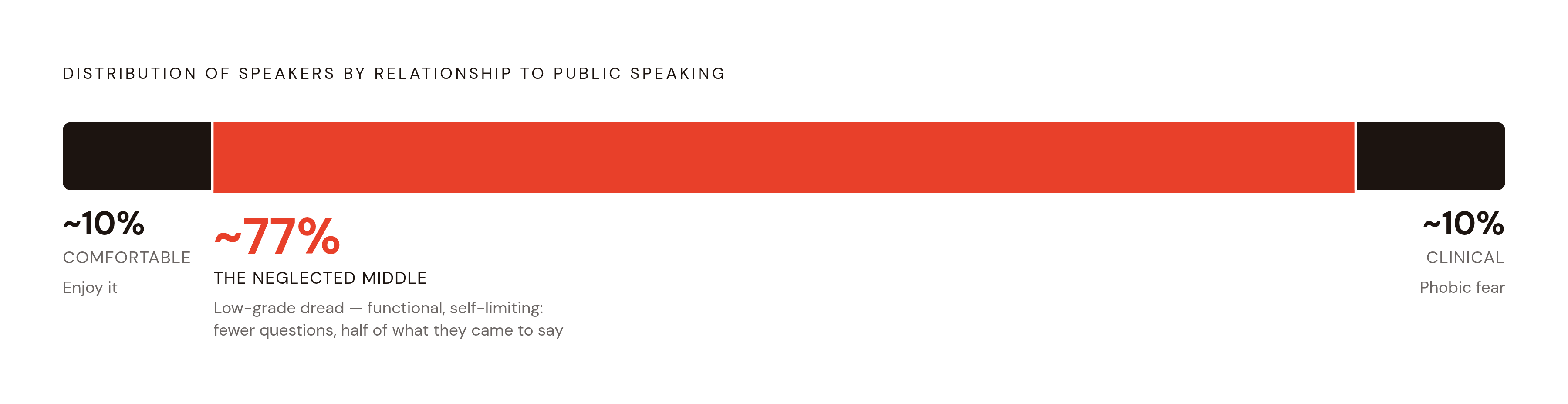
Roughly 77% of adults report some fear of public speaking. That figure gets cited constantly, usually to make anxious speakers feel better about their company. It does that job fine. What it obscures is more interesting.
Only about 10% of people enjoy speaking in public. Another 10% or so experience fear severe enough to qualify as clinical. Everyone else, the sprawling, uncomfortable middle, manages low-grade dread well enough to function but poorly enough to self-limit. They take fewer questions. They volunteer less. They leave the meeting having said half of what they came to say. This is not a clinical population requiring intervention. It is most of the workforce, most of the time, quietly shrinking.
That raises a question: if the anxiety is this common, and the techniques for managing it are well-documented, why does almost nobody do anything about it? Fewer than 10% of people experiencing speaking anxiety ever seek structured help. The gap between prevalence and action is the real problem, not the anxiety itself.
Part of the answer is framing. Most people treat speaking anxiety as a personality trait, something issued at birth to some and withheld from others. That framing is both wrong and convenient, because it lets you off the hook. If confidence is innate, there is nothing to practice. If it is a learnable skill, you have been wasting time.
Confidence does accumulate with experience. Younger speakers consistently report higher anxiety, and that trajectory is real. But waiting for experience to arrive on its own is like waiting for a bus that runs on no fixed schedule. You will get there eventually. You will also spend a lot of time standing in the cold.
What the Voice Signals Before a Single Word Lands
Yale psychologist Michael Kraus found that people read emotions more accurately from voice alone than from facial expressions or from combined audio-visual input (Kraus, 2017, Journal of Experimental Psychology: General). Sit with that for a moment. The voice, stripped of everything else, is the most emotionally legible channel available. Most speakers spend almost no time thinking about it.
Pitch is the most underestimated variable. A speaker's most authoritative register sits in the lower third of their natural range. Under stress, the opposite happens: pitch climbs, pace accelerates, and the voice starts broadcasting anxiety before the content has any chance to land. Uptalk makes this worse. When declarative sentences end on a rising tone, they stop sounding like statements and start sounding like questions. It is a credibility leak that runs continuously, often without the speaker's awareness.
Vocal habits are ingrained — in many cases, decades old. That is worth taking seriously. But six weeks of structured vocal practice with feedback has been shown to reduce self-reported anxiety in speaking situations and improve how observers rate a speaker's confidence. Most practitioners see real, externally perceptible improvement in eight to twelve weeks. For habits that have been running since adolescence, that is a short runway.
Using Breath and Pauses as Active Tools, Not Passive Gaps
Stephen Porges's polyvagal theory offers a useful explanation for something speech therapists have known practically for decades: slow, deep breathing activates the parasympathetic nervous system (Porges, 2011, The Polyvagal Theory). It directly counters the physiological cascade that raises pitch, compresses pacing, and makes a speaker sound like they are outrunning their own sentences. Diaphragmatic breathing is not a relaxation technique dressed up as communication advice. It is a direct intervention on the biological substrate of anxiety.
The practice itself is almost embarrassingly simple: one hand on the chest, one on the belly, breathe so the belly moves first. Three slow breaths before a high-stakes conversation can meaningfully lower the baseline. Mid-conversation, a deliberate breath before responding replaces a filler word and buys real processing time. The mouth is closed; the brain is working; the listener reads it as composure.
Most speakers treat silence as a problem requiring a solution. Deliberate pauses of two to three seconds after key points have been shown to improve audience recall and register as confidence rather than hesitation. The catch is that silence feels much longer to the speaker than to the listener. The discomfort is real; the awkwardness is largely imagined.
Silence is not a gap to fill. It is punctuation.
What Filler Words Actually Signal, and When Cutting Them Matters Most
"Um" and "uh" do real conversational work. Research on discourse markers suggests they function as floor-holding signals: "uh" indicates a short upcoming delay, "um" a longer one (Clark & Fox Tree, 2002, Cognition). In informal conversation, they prevent interruption and signal active processing. Treating them as pure noise, something to be surgically removed from all speech, misunderstands their function.
Context changes the calculus entirely. Analysis of TED talks found that speakers using fewer than two filler words per minute received substantially higher credibility ratings than those using six or more. The gap is large enough to matter. The drivers of overuse in formal contexts are consistent: pace that is too fast, preparation that is too thin, and anxiety doing both. The fix is not more words and not a different sound. It is the pause.
In casual conversation, occasional fillers are fine and appropriate. In presentations and leadership contexts, the target is roughly two per minute or fewer. Worth asking: what is the filler actually doing in a given moment? Is it buying time for a thought that is forming, or is it filling silence that the speaker is afraid of? That distinction determines whether it is serving the speaker or costing them.
How Body Language Either Confirms or Undercuts What the Voice Is Doing
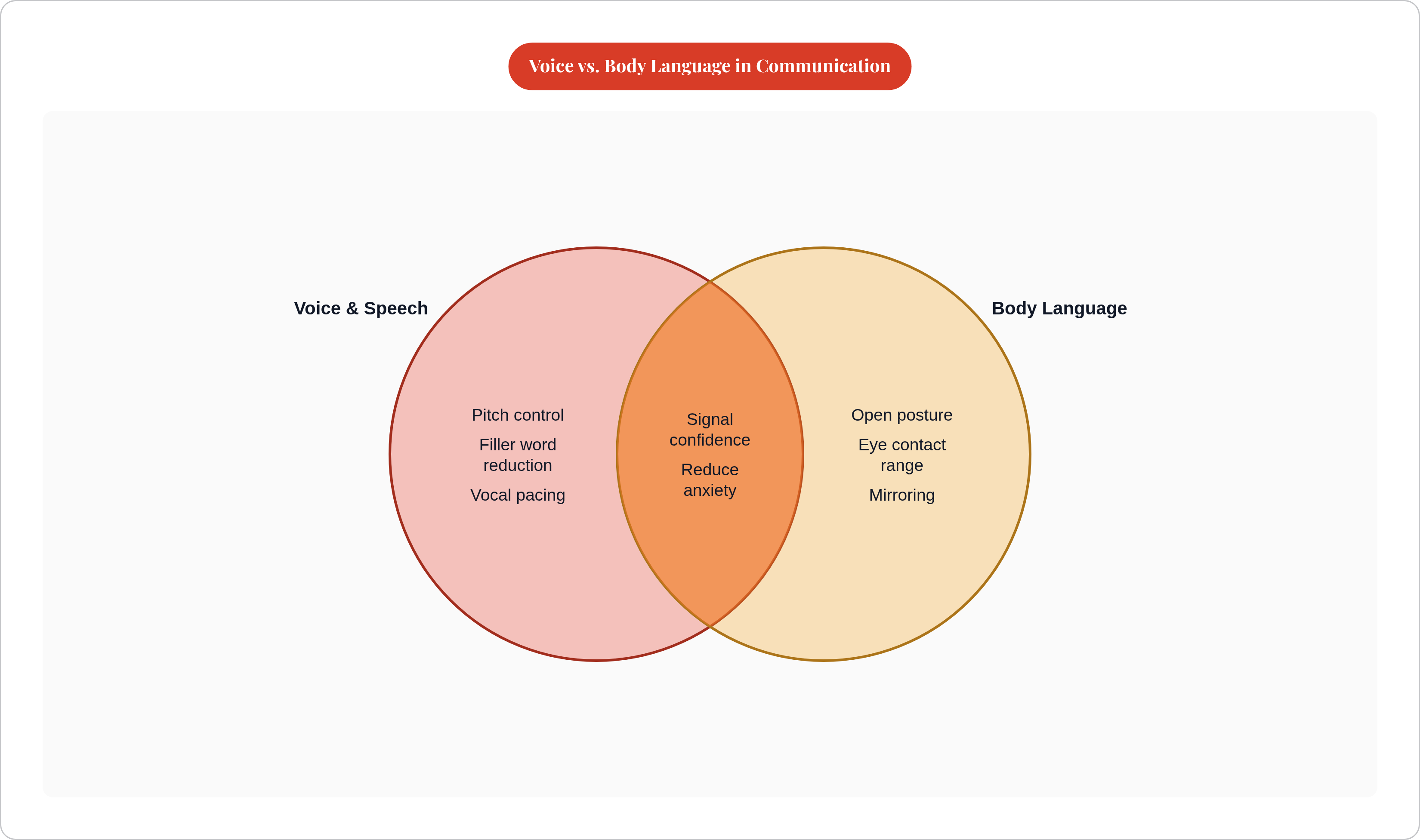
Albert Mehrabian's 1967 research on inconsistent messaging gets routinely overstated; the precise percentage breakdowns of verbal versus nonverbal communication do not hold up well outside very specific experimental conditions (Mehrabian, 1967, Journal of Consulting Psychology). What does hold up is the directional finding: when words and body language conflict, listeners consistently weight the nonverbal signals more heavily. The body is always speaking. The question is whether it is saying the same thing as the mouth.
Posture matters more than most speakers realize and less than the power-posing literature briefly suggested. The hormonal claims from that research did not replicate. What does replicate is this: open, expansive posture is consistently associated with perceived confidence and competence, and maintaining that posture before a high-stakes interaction increases felt confidence in the speaker. The internal shift has real downstream effects on performance, even if the mechanism is not what the original researchers claimed.
Eye contact operates within a range. Somewhere between 60 and 70% of the time reads as engaged and trustworthy; gaze avoidance consistently reduces perceived trust. One practical approximation: hold gaze for one full sentence per person in a group, then move. Worth naming explicitly that in some cultural contexts, sustained eye contact reads as confrontational rather than confident. Calibrating to the audience is not a caveat to the rule; it is the rule.
It is also worth considering mirroring, the subtle matching of another person's posture and gestural rhythm. It increases rapport and reduces conversational friction. At sufficient subtlety, it is largely invisible to the person on the receiving end. That last part matters more than it sounds.
Why Listening Well Makes You a More Confident Speaker
The counterintuitive move: the fastest path to more confident speaking is to spend more time not speaking. Active listening, as defined by the International Listening Association, is a specific set of behaviors: paraphrasing, asking clarifying questions, maintaining nonverbal engagement. Not a disposition, not a talent. A skill with discrete, trainable components.
Effective listeners retain more information from conversations, and that informational advantage directly reduces word-finding anxiety. When you have absorbed what someone said, formulating a response requires less effortful search. The hesitations and fillers that come from scrambling for a thought thin out naturally when the thought is already there. Listening is, among other things, covert preparation.
The practical cues are not complicated: eye contact, periodic head-nodding, brief backchanneling, paraphrasing before responding. These behaviors signal presence, and they buy the speaker processing time without announcing that processing is happening. When you listen well, the person you are with becomes more engaged and more forthcoming, which reduces the pressure on you to fill every silence. The speaking problem partially dissolves when the listening improves.
Word Choice Habits That Signal Command Rather Than Hedging
Language has tells. "I just wanted to suggest," "maybe it's sort of like," "I think perhaps." Each construction systematically undersells the idea attached to it. Hedge words function as a credibility tax paid upfront, before the listener has even evaluated the content.
The mechanism is not subtle. Hedging communicates that the speaker is not fully committed to their own point. The listener receives that signal, adjusts accordingly, and trusts the content less, often unconsciously. It is the verbal equivalent of arriving to an important meeting having done half the preparation. You showed up. But you have already told the room something important about how seriously you take the occasion.
But what if hedging is simply honesty? Epistemic humility is a real thing, and overcorrection toward false certainty has its own costs. The distinction worth drawing is between genuine qualification ("the evidence here is mixed") and reflexive qualification ("I might be wrong, but maybe"). The former is intellectual rigor. The latter is anxiety made audible.
Vocabulary range matters here too, though not for reasons of performance. A broader active storehouse means fewer mid-sentence searches, which reduces fillers and keeps pacing fluid. The goal is not to sound impressive. It is to reduce the friction between thinking and speaking so that the thought arrives in something close to its intended form. Direct language paired with open posture sends a coherent signal across every channel simultaneously. Hedged language paired with closed posture broadcasts uncertainty the same way, just in both directions at once.
Building the Habit Through Low-Stakes Daily Practice
Consider a speaker named Marcus — a mid-level manager who had attended three communication workshops over five years and absorbed exactly none of them, because each had asked him to perform in front of strangers on day one. He spent the first session of each workshop watching his own hands. By the third session, he had already mentally checked out. He did not have a speaking problem. He had a starting problem. What finally worked was recording himself leaving a voicemail to a colleague — alone, with no audience, with the freedom to re-record as many times as he needed. He listened back once. He hated it. He did it again the next day. Six weeks later, his team lead asked him what had changed.
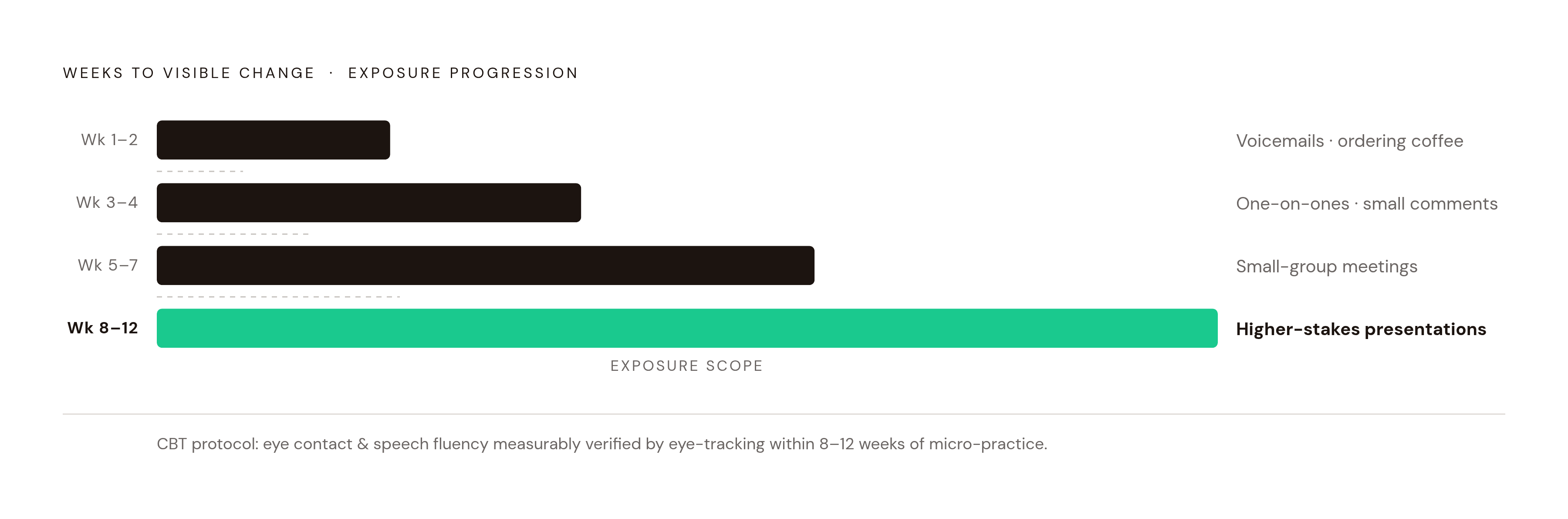
The exposure logic is incremental by design. Begin with low-stakes, familiar contexts: a one-on-one conversation, a brief comment in a small meeting, an introduction to someone new. The goal is not to perform; it is to repeat the mechanics in a setting where the cost of an awkward pause is essentially zero. From there, the complexity scales. A 12-week CBT-based training protocol produced measurable improvements in eye contact and speech fluency in anxious speakers, verified by eye-tracking rather than self-report. That is a meaningful bar.
The daily training ground is already available and mostly ignored. Ordering coffee. Leaving a voicemail. Asking a question in a meeting where you already know the answer. Each is a no-stakes repetition of pacing, posture, and eye contact. These micro-interactions are not trivial filler between the real moments. They are where the real moments get built.
Eight to twelve weeks of consistent effort produces visible, externally perceptible change. Not perfection. Not a personality transplant. Perceptible change, which is enough to shift how rooms receive you, and, eventually, how you expect them to.