Video Recording Tools for Self-Review Practice
Research shows video self-review transforms how speakers hear themselves.
A 2024 peer-reviewed literature review published in the International Journal of AI in Language Education found video recording demonstrably effective at improving fluency, pronunciation, and self-confidence in speakers. That finding matters. Everything else here is downstream of it.
The core mechanism is simple and slightly uncomfortable: video gives you a simultaneous external view of both verbal and nonverbal behavior, and your internal sense of how you're coming across is, almost without exception, wrong. You thought you made steady eye contact. The footage shows you looking at the ceiling every time you searched for a word. You thought your pace was measured. The recording reveals you rushed through the entire second half like you had somewhere to be. The gap between self-perception and observed reality is not a personal failing; it is a structural feature of being someone who cannot watch themselves from the outside while performing. Think of it this way: your self-image is a portrait you painted from memory, and video is the mirror you never knew was missing.
What makes footage particularly potent is the metacognitive loop it activates. Watching yourself speak forces self-assessment in a way that real-time performance physically cannot, because you can pause, rewind, and start noticing patterns across sessions rather than impressions from a single moment. One finding from the research is worth naming directly: learners who watched their own recordings became, in the researchers' own words, "so irritated" by their filler word frequency that they trained themselves to eliminate the habit. Someone else pointing out your filler words does not carry the same visceral weight as hearing yourself say "um" eleven times in ninety seconds. Coaching tells you the problem. Footage makes you feel it.
A 2023 systematic review in PLOS ONE covering physician self-assessment found that benchmark video review improved self-assessment accuracy, with experienced practitioners showing particular benefit. The more you already know about your domain, the more precisely video review calibrates your self-perception. There is something almost perverse about that dynamic. The people who are already competent extract more value from watching themselves than the people who are just starting out.
One critical nuance the research surfaces: video review alone did not consistently produce significant improvement in fluency. Improvement came when review was paired with active, specific criteria. Practitioners needed to know what to look for. Passive replay is just footage.
The setup that makes footage actually useful
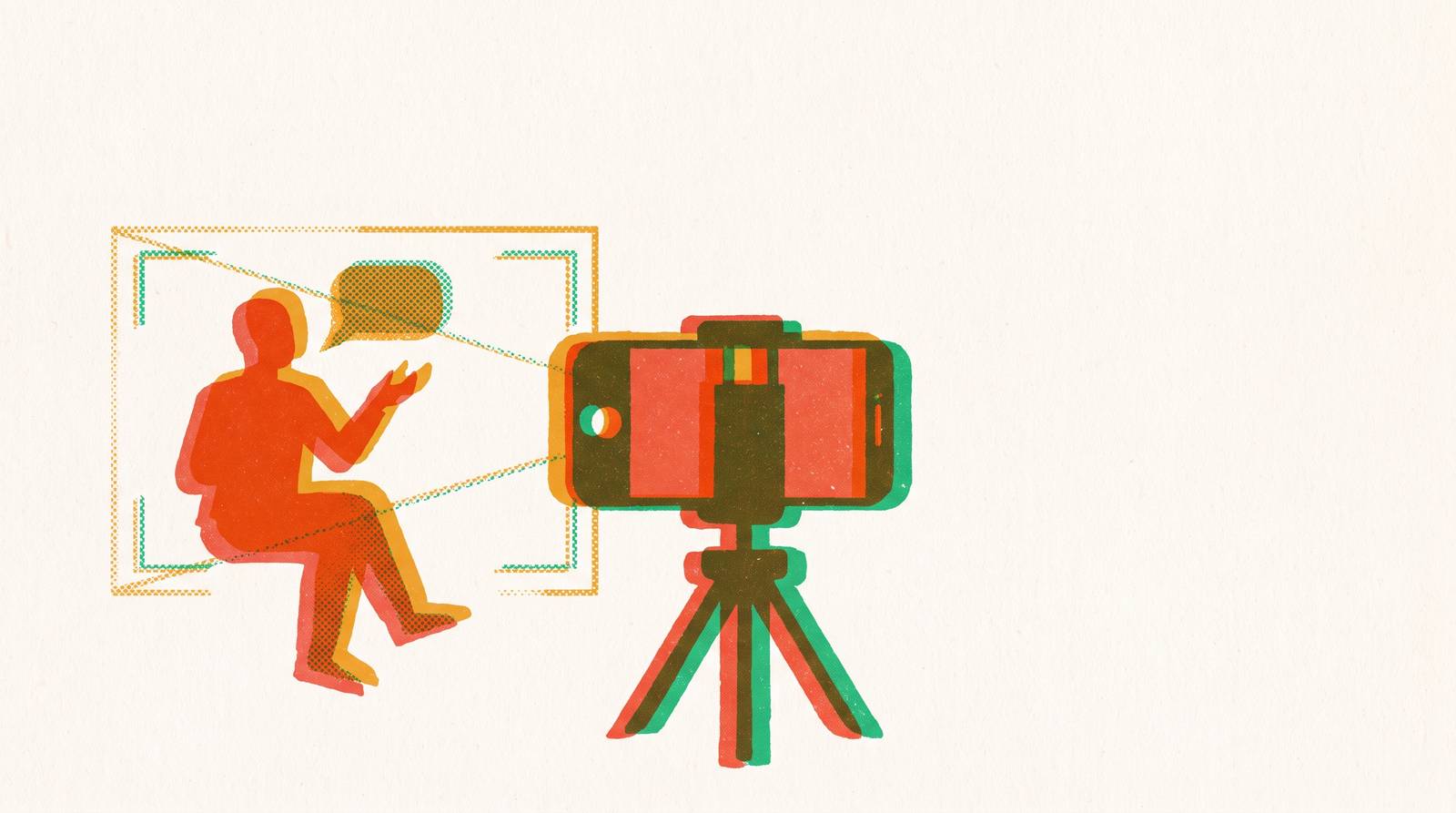
Camera angle is non-negotiable: eye level. Shooting from below makes you appear submissive; shooting from above eliminates the body language you need to review. A laptop stacked on books or a basic tripod solves this for nothing.
Frame from chest or shoulders up, not just the face. You need to see hand gestures and shoulder posture. A tight talking-head shot hides half your nonverbal behavior.
Lighting should come from the front. One lamp placed slightly off-center is sufficient. A window behind you creates silhouette; bad lighting flattens expression and makes your delivery harder to assess on review. For audio, the built-in microphone is usually adequate. What matters is that you can clearly hear filler words, pace changes, and dropped sentence endings. If the room echoes badly, monitor playback through earbuds.
Keep the background neutral and uncluttered. A busy visual environment pulls the eye away from your face during review, and you will miss the nonverbal signals you are supposed to be studying.
Recording length should be short: sixty seconds to three minutes per session. Long recordings create avoidance. Short recordings get watched, reviewed, and repeated. Frequency is the goal.
Consistency matters more than perfect setup. Same angle, same space, same rough conditions each session, so that footage from Week 1 and footage from Week 8 are actually comparable. Inconsistent setups make comparison meaningless, and comparison is the whole point.
One underrated move: record a cold take first, before any rehearsal. It shows your real baseline, the version of you that shows up unprepared, which is often the version other people actually see.
What to look for when you watch the footage back
Watch without sound first. Observe posture, eye contact, hand movement, facial expression. Your body communicates before your words do, and isolating the visual track forces you to assess it on its own terms.
Then listen without watching. Close your eyes or look away from the screen and hear your pacing, your filler words, where your energy drops, and where your sentences lose their endings. Separating the audio from the visual makes each channel legible in a way that combined review obscures.
Then watch and listen together. This is where the gaps surface: does your tone match your content? Does your face go blank at the exact moment your words are supposed to land?
Five things worth tracking across sessions: filler words, noting frequency over time rather than presence or absence; pace, particularly where you rush, which almost always signals anxiety; deliberate pauses after key points, whose absence is a reliable red flag; eye contact, specifically where your gaze goes when you're searching for a word; and energy arc, whether your delivery fades as you proceed and whether your voice drops at sentence endings. That last one is a consistent tell for uncertainty.
Pick one or two of those five things to focus on per session. Trying to fix everything at once produces nothing.
Write one sentence after each review: "This session I noticed ___ and next time I'll ___." It externalizes the insight, prevents you from recycling the same observation the following week, and creates a running record of development that becomes genuinely interesting to look back at six months later.
Tools that add structure and feedback to the review habit
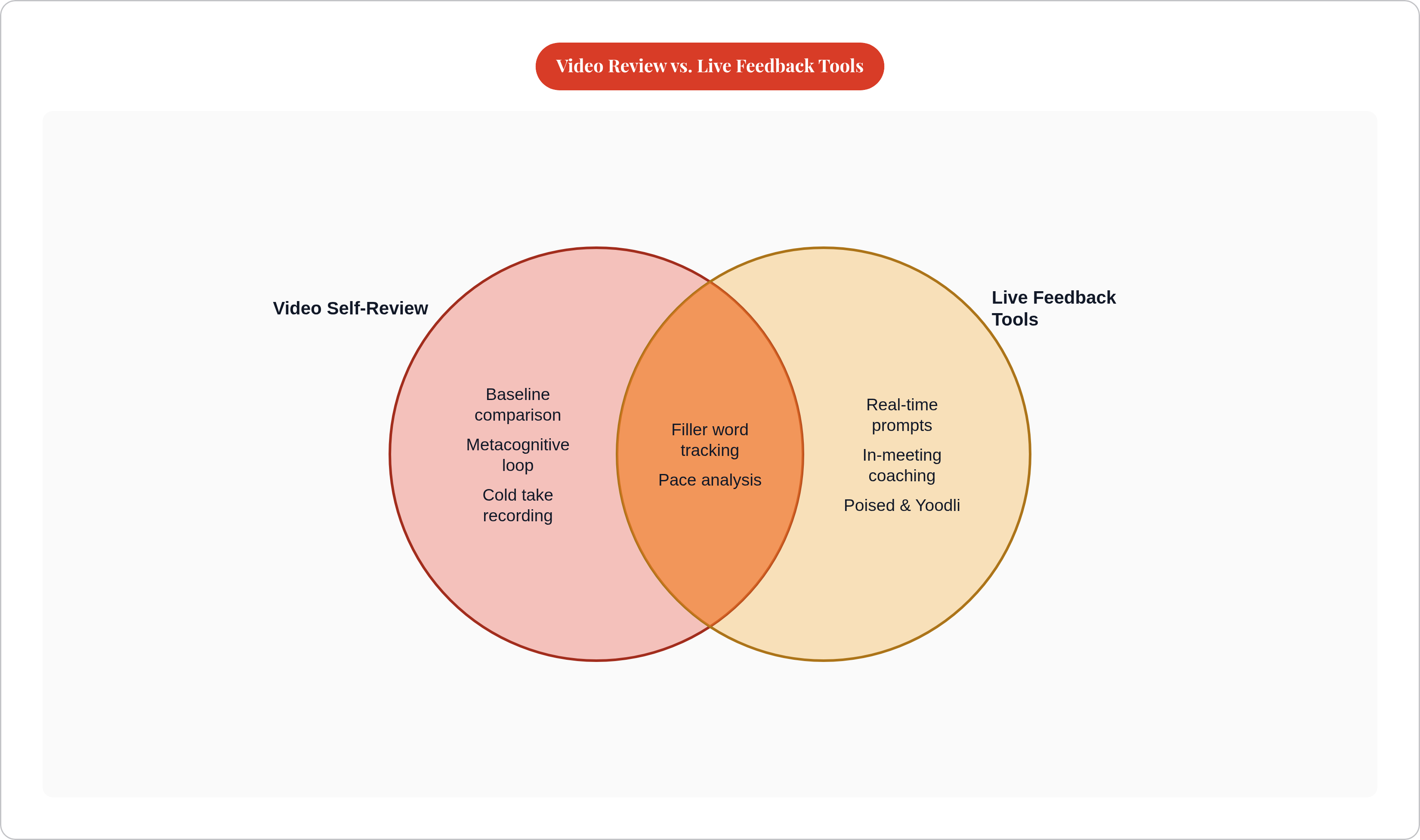
The value of dedicated tools is automation of the detection layer. They catch what the untrained eye misses and surface patterns across sessions rather than within a single recording. That said, some of these tools are more useful than others depending on what the actual problem is.
Yapp is a mobile AI speaking coach that gives users one daily prompt: receive a question, record a response, receive a score from zero to one hundred. The scoring is the key feature. Vague impressions about how a rep went are useless for improvement; a number gives you a reference point and something to beat. The framing treats your verbal score the way an athlete treats a sprint time. Most tools assume you have a presentation coming up. Yapp treats communication as the practice itself, not the preparation, and that is a meaningfully different premise.
Yoodli runs during live calls across major conferencing platforms, providing real-time prompts and detecting rhythm and flow issues as they occur. Its free plan is limited to five total sessions; the paid tier sits at roughly twenty dollars per month. The live-meeting context makes it particularly useful for professionals whose primary bottleneck is in-meeting behavior rather than prepared presentation.
Poised also operates in live-meeting environments, delivering real-time coaching during calls. If the problem is in-the-moment behavior rather than preparation, live feedback is the appropriate intervention, and post-session review tools are solving the wrong problem.
LikeSo focuses narrowly on filler word tracking at a low price point. Low-barrier entry for speakers whose primary goal is quantifying and reducing verbal crutches.
VirtualSpeech uses VR to simulate realistic speaking environments, including conference rooms and auditoriums. It requires a headset and carries a higher price point; the use case is specific to formal presentation rehearsal.
Selection is fairly obvious: live meeting anxiety points toward Poised or Yoodli; filler word reduction points toward LikeSo; building a daily verbal practice from scratch points toward Yapp, an AI app that scores your speaking every day.
Why daily short reps outperform occasional big sessions
Most people treat communication practice as event preparation. They rehearse before a presentation, then stop entirely until the next one. This produces event-specific improvement, not baseline fluency. The underlying infrastructure never changes because it is never actually stressed. It is like only going to the gym the week before a marathon and wondering why your legs give out at mile three.
Neuroimaging research links verbal fluency tasks to prefrontal cortex activation, which means regular speaking practice exercises higher-order cognition, not just surface-level delivery habits. The brain adapts to demands placed on it consistently. Occasional demands produce occasional results, and the gap closes faster than most people expect once the frequency is there.
Short sessions lower the activation cost of practice in a way that matters behaviorally. Sixty to ninety seconds daily requires no special preparation, no audience, no blocked calendar time. The barrier to entry is low enough that the habit actually forms, which is the precondition for every other benefit in this piece.
Each short rep of watching yourself and tolerating the footage reduces avoidance incrementally. Confidence and fluency are separate goals only in name; they develop through the same mechanism and through repetition only. You get more comfortable watching yourself as you get better to watch. Neither of those things happens on a monthly cadence.
Scoring your reps is worthwhile. Extrinsic structure that converts a vague self-improvement intention into a trackable number is the difference between a habit that compounds and one that evaporates after two weeks. If a number on a screen is what keeps you showing up, use the number without apology.
Building a review habit that actually compounds over time
Record, review with a specific focus, note one change for next session. Repeat daily. Complexity is a reason to skip, so resist the urge to elaborate the system beyond what it needs.
Anchor the habit to something already in your schedule: right after a meeting, a class, a commute. Any habit that requires carving out dedicated time from scratch is vulnerable to displacement; habits that attach to existing anchors survive because they have somewhere to live.
Begin with a baseline session: record yourself for ninety seconds answering a question you were not prepared for. Save it, label it Week 1, and do not watch it more than once. The value of that recording is not what it teaches you now. It is the reference point it becomes six weeks from now when you have genuinely forgotten how rough it was.
Progress through your focus areas deliberately rather than simultaneously. The first two weeks, just watch. The next two weeks, track filler words exclusively. From there, add pace and pause. Stacking criteria too early produces diffuse attention, marginal improvement, and the creeping suspicion that nothing is working.
When you plateau, change the input. Use a different prompt, switch from prepared argument to spontaneous storytelling, change the imagined audience from sympathetic to skeptical. Novelty re-engages the self-assessment loop; monotonous inputs eventually stop triggering it, and you will feel the difference before you consciously register it.
The sign that the habit is working is not a score improvement, though that will happen. It is when you start noticing your own filler words and pacing mid-conversation, in real time, without footage. That is when it has become structural rather than practiced.