Real-Time Filler Word Detection Tools
These tools reveal how often you actually say "um" during live speech.
Most people discover their filler word habit the same way they discover spinach in their teeth: after the fact, from someone else, at the worst possible moment. The gap between how you think you sound and how you actually sound is not a confidence problem; it is a structural blind spot baked into real-time speech production. Filler word detection tools, the best of which now operate silently in the background of live meetings or score your practice sessions in granular detail, exist specifically to close that gap. This article explains how the technology works, what the three major tool categories are actually designed to do, and how to choose the right one based on where you are in the process.
There is legitimate academic debate about whether fillers are errors at all. The traditional Chomsky-era linguistics view treats them as disfluencies: performance failures relative to a speaker's competence. The counter-view, associated with researchers like Jean Fox Tree at UC Santa Cruz and Herbert Clark at Stanford, frames fillers as "conversation managers," functional placeholders that carry real communicative information to listeners. Dr. Valerie Fridland at the University of Nevada Reno has argued that "ums" and "uhs" signal the brain working hard to retrieve the right word, which is a fairly charitable interpretation of a habit most hiring managers find grating. NIH research on filler utterance connects the phenomenon to lexical retrieval, verbal working memory, and the cognitive load of real-time speech, with filler production correlating with broad engagement of association and visual cortex networks. None of this is moral failure. It is, however, still a problem, because the perceptual cost lands regardless of which theoretical camp is correct.
What Filler Words Actually Cost When They Go Unchecked
The cost is not hypothetical or abstract. It is career-shaped and numerically documented. Approximately 59 to 60 percent of hiring managers consider strong public speaking an important asset for job applicants, and employees who are confident communicators are 70 percent more likely to be promoted to management. Fear of public speaking, which correlates tightly with filler-heavy speech, reduces wage potential by 10 percent and limits career advancement opportunities by 15 percent, according to Market.biz's 2025 data. About 30 percent of people have actively avoided pursuing a job or promotion specifically to sidestep public speaking exposure. That is a soft skills problem with hard consequences; it is self-imposed occupational ceilings.
The compounding dynamic is what makes this particularly insidious. Frequent filler use is tightly associated with increased anxiety and divided attention, per the same NIH research, meaning the habit and the anxiety that produces it are mutually reinforcing. Each "um" is both a symptom and a cause. Meanwhile, LinkedIn named communication the most in-demand professional skill for the second consecutive year, per a 2025 Forbes report, which means the gap between what employers want and what most speakers actually deliver is not narrowing. The point here is not to shame the habit; it is to make the invisible cost visible before discussing tools that do the same thing technically.
How Real-Time Filler Detection Actually Works Under the Hood
The basic pipeline is straightforward: microphone input flows into speech-to-text transcription, which is then pattern-matched against a filler lexicon, and each match is flagged with a timestamp. The sophistication is in how that matching works.
Most advanced tools operate on two detection layers simultaneously. The first is acoustic detection, which identifies "uh" and "um" by their sound pattern before transcription even completes. The second is semantic and contextual detection, which handles discourse markers like "you know," "I mean," "sort of," and "basically," words that are fillers in one context and entirely meaningful in another. "Just" is the canonical example: "I just wanted to say" is a filler; "a just decision" is not. Text-based filler detectors scan over 200 known filler patterns and must resolve these distinctions in real time, per research from JustBuildThings. That is a non-trivial classification problem.
The real-time versus post-session distinction matters technically because real-time tools must make detection decisions in milliseconds, which introduces a latency and accuracy trade-off that post-session tools do not face. Post-production filler removers report accuracy in the range of 85 to 95 percent in vendor studies, which is a useful benchmark for calibrating expectations. The pause problem compounds this: advanced algorithms must distinguish between a meaningful pause for emphasis and dead air, one of the harder classification tasks in the space. Cleanvoice's approach to this illustrates the subtlety well; after removing a filler from audio, it inserts room noise rather than silence so the edit does not sound spliced, which demonstrates that raw detection accuracy is only part of the engineering challenge. On the hardware side, professional speakers increasingly pair AI software with dedicated microphone hardware to improve transcription precision at the source, reducing the garbage-in problem before the algorithm ever runs.
The Three Functional Categories Tools Fall Into, and What Each One Is Actually For
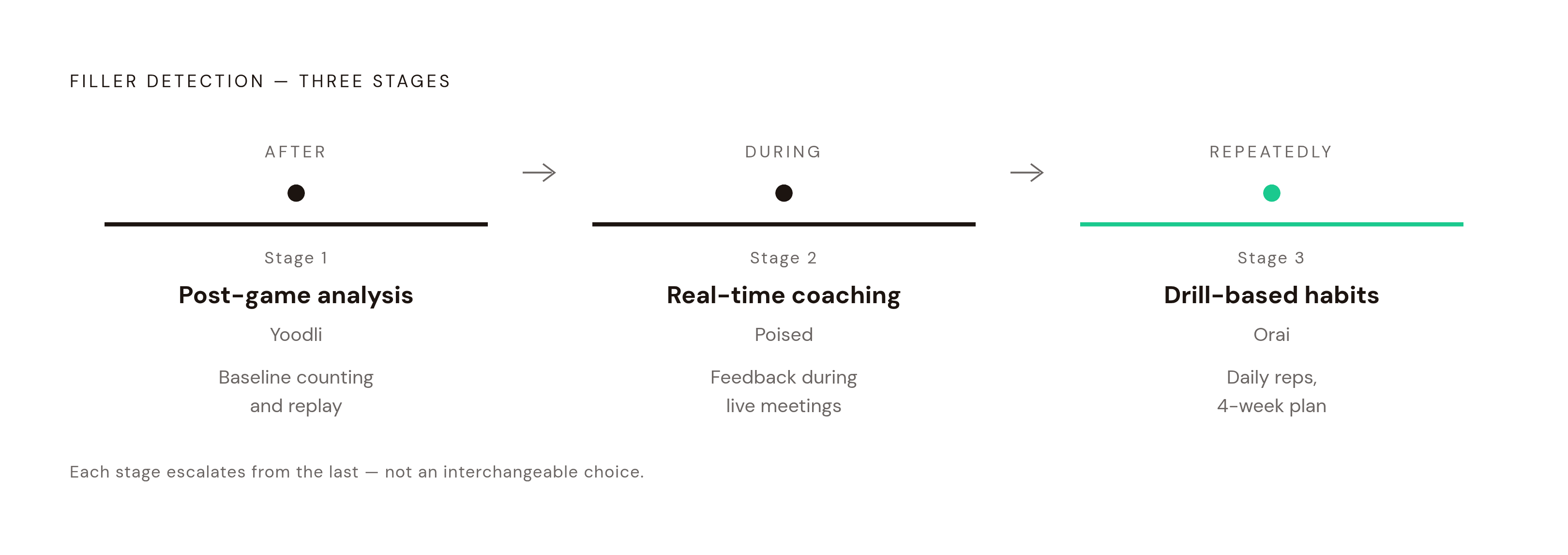
Not all filler detection tools are trying to do the same thing. The category determines when feedback arrives, which determines whether it changes behavior. Per UMEVO's January 2026 breakdown, the field organizes into three functional categories.
The first is deep analysis, or post-game tools: they record and score after the fact, useful for deliberate review and pattern identification over time. The second is real-time coaching, or in-game tools: they flag fillers during live speech, the highest-stakes configuration with the highest potential for immediate correction. The third is habit formation through drills: structured practice exercises designed to automate cleaner speech through repetition, the layer where the behavior actually gets rewired.
The category a speaker needs depends entirely on their situation. Someone preparing for a job interview needs post-game analysis. Someone on live sales calls needs in-game coaching. Someone building a baseline from scratch needs drills. Some tools attempt to span two categories, but understanding the distinction is what separates choosing the right tool from choosing the most aggressively marketed one. Apps built around daily scored repetition, such as Yapp, a mobile AI speaking coach that gives users one prompt per day with an instant 0-100 score, sit squarely in the habit-formation category, making the tier they occupy easy to identify.
Yoodli: Post-Session Analysis Built for Deliberate Practice Before High-Stakes Moments
Yoodli was founded in 2021 by Varun Puri and Esha Joshi. It raised a $40 million Series B in December 2025 at a $300 million valuation, with clients including Google, Snowflake, and Databricks. These are not vanity metrics; they indicate that enterprise communication training has found a vendor it trusts.
The platform tracks filler words, pacing, eye contact via webcam, vocabulary diversity, talk-to-listen ratio, and conciseness across six scored dimensions per session. On the filler-specific side, it flags every instance of "um," "uh," "like," "you know," "so," and "right" with precise timestamps and a session-level count. The replay feature allows users to jump directly to the moment a filler appeared and practice replacing it with a deliberate pause, which is the actual remediation, not just the diagnosis. Progress tracking plots filler frequency per minute across sessions, making improvement measurable rather than impressionistic.
The concrete scenario Yoodli is built for: a candidate who counts 47 "ums" in a 10-minute practice session has a specific, reducible number before a one-way HireVue interview where no interviewer is present to provide reassurance or redirect attention. Yoodli's partnership with Toastmasters International produces real-world confirmation of the model. One District 25 user reported running their speech through Yoodli five times before a club meeting; by the time they reached the stage, the "ums" were gone and their attention was free for eye contact. Educators have extended this further, using Yoodli to build filler-reduction leaderboards among students, per a June 2025 account from RdEne915. At $8 per month billed annually, the tool is priced like a habit, not a luxury.
Best fit: pre-event rehearsal, interview preparation, and structured improvement tracked across weeks.
Poised: Real-Time Feedback Running Silently During Live Meetings
Poised operates silently in the background on MacOS and Windows. No bot joins the meeting. Other participants do not know it is active. This design choice is not incidental; it is the entire product philosophy. It is compatible with Zoom, Slack, Microsoft Teams, and Google Meet, which collectively represent the meeting infrastructure of most knowledge-worker roles.
In real time, the platform flags filler words, pace, confidence signals, energy level, and conciseness. Post-call, it delivers a performance score, meeting summary, action items, trend analytics, and a personalized coaching plan. Users describe the core value as self-determination: knowing when filler words are accumulating, when volume has dropped, or when energy is flagging means the speaker is managing their own communication rather than hoping others are too polite to notice.
The honest caveat is that Poised users have reported occasional false positives in filler detection, noted by Cybernews, which is worth naming directly because it illustrates the real-time accuracy trade-off described in the technical section. A deliberate, emphatic pause that the algorithm misclassifies as dead air is annoying at best and misleading at worst. The deeper tension real-time tools introduce is whether a visual alert mid-conversation helps or breaks focus. The tool's value depends partly on whether the individual user can process feedback without losing presence in the conversation. Some people can; some cannot; this is worth knowing about yourself before committing to the configuration.
Best fit: professionals in recurring meetings who want passive, accumulating data on their live communication patterns.
Orai: Mobile-First Drill Practice That Builds the Habit Through Repetition and Scoring
Orai runs on iOS and Android and delivers instant feedback on filler words, pace, energy, conciseness, confidence, pausing, and facial expression after each recorded session. Its distinguishing structural feature is a 4-week training plan that positions practice as a program rather than an isolated event. Progress visualizations show clarity rising and filler frequency falling week over week, which is the kind of feedback loop that sustains effort past the first enthusiastic session.
User outcomes corroborate the model. One user reported moving from dreading standups to actually enjoying them after two weeks of Orai practice, describing results that years of advice had failed to produce. At a few dollars per month or around $40 per year on the iOS App Store, the pricing is accessible enough to remove friction from daily use, which matters because daily use is the mechanism.
The behavioral insight underlying drill-based tools is not complicated, but it is well-supported. Drills work because they make practice low-stakes enough to repeat daily, and repetition is precisely how automaticity is built in language production. The NIH research on filler utterance connects to this directly: practice makes word recall more automatic and less effortful, which reduces the cognitive load moments where fillers are most likely to fire. Orai is essentially a system for deliberately generating those low-stakes repetitions until the cleaner pattern becomes the default.
Best fit: anyone building a baseline, including students, early-career professionals, and speakers who want a structured starting point before graduating to live-meeting tools.
What the Tools Don't Catch, and Where the Pause Comes In
Detection identifies the problem. It does not install the replacement behavior. That distinction is consequential and often glossed over in tool marketing.
The replacement for a filler word is almost always silence. NYU Stern's Diane Lennard has articulated the mechanism clearly: pausing gives listeners time to process what has just been said, and speakers who pause briefly after sentences increase the impact of their ideas. This is not a stylistic preference; it is a perceptual reality about how spoken information gets absorbed. The psychological barrier is that silence feels longer to the speaker than it does to the listener. The discomfort of the pause is precisely what the filler is papering over, and no algorithm resolves that discomfort. The cognitive reframe that silence signals control rather than weakness, and the physical practice of sitting in a pause without reaching for "um," are things tools can prompt but cannot automate.
This is also why false positives in real-time tools are instructive rather than merely annoying. A deliberate pause scored as dead air is, in fact, the goal. The tool's inability to reliably distinguish it from a true filler gap is a reminder that the tools are mirrors, not substitutes for practice. The practical takeaway is direct: use detection tools to locate the pattern, then drill the pause specifically in the moments the tool flagged. Both are required. Neither alone is sufficient.
How to Choose a Tool Based on Where You Actually Are in the Process
The question is not which tool is best in the abstract. It is which stage of awareness and practice you are actually at, because the answer differs by a meaningful margin depending on that.
Stage one is not knowing your patterns yet. Start with a post-session tool like Yoodli to get a baseline count. One recorded practice session will surface the habit faster than months of vague self-monitoring and unfocused effort. The UMEVO user who had no idea they said "actually" every time they discussed pricing until they read their own transcript is the canonical example: detection surfaces what introspection reliably misses.
Stage two is knowing the habit but watching it persist in live situations. A post-session count already exists; the issue is that the feedback arrives too late to intervene in the context where the habit fires. Adding a real-time tool like Poised brings the feedback into that live context. This is the appropriate escalation, not the starting point.
Stage three is wanting to automate cleaner speech through repetition. A drill-based tool like Orai, used daily with a structured progression, is the mechanism. The 4-week structure is not arbitrary; it maps to roughly the timeframe research associates with habit consolidation in language production.
For high-stakes one-off moments, specifically interviews, pitches, and presentations, Yoodli's timestamped replay is the most targeted pre-event preparation available. Run it repeatedly until the filler count drops to a number that is no longer distracting.
The tools work best in sequence rather than in isolation. Detection without practice changes nothing. Practice without measurement drifts. Daily short sessions with a score outperform occasional marathon prep sessions because the feedback loop is the mechanism, not the duration. The goal is not a single clean performance; it is a recalibrated default.