Free vs Paid Speech Coaching Apps
Paid apps offer session-by-session feedback that actually tracks your improvement over time.
The speech coaching app market is crowded, which means the real problem isn't access, it's discernment. Only about one in four people between 16 and 24 report feeling confident speaking to an audience, according to teleprompter.com, compared to roughly 69% of adults over 45. That gap isn't a personality quirk; it's a skills deficit that a proliferating app market has rushed to fill, with mixed results. The price range runs from free to $45 per month, the feature sets vary wildly, and most users pick by download count or price and stall. Here is how to avoid doing that.
The App Market Is Built on a Misunderstanding of What "Free" Means
The price structure of this market is wider than most people realize. LikeSo sits at $9.99 per year. VirtualSpeech, which requires a VR headset to unlock its core value proposition, runs $45 per month. Most paid tiers cluster between $9.99 and $20 per month: Orai at $9.99, ELSA Speak at $11.99, Speeko and Yoodli both near $20. PromptSmart Pro is a one-time $20 purchase, though it functions as a teleprompter, not a coaching tool, so it belongs in a different category entirely.
The more important distinction is what "free" actually buys you, because the word is doing a lot of work across very different products.
Free Trial vs. Permanent Free Tier
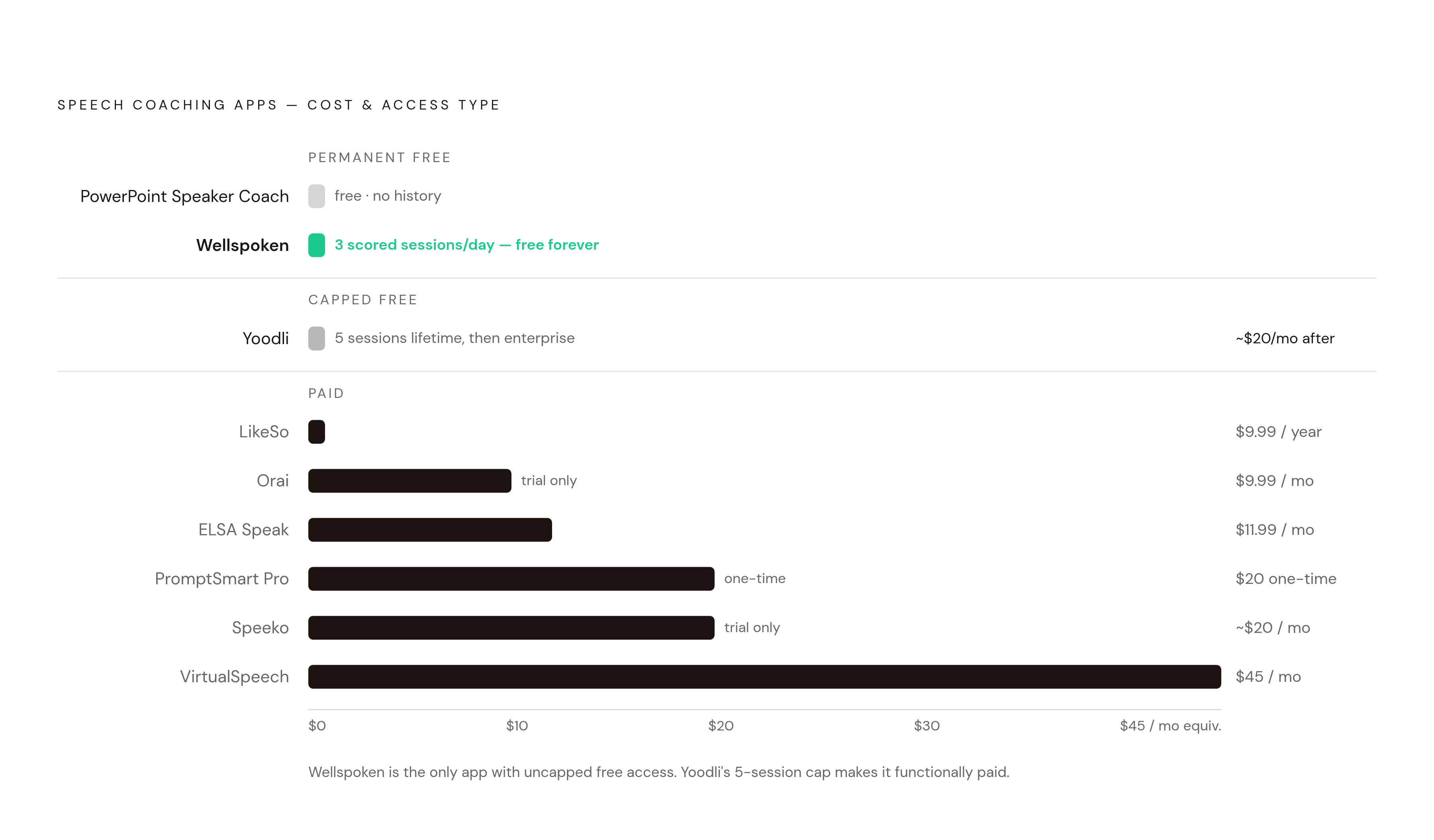
Orai and Speeko offer free trials, not permanent free access. A free trial tells you whether you like an app; a permanent free tier is what you actually train on. Wellspoken has the most substantive permanent free offering among comprehensive apps, providing three fully scored sessions per day without a paywall. Yoodli caps free users at five total sessions across the lifetime of the account, then moves core features behind enterprise pricing. Five sessions is enough to evaluate the interface — not enough to build anything.
Microsoft PowerPoint Speaker Coach occupies its own strange corner: fully free for Microsoft 365 subscribers, useful for rehearsal feedback, and completely amnesiac. Rehearsal reports disappear after each session, with no history, no trending, no way to know if you are getting better. It is fine for a one-time look and useless for training.
Free Apps Are Built to Keep You Coming Back, Which Is Not the Same as Making You Better
This is a structural observation, not an accusation. Free tiers are funded by engagement metrics, which means they are architected around features that produce daily opens. The dominant mechanic is gamification: streaks, badges, scores, progress bars that refill every morning. These features solve a real problem for the app, which is retention — not the problem the user came to solve, which is skill acquisition. A streak proves you showed up, not that you grew.
Filler word tracking is the canonical free-tier feature for a reason: it is concrete, immediately gratifying to watch improve, and easy to demo. LikeSo and the free layer of Ummo do this competently. A tool built around one metric will get you better at one metric — a real but limited win. If the goal is to stop saying "um" before every sentence, a narrow tool is the right tool.
The structural problem with free tiers is that they are reactive rather than adaptive. You record; they score. They do not adjust what you practice based on where you are specifically stuck, because building that kind of personalization requires data history, and data history is a paid-tier feature. Free apps work for breaking a specific bad habit. They are poorly suited for building a communication skill set, because they cannot see you over time.
Paid Apps Measure Dimensions You Cannot Fake Progress On
The most experienced speech coaches organize delivery feedback around what practitioners call the four Ps: Power, Pitch, Pace, and Pause. Vocal variety and dynamic range sit adjacent to these. The best paid apps operationalize exactly these dimensions rather than collapsing everything into a single score.
Yoodli's six-dimension framework illustrates why multi-dimensional feedback changes the training experience. The app scores filler word frequency, pacing, eye contact via webcam analysis, vocabulary diversity, talk-to-listen ratio, and conciseness. Each dimension is scored independently, timestamped, and trended across sessions. The timestamp detail is not a minor feature to overlook: being able to replay the exact moment a filler word appeared and practice replacing it with a deliberate pause is categorically different from knowing your filler count went up by three. One tells you your score; the other shows you where to work.
Orai reports having processed over two million speeches from more than 300,000 users. At that scale, its feedback models are calibrated against a wide range of speakers and delivery styles, not a generic baseline — a meaningful technical advantage over tools trained on smaller or narrower corpora.
Roleplay Changes What You're Actually Practicing
Yoodli's roleplay mode introduces a dimension that free tools do not attempt: AI personas that ask follow-up questions in real time. This forces the user to think and respond spontaneously rather than deliver prepared remarks into a void. For someone preparing for investor pitches, job interviews, or high-stakes one-on-ones, this is the difference between rehearsing a monologue and simulating an actual conversation. The transfer to real-world performance is substantially higher when practice conditions approximate real conditions.
The structural feature that justifies the cost of paid tiers is longitudinal data. Session-over-session trending is the mechanism by which isolated practice becomes a feedback loop. Without it, you are performing for an audience of zero with no record of the show — training in name only.
What No App, Paid or Otherwise, Can Actually Do
AI coaching platforms are almost entirely delivery-focused. They measure how you say something. They do not evaluate whether what you are saying is actually working on a human being in real time, because they are not human beings and there is no real time.
Experienced speaking coaches consistently report that content problems drive delivery problems. A speech that needs to be restructured, condensed, or made conversationally human will not become more effective because the speaker's pacing improves. Fixing the wrong variable is worse than doing nothing, because it produces a more polished version of an ineffective argument.
According to a survey by Prezi, roughly 46% of presenters identify crafting a compelling story as the hardest part of a presentation, while approximately 90% believe a strong narrative is critical for audience engagement. That gap — between where speakers most struggle and what they believe matters most — is essentially unaddressed by any current app. Neuroscientist Uri Hasson's research at Princeton on neural coupling, the phenomenon where the brain activity of a speaker and listener begin to align during successful communication, suggests that narrative skill operates at a deeper persuasion mechanism than delivery alone. No current app scores for it.
Reading a room, adjusting in the moment, noticing that an audience is confused before they say so: these remain firmly in the domain of human coaching. Paid apps earn their price on delivery, habit formation, and measurable repetition. They do not replace the judgment layer.
Match the Tool to the Actual Goal, Not the Budget
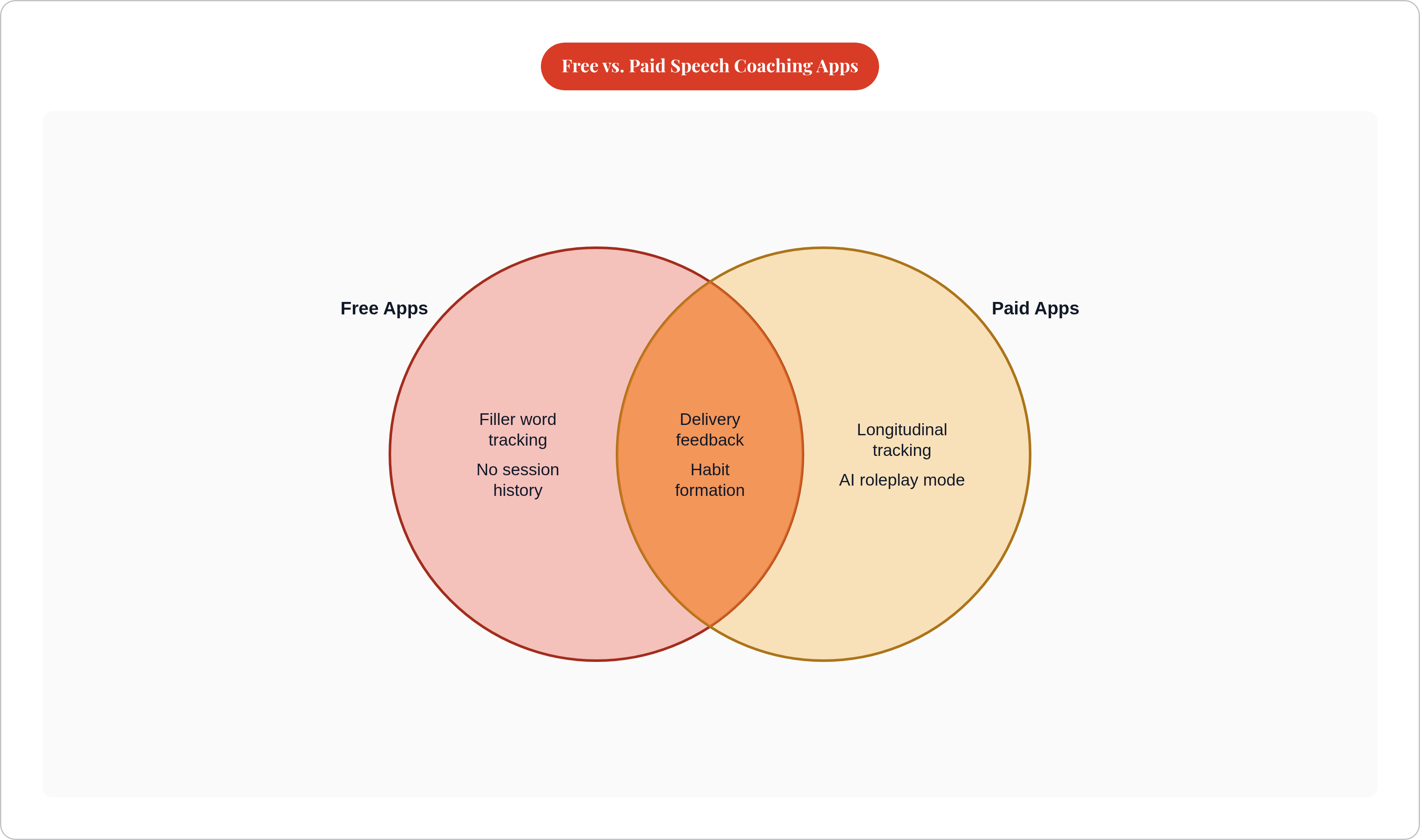
The right question is not "free or paid." It is "what am I trying to fix, and over what time horizon?"
For eliminating a specific verbal habit on a budget, a narrow free tool is sufficient. LikeSo or the free Ummo tier handles filler word reduction without requiring a subscription. For building a consistent, scored daily practice that shows progress over months, a paid tier is necessary, and free trials exist to let you evaluate fit before committing.
For preparing for live, high-stakes conversations, recording-and-review tools are the wrong instrument. Roleplay-mode apps like Yoodli or Orai's interview practice feature approximate actual conversation dynamics far better than anything that lets you deliver into a void. For non-native speakers working on pronunciation specifically, ELSA Speak is purpose-built for that problem; a general coaching app is simply the wrong tool, regardless of how sophisticated its other features are. For pure rehearsal of a prepared script, Microsoft PowerPoint Speaker Coach covers the need at no marginal cost, with the explicit caveat that no history is retained.
The consistency research is unambiguous on one point: short, frequent sessions build stronger habits than infrequent long ones. An app used for 10 to 15 minutes daily delivers more skill transfer than a premium subscription opened twice a month. According to a study by Prezi, roughly 90% of pre-presentation anxiety is attributed to insufficient practice, which means the app that actually gets used, at any price point, outperforms the one that doesn't.
Ambition is the real variable. If the goal is to feel less nervous before a single presentation, almost any tool will do. If the goal is to become measurably, durably better at verbal communication over months, only a structured feedback loop with longitudinal tracking delivers that outcome. Free tools are real tools — just not the right tools for every job, and confusing the two is how people invest time without making progress.