Delivering a Startup Pitch to Non-Technical Investors
Founders lose investor interest by explaining the technology instead of the outcome it delivers.

A venture capitalist reads roughly 3,000 pitches a year and funds nine. An angel investor sees maybe 500 and funds roughly one in four hundred. Do that math and you understand why founders obsess over deck design, market sizing, and the perfect thirty-second hook. What they get wrong is the target: they treat the fix as a better explanation of the technology, when the real fix requires talking about a different thing entirely. I've sat through enough of these to tell you which failure mode kills the room, and it's rarely the science.
More than half of deep tech startups fail within five years, and I've watched postmortems on a few where the engineering held up fine, and the failure traced back to translation, not to the product. Founders default to one of two broken containers. The first is the dense academic presentation, built for peer review, stuffed with the rigor that gets a paper past reviewers and gets a founder nowhere in a pitch room. The second is the SaaS-deck template, borrowed wholesale from companies selling software that ships in weeks, forced onto technology that needs years and multiple risk gates to reach a customer. Both produce the same glassy-eyed investor, the one who follows the explanation sentence by sentence and still can't tell you whether to write a check.
Here's what that investor actually evaluates: whether the opportunity is real, whether the risk is legible, and whether the person standing in front of them can lead non-technical buyers, hire a team, and close enterprise deals without a translator in the room. The elegance of the science rarely enters into it, which is a hard thing to accept if you spent five years earning a PhD to build the thing. Moving from architecture to outcome isn't dumbing anything down. It's a different muscle, and most technical founders never trained it.
The curse of expertise and what it costs a founder in the room
Practitioners call it the curse of expertise. The deeper someone's expertise, the harder it gets to remember what it felt like not to have it, and assumptions stack up invisibly as a result. A founder who's spent five years on a novel battery chemistry forgets that "cycle life" and "coulombic efficiency" aren't shared vocabulary; to her, the words feel as basic as "hello." Investors don't interrupt to ask for a definition. They quietly lose the thread, decide they don't understand what the product does, and move to the next pitch in the stack.
I once watched a founder open with a slide so dense with electrochemical notation that the partner across the table, a man who'd funded three unicorns, leaned over and whispered to his colleague, "Is this a pitch or a qualifying exam?" It got a laugh, and it also got a pass on the deal.
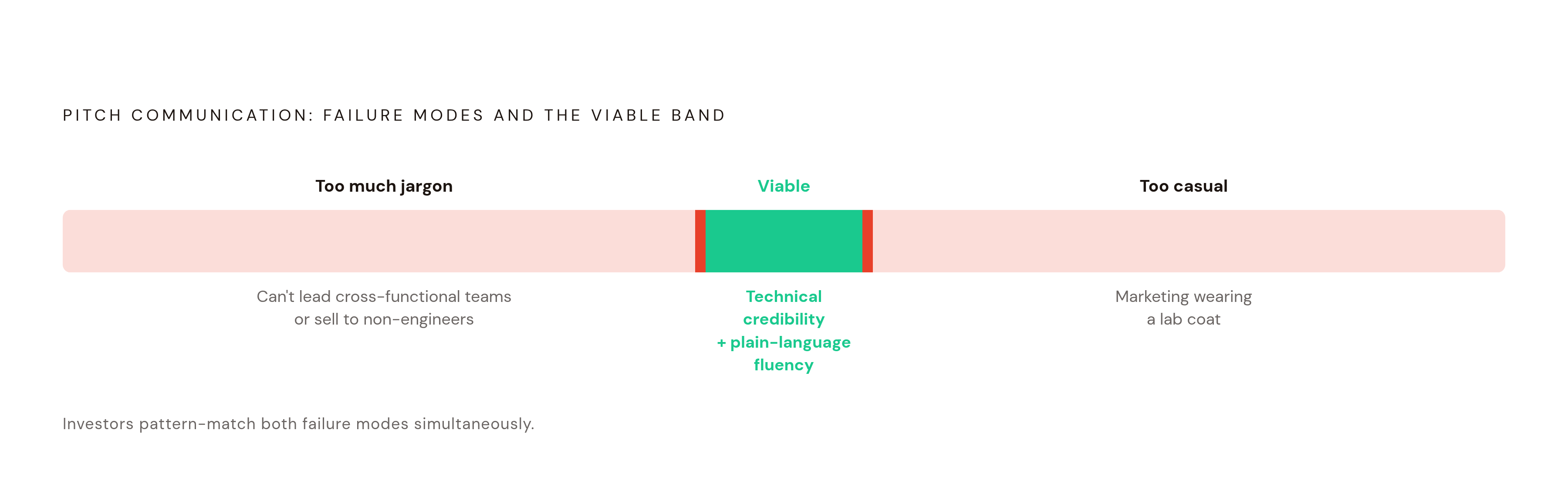
Calibration cuts both ways, which is what makes this so unforgiving. Too much jargon and the founder looks like someone who can't run a cross-functional team or sell into a market that includes non-engineers, which is every market. Too casual, and the founder looks like the whole thing is marketing wearing a lab coat, like there's no actual command of the domain underneath the confidence. Investors are pattern-matching for both failures at once, often inside the same fifteen minutes, and most founders don't even realize which one they just committed. A pitch, in this sense, is a tightrope stretched between two different kinds of falling, and the room can tell within a slide or two which way the founder is leaning.
There's a blunt audit that catches most of this before it reaches the room. Call it the so-what test: take every technical claim on every slide and ask what outcome it produces that an investor actually cares about. If the answer isn't immediate, the slide isn't ready. "Our model achieves high accuracy on benchmark X" fails on its own, while "Our model catches fraud that costs banks tens of millions a year in false declines" passes, because it lands on a number the investor already has instincts about.
Founders who raise well build two registers on purpose. One explains the technology to a smart non-specialist in about two minutes, and the other goes as deep as a technical due-diligence partner wants, three calls later, data room open. A first pitch only needs the first register; its whole job is generating enough understanding and enough excitement that the investor wants a second conversation. Proving every technical detail in meeting one isn't the assignment. Treating it like the assignment is how founders talk themselves out of a term sheet, and I've watched it happen to people who had every right to a yes.
Shifting the pitch frame from how it works to what it makes possible
The reframe is one move, though it takes most founders months to actually absorb it: non-technical investors evaluate the outcome the technology produces, not the mechanism producing it. Structure the whole pitch around what becomes possible, not around what got engineered to make it possible.
Three-act storytelling does this work efficiently, because it maps onto structure investors already know from every story they've heard since childhood. Open by setting the stage: name the problem, describe the world it creates for the people stuck inside it, specifically, with detail, not in the abstract. The middle introduces the product as the hero, showing how it resolves the exact tension just described, not how it was built or what stack it runs on. The close is credibility and vision, with the team, the market, and the investment itself as the mechanism that makes the win happen.
Story does real persuasive work here, not decorative work. Research on narrative transportation has found that audiences absorb and act on information wrapped in story differently than they do flat data. Numbers still matter, but they need to support the story rather than replace it. A bar chart with no narrative wrapped around it just asks the investor to do the translation work the founder was supposed to do himself. A slide deck without a story is a house without a hallway: every room technically exists, but nobody can find their way between them.
Practically, build slides like storyboards, not spreadsheets. One idea per slide, diagrams instead of paragraphs, and a visible line of cause and effect from one slide to the next, so an investor flipping back through the deck weeks later can reconstruct the argument without the founder there to narrate it.
The vocabulary shift is concrete, and worth doing line by line. "Robust API integrations" becomes "connects your workflow to any tool in seconds," trading a description of architecture for a picture of a Tuesday afternoon made easier. A thirty-second product demo does more persuasive work than three paragraphs of written explanation, because it shows the outcome directly instead of describing the machinery underneath it.
Using analogies to make unfamiliar technology immediately legible
Analogies are the single highest-leverage tool in a non-technical pitch. Done well, they shrink real complexity into a shape the investor already recognizes, without sanding off a shred of the underlying substance.
The sharpest version of this move borrows the investor's own domain to explain the founder's. A data integrity platform pitched as "financial auditing for your records" tells a finance-background investor exactly what's at stake, because he already knows what an audit protects against. An AI agent platform pitched as "a team of analysts that never sleeps and never asks for a raise" scales an investor's existing intuitions about staffing costs directly onto the product. A software platform pitched as "a well-organized library, where anything you need is exactly where you'd expect to find it" explains structure and findability without a single technical term entering the sentence.
Three questions pressure-test any analogy before it goes in front of a room. Does it connect to something the investor already trusts, not something he'd need a footnote to follow? Does it point toward the outcome rather than restating the mechanism in different words? And would a reasonably sharp non-specialist repeat it to a colleague the next day, unprompted, because it stuck? If it fails that third test, it wasn't sticky enough to survive contact with a partner meeting the founder isn't in the room for. A good analogy lets an investor hand over something complicated and retrieve it later with a simple mental ticket.
This is also where a two-deck habit earns its keep. One core pitch, two orderings of the evidence. Technical investors get architecture first, because that's the language that builds their confidence, while non-technical investors get market and traction first, because that's the risk they're actually equipped to judge. The story underneath doesn't change. Only the order of the proof points does.
Chat Labs demonstrated this at the 2023 LVMH Innovation Award, winning by showing exactly how the technology solved a specific problem a luxury operator already recognized, rather than reciting a feature list. Nobody spoke the analogy out loud. The demonstration didn't need saying, because it sat entirely inside logic the audience already lived in.
What non-technical investors actually want to hear about market and timing
Non-technical investors underwrite opportunity and risk. Every pitch has to answer three questions in plain terms: how big is this, who else is already trying to win it, and why does it have to happen now.
The current climate raises the bar on all three. In 2025, venture capital got more selective, 14,320 deals closed worth $215.4 billion, and investors leaned hard toward proven traction over raw potential. I've seen the number quoted enough times that it's started to feel like a talking point rather than a fact, but the underlying behavior tracks: partners want traction, not promise. AI alone made up 37% of deal volume, so a founder pitching in that category competes inside an unusually crowded room. Clarity about market position stops being a nice-to-have and becomes the actual differentiator.
"Why now" isn't rhetorical throat-clearing. It's a risk question with a real answer attached: what changed in the market, in regulation, or in available infrastructure that makes this the right window, and what does it cost to wait. A founder who can't answer that concretely is asking the investor to underwrite timing risk on no evidence.
Competitive positioning follows the same logic. Name the alternatives the investor already knows about, even the imperfect ones, and show precisely where they fail the customer. "We have no competition" should never leave a founder's mouth. It signals thin research, or a market too small to bother funding, and experienced investors have heard the line often enough to read it as a red flag instead of a boast. Ask any partner what they hear when a founder says that, and most will give you some version of the same joke: "No competition usually means no customers either."
Unit economics matter more this cycle than last. The shift toward proven traction means the business model has to stand on its own, independent of the technology story, so an investor can trace a straight line from capital going in to specific risk coming out.
How milestone-linked narratives retire investor risk in real time
The investor's real anxiety centers less on "does this work" and more on "can I trace exactly where my money goes and precisely what risk it buys down." That's a different, more answerable question, especially in categories where the science takes years to fully validate.
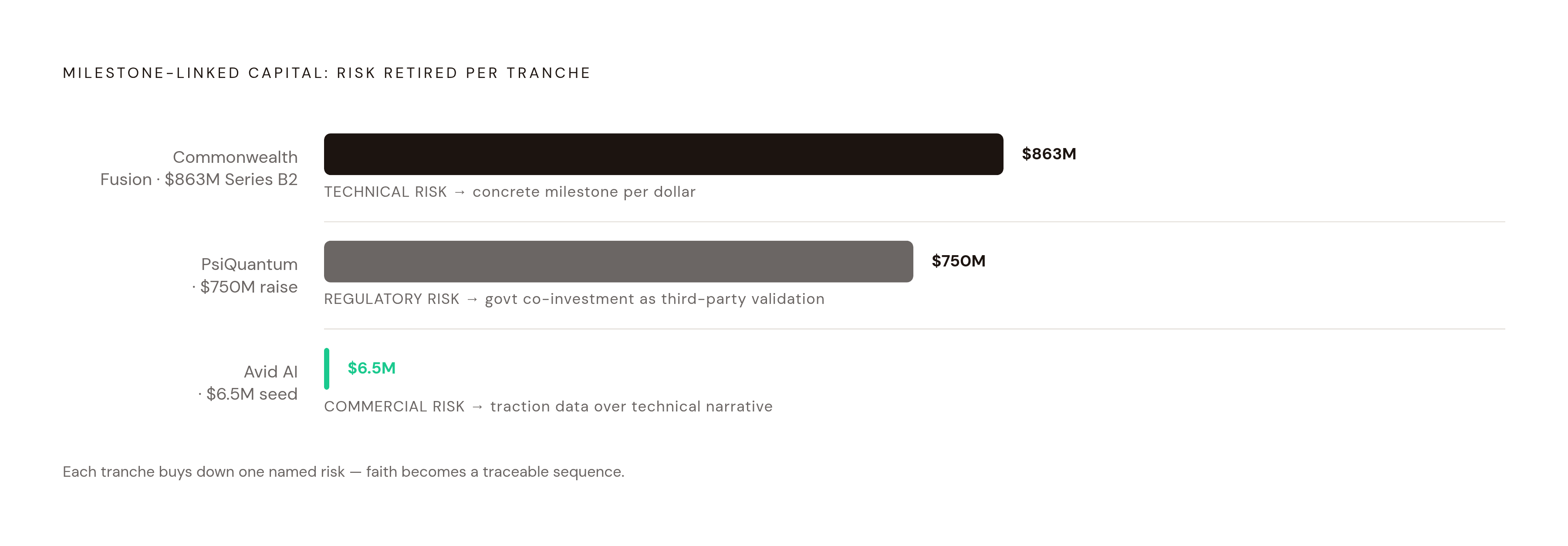
Commonwealth Fusion Systems closed an $863 million Series B2 in August 2025, and what sealed the round wasn't the physics alone. CFS tied every dollar raised to a concrete milestone, letting investors trace the line from capital committed to specific technical risk retired. That's the entire trick: it turns an unfalsifiable claim about eventual success into a sequence of falsifiable, near-term checkpoints. Fusion as a category pulled in $2.64 billion between mid-2024 and mid-2025, a sum that would've looked unfundable to non-technical capital a decade ago. Milestone framing is what made frontier physics legible as a business instead of a bet on faith.
PsiQuantum's $750 million raise blended private capital with government funding, and the government's non-dilutive commitment did more than provide cash. It worked as third-party validation, telling private investors the underlying science had already passed scrutiny from a party with no financial stake in overselling it.
The pattern repeats at every stage and size. Map each funding tranche to the specific risk it removes, technical, regulatory, or commercial, and name the proof points already hit, so delivery reads as a pattern instead of an assertion. State plainly what the current round unlocks. Avid AI's $6.5 million seed round in October 2025, led by Silverton Partners, illustrates the principle: when the audience can't evaluate the underlying technology directly, traction data does the persuading a technical explanation can't.
Delivering the pitch as a verbal performance, not a slide presentation
The deck is evidence. The founder is the argument. Investors in that room are evaluating something the slides can't show them: can this person sell to a customer who's never heard of the category, recruit an engineer away from a comfortable job, and hold a team together through the eighteen months when nothing works yet.
Eloquence isn't a trait some founders are born with and others aren't. It's practiced, available to anyone willing to slow down, choose words on purpose, and rehearse under conditions that resemble the real room. Delivery signals things a founder never states out loud. Confident pacing reads as command of the material; rushing reads as nerves, or worse, as someone who never actually distilled the idea to its core. Fluent transitions between sections signal the founder can hold a through-line under pressure, which is exactly what a board meeting eighteen months out will demand. Precise, jargon-free language reads as a proxy for something bigger: can this person lead across functions she doesn't personally have expertise in.
Every pitch should end with one sentence that carries the whole company, delivered in the last sixty seconds. It gives investors a phrase to physically carry out of the room and repeat in the partner meeting the founder isn't invited to.
None of this comes from talent alone. It comes from repetition, and founders who record themselves pitching and actually watch the footage back catch verbal tics, muddy transitions, and pacing problems invisible in the moment. Short, frequent rehearsals in front of a non-technical listener, a spouse, a neighbor, anyone outside the field, build the exact translation muscle live Q&A demands later. Work on leadership communication, including Denning's writing from 2011, found that emotionally engaging delivery measurably improves how well an audience retains a message and how much it moves them. The mechanism is narrative coherence delivered with confidence, and unlike charm, that's trainable.
Handling Q&A when investors probe what you can't fully predict
Most venture capitalists will never know a founder's technical domain better than the founder does, and they're not in the room trying to. What they're testing is whether the founder can guide non-specialists into unfamiliar territory with confidence and without condescension, because that's the exact skill she'll need with customers, board members, and new hires for the next decade.
Q&A is where the outcome-first frame most visibly cracks. A founder who reverts to dense jargon the moment a question gets uncomfortable is telling the room, without meaning to, that the plain-language version upstairs was a performance rather than a genuine translation.
Three registers hold up under live pressure. Inviting curiosity treats a hard question as validation: "That's exactly the tension we spent the most time on, here's how we resolved it." Honest uncertainty beats a confident wrong answer every time; naming what isn't known yet, alongside the specific milestone that will resolve it, reads as more credible than false precision. Grounded optimism projects control without arrogance, giving the investor permission to follow the founder's lead without feeling sold to.
Two traps show up in nearly every Q&A session. The "what about [named competitor]" question gets answered in outcome terms: what that competitor delivers for the customer, and what this company delivers differently, never a takedown of the competitor's engineering. The "how does it actually work" question from a non-technical investor is almost never really about mechanism; it's a trust question wearing a lab coat. Answer it with the sharpest analogy available, then offer to go deeper with whichever technical partner on their team wants the full architecture.
The pitch doesn't end when the meeting does, and the most common failure after a good pitch is a bad follow-up, or none at all. A short, specific note that references something particular from the conversation continues the translation work the whole meeting was built around, and it tells the investor, in miniature, that this is a founder who runs a tight operation even when nobody's watching.