STAR Format for Behavioral Interview Answers
Mastering the delivery of STAR answers matters as much as knowing the format itself.

Behavioral interviewing rests on one bet: what you did last time predicts what you'll do next time, better than a credential or a hypothetical ever could. STAR is the format that turns that bet into something an interviewer can actually score. Knowing the format and being able to say it out loud, under pressure, to a stranger who's already decided how the next hire goes, are two different skills entirely. Most candidates train the first one and skip the second, then wonder why the answer that sounded great in their head came out as a shapeless ramble in the room.
What STAR actually is — and what it was designed to solve
STAR came out of Development Dimensions International as a structured framework, built to help interviewers extract usable data from people who, left alone, tend to narrate in circles.
The four parts each do a specific job. Situation sets the scene: when, where, what was actually at stake. Task narrows the lens to what you, specifically, were on the hook for, separate from whatever the group was doing. Action is the real content of the answer, the step-by-step account of what you did. Result is the payoff: what changed, what got measured, what you'd do differently now.
A workable architecture for this, in practice, runs one beat for Situation, one for Task, two beats for Action, and one for Result, the whole thing landing under ninety seconds. Most interviewers map these stories to a short list of competencies: leadership, teamwork, problem-solving, conflict, failure, adaptability, communication. Those are the categories worth having stories banked for, because they'll come up again and again across companies that have never spoken to each other.
STAR logic also shows up in resume bullets and cover letters, same evidence structure, different medium. Writing it down and saying it out loud under a stranger's gaze are different tests, though, and the rest of this piece is about the second one.
Where most STAR preparation goes wrong
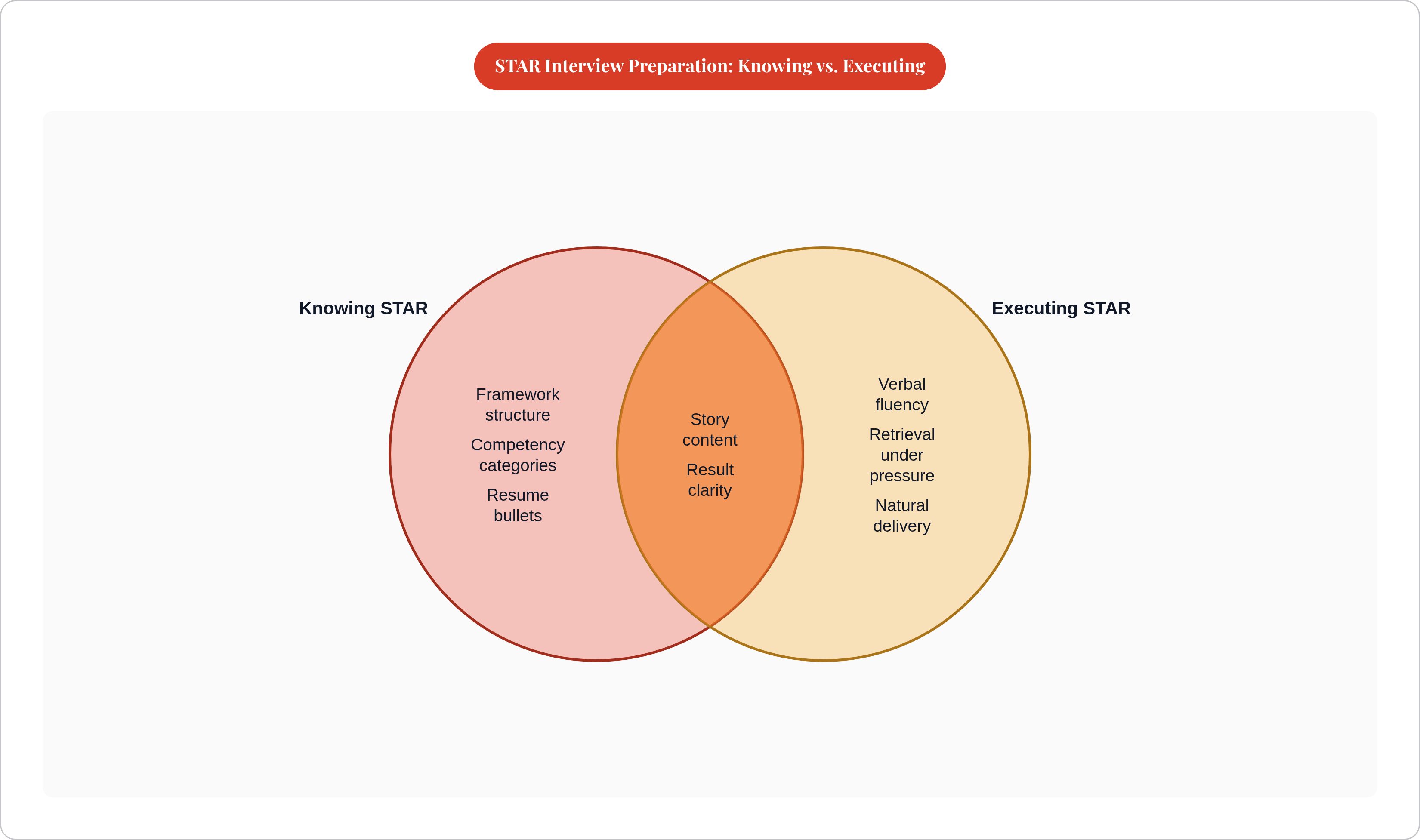
Most people prepare for STAR the way they'd prepare for an essay exam: outline the stories, maybe script a few lines, call it done. That approach trains writing, and the interview tests something else entirely.
Executing a structure under pressure, live, in real time, is a completely different cognitive task than knowing the structure exists, and it shows up in predictable ways once the nerves kick in. Candidates lean on "we" because it feels safer than claiming credit, and end up handing the interviewer zero individual evidence. The Result section, the entire point of the story, collapses into "and it went well" with no number attached to it. Action, the section that's supposed to carry the weight, turns into the most shapeless part of the answer, because that's exactly where nerves hit hardest. Some candidates overcorrect the other direction and sound like they're reciting a script, which interviewers flag as a warning sign rather than a strength. Conflict stories, meanwhile, go sideways fast when the other person gets painted as "completely wrong" or "incompetent," which reflects worse on the teller than the subject.
Yet none of this is a knowledge gap. These are candidates who know the STAR framework cold and still can't execute it, because under pressure, retrieval fails. The story is in there somewhere, and the door just won't open. More outlining doesn't fix that. Saying the story out loud, repeatedly, until the words show up without being summoned, does.
Why the brain responds to a well-delivered STAR answer differently than a correct one
STAR's shape isn't arbitrary paperwork. It tracks how episodic memory actually gets encoded and retrieved: set the scene, walk through the problem, land the resolution. That's the same arc your brain uses to store what happened to you yesterday.
Princeton neuroscientist Uri Hasson's research on storytelling found something worth sitting with: when a listener understands a story well, their brain activity starts to mirror the teller's, and the closer the comprehension, the tighter that synchrony gets. A recited fact doesn't produce that effect. A well-told story activates regions tied to emotion processing (the medial prefrontal cortex) and long-term reflection (the posterior cingulate cortex) in ways that flat information delivery doesn't touch.
Cognitive scientist Fritz Breithaupt, in his 2025 book The Narrative Brain, calls narrative "the typical means by which we can transport experiences from one person to another." A STAR answer, told well, is that transport mechanism doing its job. It's also a defense breaker: an interviewer who hears "here's what happened" evaluates the story, while an interviewer who hears "I'm a great leader" resists the claim on reflex.
Two candidates can therefore walk in with the identical story, same outcome, same facts, and land in completely different places, purely on the strength of delivery. A technically correct STAR answer delivered haltingly doesn't produce synchrony. It produces effort on the listener's end, and effort breeds skepticism.
What verbal fluency actually looks like in a STAR answer
Fluency here doesn't mean smooth in a broadcaster sense. It means the story comes out without audible searching, holds its shape without sounding memorized, and the person telling it sounds present instead of retrieved.
Situation and Task should feel like setup, short, confident, specific enough that the listener knows exactly where they are without needing more context. Action is where fluency matters most, because it's supposed to sound like someone explaining what they did, not summarizing a bullet point they wrote down three days earlier. Result lands with more force when there's a small pause in front of it, a beat of silence that tells the listener something real is about to land.
A few things affect how this gets scored, whether the interviewer says so or not. Pace matters: slowing down through Action signals the person is thinking, not performing. Specific language beats vague language every time, "I restructured the meeting agenda and cut the standing items" does more work than "I improved team communication" ever will. Ownership, too, has to stay first-person through Action, "I," not "we," even when the underlying project was a team effort.
There's a ceiling here worth naming directly. Ninety seconds is roughly where a tight answer stops feeling complete and starts feeling stretched. A rambling two-and-a-half-minute answer and a clean eighty-second one can contain identical information and land as completely different experiences for the person listening. Fluency isn't speed and it isn't the absence of pauses; it's structure and authenticity sitting in the same sentence without one crowding out the other.
The pressure problem — and why anxiety specifically breaks STAR
Interviews sit near the top of the list of high-stakes speaking situations most people will ever face, and a meaningful share of people carry real anxiety into that room. Recent graduates in particular tend to arrive with fewer reps at high-stakes verbal performance than more experienced candidates, and that gap has more to do with reps than raw ability.
Anxiety doesn't politely sit in the background during a STAR answer; it actively dismantles it. Retrieval interference is the first casualty: the story is fully there, but the pressure blocks the door, and candidates go blank mid-sentence on material they know cold. Structure collapses next; under stress, people abandon the STAR arc and default to plain chronological narration, which almost always means the Result gets dropped entirely because nobody's watching the clock anymore. Verbal hedging creeps in too, filler words, qualifiers, self-interruptions, all of which quietly undercut the confidence the story was supposed to project in the first place. A smaller group, meanwhile, overcorrects into over-scripting, which reads to an interviewer as rehearsed rather than reassuring.
The research on anxiety reduction points in one direction without much ambiguity: rehearsal beats review. Saying the story out loud again does more than reading it again ever will, and anxiety in this context isn't a personality trait or a character flaw. It's a training deficit, and training deficits respond to training.
How to actually practice STAR delivery — not just prepare it
Preparing is outlining. Practicing is speaking out loud under conditions that resemble the real thing, which is a much less comfortable activity and exactly why most people skip it.
Career coaches keep landing on the same recommendation: record multiple practice rounds. Not for playback vanity, but because a recording forces real commitment to the actual words leaving your mouth, no do-overs mid-sentence, no quietly restarting when it gets clumsy. A real practice session looks something like this: pick one story, pick one competency question, record a response cold with no notes and no script, then review it against a short checklist. Did "I" show up more than "we"? Did the answer actually reach a Result? Did it stay under ninety seconds? Did it sound like a person talking, or a person reciting?
Repeat with the same story until it stops feeling like a performance, and only then rotate to the next one. Building a bank of ten to fifteen stories across the core competency categories before interview season starts means less improvising in the room and more actual presence once you're in it.
Repetition builds three things outlining can't touch on its own. It builds muscle memory for the arc, so the structure holds automatically once nerves show up. It replaces scripted language with natural language, so the story sounds lived-in rather than read. And it builds confidence in retrieval, because you've told this story before, even if never to this specific person across this specific table. None of that works without a feedback loop, and vague encouragement doesn't count as one. "That was great" from a friend builds nothing. Specific, scored feedback on what landed and what didn't is the only version of practice that actually moves the needle.
Why communication skill is the actual competitive variable for early-career candidates right now
Communication has sat at or near the top of employer priority lists for years running, and it's not showing up there as a courtesy line item. It's a ranked, documented priority across industries.
Meanwhile a sizable share of hiring managers report that recent graduates arrive underprepared, and the specific complaint centers on verbal communication and the ability to structure an answer on the spot rather than technical skill. A notable share of business leaders say this gap has gotten wider recently, and some admit to quietly deprioritizing early-career candidates because of it, a blunt fact worth sitting with for a second before moving on.
For Gen Z candidates specifically, there's a particular mismatch worth naming. Fluency in async, text-first communication, Slack threads, DMs, short-form video, doesn't automatically transfer to live, real-time, structured verbal performance in front of a stranger. Hiring managers report higher concern about eye contact, verbal clarity, and interview-room professionalism among recent graduates than among more experienced candidates. Call it the gap between how people communicate natively now and what a formal interview still demands; it's real, and it's also closeable with practice, not some fixed trait people are stuck with.
Here's the upside hiding in that statistic: because the gap is this visible, candidates who show up and communicate clearly stand out disproportionately. The bar sits lower than most people assume walking in. STAR is where this plays out most immediately, but the underlying skill, structured verbal fluency under pressure, compounds across every high-stakes conversation a career throws at someone afterward.
Turning STAR practice into a daily verbal habit with Yapp
The argument by this point should be settled: knowing STAR is table stakes, and the ability to execute it fluently, live, under pressure, is what actually separates candidates. That ability doesn't come from one marathon prep session the Sunday night before an interview; it comes from short, repeated, daily verbal reps.
Some tools are built around exactly that mechanic: a daily prompt, a recorded spoken response, a scored result, the same tight loop interview coaches already recommend, compressed into something you can do in a few minutes a day instead of scheduling as a special event. Daily prompts can double as behavioral interview questions, which means the practice is training the exact retrieval-under-pressure muscle a real interview will test. Scoring replaces the vague "sounded good" feedback loop with something concrete enough to actually act on. And the repetition is what eventually makes the STAR structure feel like the way you naturally talk, instead of a template you're visibly reaching for mid-sentence.
STAR is just one arena where this shows up. The skill underneath it, verbal fluency and composure on demand, pays out in every high-stakes conversation that comes after the interview too. The candidates who get the offer rarely had the single best story in the pile. They were the ones who could actually tell it, out loud, in the room, when the room was watching.