Voice Warmup Routines Before High-Stakes Conversations
Stabilizing your nervous system before high-stakes conversations starts with your body.
Most people think they have a voice problem. They don't. They have a state problem. Under pressure, the body hijacks the voice, and what comes out is a stress-compressed version of the real thing — like a sports car running on the wrong fuel. A structured warmup routine, done consistently before high-stakes conversations, is the most direct way to close that gap.
The misconception is understandable. Warmups feel like something actors do backstage before a matinee, which makes them feel inaccessible, or worse, embarrassing, to the rest of us. This is a costly misread, and I spent years watching otherwise capable people walk into rooms and immediately lose half their authority because their bodies hadn't been told it was showtime yet.
Vocal cords are not strings. They are layered tissue structures, including muscle, mucous membrane, and connective tissue, and like any muscular system, cold tissue underperforms and strains more easily. A warmup increases blood flow to the laryngeal muscles, loosens the primary articulators (jaw, tongue, lips), and shifts breathing from shallow chest-breathing to the diaphragmatic kind. It also activates the full resonance spectrum so the voice has dimension rather than arriving flat and thin.
The psychological mechanism is equally real. Kat Homer, a speaking coach at the University of Maryland's Robert H. Smith School of Business, puts it plainly: the warmup "gets you out of your own head so you're not obsessing over the bullet points of your presentation." The physical routine redirects attention from anxious cognitive loops toward the body, creating a ritual boundary that signals you are no longer preparing. You are on.
What a warmup does not do: rescue weak material. It is no substitute for preparation. It optimizes delivery of whatever you already have, and that distinction matters because people conflate the two constantly. The warmup is the sharpening of the knife — it doesn't write the recipe.
Homer recommends 30 minutes for a complete pre-talk preparation sequence but confirms the core physical routine compresses to seven minutes. That compression matters because the most common reason people skip the warmup is the belief that they don't have time, which is, almost without exception, false.
The Four Physical Layers of a Complete Warmup Routine
Each layer enables the next. Skipping ahead is like trying to sprint before you've stretched: technically possible, reliably counterproductive.
Breathing. Breath is the engine. Everything else fails if it isn't stable. Diaphragmatic breathing activates the parasympathetic nervous system, which lowers heart rate and reduces physiological arousal. In practice, stable breath means a controlled pace, fewer filler words, and the absence of that runaway-train cadence that tells every room you're nervous before you've said anything substantive. Box breathing is the exercise: inhale four counts, hold four, exhale four, hold four. Repeat until the breath feels settled. This is calibration, not performance.
Resonance. The voice resonates primarily in the chest, throat, or nasal cavity. Chest resonance reads as authority and warmth. Throat or nasal resonance reads as tense and thin. Under stress, most people default upward, which is exactly the wrong direction. Humming from nose toward belly, tracking where vibration lives in the body, wakes up the full resonance range. Straw phonation, breathing in and out through a narrow straw, forces controlled airflow and reduces tension in the vocal folds; research on semi-occluded vocal tract exercises, the family of techniques to which straw phonation belongs, has consistently shown improvements in phonation efficiency and vocal fold adduction.
Articulation. Tongue, lips, and jaw are the three primary articulators, and all three stiffen under stress. The fix is deliberate over-articulation: take any short text, read it aloud with exaggerated precision, overcrisped consonants and wide-open vowels, then read it again at normal pace. The clarity carries over. Tongue twisters work on the same principle. Do them privately, not because they're shameful, but because explaining them mid-hallway is a distraction you don't need.
Projection. Projection is not volume. It is the sense that sound is traveling toward a target rather than dying at your lips. People who try to project by simply speaking louder often tighten instead, which is counterproductive. The exercise: swing one arm in a full arc, and at the bottom of the swing, say "ha!" Visualize the sound as an object thrown across the room. The physical movement overrides the contracted posture that stress reliably creates, opens the chest, and activates the full vocal range.
The Mental Layer Most People Skip Entirely
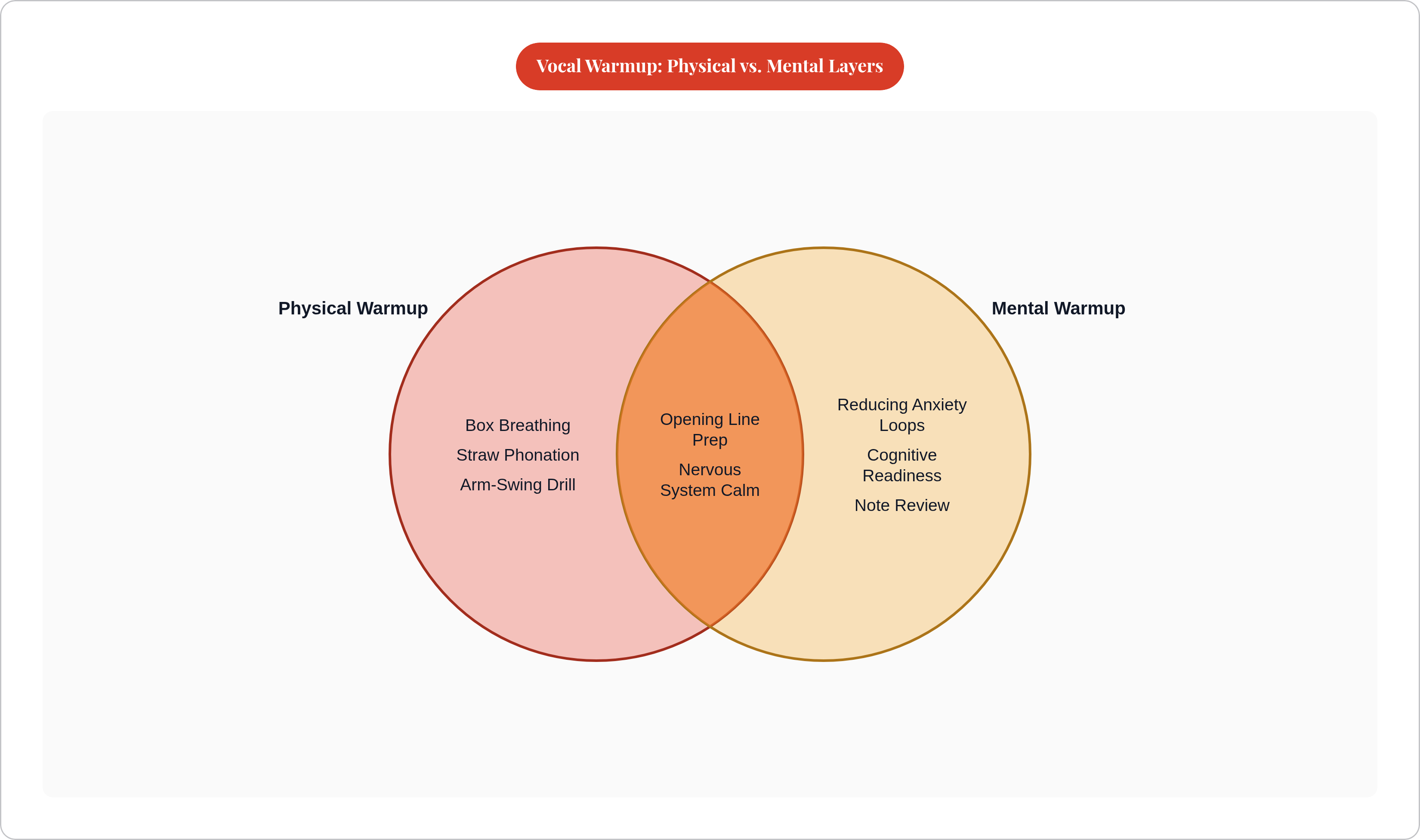
Standard pre-conversation preparation looks like this: review notes, re-check slides, run through bullet points silently. All of it is cognitive. None of it involves the voice or the body. This is a significant miscalculation, and the evidence for it is sitting in every conference room you've ever watched someone stammer through the first two minutes of a talk they clearly knew cold.
Research on first impressions in professional speaking contexts suggests audiences form initial credibility judgments within the first half-minute. That window is not served by having reviewed your deck one more time. It is served by having already felt your opening line in your body.
The mental warmup is simple: say your opening sentence out loud, with your actual voice, three times. Not to memorize it. To make it physically familiar. There is a material difference between a line you know in your head and a line your mouth has practiced. The former can desert you under pressure. The latter is harder to lose. Why do opening lines fail under pressure? Because they only ever lived in the brain and never made it to the mouth.
The instinct before high-stakes conversations is to manufacture intensity, to hype yourself into a heightened state. This is usually counterproductive. Elevated physiological arousal makes the voice harder to control, not easier. The warmup works in the opposite direction, bringing the nervous system toward regulation rather than agitation. Homer documented this exact pattern in a newly promoted senior manager whose presentations consistently started rocky, heart racing and pacing out of control, not because her content was weak but because her opening hadn't been stabilized. The warmup, targeted specifically at the first impression, fixed it.
How to Build a Seven-Minute Routine That Fits Real Life
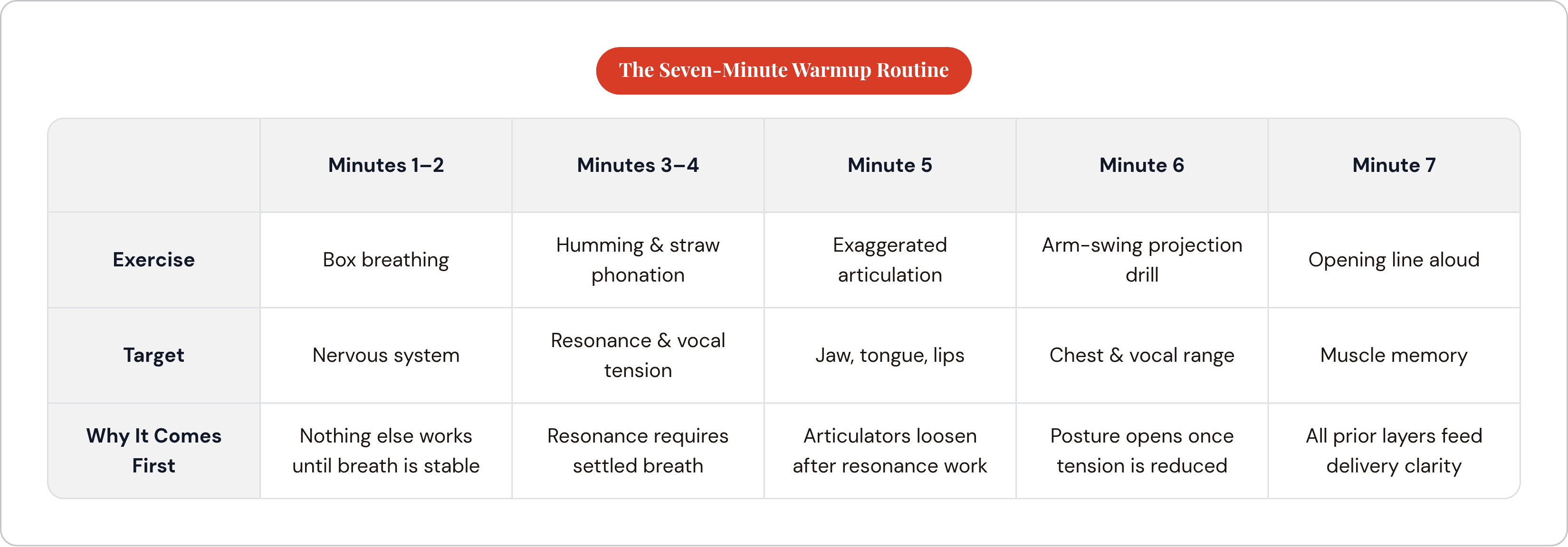
The practical constraint is real. Most high-stakes conversations don't come with a green room. They happen in offices, on video calls, in lobbies. The routine has to work in a bathroom stall, a parked car, or an empty stairwell. It does.
Minutes 1 to 2: Box breathing. Settle the nervous system first. Nothing else functions reliably until this is done.
Minutes 3 to 4: Humming and straw phonation. Wake up resonance, reduce vocal tension.
Minute 5: Exaggerated articulation on a short text. Any text works. A paragraph from an email. A news headline. The goal is mechanical precision.
Minute 6: Arm-swing projection drill. Open the chest, activate range, override the stress posture.
Minute 7: Opening line, said aloud, three times. Slowly. Feel it land.
A few logistical notes worth taking seriously: avoid coffee within a couple of hours of the conversation, since caffeine compounds adrenaline-driven over-arousal and dries the vocal tract. Dairy and sugary drinks thicken mucus in ways that degrade articulation. Room-temperature water is a straightforwardly better option. The exercises that look unusual in public, straw phonation and articulation drills especially, belong in private spaces. Identify those spaces before you need them. Improvising this mid-morning creates friction, and friction is how routines die.
Why the Warmup Only Compounds If You Do It Every Day
A one-time warmup is better than nothing. A daily warmup changes your baseline. These are not the same outcome, and treating them as equivalent is why most people who try this eventually stop.
The confidence gap across age groups tells the story structurally. Surveys consistently show that speakers in their mid-twenties report confidence levels well below those of speakers in their forties and fifties. This gap is almost certainly not explained by talent; it is explained by accumulated exposure and repetition, the unglamorous arithmetic of having done it more times, in more contexts, and having slowly internalized that it doesn't kill you.
Daily practice builds three things at once. The physical mechanics become automatic, which frees attention to stay on the message. The mental ritual accelerates, so the shift from default mode to sharp mode is conditioned rather than willed. And the resting vocal baseline improves: resonance, projection, and articulation get better even when you're not actively warming up, because the underlying musculature and habits have genuinely changed. This tracks with what the research on performance anxiety treatment has shown for decades: skills training combined with repeated, graduated exposure produces durable reduction in anxiety, not temporary relief.
The pattern I've seen reliably is this: speakers only think about their voice when something important is approaching. The warmup is always reactive, always remedial, never accumulating. The shift is to treat it as a daily communication practice rather than a pre-event ritual. The shower, the commute, the first video call of the morning are all viable windows. Track it. Notice whether the box breathing takes two minutes or four to settle your nervous system, and notice when that number drops. Improvement that isn't observed doesn't feel like progress, and improvement that doesn't feel like progress gets abandoned. The seven minutes are not the investment. The compounding across months is.