Impromptu Speaking Drills for Thinking on Your Feet
Practice daily drills to train your brain into coherent speech under pressure.
Impromptu speaking is a trained reflex that comes from drills, and skill gaps like the freeze that hits when someone hands you a microphone and says "just say a few words" close with reps, full stop. Years of texting, DMs, and email quietly replaced the live back-and-forth that used to train this reflex by default, and reporting suggests that large shares of Gen Z say their in-person social skills have gotten worse, with many reporting a specific decline in verbal communication. Many people report that poor communication has cost them a job or a raise at some point, and that's a training deficit. It gets fixed the same way any other atrophied muscle does.
What actually happens in the brain when you have to speak without preparation
Ask someone to speak off the cuff and you're asking their brain to juggle three jobs at once: stay flexible about what comes next, keep the nerves in check, and stitch it all into something resembling a sentence, live, with zero draft. That's divided attention, and divided attention is the enemy here. A 2024 Frontiers in Psychology study, 487 participants, found every secondary task tested, even a minor one that only tapped the attentional system, dragged down verbal fluency, p-value under 0.0001, which is about as clean a result as psychology research produces.
Social pressure is exactly this kind of secondary task in disguise. Reading the room, watching your own tone, registering that people are staring at you: all of it runs on the same cognitive hardware you need to build sentences. So when someone tells you to "just relax and speak naturally," they're asking you to shut off a process that's actively siphoning bandwidth away from your mouth, and good luck with that one.
Coherence takes the worst hit. Researchers scoring impromptu speech on structured rubrics found speakers landing in the moderate-challenge range for coherence and cohesion specifically, mean scores between 2.11 and 2.36. People don't run dry on things to say under pressure nearly as often as they lose the thread connecting what they've already said, and that's the actual bottleneck. Drills don't make you think faster; they offload structure into muscle memory so whatever's left of your conscious mind can focus on content instead of scaffolding.
Why frameworks beat raw thinking speed when the pressure is on
Nobody thinks their way to a sharp impromptu answer in real time. What they do, if they've trained, is drop into a scaffold the brain already has memorized, the way a pianist never once thinks about finger placement mid-performance.
PREP is the standard: Point, Reason, Example, Point. State your position, explain the why, give one concrete example, restate the position to land it. Works on almost any prompt you'll get thrown at you, and it buys thinking time while sounding put-together, which is the whole game here.
STAR (Situation, Task, Action, Result) does something similar, mirroring how cause and effect actually unfold in a story. It's widely used in interviews and has migrated well past interviews into live speaking and on-the-fly problem-solving, because it maps onto how people narrate events anyway.
A few others earn a spot on the bench. Past-Present-Future suits updates and personal storytelling well, while ABT (And, But, Therefore) builds narrative tension in three moves flat. The diplomatic structure, pros then cons then a conclusion, stretches your speaking time and makes you sound balanced even when you walked in already holding a strong opinion.
Timing matters just as much as structure does. An impromptu answer running 60 to 90 seconds holds a room; cross two minutes and you lose them no matter how good the content is. Memorize two or three frameworks and your brain grabs one on reflex, the way a driver downshifts without deciding to. Build structure from scratch under pressure instead, and you're improvising twice, once on content and once on shape. That gap is the whole difference between sounding sharp and sounding like you're stalling for time.
The drills that actually wire the reflex
Volume beats intensity, every time. Ten to fifteen minutes of daily practice produces steadier gains in articulation and lower anxiety than one long weekly session ever does, and the arithmetic backs it up: five minutes a day, 300 days a year, is 1,500 minutes of live reps annually. Compare that to the person who does one two-hour session a week and calls it training, and you're looking at a hobby with a spreadsheet.
The 60-second random object drill is the cheapest entry point there is. Grab whatever's within reach, run PREP on it, record yourself on your phone, and do three reps a day. The point isn't the object; it's building the habit of grabbing a framework the instant any topic lands in front of you, quarterly earnings or a stapler, doesn't matter.
The timed-section drill fixes a specific and extremely common failure: people front-load their first point, then rush or drop the conclusion entirely because they ran out of runway. Divide your response into five segments, intro, three points, conclusion, assign each a time budget, and keep talking when the timer moves on, even mid-sentence if you have to. It forces proportional structure into your body instead of leaving it stranded in your notes.
The double-take drill has you speak on the same prompt twice, once cold and once after two minutes of reflection. It trains the post-mortem instinct, actually noticing where a response fell apart and why, which moves the needle faster than burning through a fresh prompt every time and never once examining the wreckage.
The filler-word audit is unglamorous, and it works anyway. Record two or three minutes on any topic, then listen back and tally every "um," "uh," and "like," since you can't kill what you can't hear yourself doing. The goal is swapping fillers for a deliberate pause, because a pause reads as thought and a filler reads as panic.
Active listening doubles as a stealth drill, and it costs nothing. In any conversation, paraphrase before you respond: "so you're saying..." It trains the same real-time comprehension and reframing that impromptu speech runs on, and it turns every conversation into a rep whether you meant it to or not.
Improv-style exercises deserve a real look here, not a polite nod. Comparative studies on drama and improvisation techniques show meaningfully bigger gains in oral fluency than traditional practice methods, and a 2024 SAGE study found 78% of participants reported a clear jump in speaking confidence from improv work specifically. No class or coach is required for the lowest-friction version: "yes, and" conversations with a partner, or building a story one sentence at a time back and forth.
One more thing worth doing: find your specific freeze point. Maybe quotes lock you up but random objects don't, or maybe abstract concepts turn your brain to static while personal stories flow just fine. Spend a few weeks drilling only that prompt type with one repeatable structure, until it stops feeling special and starts feeling boring.
How storytelling gives impromptu answers staying power
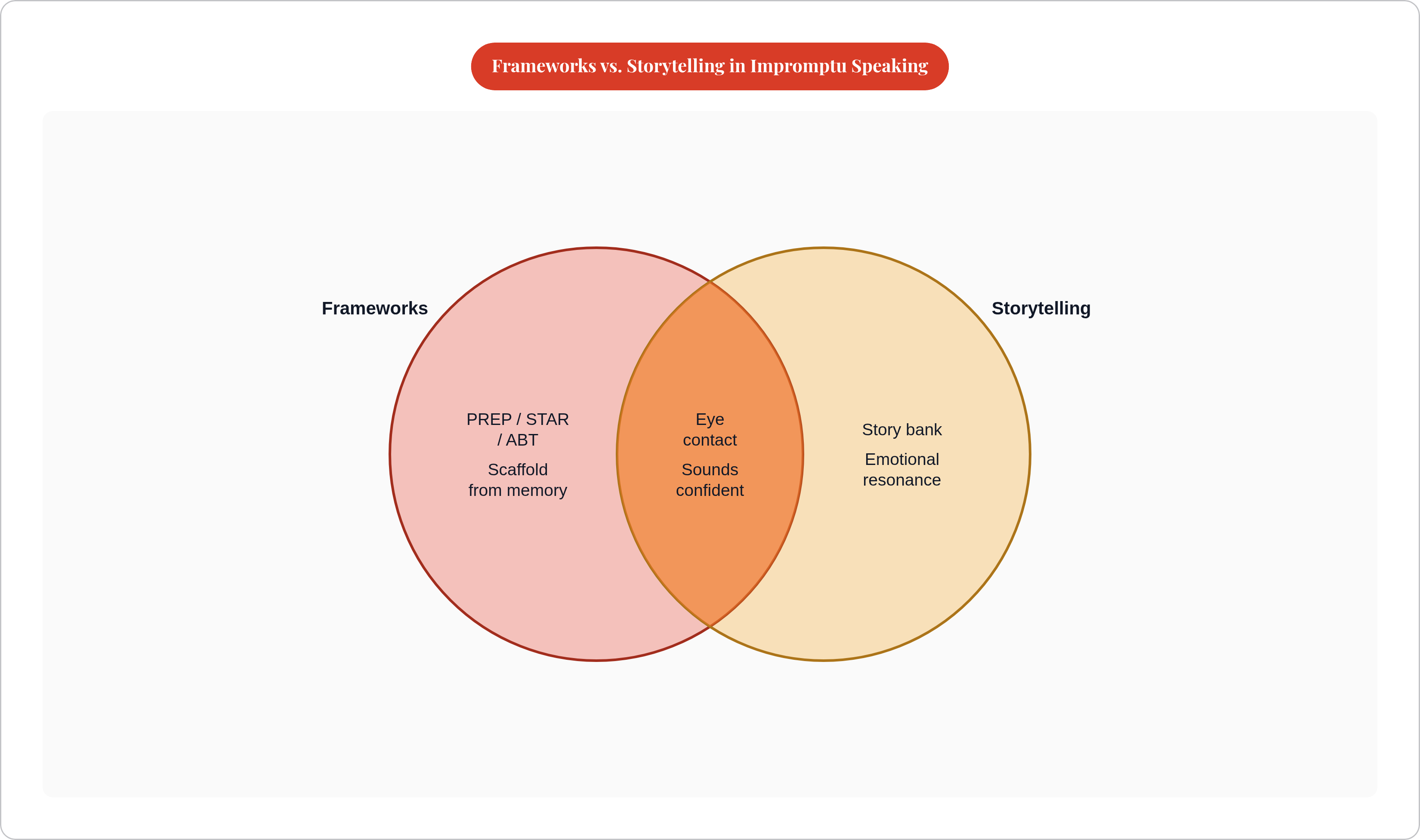
A framework keeps you organized in the moment, while a story is what the room actually remembers an hour later, on the drive home, at dinner.
Here's the mechanism: a listener can't hold five isolated facts in working memory, but they can follow one person through one problem without any effort at all. The point rides inside the narrative instead of sitting there naked, waiting to be memorized separately. That's just how attention works, and it's why a well-placed anecdote outperforms a well-placed statistic in a live room, even when the statistic is the more precise of the two.
The small-medium-large technique fits impromptu speaking especially well. Start small, a personal anecdote tied to the topic, then widen to medium, a broader group or a shared experience the room already recognizes, and close large, the bigger-picture implication. It's a natural zoom-out, and it reads as thoughtful rather than rehearsed, even in high-stakes moments like a toast or a Q&A you never saw coming.
Keep a story bank going. A running one-line log works fine: something that went sideways, a strange remark someone made, a moment that caught you off guard. One entry a week is plenty, and months in, that log is a library you can pull from for almost any prompt, because you're retrieving material instead of inventing it live under a clock.
One nonverbal detail gets underrated constantly: eye contact. It's arguably the single most load-bearing nonverbal tool in an impromptu situation, because it projects assurance while the sentence is still assembling itself somewhere behind your eyes. Put it together, PREP or STAR for the skeleton, a story sitting in the example slot, steady eye contact holding the room, and the result reads as confident whether or not it felt that way from the inside. Nobody out there can hear your heart rate.
What consistent reps actually produce over time
A 2024 ScienceDirect study, 99% confidence, p-value of 0.001, found that creative thinking, emotional intelligence, and academic enthusiasm each predict speaking fluency, positively and significantly. Fluency sits downstream of trainable habits far more than fixed talent handed out at birth, which is either encouraging or mildly infuriating depending on how many years you've spent assuming you were just "not a public speaking person."
The compounding works roughly like interest on a savings account nobody remembers opening. Each rep makes the next one marginally cheaper cognitively, because less bandwidth goes toward building structure on the fly and more stays free for content, presence, actually reading the room instead of just surviving it.
Filler words drop first, usually within a few weeks, and pauses start turning intentional instead of panicked, while answers begin to have a shape a listener can actually trace from start to finish. Then the freeze itself shrinks: the gap between the prompt landing and the first confident word narrows, because a scaffold shows up faster than it used to, sometimes before you've consciously gone looking for it.
This was never about being the smartest person in the room. It's about being the one whose ideas land clean while everyone else is still clearing their throat, fishing for a word that won't come. Log the reps, listen back, get uncomfortable with your own filler words, because the gap closes, and it just takes longer than anyone wants to hear.