How to Memorize a Speech Reliably
Use semantic memory and spaced repetition to lock in your speech.
Memorizing a speech comes down to a system: chunk it, space out the review, rehearse it out loud, run the loop daily. About three in four people report some fear of public speaking. Researchers who study student speakers broke that fear apart and found roughly 30% traces to worry over judgment, 23% to something narrower: the fear of losing your place mid-speech. Forget the judgment slice. That 23% is the fixable one, and it's what this piece is about.
Blanking feels like a nerve failure in the moment. Usually it's a preparation failure from three days earlier that just cashed its check at the worst possible time. Confidence gaps track this almost too neatly, with about a quarter of people aged 16 to 24 saying they're comfortable speaking to an audience, versus close to 70% of adults over 45. That gap looks less like talent accruing like interest and more like plain reps. One frequently cited figure pins roughly 90% of pre-presentation anxiety on plain under-preparation. Usually the anxiety amounts to nerves in a costume, and not a very convincing one.
So here's where most people reading this actually live. You've got something to say, you've written it down, and some part of your brain is quietly convinced it's going to fall apart under the lights. Fair enough. "Practice more" is advice with no skeleton to it. Here's the skeleton, and I've built enough of these for enough nervous people to know which parts of it actually hold weight.
The foundational mistake: trying to memorize words instead of structure
Most people memorize a speech like a phone number. Start at the top, go word by word, hope the chain holds all the way through. This method basically produces blanking, because one dropped word snaps the whole sequence and there's nothing underneath to catch you.
Watch how people who do this for a living prepare: a CEO running an all-hands, an actor, a politician giving stump speech number four hundred. They memorize themes, not text. They own the argument and the order it unfolds in, plus maybe three or four signature lines polished to a shine. Everything else stays loose, on purpose, because loose is what survives contact with a live room.
That maps onto a real split in how memory works. Semantic memory holds meaning and structure, the "what" and "why this follows that." Verbatim memory holds exact wording: these words, this order, no substitutions. The system here leans on semantic memory almost entirely and saves verbatim memory for the few spots that earn it, an opener, a closer, a line built to land clean or not at all.
Brains are pattern machines. They're structurally bad at holding arbitrary strings of words, so work with that wiring instead of against it. Once you're memorizing ideas instead of sentences, you need some way to keep those ideas from turning into soup. That's a mapping problem, and it's the next one.
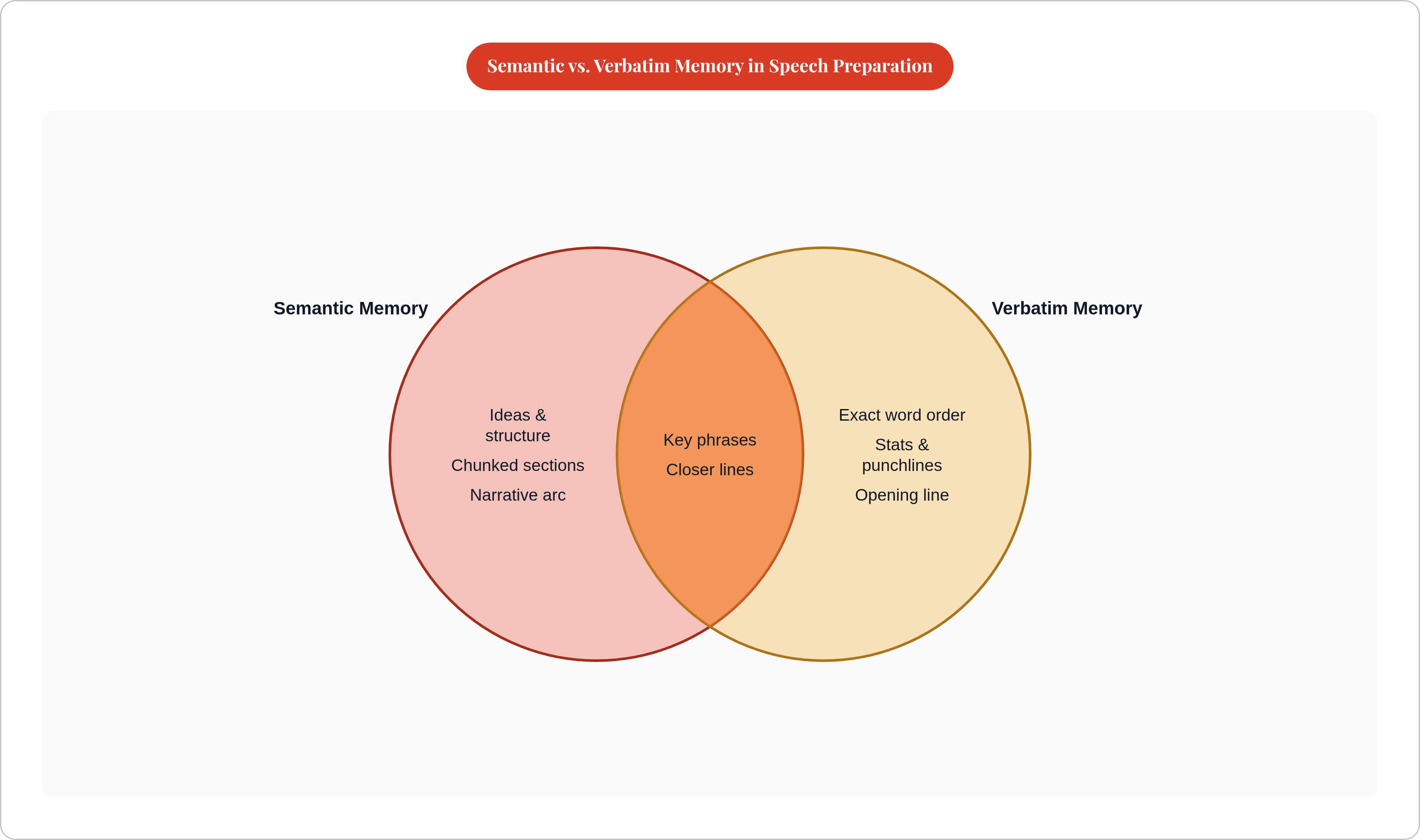
Chunking: how to break a speech into a map you can actually navigate
Chunking runs four levels, top-down. Level one: the three to five big sections forming the skeleton of the talk. Level two: the beats or mini-arguments inside each section. Level three: load-bearing phrases, language specific enough that swapping it out would sound wrong. Level four: exact words in exact order, and this level only shows up in a handful of spots, a stat, a punchline, an opening line you refuse to fumble.
Map it on paper before memorizing a single word. The map is the first thing you build, not scratch paper you toss once rehearsal starts.
Write it by hand. Not for sentimental reasons: research has found students who take notes longhand score meaningfully higher on retention tests than students who type them, likely because handwriting is slower and forces deeper processing of structure instead of passive transcription. Typing an outline mostly amounts to dictating to yourself, while writing it out already functions as a form of rehearsal.
Once the map exists, drill it section by section, not top to bottom every run. Sounds like a small tactical choice. It isn't. Starting from line one every time means your opener gets fifty reps and your closing section gets maybe a dozen, exactly backward from what you want walking into a room. Chunk-based rehearsal spreads reps evenly, so the back half is as solid as the front by the time you're done.
The map doubles as a rescue rope mid-delivery. If you blank, the specific lost word barely matters; what matters is knowing the next section header cold, because the system was built around that anchor. One cheap trick: take the first letter of each section's key idea and build a short acronym. Small enough to fit in working memory, which is the only real estate that counts once you're standing up front and your palms have quietly defected to the other side.
Spaced repetition: the schedule that fights forgetting before it happens
Forgetting runs on a curve, and spaced repetition works by hitting the material again right before it would slide off that curve. The timing is the whole trick. The goal is catching what's about to leak out, not repeating what you already half-know.
Cramming is the obvious shortcut. It manufactures a short-term fluency that feels great the night before and buckles under the exact pressure it's supposed to survive: standing in front of people. A study covering tens of thousands of physicians found spaced repetition beat no spaced repetition by a wide margin, with gaps showing up in both initial learning and the ability to transfer that knowledge later. Twenty-six thousand physicians is a real sample size, not twenty sophomores in a psych lab getting course credit for showing up.
Applied to a speech: spread rehearsal across days instead of one long panicked night. A schedule that holds up in practice looks like this. Day one, build the chunk map, run the full speech once. Day two, review each section unprompted and mark whichever ones felt shaky. Days three and four, drill only the weak spots. The day before, one full run at real performance pace, no stopping to patch mistakes mid-sentence.
Anki and Quizlet will automate the spacing math if you want cue cards built around section headers instead of full text, handy for tracking which chunks you keep quietly avoiding. The underlying idea survives with zero apps involved, though: cramming feels productive and leaves you fragile, while spaced practice feels slower and leaves you durable exactly when durability is the only thing that matters. Spacing sets the calendar; out-loud rehearsal is what happens inside each session on it.
Out-loud rehearsal and why silent review isn't practice
Reading a speech silently feels like work. Mostly it trains recognition memory, that "yeah, I've seen this before" flicker, rather than recall memory, the "I can produce this from nothing, right now" skill that's the only one that matters on stage. Different systems entirely, and only one survives contact with an actual audience.
Delivery is a physical task before it's a mental one. Mouth, breath, pacing, all of it needs training the same way content does, and none of that gets touched by scanning a page in silence. Record yourself and play it back during dead time: commuting, walking the dog, whatever fills the day anyway. Make one version at normal conversational pace, then two more sped up with exaggerated vocal variety. The mix builds flexibility and keeps delivery from calcifying into something flat.
Try intonation drills too. Run one passage five times and shift the emotional emphasis to a different word each pass. This forces actual meaning-processing instead of string-retrieval, and that distinction matters enormously: a memorized string snaps under pressure, meaning doesn't.
Some speakers tie a section to a piece of music or a rhythmic cadence, and the beat becomes a retrieval cue the same way a landmark cues the next turn on a familiar drive. Pacing or gesturing while rehearsing works the same angle: it drags your body into the retrieval system instead of leaving it standing around as a bystander.
Run at least one full rehearsal under real conditions: standing, projecting, no pausing to self-correct the second you flub a line. Stopping and restarting every mistake only teaches you to stop and restart. Recovery is the actual skill, the one you need when something goes sideways live and there's no pause button on the room. Out-loud rehearsal is also where the chunk map gets genuinely stress-tested. You find out fast which transitions are weak and where the real blanks live, as opposed to the ones you imagined on paper.
The memory palace for high-stakes speeches that have to be delivered exactly right
The method of loci is ancient and it still works, flatly and reliably. Pick a route you know cold: your house, your commute, your old college quad. Hang a vivid mental image at each stop for a chunk or key idea. To recall the speech, walk the route in your head. Each location cues the next idea the way passing a landmark cues the next turn without you having to think about it.
Brain imaging of World Memory Championship competitors shows their edge comes from strategic use of the method of loci rather than some structural gift the rest of us are missing. Training studies show a few weeks of practice shift a novice's neural wiring toward those same expert patterns. A 2025 meta-analysis in the British Journal of Psychology found a large effect size for immediate serial recall with the method, with the Bayesian analysis calling the evidence "very strong." A separate review of randomized controlled trials found a meaningful effect favoring the method of loci over standard memorization. A 2022 feasibility study on VR memory palaces found a 20.4% bump in recall of non-spatial information versus traditional memorization, an emerging tool worth watching even though most people will keep building theirs the old way: in their own head, for free, no headset required.
None of this comes free of limits. Cap it around two items per location; cram in more and the images start bleeding into each other like a bad photo double-exposure. Building a palace takes real time up front, and getting quick at it takes several speeches' worth of practice, not one lucky attempt at the county fair. Skip it for a five-minute toast. Use it for something long, dense, or that has to come out clean with zero notes in hand, and let it handle the sequence of major chunks only. Leave the granular stuff to the chunking system already doing that job.
What narrative structure does that pure memorization can't
Stories stick. Lists and raw data don't, not nearly as well, because a story carries its own internal logic that predicts what's coming next. Know the emotional arc and you can rebuild the content sitting on top of it even after the exact wording has gone fuzzy.
Before memorizing anything, find the actual story the speech is telling. What's the tension that opens it. What's the turn sitting in the middle. What does the ending resolve, or pointedly refuse to resolve. Anchor each main idea to a real anecdote, a concrete scene, a specific moment, not because it's more fun, though it usually is, but because texture gives your brain something to grab. Abstractions slide right off. Concrete scenes stay put.
Here's the part nobody tells you upfront: a memorable speech and a memorizable speech are, nine times out of ten, the same speech. Concreteness, causality, a clean arc, those are the exact features that make an idea land with an audience, and they're also what makes it easier for you to hold onto as the person delivering it. Build the speech right and half the memorization work finishes itself before you've drilled a single rep.
Daily reps as the actual differentiator between blanking and delivering
Every technique above is a system, and systems only pay off if somebody runs them, over and over, without romanticizing the process into something it isn't. That's the entire gap between people who deliver and people who don't.
Belief that this is learnable is nearly universal: 95% of people surveyed think anyone can beat a fear of public speaking with the right training. Most people still treat each speech as a one-off crisis to survive rather than a rep inside an ongoing practice, though. The exposure data backs this from a different angle. 52% of people with a high school education or less report fearing public speaking, versus 24% of college graduates. Accumulated reps in environments that force regular speaking, more than raw intelligence, explain that gap.
Short daily practice, one prompt, one recording, one scored attempt, builds the fluency and retrieval speed that makes everything else in this piece hold up once the pressure's on. Each rep tightens the wire between what you meant to say and what actually comes out of your mouth on demand. Scoring closes a loop that vague, unmeasured repetition leaves wide open. Without it, you can't tell which reps sharpen the skill and which ones just rehearse the same mistake on a loop.
I built Yapp around this exact idea after watching too many smart people bomb speeches they'd technically "prepared" for: a daily prompt, a recorded response, a score from 0 to 100, nothing fancier than that. Build the chunk map, space out the rehearsal, drill it out loud, and the speech in front of you is covered. Keep running daily reps past that, and the next speech costs less than this one did. Talent rarely decides the outcome. A system, run consistently, does, and the people who walk off stage without blanking simply logged more reps than everyone else in the room.