One-on-One Speech Coaching vs Group Practice Clubs
Group clubs build comfort under observation; one-on-one coaching refines delivery mechanics.

Toastmasters is the obvious starting point: hundreds of thousands of members across thousands of clubs in nearly 150 countries, running continuously since 1924. That longevity reflects a mechanism that works for a specific problem. Every club meeting puts you in front of a live audience inside a structured, predictable container. You organize your thoughts while being observed, which replicates the cognitive and social pressure of professional settings in a way no solo drill ever will. Think of a Toastmasters meeting as a flight simulator for your mouth — the cockpit feels real enough that your hands sweat, but the ground stays safely below. The audience variable is never removed, because removing it would defeat the purpose entirely.
There's a secondary mechanism that gets underappreciated: observational learning. Watching speakers at varying skill levels every session, you accumulate pattern recognition about delivery, structure, and recovery from mistakes. Solo practice cannot replicate this.
A Toastmasters survey found that a large majority of members reported experiencing less fear during public speaking after joining. Self-reported, so it captures perceived confidence rather than measured skill ceiling. Reduced fear is still a legitimate outcome, and the format delivers it consistently. AgoraSpeakers, Storymasters circles, and local Meetup groups operate on the same essential architecture, just without the institutional infrastructure.
What group clubs genuinely build: comfort under social observation, the habit of showing up and speaking regularly, and peer accountability that keeps people in the reps long enough for the exposure to compound.
What One-on-One Coaching Is Actually Designed to Do
Remove the audience and something useful opens up. Without social pressure distorting the reps, a coach and speaker can isolate specific behaviors at a granularity a peer group rarely reaches: pace, resonance, inflection patterns, filler words, breath control. A coach also adjusts the curriculum session by session based on direct observation, which no group can do for an individual member.
Most professionals see visible change within three to five coached sessions that include real practice and specific feedback. That compression of the improvement timeline comes from the tight feedback loop, not from the coach's intuition alone.
The customization extends to goal specificity. Working on a single upcoming presentation from the first session is entirely possible. Goals like interview preparation, vocal tone refinement, or executive presence are reachable because the curriculum is built around one person's actual situation, not a generalized syllabus. Online coaching produces comparable outcomes to in-person work for anxiety reduction and presentation competence, which matters if you lack geographic access to a strong local practitioner.
The limitation is real: removing the audience variable is also a ceiling. A speaker who trains exclusively one-on-one builds skill in the coaching room and freezes when 20 people are watching — like a swimmer who has perfected their stroke in a pool and then discovers the ocean has waves. The social pressure that group settings replicate is genuine, and coaching alone doesn't substitute for accumulated exposure to it.
The Muscle Each Format Actually Trains, Stated Plainly
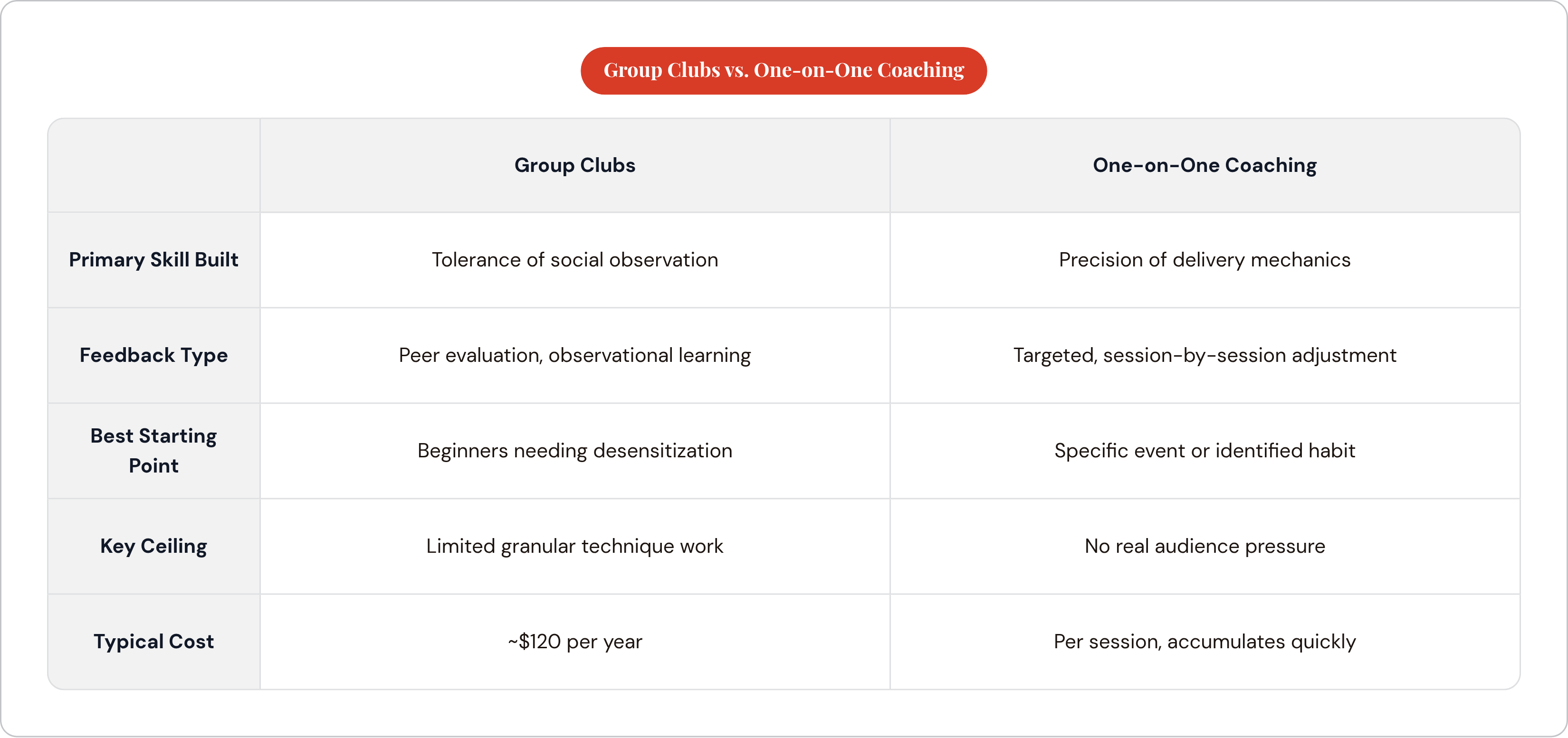
Group clubs primarily train tolerance of social observation, real-time composure under peer evaluation, and the habit of consistent public practice. Research on verbal fluency identifies processing speed and lexical access as trainable functions that respond to deliberate practice; group exposure builds the regulatory layer that keeps those functions online when anxiety spikes, which is the part that breaks down for most people in real professional settings.
One-on-one coaching primarily trains precision of delivery mechanics, conscious control of specific verbal behaviors, and confidence in a defined context. The skill being developed is technical command: executing correctly before social pressure is reintroduced.
Neither format trains both muscles equally well. That's the design. Research in impression formation shows that audiences form assessments of a speaker's competence before that speaker has finished an opening sentence; coaching tends to address this directly through work on vocal presence and physical composure, while group formats rarely do. Meanwhile, the desensitization that group exposure produces cannot be coached around indefinitely. Both ceilings are real, and pretending otherwise is how people spend years inside a format that was never suited to their particular deficiency.
What's Actually Holding Your Verbal Game Back, a Self-Diagnosis
The operative question is specific: what breaks down for you, and under which conditions? Does the problem appear when you're alone and unprepared, or only when people are watching? Is the issue a discrete bad habit, such as filler words, trailing off, or monotone delivery, or a general anxiety response that degrades overall function?
Cases that point toward group practice:
- You speak fine when relaxed but freeze or rush the moment you're being observed
- You need the accountability of a recurring commitment to actually practice at all
- You want to observe a range of speakers and build pattern recognition through comparison
- You're early enough in the process that desensitization has to precede refinement
Cases that point toward one-on-one coaching:
- You have a specific high-stakes event on a defined timeline
- You've identified a precise habit that isn't improving on its own despite regular practice
- Group settings worsen your anxiety rather than gradually easing it, because each club meeting becomes another high-pressure performance rather than a low-stakes rep
- You need curriculum aimed at a goal a peer group won't reach, like interview performance, vocal authority, or tailored presentation structure
A meaningful tension exists in the generational data: roughly 74% of Gen Z report fear of speaking in front of others, making them the population most likely to benefit from group desensitization and also the one most likely to find the group format immediately threatening. For that cohort specifically, coaching often makes more sense as a first stage even when group practice is the right long-term environment. The sequence matters as much as the format.
Why Daily Reps at Home Are the Missing Infrastructure for Both Formats
Both formats have a structural frequency problem. A Toastmasters club typically meets weekly or biweekly, and a member delivers one prepared speech per meeting at most. Coached sessions run weekly or less frequently, and the gap between sessions is where habits either harden or regress.
Verbal fluency responds to volume of practice, not just occasional quality feedback. These are not interchangeable inputs. The improvement figures associated with both formats describe outcomes for people who are actively practicing between formal sessions, not just showing up for them.
Daily short-form practice, whether recording a spoken response to a prompt, arguing through a position without notes, or narrating a complex thought aloud, builds the between-session reps that make coaching and club work compound rather than reset each time. Studies of AI-powered speech feedback tools have reported reductions in filler word frequency of around 47% and gains in audience engagement scores around 41%. The meaningful variable in those results is feedback frequency, not the AI itself. Tight feedback loops catch and correct habits before they calcify.
Yapp is built specifically around this gap: a daily spoken prompt scored on a 0 to 100 scale, producing the repetition density that turns coaching or club sessions into compounding practice rather than periodic tune-ups. The score isn't the point; the daily rep is.
How to Build a Training Stack That Matches Your Actual Situation
Choosing between formats is the wrong frame. Sequencing and combination are the actual decisions.
Coaching first, then group: the right sequence for people with specific high-anxiety triggers or a defined high-stakes event on a short timeline. Coaching builds the targeted skill; the group setting afterward stress-tests it under genuine social pressure. Group first, then coaching: the right sequence for beginners who need baseline desensitization before granular feedback is useful. The club builds tolerance; coaching then sharpens what the group exposure has surfaced.
For those with access to both, running them in parallel works, with group practice handling audience exposure and accountability while coaching runs concurrent targeted skill work. Many practitioners design it this way intentionally.
Cost is a real constraint. Toastmasters runs roughly $120 per year; Dale Carnegie courses run $2,000 to $2,500; private coaching is priced per session and accumulates quickly. For readers who cannot access either format consistently, daily self-directed practice with structured feedback is the repetition layer that makes everything else work.
Specific habit changes, like filler words, pace, and vocal projection, become visible within weeks of consistent feedback-dense practice. Composure under audience pressure builds through accumulated exposure; that takes months, not sessions. Eloquence and the ability to hold a room become defaults rather than performances only after daily practice plus quality feedback sustained over time. Yapp's daily prompt-and-score loop fits into any of these stacks as the repetition layer between sessions, tracking progress concretely rather than relying on self-assessment, which is, notoriously, the least reliable metric available.