Debate Clubs as a Path to Confident Speaking
Students gain real speaking confidence only through high-pressure practice with specific feedback.
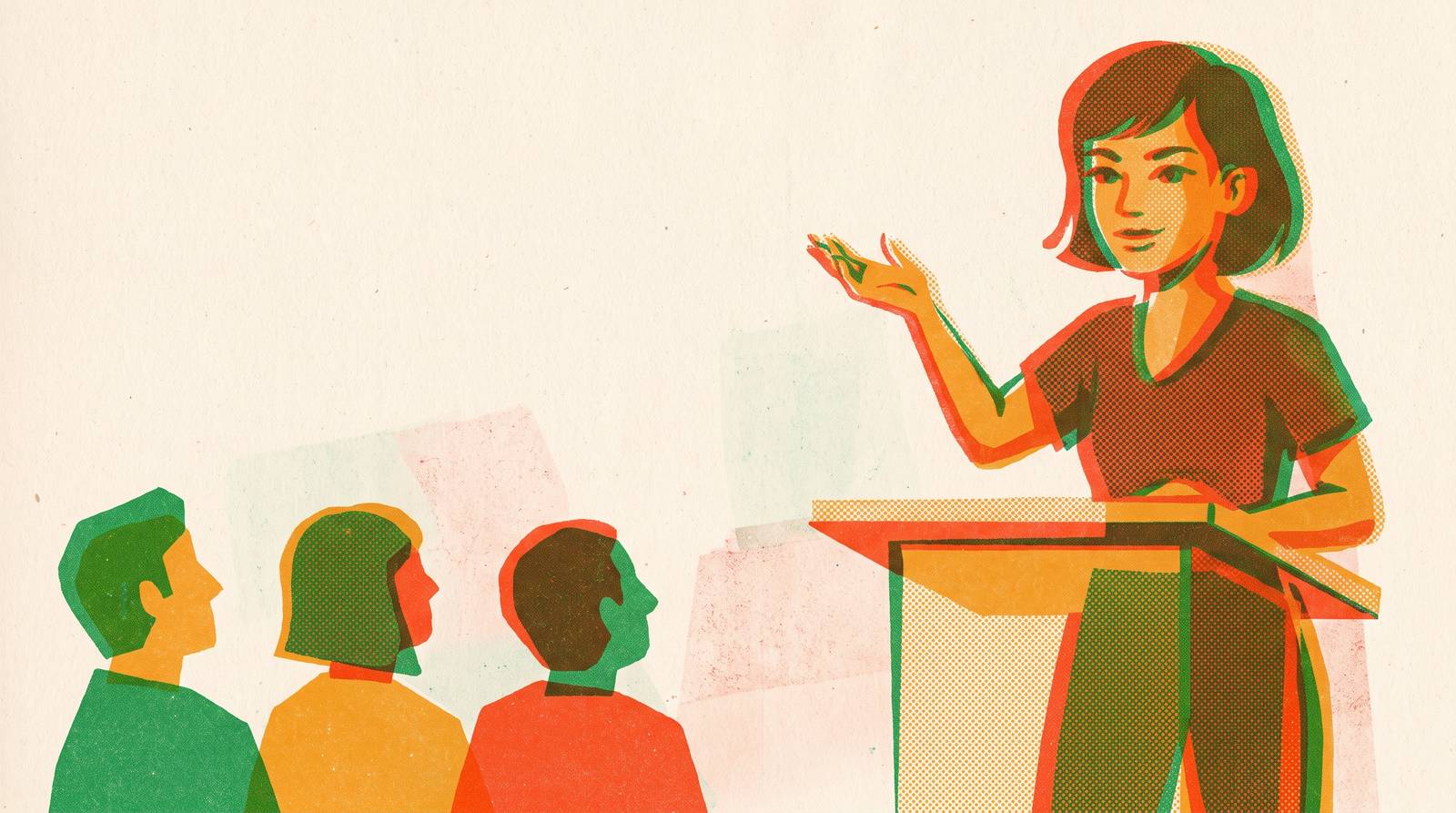
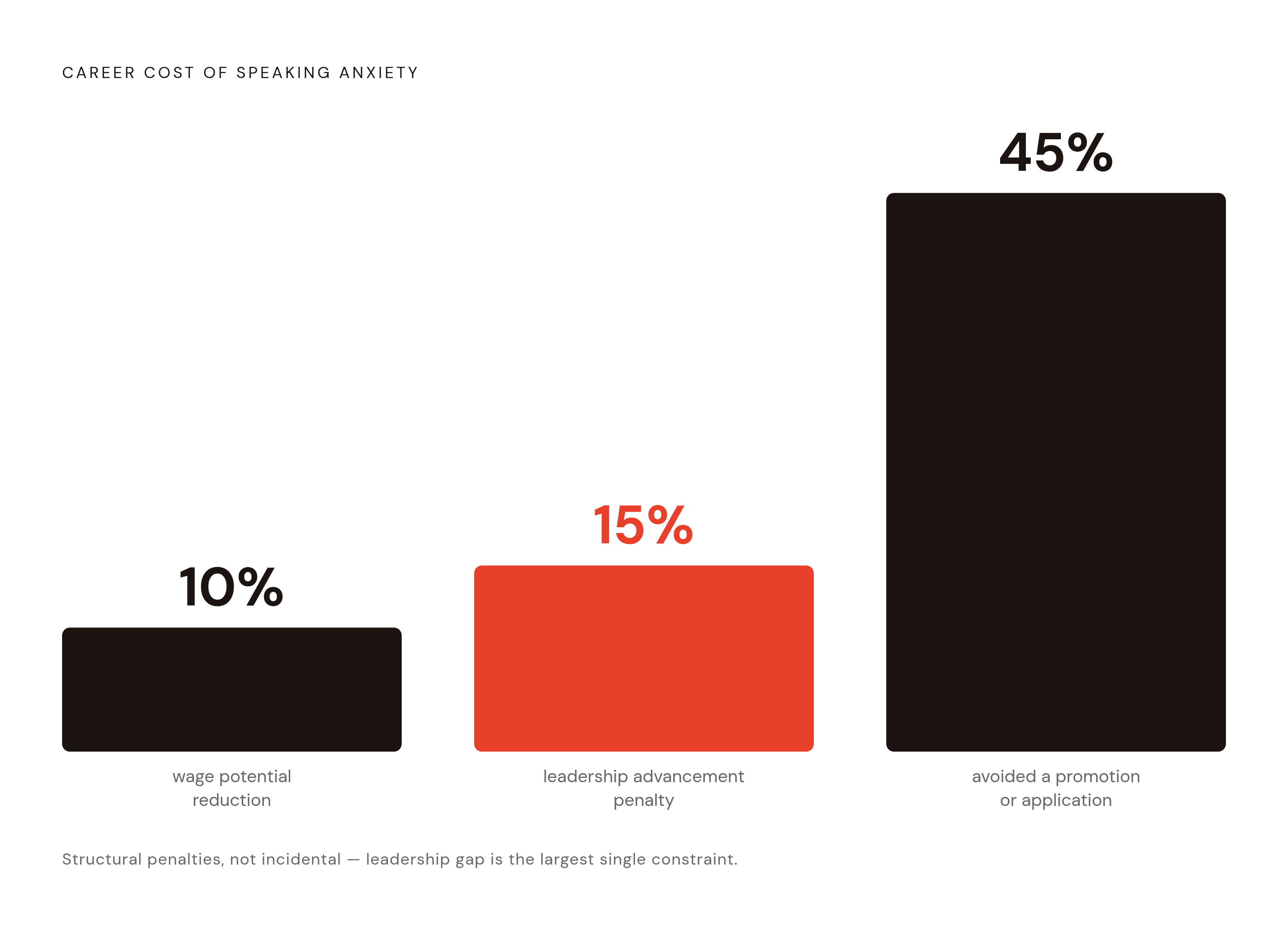
Approximately 75% of people experience glossophobia, which makes public speaking fear less a personal quirk and more a near-universal baseline condition. That fear typically takes root in adolescence, making school both the origin point and the intervention window. The career costs are concrete: research links speaking anxiety to a 10% reduction in wage potential and a 15% penalty in leadership advancement, and roughly 45% of people have avoided promotions or job applications because of it. Debate, specifically the competitive, structured, feedback-rich kind, is one of the few interventions with the architecture to actually address this.
Most students get exposure without ever getting the three ingredients that move the needle: stakes, real-time pressure, and specific feedback. Presenting to a friendly classroom audience or rehearsing in front of a mirror doesn't reliably reduce anxiety because it never reproduces the conditions that trigger it. Practicing calm in a calm room prepares you for calm rooms — and that, unfortunately, is not the problem.
Anxiety reduction, as understood through exposure-based frameworks in behavioral psychology, requires repeated contact with the feared situation at sufficient intensity. The student has to feel the nerves and survive them, repeatedly, until the nervous system recalibrates its threat assessment. Debate manufactures that condition. A real opponent, a judge, a running clock: the situation is live enough to trigger anxiety, which is precisely the point. Real-time rebuttal forces a student to think and speak simultaneously, attacking the freeze-response at its root. And the feedback is specific; not "speak louder," but critique tied to particular arguments in a particular round. Per KQED MindShift (2025), students in debate programs learn to recognize nervousness as temporary and manageable, reframing it from threat to signal — treating nerves not as a fire alarm, but as a starter pistol. Repetition alone cannot get you there.
What Debate Club Formats Actually Ask Students to Do
Debate is not organized opinion-sharing. Policy debate, one of the more demanding formats, places two-person teams on a single resolution for an entire academic year, requiring sustained research, argument development, and live delivery across dozens of rounds. The year-long structure creates compounding exposure: students cycle through preparation, competition, critique, and revision repeatedly, each iteration building on the last.
The National Speech and Debate Association runs more than ten speech and public speaking events alongside five distinct debate formats. That breadth is pedagogically deliberate. Different formats stress different capacities; some reward evidence and adversarial logic, others extemporaneous delivery or persuasive narrative. A student can begin in a team-based format, where individual exposure is lower, and migrate toward more demanding individual events as their tolerance for pressure develops.
This progression structure is what separates debate from most other speaking interventions. The most anxious students don't have to walk into a room alone on day one. Team-based entry lowers the barrier enough that students who would never sign up for a solo public speaking course will join a debate team, which is the only way any of the subsequent mechanisms get a chance to operate at all.
How the Feedback Loop Inside Debate Rounds Builds Confidence Progressively
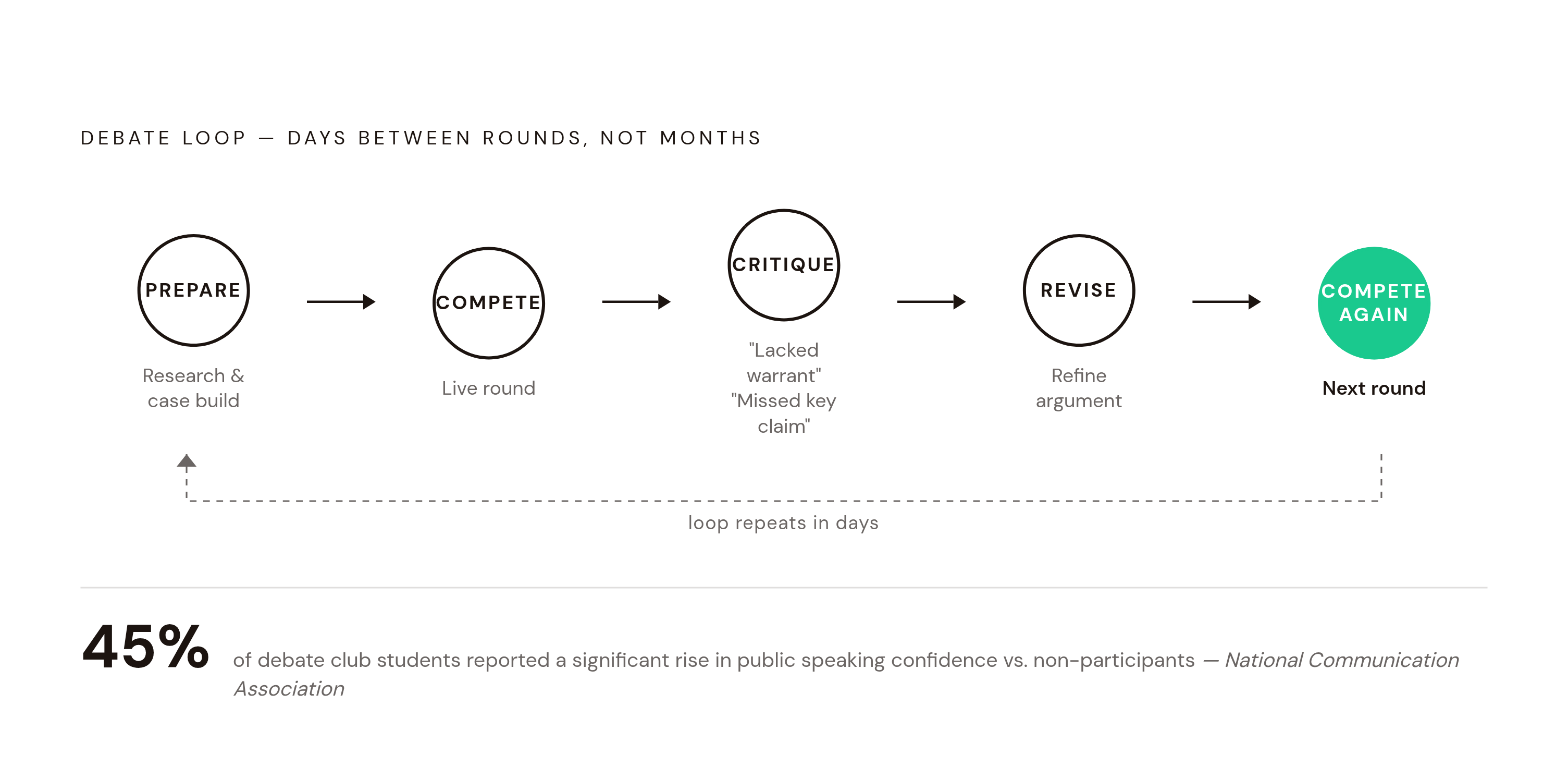
Each competitive round produces immediate, specific feedback tied to identifiable moments. A judge won't tell a student their speech was weak; they'll say a particular argument lacked warrant, that the rebuttal missed the opposing team's key claim, that the student looked down during cross-examination. That specificity is what makes feedback actionable rather than merely demoralizing.
The loop works in stages. Students first learn to identify their own weaknesses by hearing them named precisely. They adjust and compete again, closing the gap between critique and revision quickly because the next round is often days away, not months. Over time, the distance between what a student intends to say and what they actually deliver narrows, and that narrowing is what erodes the core anxiety: the fear of real-time failure.
A National Communication Association study found that 45% of students in debate clubs reported a significant rise in public speaking confidence compared to their non-participating peers. CPD Singapore (2024) corroborates the mechanism: as students receive constructive critique and experience success in rounds, their self-assurance generalizes beyond competition into classrooms and job interviews. Confidence built in round five is drawing on everything built in rounds one through four. A single seminar on "overcoming fear of public speaking" cannot replicate that accumulation; the sequencing is the point.
What the Research Actually Shows About Debate's Academic and Confidence Outcomes
The most rigorous study available is Schueler and Larned (2023), published in Educational Evaluation and Policy Analysis, which examined debate program data from Boston Public Schools. Students on debate teams showed reading score improvements of 13% of a standard deviation, roughly equivalent to two-thirds of a typical year of learning. The gains were largest among the lowest-performing students at baseline, which cuts against the persistent assumption that debate is a program for high achievers who would have succeeded regardless.
The study also documented positive impacts on high school graduation rates and four-year college enrollment, outcomes that extend well beyond the debate round itself. Researchers describe debate programs as cost-effective relative to other prominent educational interventions and note strong scalability potential. The caveat worth acknowledging: the study draws from one city, the authors explicitly call for broader replication, and effects on critical thinking and civic competency haven't been fully assessed at scale.
The academic gains belong in this discussion not as a detour but as corroborating evidence. Students who read more proficiently, reason more rigorously, and enroll in college at higher rates are students whose confidence in their own thinking has grown. The skills compound; they don't operate in isolation.
Skills Debate Builds That Carry Directly Into Adult Professional Life
The competencies debate develops are specific, not aspirational. Analytical thinking under time pressure, persuasive communication with live pushback, evidence-based argumentation, the ability to hold a position against challenge: these are the core technical demands of litigation, sales, management, journalism, and most other fields where advancement requires influencing people in real time. Calling them "soft skills" is one of the more persistent mislabelings in professional development discourse — like calling a surgeon's hands a hobby.
NACE's Job Outlook 2025 identifies problem-solving, teamwork, and communication as top employer priorities when evaluating candidates. Grammarly's State of Business Communication (2024), drawing on a Harris Poll survey, found that 55% of knowledge workers reported effective communication increased their confidence at work, framing workplace confidence as a measurable professional output, not a disposition. Debate trains the communication and the confidence simultaneously, which most professional development programs never even attempt.
The connection back to the opening is direct. The 10% wage penalty and 15% leadership advancement penalty associated with speaking anxiety are not inevitable; they are the cost of failing to build these skills earlier. Debate doesn't merely reduce fear. It installs a positive skill set where the fear used to live.
How Urban Debate Leagues Are Widening Access to These Benefits
Debate has historically concentrated in elite private and well-resourced suburban schools. That's not editorializing; the participation data support it. The practical consequence is that the students who would benefit most from debate's outcomes (those with fewer professional networks, mentors, and credentialing advantages) have had the least access to the program.
That is changing, with real infrastructure behind it. More than 10,000 students from 20 cities participated in tournaments through urban debate league programs last year, per the National Association for Urban Debate Leagues as cited in Education Next (Summer 2024). The Washington Urban Debate League serves students across more than 100 public schools in D.C., Maryland, and Virginia, with explicit focus on Title I schools where debate was previously absent. The Urban Debate League model has been rated "Promising" by the National Institute of Justice's CrimeSolutions program, an endorsement that extends beyond academic metrics into civic and social-emotional development.
The equity argument sharpens the confidence argument. If debate builds the skills that counter speaking anxiety, and the career costs of that anxiety fall hardest on students with the fewest compensating advantages, then access to debate is not an enrichment question. It is an access-to-opportunity question, and the gap between who has historically participated and who most needs the program is still wide.
What Notable Alumni Reveal About Debate's Long-Term Impact on Public Confidence
Ketanji Brown Jackson, a national oratory champion and NSDA alumna, has said debate was "the one activity that best prepared me for future success in law and in life." Oprah Winfrey competed at National Forensics League nationals. Nelson Mandela's capacity for unscripted, connecting public address has been attributed to his college debate experience. Historic National Forensic League data suggests a substantial majority of U.S. Senators and Representatives participated in high school or college forensics, though updated verification of current figures is warranted.
None of them walked in polished. What debate gave each of these people was a specific, trainable capacity to think and speak simultaneously under pressure, in front of audiences that can and will push back. That capacity was built in rounds, not conferred by talent. They got there the same way everyone gets there: by losing badly, hearing exactly why, and showing up again. Fluency in public argument, it turns out, follows a period of being publicly wrong. That's a detail the motivational-speaker version of this story usually leaves out.
How to Evaluate Whether a Debate Program Is Actually Doing the Confidence-Building Work
Not all programs that call themselves debate clubs deliver the mechanism. A club that meets twice a semester for informal discussion produces none of the three conditions that matter. Frequency, competition, and structured feedback are not optional features of an effective program; they are the program.
A program doing the actual work looks like this: regular competitive rounds against external opponents, judged by people who don't know the student and have no social incentive to be encouraging; round-level feedback delivered promptly and specifically; a progression structure that moves students from supported team formats toward more exposed individual events; and coach engagement between rounds to help students close the loop between critique and revision.
For students without access to a formal school program, urban debate leagues, community-based organizations, and online formats are expanding the options. Research published in Revista Universidad de Guayaquil (2024) found real communication gains in university-level online debate participants, suggesting that while online formats aren't identical to in-person competition, they carry meaningful portions of the mechanism.
The team-based entry structure remains one of debate's most underappreciated design features. A student does not have to walk into a room alone on day one. That's not incidental to the program's efficacy; it's what makes debate a more accessible intervention than solo public speaking training for the people who are most anxious (which is, again, most people). Confidence accumulates through repetition, not revelation. You do not arrive at it. You outlast your way to it, one uncomfortable round at a time.