Informative Speech Topics That Hold Audience Attention
Pick a topic that stakes something the audience already cares about, not just what interests you.
Picking a topic for an informative speech is half the actual job, maybe more. People decide whether to keep listening within the first few seconds of hearing what you're about to talk about, and a topic with real stakes or a built-in surprise does work that hand gestures and vocal variety can't fake later. A flat topic digs a hole you then spend the rest of your time climbing out of. Attention starts sliding after roughly eight to ten minutes on average, so if the subject doesn't earn buy-in fast, you're losing ground before your second point even lands. Recognizing what grips a room versus what bores it is learnable, and most speakers never bother to learn it.
What an informative speech is actually trying to do
There are four flavors here. Definition speeches explain what something means, while explanatory speeches get into how something works or why it happens. Descriptive speeches paint a picture detailed enough that the audience can see it, and demonstrative speeches walk someone through doing a thing, step by step. Different shapes, same job: hand over knowledge without pushing an opinion on it, letting the audience conclude on its own.
Objective doesn't mean lifeless. I've sat through informative speeches that still managed to spike curiosity, drop a small jolt of surprise, or nudge how someone saw something they thought they already understood. That's the real craft problem, staying factual while still holding a room, and it's trickier than it sounds because most speakers assume those two things are in tension. They're not, much, but only once you've picked the right subject first. Get that part right and the "just the facts" rule stops feeling like a leash.
The three qualities that make a topic grip an audience automatically
Three things do the early lifting. Stakes: the audience senses this touches money, health, identity, or their future, so they lean in before you've said a full sentence. Surprise: the topic promises to knock over something they assumed was settled. Personal relevance: it lines up with their own life closely enough that it stops feeling abstract and starts feeling like it's about them specifically.
Land two or three of these together and you've got a head start most speakers never bother building. Compare climate policy discussed in the abstract to climate policy framed as what it does to your audience's specific city's flood insurance rates next year. The first gets polite nodding, while the second gets people actually leaning forward in their chairs. One more thing worth flagging, separate from all three: match the topic to what the room already knows going in. Pitch over their heads and you get confusion, and pitch under and you get condescension, either one killing the room at the same speed.
How audience and occasion shape which topics actually land
No topic grips in a vacuum. The same subject sets one room on fire and puts the next one to sleep, depending entirely on who's sitting in it. Before picking anything, you need three things mapped out: the audience's age and generational reference points, how much they already know, and whatever's already keeping them up at night or feeding their curiosity on their own time.
Occasion changes the math too. A classroom assignment, a conference keynote, and a community town hall each define "newsworthy" differently for the people in the seats. Skip this and you land on the most common mistake in the business: picking what fascinates you instead of what your audience has any reason to sit still for. Here's a quick gut check: if you catch yourself needing to explain why the topic matters before you've even started explaining the topic, that's your answer, so pick something else.
Topic categories that consistently outperform in informative contexts
Some categories just win more often, and the reasons hold up. Science and the body, sleep, memory, the stress response, land hard because they're personally relevant and usually counterintuitive; most people are flatly wrong about how their own brain runs. Technology and its fallout, AI, surveillance, algorithms quietly deciding things about people's lives, arrives with built-in stakes, and audiences already show up half-curious about it.
History earns its keep differently: the hidden backstory behind something people use every single day comes pre-loaded with surprise. Everyday economics, pricing, debt, housing, why supply chains snap, lands because the stakes are immediate and personal rather than theoretical. Cultural shifts around work, gender, and media hit especially hard with younger crowds who are living the shift in real time instead of reading about it after the fact in a textbook. Psychology, the "why do people actually do what they do" territory, tends to pull weight almost regardless of the specific angle you take on it, since the subject does the convincing the moment you name it out loud.
The topics that sound safe but quietly kill attention
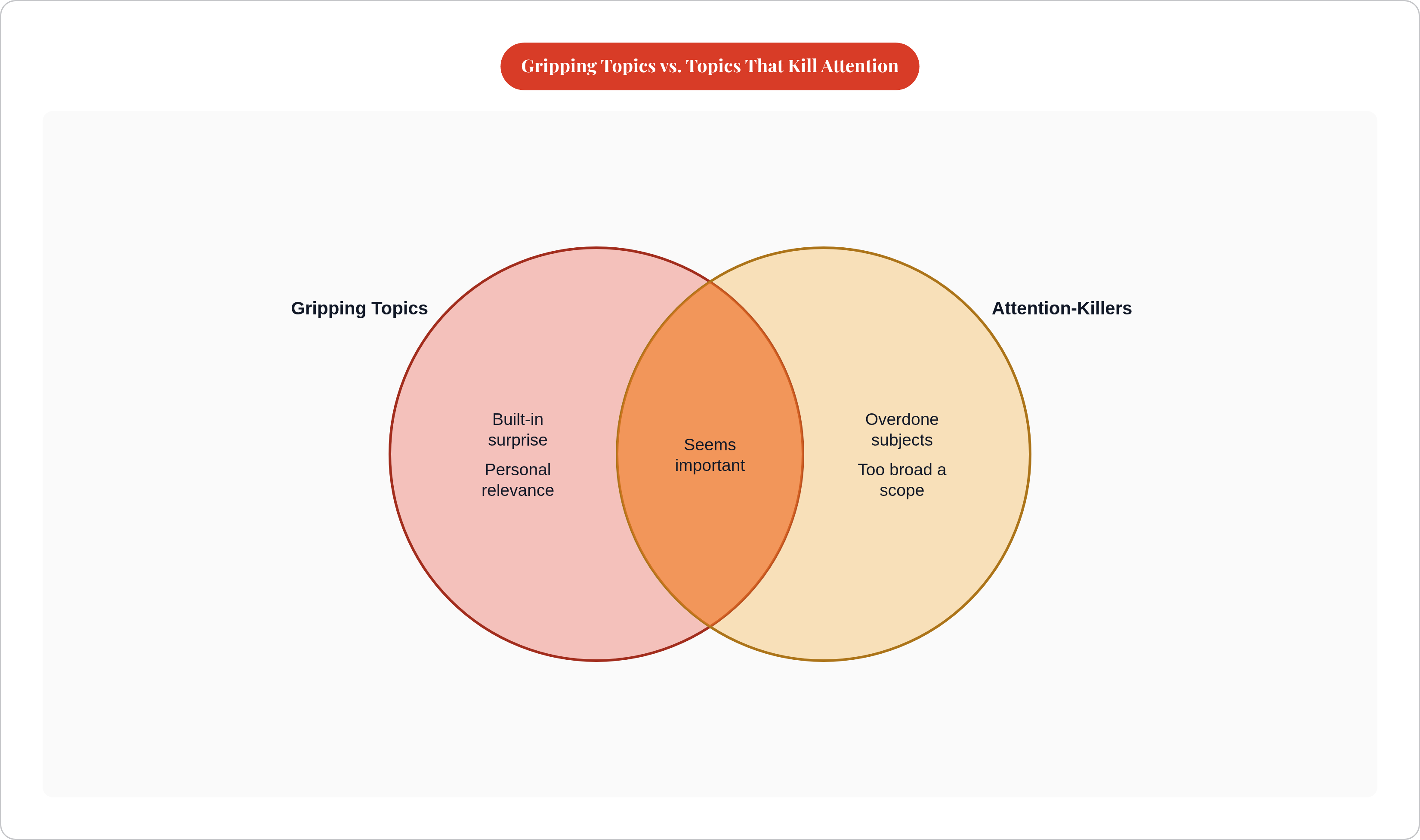
Some topics feel safe precisely because they've been done to death, and that's the trap waiting inside them. Climate change in the abstract, "the importance of exercise," a biography of a famous historical figure delivered the way every textbook already has: the audience feels like they know the ending before you've opened your mouth. Boredom kills these speeches, not disagreement.
Broad topics fail from a different angle entirely. "The history of technology" or "mental health," left unnarrowed, hand the audience nothing contained enough to actually track, so attention drifts off within minutes. Watch too for topics you picked because they're comfortable for you to talk about, not because anyone in the room is curious about them; this usually shows up as heavy reliance on personal anecdote that never pays off for the listener sitting there waiting for a point. Gravity alone doesn't buy engagement either. A topic can matter enormously and still put a room to sleep if it doesn't feel urgent right there, in that specific room, on that specific day. So ask the blunt question: can you name one concrete thing the audience walks away knowing that they didn't already vaguely suspect walking in? No answer means the topic isn't earning its slot.
How storytelling structure gives any topic an attention architecture
A strong topic opens a question in someone's head, and the speech itself has one job: keep that question open just long enough that the answer feels earned instead of just handed over on a platter. Paul Zak's research at Claremont Graduate University backs this up at the chemical level; emotionally resonant stories trigger oxytocin, which builds trust and empathy, alongside dopamine, which drives anticipation, and both track with how well people actually remember what they heard afterward.
There's a mirroring effect layered on top of that. Audiences who identify with a character in a story sit closer, neurochemically speaking, to the speaker's actual message than audiences who just get handed a pile of facts. Getting "lost" in a narrative, what researchers call narrative transportation, shifts attitudes more durably than a logically airtight argument does, even when the logic itself holds up fine under scrutiny. In practice, that means even a fact-dense informative speech does better wrapped around one concrete case, one clear before-and-after, or a single question the room can hold onto start to finish. Presenters consistently name building a genuinely compelling story as the hardest part of prepping any talk, harder than the research, harder than the slides, which is fair enough: the topic is the spark, and story structure is the part that keeps it burning past minute four.
Topics that work especially well for student and early-career speakers
If you're newer to this, lean into whatever sits close to your own life. Authenticity covers for rough delivery in a way that polish never covers for an empty topic. A few areas that consistently work for this crowd: the psychology of social media and attention spans, how student debt mechanically functions (most people carrying it couldn't explain the system if asked), the actual science of memory and studying versus the folk wisdom everyone repeats without checking, and how recommendation algorithms quietly shape what people see and end up believing.
Communication itself is fair game, and honestly underused as a topic. Only about a quarter of people aged 16 to 24 say they feel confident speaking in front of an audience, which turns the skill gap itself into a topic with real stakes for a room full of peers who feel exactly the same way. Mental health and the nervous system work for similar reasons: high personal relevance, plenty of room left to say something the audience hasn't already heard secondhand. So does the economics of daily adult life nobody bothers explaining clearly, the gig economy, renting versus owning, how a credit score actually gets calculated behind the scenes. Pick something where you know something your audience doesn't, or where you can make something familiar look strange again.
How daily verbal practice sharpens the instinct for what grips an audience
Choosing a gripping topic is a judgment call, and like every other judgment call in speaking, it sharpens with repetition and honest feedback. Speakers who practice regularly start catching audience drift earlier, start telling the difference between a framing that lands and one that just confuses the room. That instinct comes from doing it badly a few dozen times and getting told exactly how.
The research on structured repetition backs this up: learners who got consistent, corrective feedback on their speaking saw oral fluency and accuracy jump 30 to 50% over 12 to 16 weeks. Short daily sessions build this faster than the occasional marathon practice block, because a skill goes automatic through small repeated exposure, not through one heroic all-nighter before the big talk. "Great job" and "really compelling" tell you nothing about where the topic framing actually lost the room, while a specific score attached to a specific moment in your delivery gives you something to work with. That feedback loop works best when it delivers an actual number rather than a shrug and a compliment, one daily prompt, recorded and scored 0 to 100. Stick with it a few weeks and you don't just deliver a better speech, you get sharper at picking the right topic before you've said a single word out loud.