AI-powered speaking coaches that score recorded practice sessions
AI coaches deliver real-time feedback that accelerates speaking skill improvement.
Practice without feedback doesn't make you better. It just makes you faster at being the same. That's the entire argument behind the current wave of AI speaking coaches, and decades of research on skill acquisition backs it up, research that most people practicing their pitch in the mirror have never read and never will.
How AI scoring closes the feedback loop that human coaches and self-review leave open
A cognitive scientist spent his career studying what separates people who get better at a skill from people who just get older doing it. His answer, deliberate practice, has four requirements: break the skill into parts, pay focused attention, get feedback right away, and push past the edge of comfort. Miss any one of those and you plateau. Joshua Foer gave this plateau a name in "Moonwalking with Einstein": the OK plateau, the point where a skill gets automatic enough that the brain stops bothering to improve it, since it already works well enough to get by.
Public speaking sits right on that plateau for most adults, and the reason has nothing to do with a lack of reps. A salesperson runs forty discovery calls a month. A manager sits through a dozen meetings a week. None of that repetition turns into skill, because none of it comes back with a signal about what actually went wrong. Rehearsing in the mirror tells you how you look to yourself, which isn't how you sound to a room. Recording yourself with no rubric just produces a video file, not data. Talking more produces confidence, sometimes badly placed confidence, which is worse than none at all.
Ericsson's research suggests the gap isn't small: professionals who train with deliberate-practice structure improve two to three times faster than people who just accumulate hours on the job. Verbal fluency isn't some fixed trait handed out at birth, either. It runs on memory retrieval, processing speed, and executive control, the same systems that sharpen with targeted repetition and go slack without it. Speaking is trainable the way a jump shot is trainable. Feedback works. It's where anyone was supposed to get it, at scale, every day, without paying a human coach by the hour.
AI scoring answers that with a mechanical loop: speak, get transcribed, get scored, get a signal specific enough to actually act on. That's Ericsson's immediate-feedback requirement running asynchronously, which just means it works whether or not another human is in the room. And the signals it tracks are things no speaker can watch for while also trying to speak. Filler word count, and exactly where each one lands in a sentence. Words per minute. Pause length. Vocal energy. Eye contact tracked through a webcam. Nobody self-audits "um" placement mid-sentence, because the part of the brain doing the talking isn't free to also do the counting.
There's a mechanism underneath this worth naming directly: repeated firing along the same neural pathway builds a thicker myelin sheath around it, and thicker myelin means faster, cleaner signal transmission. Repetition is how the brain gets efficient at anything, full stop. But repetition with no correction just myelinates the mistake. Scored feedback is what tells the brain which pathway to reinforce and which one to let starve.
None of this takes more time, either. Thirty minutes with full attention on one specific error beats two hours of distracted rehearsal, because distracted rehearsal never isolates anything to fix. A scored session forces focus by design: the score attaches to one measurable thing, not a vague feeling that "that went fine."
Worth separating early: some tools score how someone sounds (pace, filler words, tone, energy), others score what someone says and how they handle a hard moment in a live back-and-forth. Delivery coaching and behavioral coaching solve different problems. Pick the wrong one and the thirty minutes is wasted.
One more thing before the product comparisons. Recorded speech, especially anything rehearsing a real sales pitch or a real HR conversation, can carry sensitive information. Anyone uploading practice sessions should check an app's retention, consent, and sharing policies before recording, not after. Consider it flagged once here, for every product listed below.
As for the timeline: most people report a noticeable shift in four weeks or less of daily use. Consistent is doing the heavy lifting in that sentence. Five minutes a day beats one hour on Sunday, every time, because myelin doesn't check your calendar. It cares about frequency, nothing else.
What to look for in a scored speaking app before choosing one
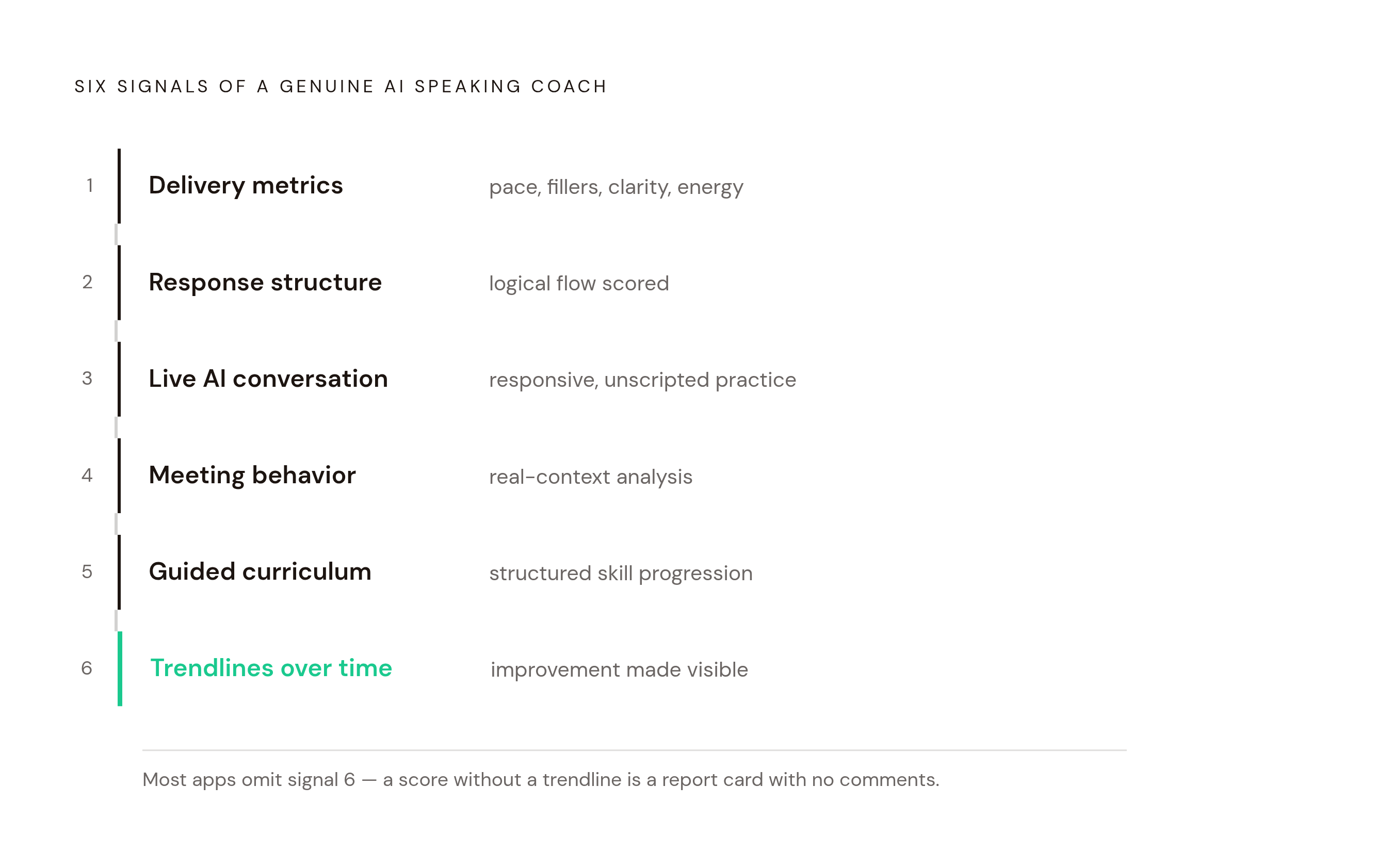
A scorecard only matters if it measures the right things and tells the user what to do about them. Six signals separate a real coaching tool from a novelty: delivery metrics (filler words, pace, pauses, clarity, vocal energy), response structure, live conversation practice against a responsive AI, meeting-behavior analysis, a guided curriculum, and trendlines across sessions over time. A score with no coaching direction attached is just a number. It's a report card with no comments section, and nobody ever improved from a blank comments section.
Timing matters as much as content. Feedback after a private practice response does a different job than feedback during a simulated roleplay, which does a different job again than feedback surfaced inside an actual live meeting. No app does all three well. Anyone shopping for one should know which moment they're actually trying to fix before comparing feature lists, not after.
Platform matters too, more than it gets credit for. A mobile app kills the friction that ends daily habits, because it's already in someone's pocket. Desktop software fits meeting-heavy jobs where practice needs to sit next to the calendar. Browser or VR tools build immersive rehearsal, useful for a one-time high-stakes event like a keynote or a courtroom argument, useless for someone who wants five minutes before their commute.
Watch for the score-optimization trap. A useful coach makes feedback specific enough to act on without turning the whole exercise into a game where the goal is pushing one number higher, regardless of what that number was ever supposed to measure. Ask whether the app tells a user what to change next, not just where they rank against some hidden curve.
Beyond features: check pricing transparency (can it be judged without booking a call with an enterprise sales rep?), check what happens to recordings after deletion, and check whether the free tier gives enough real reps to know if the feedback style even fits.
The six active apps worth using in 2026, and what each one is actually best at
One programming note before the list: Poised is shutting down October 9, 2026, according to the notice on its own homepage, so it's left off here. Its in-meeting feedback model still gets referenced below as a category concept, because the idea (live coaching during a real call, not a recorded drill after the fact) is worth understanding even with the product itself winding down.
Yoodli, built for interactive roleplay, workplace simulation, and organization-wide training, is the strongest pick on this list if the goal is practicing an actual conversation rather than a monologue. Instead of talking into a one-way recorder, a user responds to AI personas in a conversation that changes based on what they say, and the app scores six delivery dimensions: filler words, pacing, eye contact via webcam, vocabulary diversity, talk-to-listen ratio, and conciseness. Sales teams run live conversations against AI avatars modeled on real buyer objections, while enablement teams get pacing and clarity data with pass/fail thresholds and trendlines across a whole team. Yoodli raised a $40 million Series B in December 2025, bringing total funding to roughly $60 million at a valuation past $300 million, with year-over-year revenue growth reported at 900%. Customers listed include Google, Snowflake, Databricks, RingCentral, and Sandler Sales. G2 reviewers rate it 4.7 out of 5, with the large majority of reviews at five stars. The Starter plan gives five roleplays free, Pro runs $96 a year, Advanced runs $240 a year, and enterprise pricing is custom. The tool leans English-first, though multilingual roleplay support, including Spanish, French, Portuguese, Italian, German, Chinese, Hindi, Japanese, Korean, and Thai, got added through 2024 and 2025. It scores how someone speaks, not the quality of what they say, so content-level feedback sits outside what the tool covers. Students at one university get free access through a university email at yoodli.ai/uw.
Orai is built for repeatable delivery drills on mobile and web, the kind of rehearsal that matters most right before a high-stakes moment. A user records a practice response and gets a scorecard on filler words, pace, clarity, and energy, backed by guided scenarios, lessons, streaks, and progress tracking to keep people coming back. The curriculum builds around each user's own speaking patterns instead of a generic course, put together alongside communication coaches for real pedagogical structure, not just a checklist. Pricing runs a 7-day free trial, $12 a month, $49.99 a year, or $149 for lifetime access; corporate plans run $100 to $300 per seat annually. The catch: practice mode is one-way. Users speak to the app, not to a responsive AI, so it never replicates the back-and-forth of a live call. Google Play shows 4.6 stars across more than 2,000 reviews, and Fast Company and TechCrunch have both covered it.
Speeko fits someone building a general daily habit with no specific event on the calendar to prep for. Phonetic and linguistic AI analyzes the user's voice and builds personalized lessons around strengths and weaknesses. Basic insights are free with no account required, while personalized feedback, real-time guidance, and the full exercise library sit behind Pro. An Android app arrived in May 2025, though most third-party coverage still describes Speeko as iOS-only, worth checking before assuming otherwise. Pricing on Speeko's own site runs $99.99 a year (about $8.33 a month) or $299.99 for lifetime access, though the App Store listing shows a different tier structure worth checking directly before paying.
Articulated runs structured drills covering delivery, content, and presence in one place, with a catalog of nine recorded exercises including Filler Eliminator, Freestyle, Speed Breakdown, Debate Yourself, Scenario Practice, and Voice Type. After each attempt, it scores six skills: clarity, fluency, structure, vocabulary, confidence, and engagement. What sets it apart: feedback ties back to specific moments in what the user actually said, with rewrites attached, not just one number floating with no context behind it. Available on iPhone and Android.
SpeakUp is the lightest-friction option on this list, and the right one for testing the whole category before committing money to anything. Users record any speech or pitch up to three minutes and get instant feedback covering filler word detection (um, uh, like, you know), pace and clarity analysis, an overall score, a transcript with fillers highlighted, and an audio waveform mapped against a speech timeline. A newer Analyze a Clip feature handles uploaded audio or video. Pricing is $7.99 a month, cancel anytime, with one free session for new users. It's iOS only for now, and new enough that it hasn't built up App Store ratings worth an aggregate score yet.
VirtualSpeech stands alone here as the only major option with a VR mode, pairing AI feedback with an optional simulated audience. Exercises run in a browser or in VR, roleplays run against AI avatars, and users can adjust venue, crowd size, and audience behavior to build exposure to a specific kind of pressure. It's built more for cutting fear and rehearsing realistic scenarios than for daily habit-building or script generation. Pricing runs $45 a month or $399 a year, and the hardware requirement makes it a more specialized purchase than anything else on this list.
Other confirmed tools in the category and where they fit
Pronounce analyzes recorded or live speech for pronunciation, fluency, pacing, and delivery patterns, useful for professionals who want structured feedback across presentations, interviews, and recurring meetings. Its metrics work best as prompts for deliberate practice, not as a verdict on someone's accent or credibility.
Vocal Image is built for behavioral practice rather than presentational polish, focused on interpersonal and difficult conversations like giving feedback, setting a boundary, or navigating conflict. It runs live AI roleplay with feedback tied to specific moments in the exchange.
PatterAI and Tonen are lighter entry points, good for daily habit-building or for rehearsing a script before one specific hard conversation.
Gabble.AI offers interactive speech training with personalized coaching metrics and is active in 2026.
ELSA analyzes pronunciation, fluency, and grammar through AI, most relevant for non-native English speakers working on accent and clarity together.
BetterUp sits outside the AI-only category entirely, included here for contrast as the premium human-coaching alternative. It's built for live, one-on-one sessions with a real coach and comes at a correspondingly higher price. Different tool, different budget, different problem entirely.
LinkedIn ranked communication as the single most in-demand skill in 2024, and it stayed near the top of that list into 2025. That single data point explains why this category has grown fast enough to produce this many credible options. When the job market pays that heavily for one skill, the tools to train it multiply to match.
How to build a daily scored-practice habit that actually compounds
The habit itself is simple: one prompt, one recording, one look at the score and the specific feedback, one repeat attempt. The whole loop should take under thirty minutes, or it won't survive a real week's schedule.
Daily short sessions beat weekly long ones for a reason rooted in how the brain consolidates skill. Five consistent minutes fires the same pathway over and over, and spaced repetition across days is what locks the improvement in place. A single ninety-minute session once a week gives the old habits enough room to creep back in between attempts, which defeats the point before it even starts.
Once the scorecard comes back, resist the urge to fix everything at once. Pick the one or two signals furthest from baseline (filler word count, pace variance, structural clarity, whatever it is) and make that the sole target of the next session. That's Ericsson's deliberate-practice structure in action: isolate the piece that's actually broken instead of trying to overhaul the whole performance in one sitting.
Progress shows up within two to four weeks for most consistent users, but only for someone watching the trendline across a week of sessions instead of fixating on any single score. One bad session means nothing. A downward slope across five sessions means something.
None of this guarantees a standing ovation out in the real world. A high app score builds delivery control: fewer fillers, better pacing, a steadier tone. It says nothing about whether the message itself was any good, whether the audience research held up, or whether a keynote actually lands with three hundred strangers in a room. Those still take separate work, and no scorecard will do it for you.
That's where scored practice earns a place in a bigger toolkit instead of replacing one outright. Daily reps in an app handle the mechanical fundamentals of delivery. A coach or a sharp colleague still handles nuance, presence, and whether the argument itself holds up. Apps that send a single daily prompt and return a score within seconds, are built around exactly this kind of narrow, repeatable drill, the kind that keeps a user's attention on one skill at a time instead of trying to fix everything in a single take. Yapp, a daily-prompt speaking coach on the App Store, scores each recorded response on a 0-100 scale and is designed around that same narrow loop. The two approaches aren't competing for the same job. They're splitting it.