Using a Mirror vs Camera for Speaking Practice
Cameras catch what audiences see; mirrors only show you what you already know.
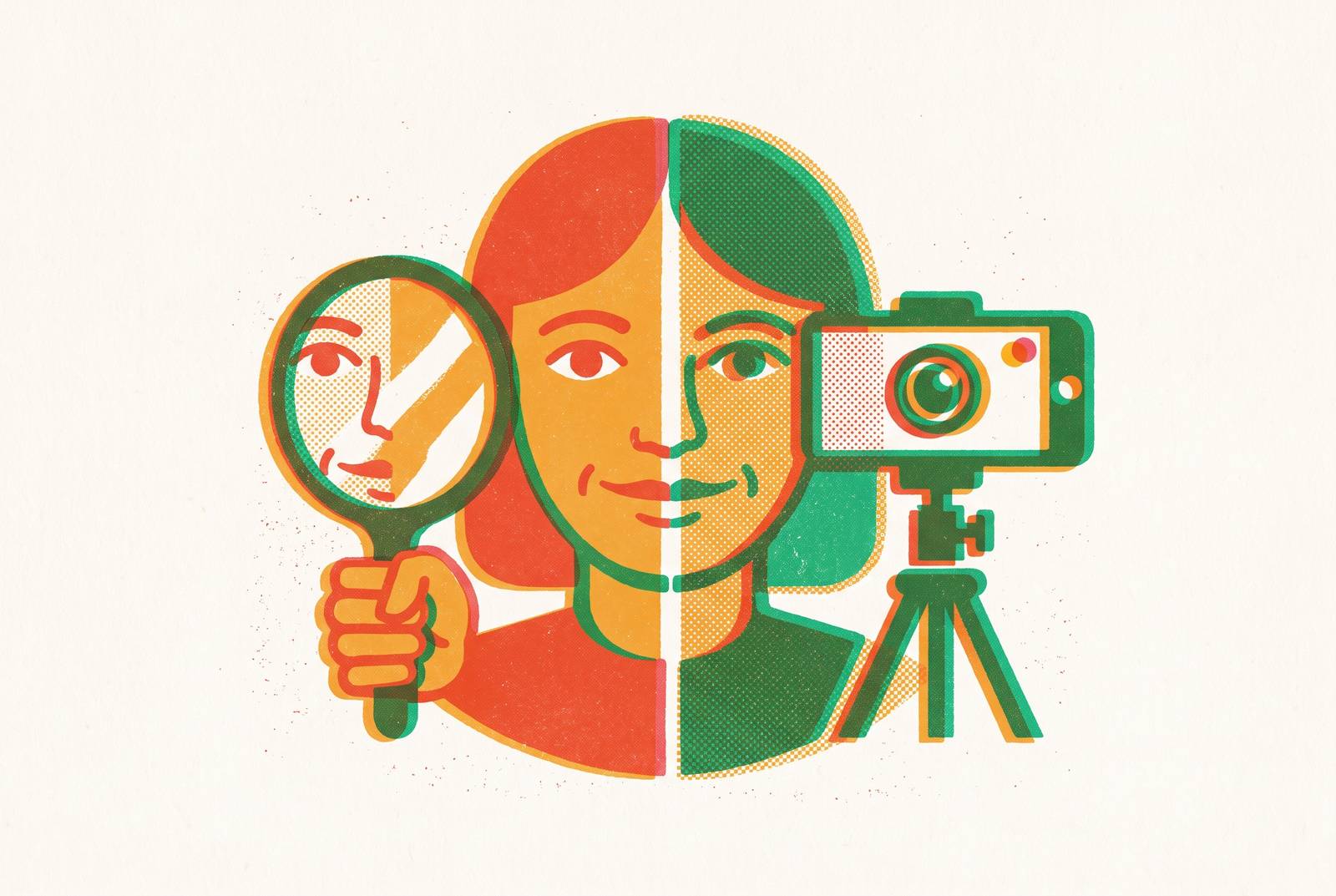
The mirror shows you your own mouth. The camera shows you what a stranger in row twelve actually sees. Confusing the two is why most rehearsal habits produce confident speakers who still ramble, still slouch, and still have no idea their hands do something strange when they get nervous. If you pick the wrong tool for the wrong stage of practice, you're not preparing, you're just performing for an audience of one who happens to be you. The fix isn't complicated: use the mirror in the final moments before you speak, and use the camera for everything that actually needs correcting before that.
What the mirror genuinely does well
The mirror turns you into your own audience in real time, and that immediacy is the whole point. Speak, watch, correct, all in one breath, no gap between the mistake and the fix.
A qualitative study published in PARAPLU JOURNAL (Atrianus Toni, Universitas Kapuas) tested this directly. Participants ran self-introductions, storytelling, and impromptu speeches in front of a mirror, and researchers logged gains in confidence, lower anxiety, and sharper self-correction on pronunciation and body language. That tracks with what performance training has long assumed about the connection between physical gesture and vocal delivery. Actors used mirror work to sync body and voice long before anyone thought to carry a camera in their pocket.
The mirror earns its keep on a narrow set of jobs. Watching mouth shape as you form sounds. Catching a shoulder that's crept toward your ear, or eyes drifting to the floor, the instant it happens. Getting used to the plain psychological weight of being watched, which matters if you've never had to hold a room's gaze and need to build tolerance for it before someone else supplies the gaze instead. SlideModel's public speaking guide recommends using it to rehearse the first sixty seconds of an opening, specifically to check posture, eye contact, and confidence before you're on stage.
Narrating everyday activities aloud while watching yourself in a mirror is one approach to building fluency, since talking without pausing to self-edit encourages the brain to build sentences faster. And the barrier to entry is zero. No tripod, no app, no file waiting in a folder to be reviewed. You can't skip the gym because you forgot your gym bag if the gym is your bathroom.
Where the mirror misleads you
You always stand closer to a mirror than any audience will ever stand to you, and that single fact undoes half its value.
The Throughline Group, a public speaking and media training firm, points out that a mirror shows a close-up no audience will ever see. If you can see the inside of your own mouth, you're scrutinizing details that mean nothing to the room. That proximity creates a specific, almost comic failure mode: you optimize for micro-expressions and tiny lip movements while missing the full-body signals, posture collapse, arm placement, general presence, that audiences actually register. You end up rehearsing for an audience of one standing twelve inches away, when the real audience sits ten feet back and reads you as a whole shape, not a close-up.
The mirror also can't hear you. Pacing, filler words, vocal variety, volume: none of it registers, because a mirror has no ears. And the moment you stop talking, the image disappears completely. No file, no replay, no way to check the version of yourself from two weeks ago against the one standing there now. Improvement becomes a feeling instead of a fact you can point to.
A sharper problem is underlying that one. Research on video self-view has found that watching yourself during performance drains mental resources and drags down the result, because attention splits between doing the thing and judging the thing. The mirror's live mode almost certainly carries the same tax, since it forces the identical split-attention act in real time. Recorded review sidesteps that cost by separating the performing from the judging, letting each happen on its own turn. The Throughline Group's advice reflects this directly: keep the mirror for a last glance before walking on stage, and leave it out of full practice runs.
What the camera sees that you cannot see yourself
A camera does something a mirror structurally cannot: it stands where the audience stands. Several feet back, not inches, catching voice, pacing, facial expression, and full body all at once, in one continuous file you can revisit later. The Throughline Group calls it a much better proxy for how an audience actually experiences you, and the reason is simple: distance and audio are two variables the mirror does not have.
Recording also splits the task in a way that helps rather than hurts. While the camera rolls, the job is to perform, full stop, no internal referee weighing in mid-sentence. Playback is when observation happens, and by then you can pause, rewind, and set one session against another. It's the same workflow athletes use reviewing game film: perform first, review later, never both at once.
That review process contains things a mirror simply cannot show, because a mirror leaves nothing behind to examine afterward. Filler words and how often they show up. Whether the pace rushes or drags. Whether the voice stays flat for four straight minutes without a single shift in tone. Full-body signals, weight shifting, arm position, whether the stance reads as grounded or apologetic. Whether the energy in the room, or what would be the room, actually lands, or quietly collapses somewhere around minute two.
Research on video-aided reflection in professional education has found it can produce significant changes in practice. Participants noticed physical habits they hadn't clocked before and built sharper awareness of their own questioning technique, listening style, and conversational rhythm. Confetto.ai's analysis found that nonverbal cues make up more than half of what an audience actually perceives, and the camera is the only solo-practice tool built to capture that whole nonverbal channel in one pass, rather than a fragment of it.
Setup doesn't need to be complicated. A smartphone on a cheap tripod covers it. With a second person helping, varying the camera distance can be useful, since different framings catch different problems.
The specific protocol that makes camera practice productive
Recording without a plan just means watching yourself, cringing, and changing nothing, or worse, trying to fix every flaw at once and fixing none of them. A protocol turns raw footage into a checklist instead of a source of dread.
The Throughline Group's method is simple: watch the clip, pick two or three things worth changing, run it again, check whether those specific things improved. If they did, add one more target. That cycle, watch, target, rerun, is the entire method. Progressive correction beats a full teardown every time, mostly because a full teardown is a great way to quit after one session.
One executive coach, cited in the research with 25 years in the field, recommends recording yourself talking for sixty seconds a day, about anything, to no one, without watching it back, as a lower-stakes version to build as a daily habit. One executive coach, cited in the research with 25 years in the field, recommends recording yourself talking for sixty seconds a day, about anything, to no one, without watching it back. Do it again tomorrow. By the following week, being on camera stops feeling like a performance review and starts feeling like brushing your teeth. That shift, from dread to routine, is the nervous system quietly adjusting to a stimulus it used to flag as a threat.
Frequency beats duration here. Solis Quest's research on structured habit interventions, combining practice, recording, and reflection, found self-reported confidence rising by as much as 30% over four weeks. Ten to fifteen minutes daily builds a steadier curve than one long session crammed in once a week, the same way ten short walks beat one exhausting hike if the goal is a durable habit rather than a single memory.
Tracking closes the loop. One approach recommended by speaking coaches is keeping a speaking journal logging what got targeted each session and whether it actually moved. Vague goals like "be better" give you nothing to measure against; "cut filler words" or "hold eye contact with the lens" do. SlideModel suggests going a step further with a rehearsal feedback sheet, simple checkboxes for posture, pacing, gestures, volume, eye contact, turning a fuzzy feeling into a scorecard. Set a baseline clip before any of this starts, so improvement three weeks in is something visible on screen rather than something you're hoping is true.
SlideModel argues the discomfort of watching yourself is doing its job. The habits that make a recording hard to watch are usually the exact habits weakening the live version of the same speech, and as corrections stack up, that discomfort gives way to something that looks a lot like clarity.
How to use both tools without wasting either
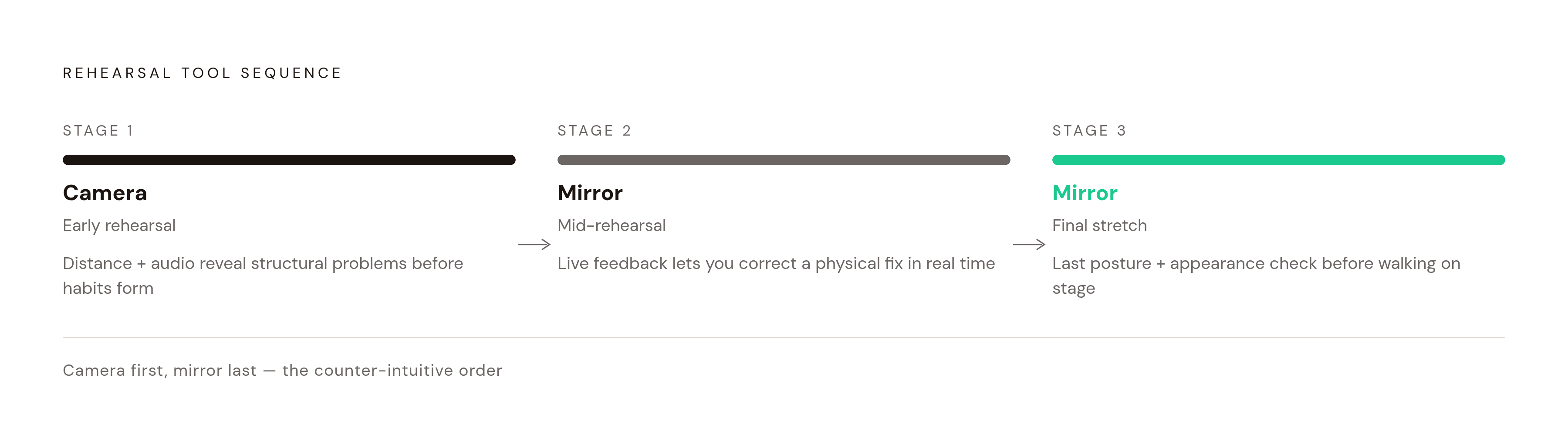
Treating the mirror and camera as competitors misses the point. They serve different moments in preparation, not rival versions of the same exercise, and picking one as your permanent tool is the actual mistake here, not picking the "wrong" one on any given day.
A rough sequence: early rehearsal, when material is new or unfamiliar, calls for the camera, since finding the real structural problems needs the distance and audio a mirror can't provide, before those problems calcify into habits. Mid-rehearsal, once a specific physical fix is underway, holding eye contact, opening up gestures that have gone stiff, is where the mirror's live correction actually helps, because the fix happens in real time and benefits from an immediate check. The final stretch before walking on stage belongs to the mirror too: posture, teeth, a last glance at general appearance. That's The Throughline Group's explicit call, and it holds up.
The numbers explain why any of this is worth the trouble. Teleprompter.com reports that around 75% of people worldwide fear public speaking, with only 10% saying they enjoy it and about 57% claiming they'd do almost anything to dodge speaking in front of a large crowd. Meanwhile, roughly 70% of jobs require some form of presentation ability. That gap, between how much people dread this and how often it gets demanded of them anyway, is the whole case for building a deliberate practice habit instead of hoping stage fright resolves itself.
Most speakers skip both tools entirely, which means any consistent self-observation habit, mirror or camera, already puts someone ahead of the field. Confidence that holds up under pressure doesn't come from flawless delivery: the exact moment someone loses their train of thought, catches it, and keeps moving is when the nervous system files away proof it can handle the unexpected. Camera practice speeds this up by manufacturing those stumbles on purpose and keeping a record of the recovery, rather than waiting for one to happen live and hoping the lesson sticks on its own.
Use the mirror to build presence. Use the camera to find the truth. Do both on purpose, and the gap between how a speech feels from the inside and how it lands from row twelve closes fast. A short, timed, prompted recording done daily, then scored against a simple checklist, is about as efficient a habit as exists for closing that gap for good.