Why People Use Filler Words and How to Stop
Filler words spike when your brain outruns your mouth.
The average speaker drops a filler word every 12 seconds. That works out to a meaningful share of the words in a normal conversation. It's a byproduct of how speaking and thinking are wired together. It's a byproduct of how the brain and mouth negotiate speed, and once you understand the negotiation, you can actually win it.
Two categories cover most of the territory: filled sounds like "uh," "um," and "hmm," and discourse markers like "you know," "like," "anyway," and "I mean." No exhaustive list exists, and it never will, because the category evolves as fast as speech itself. Linguists Jean Fox Tree and Herbert Clark, working out of UC Santa Cruz and Stanford, coined the term "conversation managers" for these sounds precisely because they refuse to treat them as junk. They're structural. Every language has its own version: German speakers lean on "äh" and "ähm," French speakers use "euh," and plenty of languages just stretch out a final vowel until the next thought arrives. Michael Handford, a professor at Cardiff University, points out that speakers use fillers largely unconsciously, often to help the listener process something complicated, not just to buy the speaker time. That's the tension this piece is built to resolve: fillers are functional, and they're also costly. The job is to manage them. It's to control them.
Why the brain reaches for fillers in the first place
Here's the mismatch nobody tells you about in school. The average person talks at somewhere between 125 and 150 words per minute, but the brain composes thought at around 400 words per minute. The mouth is perpetually behind, sprinting to catch a train that already left the station. A filler word is what happens in that gap. It's a placeholder, something to hold the floor while the actual sentence finishes assembling itself upstairs.
A 2020 study in Scientific Reports mapped this at the neural level and found that filler utterances correlate with spikes in gamma activity across the association and visual cortex, regions tied to pulling up words from memory, holding a sentence in working memory, and scanning a mental scene. That's about as close as anyone has gotten to watching "uh" happen in real time.
Three specific situations trigger it most. Lexical search is the big one: the right word is somewhere in there, it just hasn't surfaced yet. Topic unfamiliarity is another, when a question lands outside whatever territory got rehearsed beforehand. The unexpected turn is another factor, getting put on the spot mid-conversation with zero runway to prepare a response. Separate from cognitive load, fillers also serve a social function: they soften a refusal, hedge an opinion, cushion a "no" so it doesn't land like a slap. "I guess" and "maybe" are doing diplomatic work, not covering for a blank mind.
Fillers also show up more in contexts that load the brain harder than casual chat with a friend. The pattern across all of this points to one conclusion: fillers spike when the brain is working.
The paradox: fillers can signal a working mind but still tank how you're perceived
Here's where it gets interesting, and a little unfair. Some research has found that people who use more discourse markers tend to score higher in conscientiousness. The reasoning is that more conscientious speakers, the ones more attuned to how their message lands on a listener, may use discourse markers more often as a result. The filler, in other words, can be a sign of someone paying closer attention, not less.
None of that matters to the person listening. Separate research found that audiences rate speakers with more fillers as less confident, less competent, and less intelligent, full stop. Listeners assume anxiety or a lack of preparation even when neither is remotely true. Research into listener perception has found that speaker credibility drops in the listener's mind as filler frequency climbs. The brain doing the talking and the brain doing the judging are simply not running the same calculation.
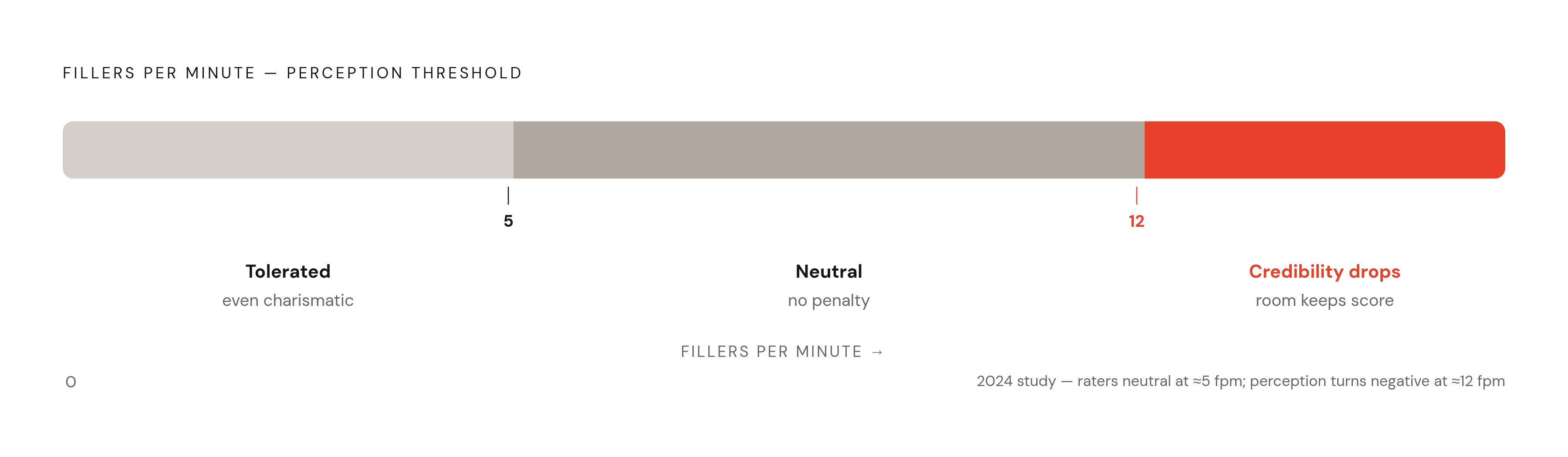
There's a threshold, and it's more forgiving than most people assume. A 2024 study found that raters didn't penalize speakers using around five fillers per minute. Perception turned negative closer to twelve per minute. Moderate use, that same Frontiers study noted (citing Fischer et al.), can even read as charismatic or polite. The target was above zero. It's staying under the number where the room starts keeping score.
Why the stakes are higher for students and young professionals than they realize
According to NACE, 95.5% of employers name communication as the single most important competency a candidate can bring to the table, ahead of technical skill, ahead of academic standing, ahead of nearly everything else on the checklist. Communication skills have consistently ranked at the top of employer wish lists across recent years. Among international employers, 57% say they'll take strong communication skills over formal qualifications.
And yet the gap is glaring. One assessment found 35% of 2024 graduates severely lacking in complex communication skills, including multi-party negotiation and data presentation, and 53% of employers report that recent graduates struggle to hold eye contact in an interview. A hiring manager quoted in Credible app reviews said frequent filler use "is a bigger issue than many applicants realize and can be exacerbated by nervousness."" That's the moment where it costs the most, precisely the moment nerves are highest.
Laserna's 2014 research adds an uncomfortable wrinkle: college students use discourse markers like "like" and "you know" three to four times more often than people in early or late adulthood. The habit peaks exactly when the interview, the pitch, and the first job offer are on the line. Leaders who fill their speech with these markers struggle to project the authority the role requires, because fluency and perceived competence are tangled together whether that's fair or not. In a room where every candidate has a similar resume, the one who speaks with control gets remembered. The one who doesn't gets forgotten by lunch.
Why Gen Z faces this challenge differently than any previous generation
A Trinity College London study found that 80% of Gen Z students pick up a significant share of their language skills from TikTok and Instagram rather than from classrooms or dinner-table conversation. This isn't a knock on the platforms. It just means the register getting practiced most is built for speed, for visuals, for concision, not for the slower, structured cadence a boardroom or an interview panel expects.
Rob Drummond, a linguist at Manchester Metropolitan University, argues that a word like "like" is doing real work for its users: managing tone, performing identity, signaling belonging. Gen Z slang has been broadly observed as an expression of identity, authenticity, and belonging within digital communities. None of it registers as noise to the people using it. "Rizz," shorthand for charisma, is its own piece of evidence here: the cohort clearly values smooth, confident, outcome-getting talk. The appetite for verbal skill is there. The training ground for it, in formal settings, just hasn't caught up.
That gap shows up as a code-switching tax. Workplace research on Gen Z employees found real hesitancy communicating with people above them, real discomfort volunteering an opinion out of fear of being judged for it. Digital fluency is genuine and valuable, but it wasn't built for a quarterly review or a client pitch, and that mismatch surfaces at exactly the wrong moments.
Where fillers do the most damage: presentations, pitches, and high-stakes conversations
Fillers function like speed bumps. They interrupt delivery, and once an audience starts noticing them, attention drifts from the message to the tally. A presentation loaded with "ums" can take genuinely strong content and turn it into something the audience mentally checks out of, one filler at a time.
Anxiety is the accelerant. Most people don't have a filler problem sitting alone in their car rehearsing a talk. They have one the moment someone important is in the room and the brain starts thinking about being judged instead of thinking about the actual message. That's when cognitive load spikes and the placeholders start piling up.
There's a sharper edge to this too. Some practitioners in high-stakes communication have noted that trained listeners may read excessive filler use as a signal of uncertainty or evasion. In a high-stakes conversation, that association doesn't help. It compounds whatever credibility damage the fillers were already doing.
The fix has more to do with structure than willpower. Clear narrative structure makes information easier to follow and easier to remember, for the speaker producing it as much as the audience receiving it. A speaker with a clear narrative thread, beginning, middle, end, isn't hunting for the next word mid-sentence, because the structure already told them where to go next. Less hunting means fewer placeholders. Preparation, done right, is about building understanding you can draw on naturally. It's about building the path so the brain never has to search for one in the moment.
How to actually reduce fillers: techniques that work with the brain instead of against it
Awareness comes first, and it's more useful than it sounds. Most speakers have no real sense of how often they say "um," because nobody narrates their own fillers back to them in real time. Recording a few minutes of unscripted talking and listening back is the fastest way to hear what an audience actually hears.
The pause deserves more respect than it gets. Silence isn't failure. A deliberate pause buys the exact same thinking time as "um" without any of the credibility cost, and tolerating that silence is a trainable skill, not a personality trait some people are born with and others aren't.
Slowing down helps close the gap directly. Recall the mismatch between the mouth's 125-to-150-words-per-minute pace and the brain's 400-word sprint. Slow the mouth down even slightly and the gap narrows, which means fewer moments where a filler has to rush in to cover the silence.
Structure beats scripting. A speaker who walks in with a clear shape, a point, an example, a takeaway, gives the brain a map to follow instead of a blank page to search. That map is what prevents the mid-sentence scramble that produces most fillers in the first place.
None of this sticks from a single rehearsal the night before a big presentation. Daily short-form practice, responding to a prompt out loud, recording a minute of unscripted thought, builds the automaticity that lowers cognitive load when it counts. And the feedback has to be specific to work. "I say 'um' too much" changes nothing. Knowing the actual number, five fillers a minute versus twelve, gives a speaker something concrete to chase. Since the research puts the tolerance threshold at roughly five per minute, the real target sits just under the line where a listener stops noticing and starts judging, not zero, not perfect. Apps that track and score filler use in real time can compress that feedback loop considerably, turning what used to require a speaking coach and a stopwatch into a daily five-minute habit. That daily rep, scored and repeated, is what actually closes the gap between the mind that's working and the mouth the audience is judging.