Common Interview Communication Mistakes and How to Fix Them
Employers reject most candidates for delivery, not credentials, and these fixes work.
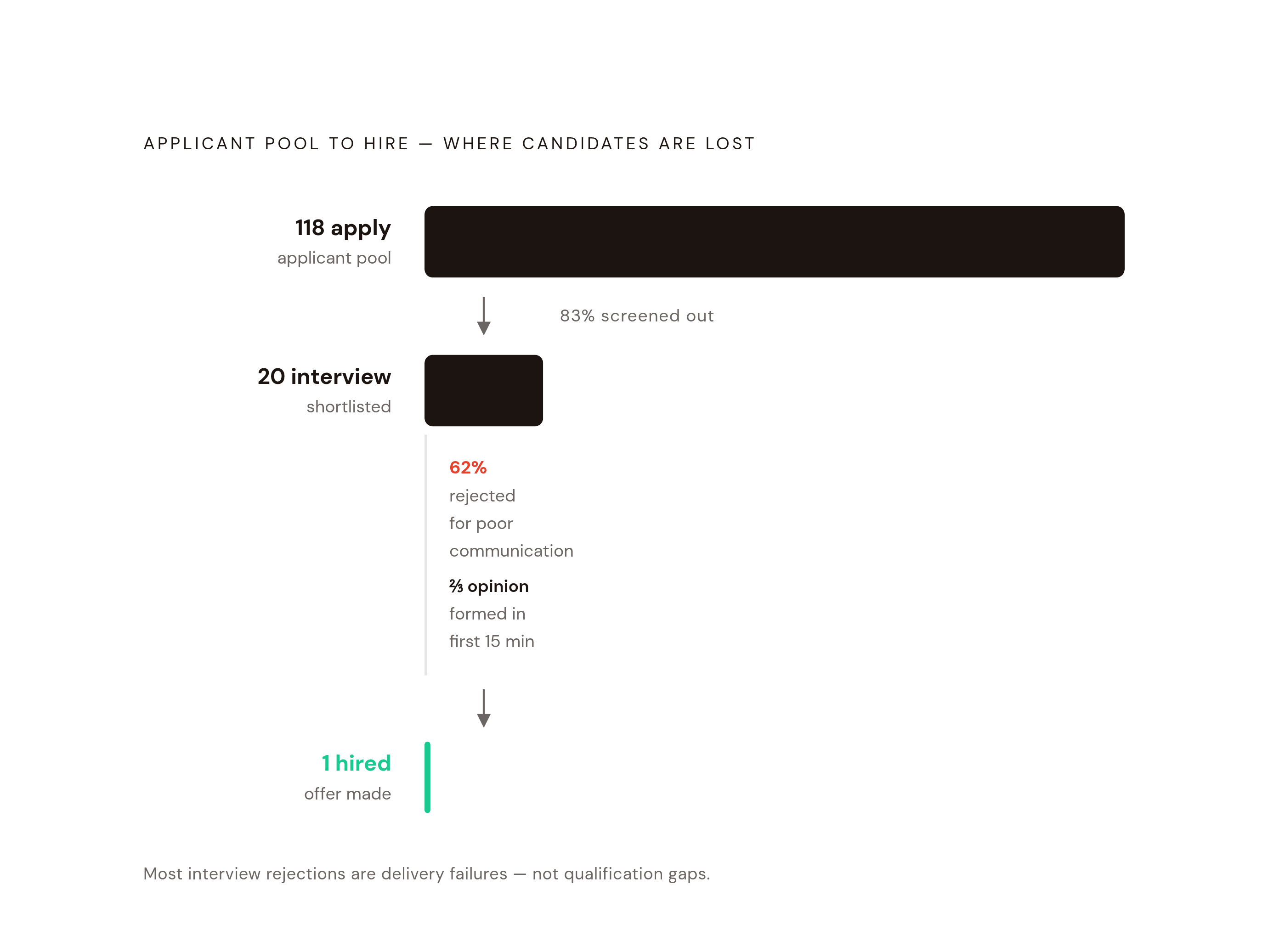
118 people apply for the average job opening. Twenty of them get an interview. That interview is the whole game, and 62% of employers say they reject candidates for poor communication rather than weak qualifications or thin experience. Hiring managers make up two-thirds of their minds within the first fifteen minutes, based on how someone talks and carries themselves in the room. Candidates spend roughly six hours prepping for that window, and almost all of it goes to content instead of delivery, which is the wrong six hours spent on the wrong thing.
What follows is a set of habits, and habits have causes, which means they have fixes.
How a qualified candidate sounds unqualified: the delivery gap
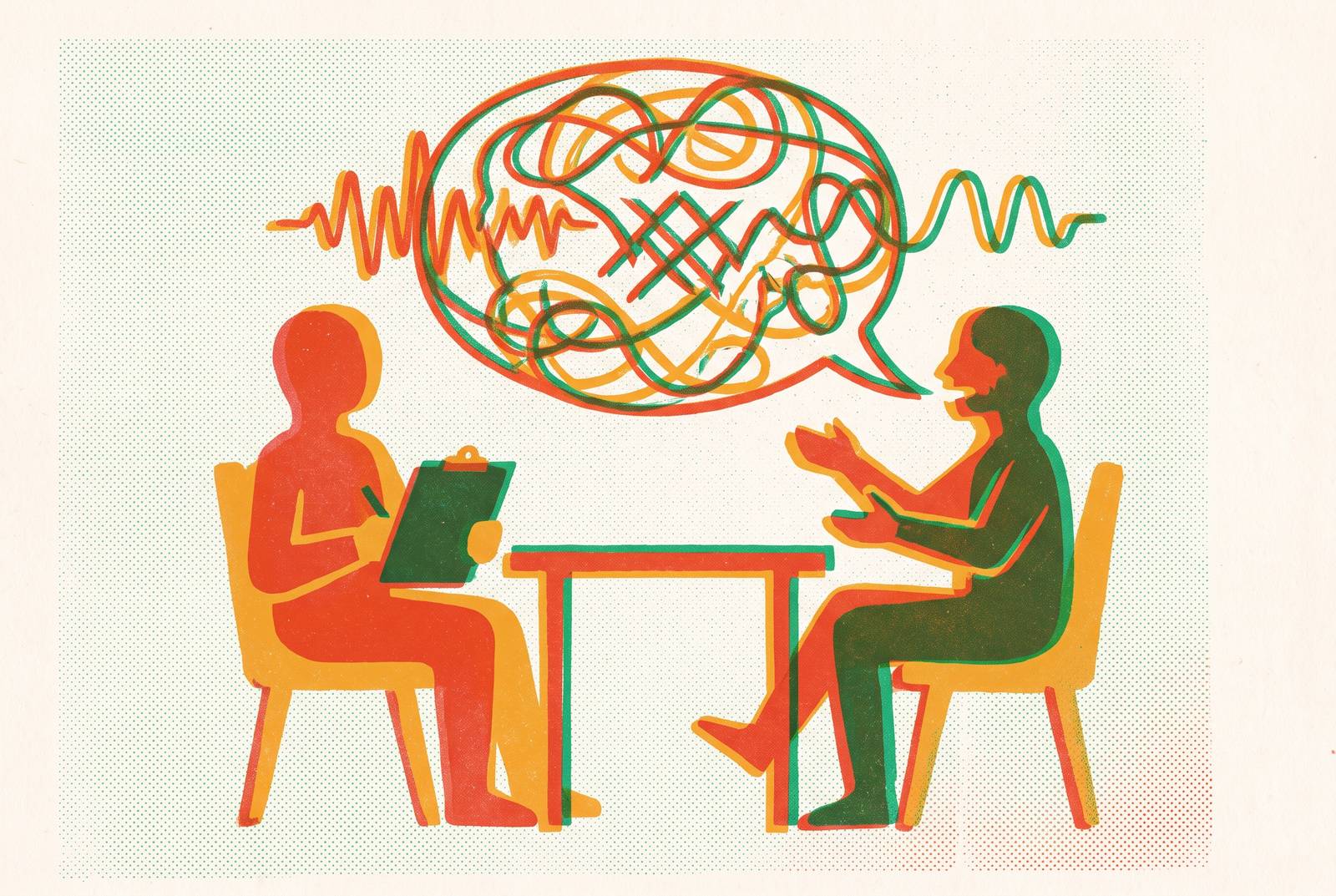
Researchers who study spoken performance identify several dimensions of how fluency works in practice: how fast and smoothly someone talks, how often they stall and lose the thread, and how well they recover when they do. Interviewers do not score these dimensions consciously. They register something researchers call "perceived fluency," a gut read that happens in real time and gets translated, fairly or not, into a judgment about competence. Fifty-one percent of hiring managers cite poor communication skills as a top concern when evaluating candidates, which puts it near the top of the filter.
This has little to do with vocabulary or accent or how articulate someone is at dinner. The gap shows up specifically under pressure, and plenty of candidates who communicate just fine in ordinary conversation fall apart the second a stranger in a blazer asks them to describe a time they handled conflict on a team. Pressure is the variable, and pressure is exactly what a job interview manufactures on purpose.
The filler word trap and how interviewers actually hear it
Everyone says "um." Everyone says "like," and the frequency is the issue, the dial that moves a candidate from "normal speaker" to "unprepared candidate" in an interviewer's head. Anxiety causes a retrieval failure: the brain reaches for the next word, comes up short, and fills the gap with noise while it searches. It's a physiological hiccup, which is why telling someone to "just stop saying um" is roughly as useful as telling someone to stop sweating. Forty-five percent of candidates report feeling nervous heading into interviews, so almost half the applicant pool is walking in already primed to over-produce filler before a single question gets asked.
The actual fix is a swap: replace the filler with a deliberate pause. Silence reads as composure; "um" reads as scrambling. Try this: record a 60-second answer to a standard question like "tell me about yourself," count the fillers, then re-record and try to cut that number down. Do it again the next day, since the pause reflex gets built through repetition, the same way any reflex does.
This matters more than it sounds like it should, because 80% of employers use behavioral interview questions, the kind that demand a longer, structured answer rather than a one-liner. Longer answers give filler more runway to accumulate, especially when the candidate has no scaffolding to hang the answer on, which is exactly the problem structure is built to solve.
Vague answers and the specificity problem
Ask hiring managers what irritates them most and vague answers consistently surface as a common complaint. Candidates go vague for two reasons. One is fear: naming a specific detail feels riskier than staying general, because a specific claim can be picked apart. The other is a preparation failure disguised as caution; candidates rehearse topics ("teamwork," "leadership," "conflict resolution") instead of rehearsing actual answers, so when the moment comes they have a theme but no story.
"I'm a good team player" is a theme. "On a four-person project team, the timeline slipped two weeks after a vendor dropped out, and reassigning tasks got us to launch three days ahead of the revised date" is a story with a timeline, a team size, and an outcome attached. Interviewers use specificity as a stand-in for honesty, and a vague answer quietly raises the question of whether the thing actually happened, or whether it's a composite sketch of things that sort of happened to other people.
The fix: attach one concrete element to every answer. Not every story has a percentage sitting around waiting to be quoted, but every story has a timeline, a team size, a decision point, or a before-and-after. Pick one and name it.
Specificity alone doesn't finish the job, though. A specific answer with no shape still wanders, and wandering is its own separate failure mode.
Rambling and the structure that stops it: how STAR actually works under pressure
Talking too much is its own named mistake in behavioral interview research, distinct from vagueness. Rambling reads as disorganization to the person on the other side of the table, because it is disorganization, just dressed up as enthusiasm.
STAR, Situation, Task, Action, Result, solves this by preloading structure into memory before the question ever lands. The candidate isn't inventing a shape for the answer while simultaneously trying to recall the content; the shape is already sitting there, waiting to be filled in. Theresa Adams, a senior HR knowledge advisor at SHRM, describes STAR as giving candidates "a method of communicating a response in an organized method with a focus on behaviors and results." The format is widely recommended for a reason that has nothing to do with interview-prep culture: it's the template interviewers are trained to score against.
The Result stage is where most candidates leave value on the table. They'll walk through Situation, Task, and Action in careful detail, then close with something limp like "and it worked out well," which wastes the entire buildup. That's the moment to attach a number, a team outcome, or a specific change that happened because of the action taken. A STAR answer long enough to cover all four stages tends to feel complete, while a clipped answer reads thin and a runaway one is rambling again, just with better vocabulary.
Building three to five core STAR stories ahead of time, ones flexible enough to bend toward different question angles, turns this from a live-improvisation problem into a retrieval problem. Retrieval is much easier under pressure than invention.
What your body is saying while your mouth is talking
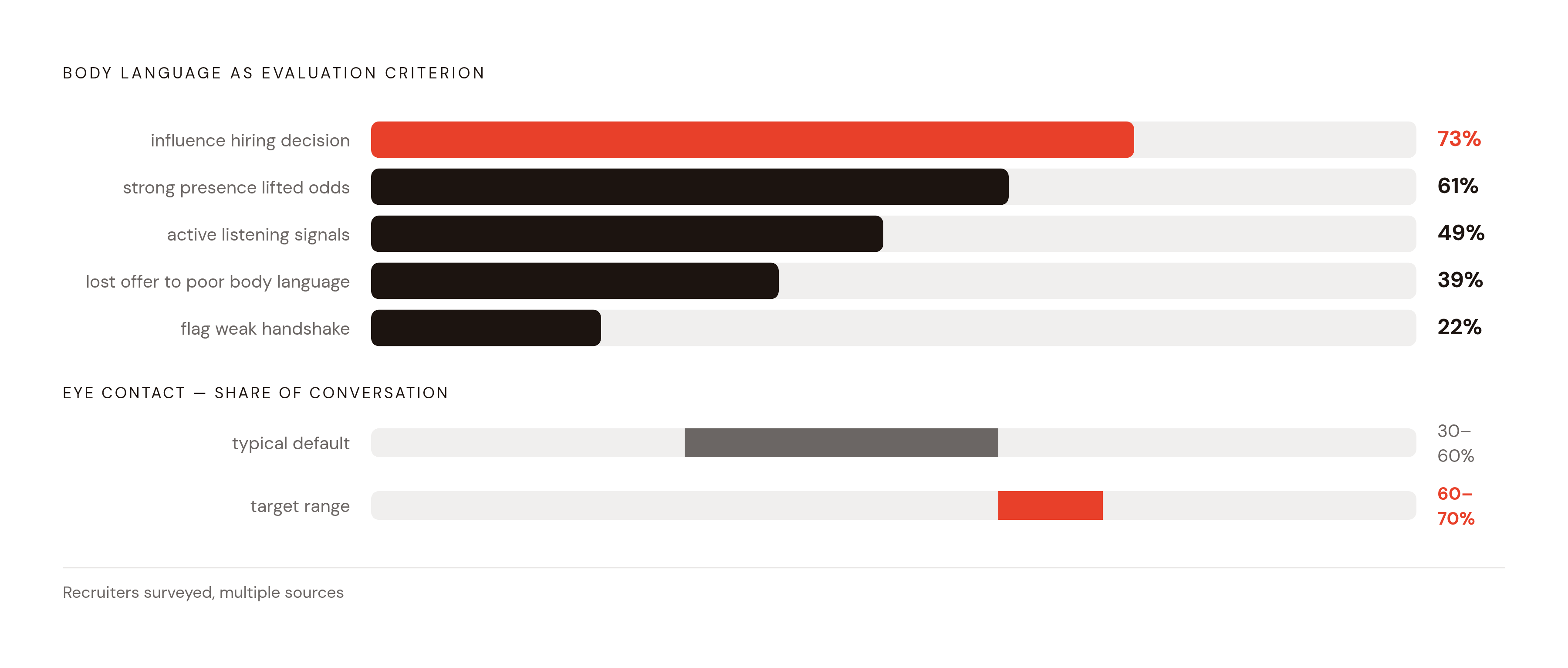
Seventy-three percent of interviewers say body language influences their decision, making it part of the primary evaluation rather than a tiebreaker consulted after the fact. Thirty-nine percent of hiring managers have seen a candidate lose an opportunity specifically over poor body language, and 61% say a strong nonverbal presence meaningfully improved a candidate's odds. Three specific habits do most of the damage.
Eye contact that's too low or too erratic reads as evasive even when nothing evasive is happening. Research from Quantified Communications finds that pushing eye contact up to 60-70% of conversation time builds a noticeably stronger sense of connection, compared to the 30-60% range most people hold by default. Handshakes cut both ways: 22% of recruiters flag a weak handshake as a major red flag, but 8% are put off by a handshake that's too aggressive, which means the target is calibration, not force. And closed or collapsed posture, arms crossed, shoulders curled inward, signals low status before a single word gets spoken, undoing whatever careful verbal preparation came before it.
The fix mirrors the fix for filler words: record it. The gap between how someone imagines they look and how they actually look on video is almost always wider than expected, and it's the same gap that separates the candidate who wrote a great answer from the candidate who delivered it well. Forty-nine percent of recruiters specifically prioritize candidates who show active listening, nodding, tracking with facial expression, staying engaged while someone else is talking, which means body language matters even during the parts of the interview when the candidate isn't the one speaking.
Listening failures that candidates don't know they're making
Active listening functions as an evaluated skill in this context, on par with the content of an answer, and 49% of recruiters treat it that way. The most common failure is answering the question that was rehearsed instead of the one that was actually asked; a close second is interrupting to fill silence, and a third is launching straight into an answer with zero acknowledgment of what the interviewer just said.
Sixteen percent of hiring managers report Gen Z candidates checking phones mid-interview, which is the extreme version of the same underlying failure: demonstrating, unmistakably, that part of the candidate is somewhere else. Good active listening sounds like a brief acknowledgment before the answer starts ("that's actually close to a situation I ran into at a previous job"), mirroring the interviewer's own phrasing at the top of the response, and a beat of pause after the question ends before jumping in. The fix here is less mechanical than the others, since candidates who treat the interview as a performance where they simply deliver prepared answers on cue tend to miss the conversational cues a real listener catches, because they're waiting for their turn instead of paying attention to the room.
Why Gen Z candidates face a specific version of this problem
A significant share of employers say Gen Z candidates need to sharpen their interview skills specifically. Fifty-six percent of hiring managers report encountering Gen Z applicants who show up unprepared, and unpreparedness happens to be the single most controllable variable in that whole equation.
There's a structural reason behind the number, not just a generational punchline. Growing up inside digital environments built for brevity, texting, DMs, short-form video, produces plenty of reps in fast, casual, low-stakes communication and very few reps in sustained, formal, high-stakes verbal performance. The pandemic didn't help; a meaningful stretch of Gen Z's formative social and professional development happened through screens, which further narrowed exposure to the specific format an interview demands: extended, face-to-face, unscripted, evaluated conversation. Call it a reps deficit rather than a character flaw, because the skills Gen Z built are real skills, and they just don't transfer to a conference room by default.
Twenty-four percent of hiring managers separately flag recent graduates broadly as unprepared, which means this expectation gap is already baked into how early-career candidates get evaluated before they ever sit down. Closing it isn't a matter of reading another article about it. It's a matter of building the specific reps that are missing, in the specific format where they're missing.
Why reading this article isn't enough: the case for daily spoken practice
Seventy-five percent of people experience some form of speaking anxiety, and 45% of candidates report feeling nervous specifically walking into interviews. Anxiety is the baseline condition here, and the real variable is how it gets managed.
Sixty-one percent of job seekers prepare answers to common questions ahead of time, but only 48% improve their odds by running actual mock interviews, which means the majority are rehearsing silently, in their heads, and never out loud. Those are different skills. A candidate who has only ever heard an answer inside their own head is, for practical purposes, hearing it out loud for the first time in the actual interview, live, with a stranger watching. Public speaking research on anxiety reduction points to gradual exposure cutting anxiety by as much as half; the mechanism is desensitization through repetition, not memorizing better content. Short daily sessions beat one long weekly one for the same reason interval training beats a single marathon effort: ten to fifteen minutes a day builds steadier gains in articulation and calmer nerves than an hour once a week ever does.
Structured habit interventions, practice, then recording, then reviewing the recording, have been shown to lift self-reported confidence by as much as 30% within four weeks. That's a fast enough timeline to matter before a real interview date. Seventy-eight percent of job seekers already say interview prep is vital to landing the job. The gap isn't in believing that; it's in doing the prep in the format that actually moves the needle: out loud, recorded, and repeated.
What measurable practice looks like and how to track actual progress
Candidates who practice consistently tend to see measurable gains within two to three weeks, short enough that this fits inside a normal job search timeline. Three things are trackable on a self-recorded video, and all three are worth writing down after every session.
Filler word count per minute is the simplest: count it on one take, try to bring the number down on the next. Eye contact duration is trackable by watching the playback and estimating how much of the time was spent looking at the camera versus looking away; the 60-70% range is the target Quantified Communications research associates with a stronger sense of connection. STAR answer length is the third, moving away from the clipped answer that reads thin and away from the two-minute ramble, toward a window where a full story fits without spilling over.
Recording is the highest-leverage tool in the whole process, because it's the only method that surfaces the gap between self-perception and actual performance across posture, filler words, pacing, and energy all at once, in a single sitting. Treat each session as a training rep, not a dress rehearsal, and let the goal be raising the floor on the worst version of an answer under pressure, so that even a bad day in the room still clears the bar. A reasonable starting routine: one STAR story built and recorded per day, fillers counted, one body language element targeted per session, five sessions a week, reviewed against the previous week's recordings at the end. Two to three weeks in, the tape usually tells a very different story than the one a candidate would have guessed going in.