Executive Presence in High-Stakes Presentations
Gravitas matters far more than appearance when executives command a room under pressure.
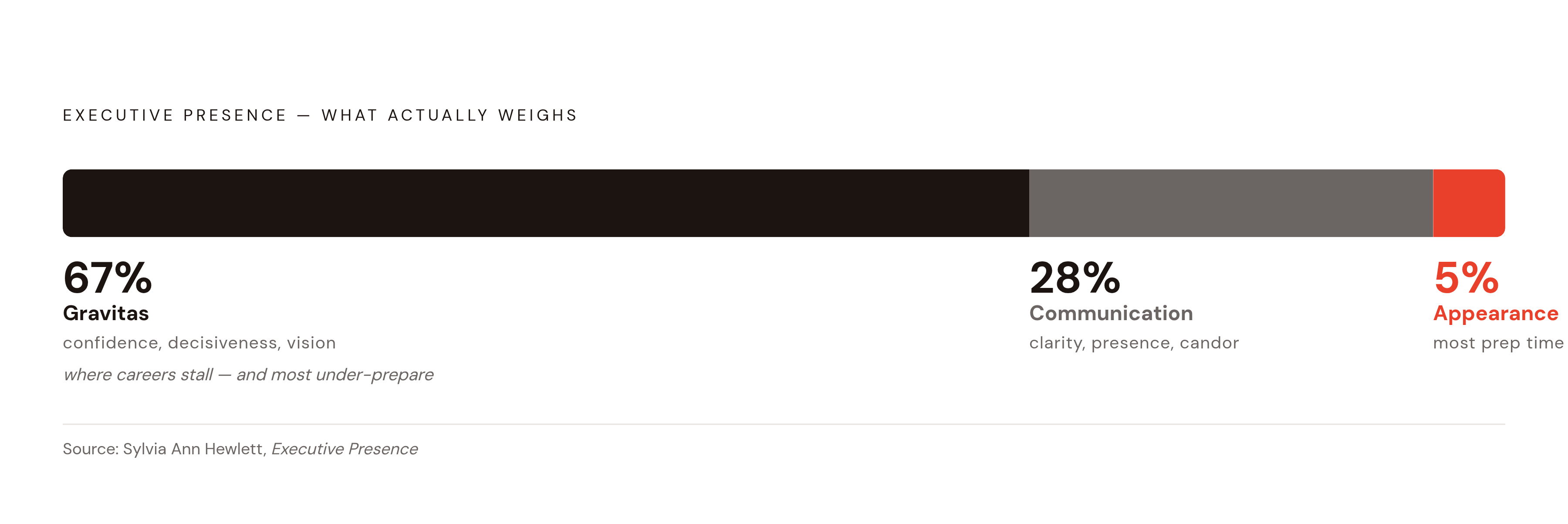
Executive presence in a boardroom is a set of behaviors that show up on tape, get scored by the people watching, and can be built through practice like any other skill. Sylvia Ann Hewlett's research breaks it into three parts: gravitas at 67%, communication at 28%, and appearance at 5%. Most people spend their prep time on the 5%. That's the whole mistake, right there, and it's the expensive kind, the kind that compounds over a career instead of just one bad meeting.
Gravitas doesn't mean grave or serious. It means the room believes someone can be trusted with a hard decision under pressure, which is a different thing entirely and much harder to fake. Senior executives describe it in blunt operational terms: can this person go six questions deep on their own material without stumbling when a board member pushes back? Communication, the 28% slice, is fluency and clarity under fire, and it's also the part that responds fastest to short-term coaching. Appearance sits at 5% and eats most of the anxiety anyway, which tells you something about where careers actually stall versus where people think they stall. All three are observable behaviors. None of them are a personality someone either has or doesn't.
Why the stakes of presence are higher than most people admit
Coqual's research puts a number on it: executive presence accounts for 26% of what determines the next promotion, ahead of talent or tenure. Eighty-nine percent of senior executives say presence directly helps people move up. These aren't soft impressions being noted generously in a performance review. They're selection criteria, applied quietly, every time someone decides who gets the bigger room and who gets another year in the current one.
Trust in immediate managers fell from 46% in 2022 to 29% in 2024, according to DDI's 2025 research. Walk into a room with numbers like that sitting under the floorboards, and the audience isn't neutral. It's scanning for confirmation that the doubt was justified. A rushed pace, a defensive tone, a hedge dropped into an answer: none of that reads as harmless. It reads as evidence, and the room collects it whether the speaker notices or not.
So the conclusion isn't complicated, even if people prefer to make it one. Presence under pressure is the actual signal that separates leaders trusted with bigger rooms from leaders who stay in the same room, indefinitely. Talent gets someone invited. Presence gets them asked back, which is the harder trick.
What composure under pressure looks like as behavior, not feeling
The common mistake is treating composure as an internal state, something fixed by telling yourself to calm down in the elevator. That advice is useless because nobody outside your head can see it happen. What they can see: answers getting shorter and clearer instead of longer and more defensive. Pace slowing slightly, which reads as deliberateness rather than hesitation. A visible half-second where the speaker sorts signal from noise before responding at all, a decision posture the room can actually watch happen in real time.
Board presentations are the clean test case, and here's where the standard instinct runs backwards. Given a 30-minute slot, the move is to bring a 10-minute deck, not a 30-minute one. Boards interrupt. They ask questions. They want a discussion, not a lecture, and Harvard Business Review's research suggests only about 30% of board meeting time should even be spent presenting. Anyone raised on the idea that more prep means more slides will read a short deck as corner-cutting; it's the opposite. Under-filling the slot is what signals confidence, because it says the material can survive being questioned instead of just recited at people until the clock runs out.
Strong communicators spend the extra time on purpose. They pause, ask the room a question mid-presentation, check for alignment, adjust before moving on. That adaptability is itself a presence signal, maybe the loudest one on offer. Jeff Bezos institutionalized a version of this at Amazon by replacing slide decks with six-page memos, a structural fix rather than a coaching tip. The memo format forces the thinking to happen before anyone opens their mouth, so the composure in the room reflects preparation already finished, not performance happening live and hoping to hold together.
How storytelling changes what happens in the listener's brain
Facts alone light up two regions of the brain, Broca's and Wernicke's areas, the parts responsible for processing and comprehending language. Storytelling activates those same two regions plus the motor cortex, the sensory cortex, and the frontal cortex, because a well-told story makes the listener's brain simulate the experience instead of just parsing the words. Researchers call the resulting effect neural coupling: the listener's brain activity starts to mirror the speaker's. That's the actual mechanism behind the vague phrase "commanding the room." Neurons syncing up, not charisma floating in the air.
Storytelling also does something facts can't: it lowers the listener's guard. Cold data tends to make people grip their existing beliefs tighter, a defensive reflex, while a story that lands emotionally opens the door instead of pushing against it. The standard business story runs in three beats. Situation sets the context and the stakes, complication introduces the problem that creates tension, and resolution shows what changed and why it matters. A personal story becomes an executive-level story the moment the resolution is transferable, the moment an audience can see its own situation sitting inside someone else's.
The best communicators also know the story changes shape depending on who's listening, without the underlying facts changing at all. An executive announcing a restructuring frames it around long-term growth for the board, around stability for the team, around market confidence for outside investors. Same facts, three different lenses, delivered to three different rooms sometimes on the same afternoon. That's the actual skill: reading what a specific room needs in order to receive a truth it's going to hear either way.
The vocal and physical behaviors that signal authority before you say a word
Pace, projection, and pausing send a message before the first sentence lands. Verbal fluency isn't a vocabulary contest; it's a set of cognitive functions, initiation, planning, pulling the right word out of memory, keeping executive control over a sentence while it's still forming. All of that is trainable. None of it is a gift someone was born with, no matter how often it gets discussed like one.
Short sentences and natural pauses read as clarity. What feels almost embarrassingly simple to the person speaking often lands as confident and trustworthy to everyone else in the room, which is a gap worth sitting with. The pause specifically is underused: silence after a key point tells the audience the point was meant to land, not that the speaker lost the thread. Eye contact that tracks individual faces, rather than sweeping the room like a lighthouse on a slow rotation, does similar work. So does stillness, minimal fidgeting, standing like the space belongs to the speaker rather than like they're apologizing for taking up part of it.
The failure modes are just as observable, and they travel in packs. Upspeak turns a statement into a question nobody asked. Filler words discharge anxiety audibly in real time. Speeding up under pressure is the fastest way to tell a room the wheels are coming loose. Once one of these shows up, the other two are rarely far behind, like a bad smell that brought two friends.
Why fear of high-stakes speaking is nearly universal but rarely talked about at the executive level
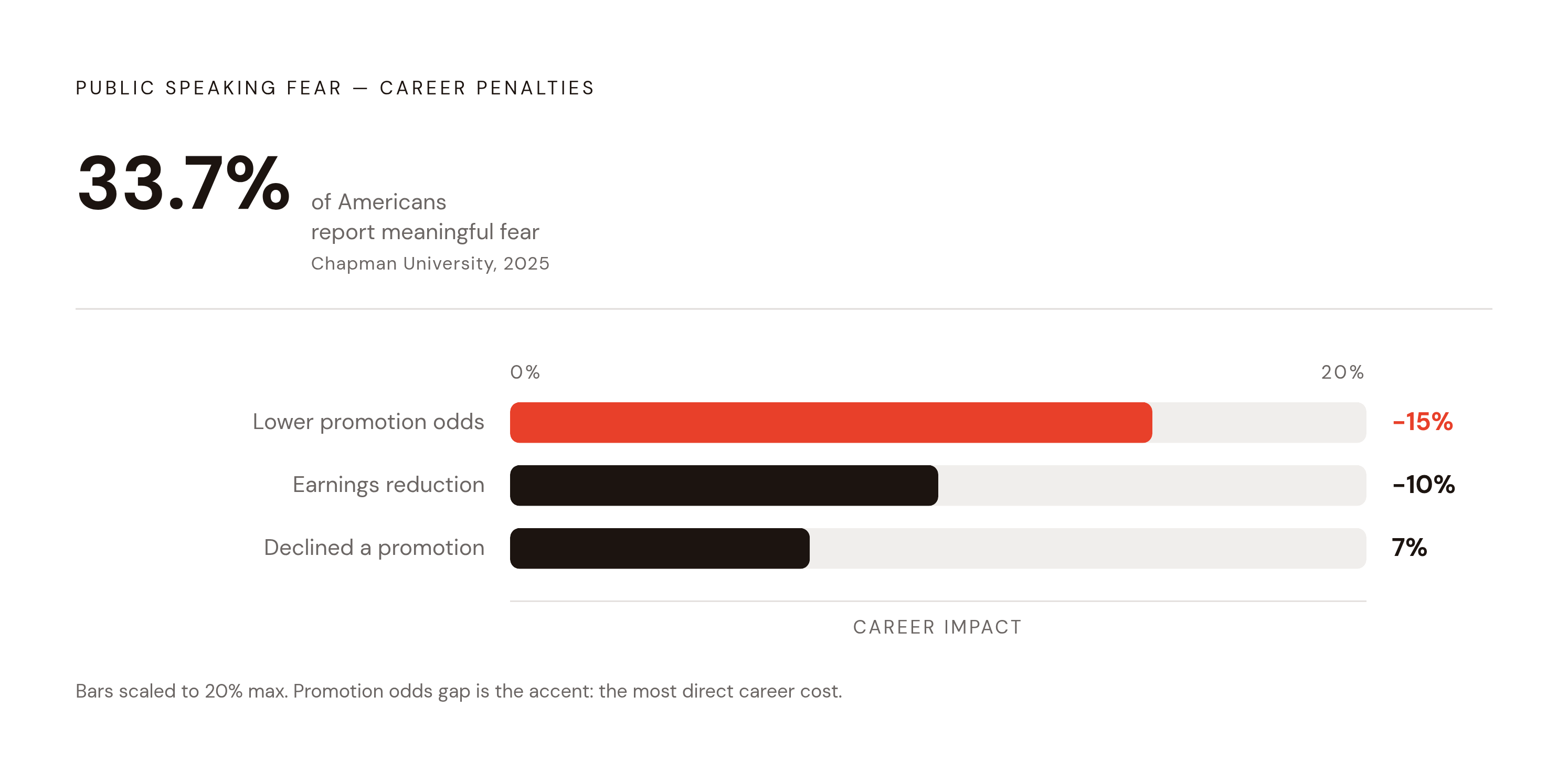
Roughly 75% of people worldwide report some fear of public speaking. Chapman University's nationally representative data lands more conservatively at 33.7% of Americans in 2025, but even the cautious number means something close to one in three adults walks into a presentation with a body that's already decided this is a threat worth fighting or fleeing.
The career cost isn't abstract. Public speaking fear can lower potential earnings by around 10%, cuts the odds of promotion into management by about 15%, and roughly 7% of workers say they've turned down a promotion specifically because of it. What almost nobody says out loud is that the fear doesn't disappear once someone makes it to the executive floor; it just relocates, to the board meeting, the investor call, the all-hands where one wrong word turns into a headline by Thursday. Only about 8% of people who deal with this fear ever seek professional help for it, which means most of the working world white-knuckles it alone, and usually not particularly well.
None of this is a character flaw, and it's worth saying plainly: the fear is the brain correctly flagging a high-consequence moment. It's an accurate alarm, not a broken one. The real question is whether deliberate practice gives someone a way to work with that signal instead of fleeing the room it's ringing in.
How deliberate, repeated practice builds the behaviors that look like natural presence
Research on expert performance points consistently to deliberate practice as the engine of skill development: structured repetition, specific feedback, and conditions that get harder over time. Presence follows the same rule as a golf swing or a violin scale. Treating it as a fixed trait instead of a trained skill is the single most expensive misread in this entire subject, and it's the one that keeps otherwise sharp executives stuck.
Frequency beats intensity, flatly. A short daily routine, something like 10 to 15 minutes, produces steadier gains in articulation and steadier drops in anxiety than sporadic preparation. Structured habit-building that combines practice, recording, and self-review has been linked to confidence gains of up to 30% within four weeks, which is a faster payoff than most people assume a soft skill can deliver.
Here's the part that gets skipped constantly: flawless run-throughs don't build confidence the way recoveries do. The moment someone loses their place, catches it, and keeps going teaches the brain something a perfect rehearsal never can, namely that a stumble isn't fatal. That's why practice has to include real stress: being watched, recorded, evaluated, not just rehearsed alone with the door closed and the dog as the only witness. Presence is a performance skill, and performance skills only develop under something that resembles actual performance conditions.
Feedback needs to be concrete to do any good. Recording a run-through and reviewing it against specific markers, pace, filler words, eye contact, sentence length, works. Vague self-grading doesn't. "I did okay" tells nobody anything useful. "My pace sped up during the Q&A" is something that can actually get fixed before the next one.
Building a pre-presentation routine that activates the behaviors, not just the nerves
Presence doesn't get conjured in the moment; it's what practice has already made automatic, and a pre-performance routine is just the trigger that switches it on. Physical prep comes first: a vocal warm-up covering projection, articulation, and pacing before walking into the room, controlled breathing to bring the heart rate down before it drags the pace up with it, standing in a way that claims space instead of hiding behind the podium or the slide deck.
Content prep follows the same logic used for board meetings. Know the material six questions deep, meaning the answers to the hardest possible pushback are ready before anyone asks. Map the story in advance using the situation, complication, resolution structure, so that when the delivery needs to bend, a pause here, a re-route there, it looks controlled instead of lost mid-sentence. If more than one stakeholder group is in the room, the framing for each one should already be decided, not improvised on the fly in front of the people it's meant to reassure.
Mental prep is the last piece and probably the most misunderstood. The physical sensation of nervousness and the physical sensation of excitement are close to identical; the only real difference is the label attached to it, and that label changes what actually comes out in the room. A quick mental review of a past recovery, rather than a past perfect performance, works better than trying to summon confidence out of thin air. It reminds the brain of evidence it's already collected: this has gone sideways before, and it got handled.
Communication has ranked among LinkedIn's most in-demand skills, a signal of how broadly the professional world has come to value it. Building this routine pays out well beyond Tuesday's board meeting. It's the one skill that keeps paying out for the rest of a career, long after the deck itself is forgotten and the slides are dust.