Persuasion Techniques That Work in Spoken Conversations
Credibility and listening matter far more than logic in winning arguments.
Most people walk into a persuasive conversation believing the job is to have the best argument. Spoken persuasion research says otherwise: logical force is one of the weakest levers in the room, and the people who rely on it most tend to lose ground, not gain it. Aristotle filed this under ethos, pathos, and logos more than two thousand years ago, and the order was not accidental. A 2026 arXiv audit of persuasive strategies in everyday conversation introduced the term "spontaneous persuasion" to describe something that should unsettle anyone who thinks they're winning arguments on merit: persuasive moves are already happening in ordinary dialogue, deployed or missed without anyone noticing, long before a person consciously decides to "make a case." The skill is noticing the moves already running on autopilot and deciding which to use on purpose.
That reframing matters because the instinct under pressure runs the opposite direction. When someone wants to convince a colleague, a client, or a hesitant hire, the reflex is to talk more, add another data point, repeat the strongest line a second time in case it didn't land the first. Each of those moves tends to increase resistance. The rest of this piece works through why, and what to do about it instead.
How credibility is established before a word is spoken
Before anyone evaluates what a speaker is saying, they've already made a judgment about whether that speaker is worth listening to. That judgment forms early, through tone, pacing, word choice, and the sense that the speaker understands the room they're standing in. Ethos is a signal the listener reads off the speaker in real time, deciding whether the argument gets a fair hearing.
Research by Tan and colleagues on Reddit's Change My View forum, drawing on 3,000 discussions, found that speakers who stylistically matched their conversation partners, mirroring vocabulary, register, and conversational rhythm, were measurably more likely to persuade them. The ordinary mechanics of being understood mean a listener trusts someone faster when that person demonstrates, through word choice and pacing, that they've already grasped the listener's world. Opening a conversation in the listener's own language does more work than opening with a title, a résumé line, or a confident claim of authority. The data table, if it comes, comes later. Credibility is the toll paid at the door, and most people try to walk in without paying it.
Why listening harder is more persuasive than arguing better
The move that breaks the model the reader walked in with is that arguing directly for a change reliably increases the listener's resistance to that change. This is a documented principle inside motivational interviewing, a clinical practice built around getting people to arrive at their own reasons for changing behavior.
The practitioner's toolkit for this is OARS, four micro-skills documented by Indiana Wesleyan University in 2025: open-ended questions, affirmations, reflective listening, and summarizing. None of them involve making a case. Picture two versions of the same conversation. In the first, a manager tells a direct report who's been missing deadlines: "You need to manage your time better, this is becoming a pattern." The report nods, says little, and nothing changes, because being told what to do invites quiet resistance. In the second version, the manager asks an open-ended question: "Walk me through what the last two weeks looked like." The report explains, the manager reflects it back ("so the deadline slipped because the scope changed twice without anyone flagging it"), and by the time the manager summarizes, the report has said out loud, in their own words, what needs to change and why. The manager never argued for anything. The report generated the argument themselves, and people trust their own reasons more than anyone else's.
That's the mechanism behind reflective listening specifically: it tells the listener they've actually been heard, and it removes the defensive posture that makes argument bounce off instead of land. Open-ended questions do a second job on top of that, restructuring the conversation so the listener, not the speaker, is the one producing the reasons for change. Reasons a person generates for themselves carry weight that borrowed reasons never do.
How emotional alignment moves people when logic cannot
That discipline matters here because emotional alignment, done right, looks less like performance and more like staying regulated enough to actually track what the room needs.
Alyahya and Aldayel, researchers at King Saud University, found in 2025 that reason-based counterspeech generates more supportive responses than other persuasion approaches, but only once emotional footing is already established. Pure logic, delivered into a room that hasn't been emotionally met, tends to fail regardless of how sound it is. A separate 2025 study by Sasaki and Inaba at HAI in Yokohama demonstrated something stranger still: when a third-party AI agent, a "Persuadee Agent," visibly accepted a persuasive argument before a human did, the human's own likelihood of accepting it rose significantly. The content of the argument hadn't changed. What changed was the social and emotional temperature of the room, and that temperature moved the human more than the logic did.
This has a direct consequence for anyone walking into a group setting or a high-stakes one-on-one: the task is reading and matching the emotional state of the room, not just winning the logical exchange inside it. Emotional alignment isn't a soft skill layered on top of the "real" persuasive work. In most live conversations, it's load-bearing.
Structure as an argument's load-bearing element
Evidence works best on a listener who already cares about the outcome. The order in which a speaker delivers evidence, affirmation, and conclusion decides whether that condition gets met before the facts show up or after it's too late to matter.
A senior product manager at a tech company used to open every quarterly review with a data table and lose the room by the second slide. The room was engaged before a single chart appeared, and the same evidence that had previously glazed eyes now landed as confirmation of something the audience already wanted to believe. Story earns the attention evidence needs to do its job.
Story works here because it closes the distance between the speaker's conclusion and the listener's own experience. A chart asks the listener to trust the speaker's interpretation of the numbers. A story lets the listener arrive at the conclusion on their own, walking the same path the speaker walked, making the conclusion feel discovered. That's the same mechanism behind open-ended questions in the OARS framework, applied to argument structure instead of to listening: people believe conclusions they reach themselves far more than conclusions handed to them.
Repetition and spoken fluency
Knowing that reflective listening works and being able to use it in a tense, live, unscripted exchange are two different skills, and the second one is built through repetition, not insight. Session data from Confidently, analyzed across thousands of practice sessions, shows that speakers who practice at least six times score meaningfully higher than they did on their first attempt, and nearly six in ten of those speakers show measurable improvement. A separate finding from the same data cuts against the instinct to rehearse longer: clarity scores peak on short practice runs and drop on extended ones, meaning ten tight, reviewable reps beat one long unreviewable rehearsal almost every time.
A 2025 pilot study on SpeakAR, an augmented-reality practice tool, found early support for building confidence through simulated environments with virtual audiences, and participants specifically credited the value of seeing themselves in context. Context shapes the outcome as much as the raw number of repetitions does. This points toward a specific practice structure: short daily prompts, scored for quick feedback after each one, rather than occasional big rehearsals before a big meeting. The techniques covered so far only become reflexes under pressure once they've been run enough times, in short enough bursts, with clear enough feedback, to stop requiring conscious thought.
The real gap for Gen Z speakers: exposure, not aptitude
The claim that Gen Z communicates badly gets repeated often enough to sound settled, and it isn't. The real gap sits in live, high-stakes spoken exposure, not in any underlying shortfall in ability.
Gen Z and younger millennials missed much of the organic in-person socialization that previous generations built up during early career years, the networking events, the public speaking reps, the collaborative back-and-forth of in-person negotiation, and that gap produces the structural piece behind this. The pandemic compressed and accelerated that gap at exactly the career stage where those reps normally accumulate. None of that is a character flaw. It's a missed set of hours that other generations got essentially for free and this one has to build deliberately.
The Deloitte Global 2026 Gen Z and Millennial Survey, covering 44 countries, found that Gen Z and millennials are already investing in their own development and name adaptability and communication among the skills they prioritize most. The motivation is already there. What's missing is a daily structure that produces real feedback. Some hiring managers are already de-prioritizing spoken communication in favor of AI fluency. Pawliw's answer is that avoiding spoken risk directly caps professional trajectory, because the people willing to do the uncomfortable, unscalable work of talking to other humans under pressure are the ones who end up differentiated from everyone else who outsourced that discomfort.
Which techniques to deploy first
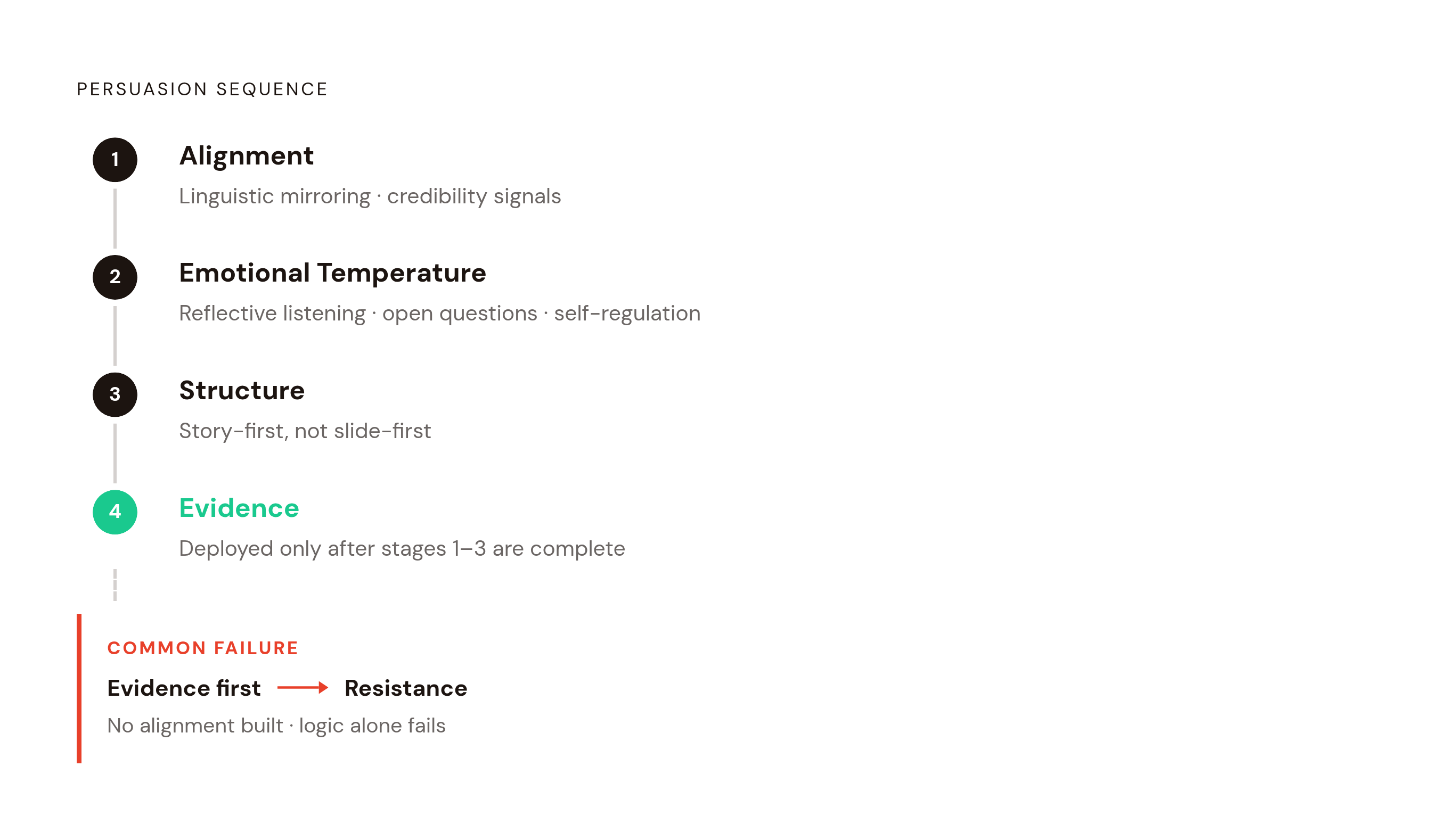
These techniques aren't a menu to pick from at random. They run in a sequence that mirrors how trust, emotion, and logic actually unfold inside a real conversation, and running them out of that sequence undercuts whichever technique is used inside it. Alignment comes first: linguistic mirroring and the early credibility signals covered earlier, the work that gets a listener to decide the speaker is worth hearing out. Emotional temperature comes second: reflective listening, open-ended questions, and the self-regulation Pawliw names as the core skill that holds the technique steady even when the conversation gets tense. Structure comes third: shaping the argument around a story, not a slide, so the listener wants the evidence before it arrives. Evidence comes last, deployed only once the first three have done their work.
The most common failure is running that order backward, opening with evidence and logic before alignment and emotional ground have been built, a sequence that produces resistance. Fixing that order doesn't require new material or a longer argument. It requires noticing, in the next conversation that matters, which of the four stages is being skipped.
Start today with one rep: pick a real exchange ahead this week, a hard conversation with a manager, a client, a direct report, and rehearse the opening thirty seconds, the part where alignment gets built or lost. Say it out loud, not in your head. Score it honestly. Run it again tomorrow. The techniques in this piece only work once they stop being something a person knows and start being something a person does without thinking about it, and that only happens through reps logged before the conversation that actually matters.
Sources
- Hatred Stems from Ignorance! Distillation of the Persuasion Modes in Countering Conversational Hate Speech
- When AI Gets Persuaded, Humans Follow: Inducing the Conformity Effect in Persuasive Dialogue
- Spontaneous Persuasion: An Audit of Model ...
- Change My View? The Dynamics of Persuasion and Polarization in Online Discourse