Ethos Pathos Logos in Everyday Verbal Arguments
Aristotle's three modes of persuasion still decide everyday arguments when deployed intentionally.
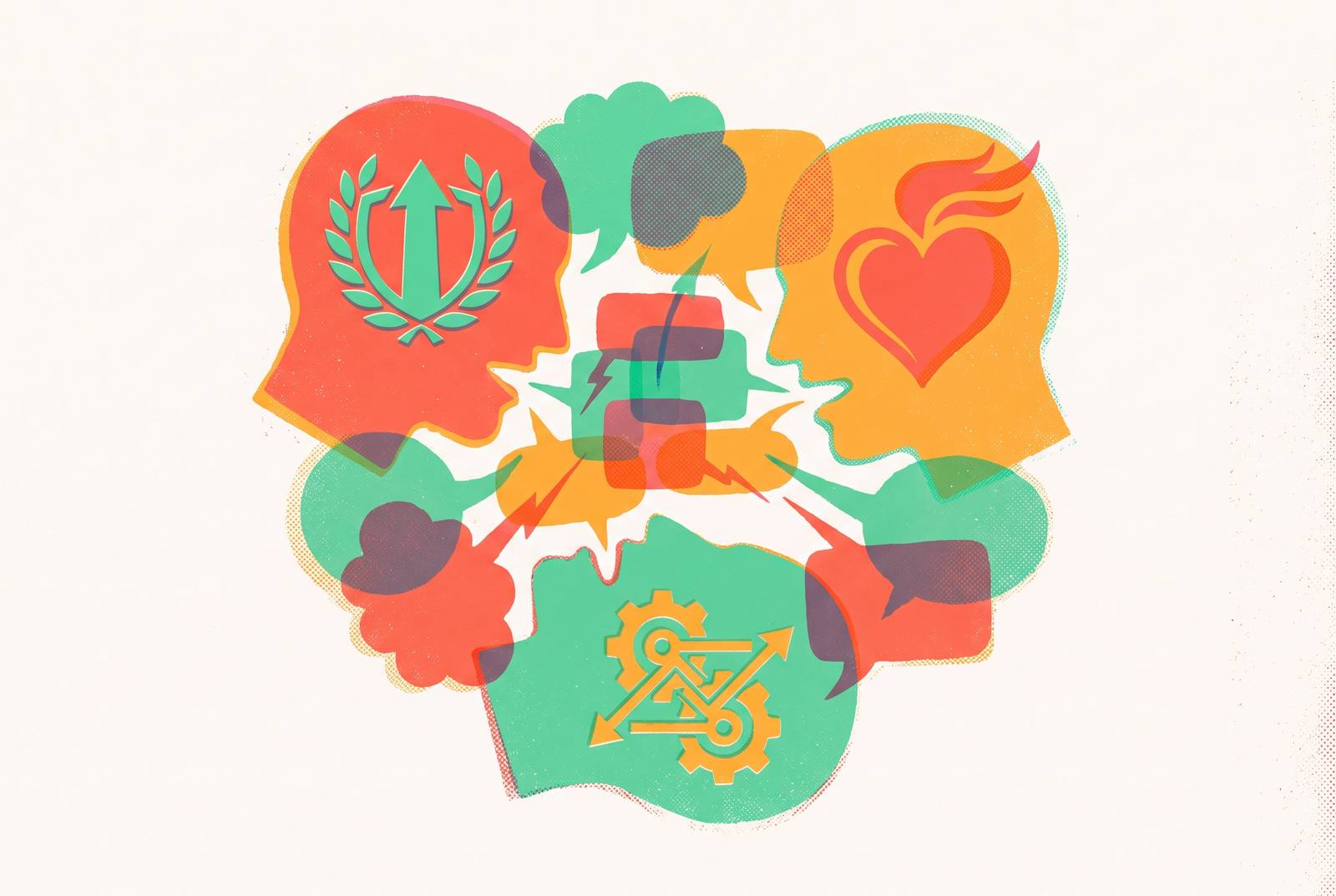
Persuasion isn't something you learn once and deploy consciously. Most people run it the way most people drive a car: pressing the right pedals without a clue what happens under the hood. Aristotle wrote it down in Rhetoric, naming three modes that still hold up as the working model, ethos, pathos, and logos. They show up in courtrooms and ad campaigns and political debates, sure, but that framing undersells the point. They show up in your group chat and at the dinner table and in the five minutes before you ask your boss for a raise.
Ethos, pathos, and logos as the mechanics of persuasion
Logos alone rarely wins anything. You can hand someone a spreadsheet full of airtight reasoning and watch them nod politely and do nothing with it, because they had no reason to trust you and no reason to care. That's the gap most people miss: winning an argument requires a reason to believe you (ethos) and a reason to feel the stakes (pathos), with the logic (logos) riding on top of both. Aristotle's three modes are a diagnostic, not a taxonomy for debate class. They're a diagnostic. When an argument fails, it's almost always because one of the three levers never got pulled.
What ethos, pathos, and logos each do alone
Ethos comes from the Greek word for character, and Aristotle broke it into three components: practical wisdom (phronesis), virtue (arete), and goodwill toward the audience (eunoia). None of those are static. Ethos isn't a badge you carry into a room, it's constructed live, in the exchange between you and whoever's listening. Research on social media rhetoric backs this up in an odd way: a 2026 study (arXiv:2607.00873) found that ethos and pathos embedded in the original sentence predict audience attitudes toward the author, even among people who never comment. Credibility signals work on people who aren't consciously grading you. Tone, posture, how you handle a pushback question, all of it counts, and none of it is captured by a resume line.
Pathos gets a bad reputation it doesn't deserve. It isn't manipulation or a violin swelling in the background, it's precision about stakes: who exactly pays the cost, and how. Saying "this affects workers" is vague to the point of meaninglessness. Naming the specific person, the specific Tuesday, the specific paycheck, that's not more emotional, it's more accurate. The strongest pathos almost always rides on a single concrete story rather than an appeal to "many people" or "society," because vague pathos smells like manipulation and specific pathos reads as careful.
Logos is the evidence, the stats, the chain of reasoning, deployed without sentimentality. Aristotle's advice was to prove the case first and land the conclusion after, which keeps an audience thinking rather than just receiving. Logos was meant to work alongside ethos and pathos rather than stand alone. It's the cornerstone, not the whole foundation, and it needs ethos to be believed and pathos to be felt. Three techniques of emphasis, working on three different parts of the brain, compounding when they run together.
Each appeal in conversations you are already having
A friend asks what to do with a bonus, and the reply starts with "I've been a financial advisor for twelve years, here's what I'd actually do with that money." That's ethos, doing its job quietly, grounding an opinion in a track record instead of a hunch.
Nudging a partner who's been burning out at work sounds different: "Think about how stressed you've been lately, don't you deserve a proper break?" That's pathos, aimed at a specific felt experience rather than a general lecture about work-life balance.
And comparing two internet plans side by side on speed, price, and contract length before picking one, that's logos, plain reasoning from evidence to decision.
None of these people were naming what they were doing. That's the whole point: most everyday arguments succeed or fail based on appeals deployed by instinct, and the upgrade comes from doing it on purpose. Timing matters as much as content, a concept the rhetorical tradition calls kairos. The right argument at the wrong moment falls flat. Steve Jobs' iPhone introduction worked partly because the market had spent years getting primed for exactly that pitch.
Credibility building and loss in the first moments of a verbal argument
Ethos isn't announced, it's read. The audience is scanning for trustworthiness and authority in real time, often before the actual content of the argument even registers. Three channels feed that read. Borrowed expert authority, citing a person or institution the listener already trusts. Borrowed organizational authority, speaking from a role or a team track record rather than as a private individual. And personal authenticity, the self-revealing, specific, first-person version of a claim rather than a detached one, which is what makes credibility feel earned instead of performed.
Negotiation theory has long held that the messenger sometimes matters as much as the message, credibility arising from position, expertise, and credentials rather than the argument's content alone. Ethos is fragile mid-conversation. Overstate one claim, dodge one counterargument, shift position without explaining why, and the credibility built over the last ten minutes evaporates in about ten seconds.
How to make emotional appeals land
The same 2026 study (arXiv:2607.00873) found that interpretations of social media messages diverged from the original message in 30% of cases, and that rhetorically charged content produced far more variability in interpretation than neutral content. Translation: emotional appeals are high-risk, high-reward. Get the calibration wrong and the message mutates in the reader's head into something you never said.
Effective pathos names a specific person, place, or moment rather than gesturing at "many people," because the abstract version invites skepticism while the concrete version invites identification. The emotion also has to connect to actual stakes, functioning as a signal about what matters rather than decoration layered on top of a fact. Arousal level matters too. Research on AI disclosure in crowdfunding (arXiv:2602.15698) found that mandatory disclosure of AI involvement led to significant declines in funds raised and backer counts, suggesting that how enthusiasm is framed around AI reads as manipulation rather than sincerity. Martin Luther King Jr.'s "I Have a Dream" speech remains the reference point for doing this correctly: concrete imagery, specific stakes, emotional weight grounded in lived detail instead of an abstract appeal to society at large.
What makes logos collapse
Courtroom argument is the clearest model of logos under pressure. A jury doesn't know the attorney personally, so borrowed credibility only goes so far, and overplaying emotion risks looking like a manipulation attempt. The evidence chain has to do the work, step by step, with each link checkable.
In ordinary conversation, that looks like comparing options against specific, comparable criteria before recommending one, citing evidence the listener can verify or already accepts, and walking through the reasoning instead of dropping the conclusion and expecting it to land on faith. Logos collapses in two predictable ways: facts the audience has no reason to trust, because ethos is missing, or facts about consequences the audience doesn't care about, because pathos is missing. Logos without the other two appeals is technically correct and completely inert.
Steve Jobs' iPhone launch is the textbook case of all three working in concert. Ethos from his standing as a tech pioneer, pathos from the excitement and the vision of a different kind of future, logos from the actual product specs and functionality. The logical case only landed because the other two appeals had already done the work of making people want to believe it.
Stacking all three appeals deliberately in a real conversation
Skilled communicators don't pick one appeal and ride it. They sequence all three, assigning each one a specific job at a specific moment. Making a case for a budget increase at work is a clean example. Ethos appears in the track record with past budgets and the way objections about existing costs get handled without flinching. Pathos appears in connecting the ask to something the audience in the room actually cares about, not "the department needs this" but what the increase means for specific people doing specific work. Logos appears last, in the numbers, the reasoning, the precedent that makes the ask defensible on paper.
Order matters here. Ethos generally needs to go first, because an audience that doesn't trust the speaker won't evaluate the evidence fairly and won't feel the emotional appeal as genuine, it'll read as a pitch. Once credibility is established, logos and pathos can interweave. One practical drill: spend five minutes before a high-stakes conversation mapping how credibility gets established, how the listener's actual concerns get addressed, and what evidence supports the case, then run it once as a rehearsal. Five minutes is short enough to stay sharp and long enough to catch the gaps.
Public speaking anxiety as an ethos and pathos problem
Roughly 75% of people report fear when speaking in front of others, making it one of the most common social fears anywhere. That fear isn't just stage fright, it's a rhetorical collapse. Anxiety flattens ethos, because a shaking voice stops projecting authority. It disrupts pathos, because a speaker locked inside their own panic loses the thread connecting to the audience. And it fragments logos, because the chain of reasoning falls apart the moment working memory gets hijacked by adrenaline. All three appeals take a hit simultaneously. "Just breathe" advice tends to miss the actual mechanism.
A 2025 study in Higher Education Studies, indexed via ERIC, tested a structured intervention combining gradual exposure, peer feedback, and guided self-reflection on university students, and found significant improvement in self-confidence alongside a corresponding drop in anxiety. Consistency beats intensity here: short, daily practice produces steadier gains in articulation and lower anxiety than an occasional long rehearsal session crammed in once a week. What builds durable confidence isn't a flawless run, it's recovery, the moment where a speaker loses their place, catches it, and keeps going. That's the rep that teaches the brain it can survive the stumble. More repetitions mean more evidence accumulated, faster, that the whole thing is survivable.
The competitive edge that deliberate rhetoric gives you in careers and social life
Communication has consistently ranked among the most in-demand skills employers cite globally. That's not a soft-skills footnote, that's employers naming, consistently, the single skill they value most. The AI paradox sharpens the stakes further: as machines take over increasingly complex analytical tasks, the distinctly human moves, reading a room, adjusting an argument mid-sentence, building trust in real time, get more valuable, not less replaceable.
Ethos, pathos, and logos were never tools reserved for debate stages and formal speaking events. These mechanics drive every negotiation, every hard personal conversation, every social situation where presence actually matters. The people who consistently win those conversations aren't the loudest or the ones holding the most facts. They're the ones who've built the credibility, felt for the stakes, and reasoning into a sequence, deployed on purpose, adjusted to whoever's actually sitting across the table.