Rep-Based Talking Drills You Run Every Day Like a Vocal Workout
Daily speaking practice builds fluency like physical training builds muscle memory.

Verbal communication is a trainable daily habit. A ten-to-fifteen-minute talking workout can build fluency through proceduralization, the process that makes practiced speech less effortful and more automatic. The useful routine is simple enough to repeat daily, with a warm-up, a targeted drill, a live response, and a second attempt guided by one piece of feedback.
Why verbal fluency feels like a personality trait but acts like a motor skill
You know exactly what you want to say. Then someone asks for it in a meeting, and the sentence arrives in several unhelpful installments. The gap between an available idea and producing it under pressure reflects difficulty speaking under pressure, often mistaken for a shortage of confidence, charisma, or natural talent.
Fluency depends on practicing how to speak as well as knowing words. Through proceduralization, conscious, effortful language production gradually becomes low-cost, automatic performance, much as a free throw or chord change does. The tongue, breath, and brain learn to work together this way through speech. Reading and listening supply useful input, but they cannot replace output any more than watching a guitarist trains a chord change. An awkward starting point is a reason to train.
What proceduralization actually does to a speaking brain
Working memory is the bottleneck in effortful speech. When attention is occupied with retrieving words and assembling sentences, less remains for organizing an argument or responding to a listener. Repeated tasks let speakers reuse linguistic constructions and gradually automate that assembly. The payoff is not merely faster talking, but less conscious work spent getting a sentence out.
Nel de Jong and Charles A. Perfetti’s research found that fluency improved during training both when speakers repeated their speeches and when they changed topics. Only the speakers who repeated their speeches maintained those gains on later tests. A new topic can feel harder, but speaking on a familiar one again gives the encoding process another chance to become automatic.
Practice activates language-processing networks, while sleep between sessions supports consolidation of what was learned. By contrast, cramming repetitions into one sitting can produce an illusion of competence, with immediate ease mistaken for durable improvement. Short, spaced practice provides a better basis for both retention and accurate self-assessment. The smooth final attempt on Sunday night is not the whole exam.
Why Gen Z and young professionals face a specific fluency deficit right now
Someone can communicate constantly and still get little practice at live, high-pressure speech. Texts, DMs, and asynchronous voice notes exercise real communication skills, but those skills do not transfer automatically to a negotiation or an impromptu exchange with leadership. Remote work and the pandemic also disrupted the informal apprenticeship through which young workers absorbed professional spoken norms.
JP Pawliw describes the distinction plainly. “Gen Z is comfortable with texting and asynchronous communication, but they have less experience with live, high-pressure situations. However, they are often better at digital collaboration. It's a different skill set, not a weakness.” Daily drills address that missing practice by rehearsing spontaneous responses rather than treating digital competence as evidence of live-speaking readiness. A training gap is something a routine can close.
The habit architecture that keeps daily drills from dying by Wednesday
To turn that premise into practice, attach speaking to something that already happens every day. The trigger should be concrete, such as finishing morning coffee, beginning a commute, or starting the walk to lunch. Write down when, where, and what the practice will be. “Practice more” leaves all three decisions unresolved, which is rather a lot of administration for a habit that does not yet exist.
Plan for roughly two months of practice, extending beyond two weeks. In the early weeks, the goal is showing up. The “never miss two days in a row” rule treats one missed day as normal while preventing a lapse from becoming the new routine. A specific anchor reduces the daily negotiation, and repeated spoken output gives that consistency a useful job. Motivation can then be helpful without being in charge.
The four-block daily session and what each block is training
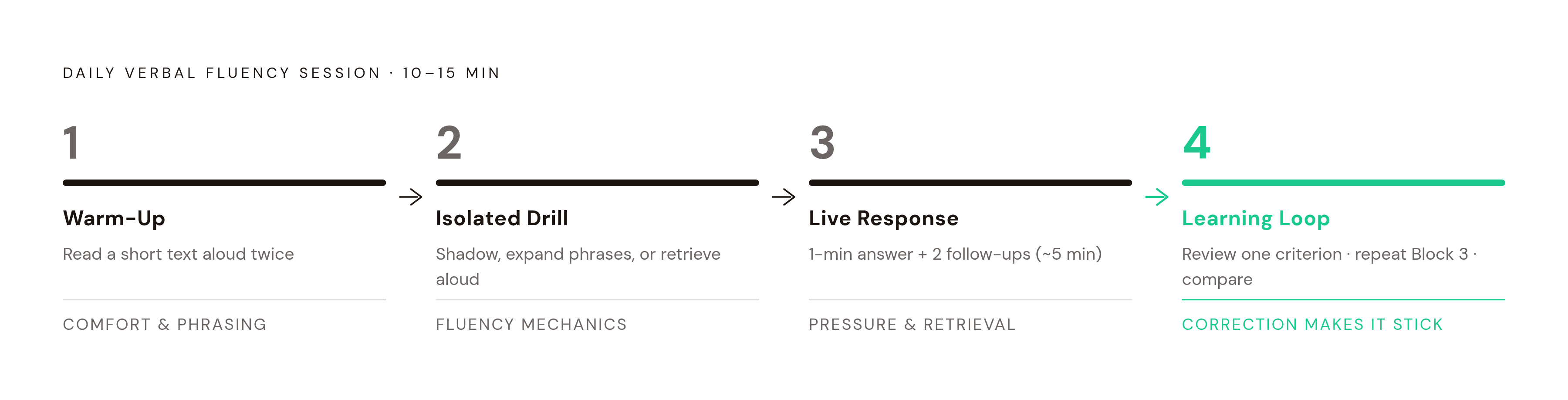
To run the workout, use four blocks in sequence over ten to fifteen minutes. Block 1 is a warm-up with a short text read aloud twice, first for comfort and then for phrasing. Settle into a comfortable pace and clear production. This gives the mouth and breath a manageable task before the session adds the pressure of inventing an answer.
Block 2 isolates one speaking skill. Choose shadowing, phrase expansion, or retrieval, and practice it aloud. Practicing in the mind leaves out the act of speaking aloud.
Block 3 puts that skill under live-response pressure. Spend five minutes answering a realistic prompt for about a minute, then handling two follow-up questions. If a word goes missing, paraphrase around it. “Let me think…” followed by a continued answer is acceptable here. The exercise rehearses staying in the exchange, as an impromptu pitch or hallway conversation requires.
Block 4 turns the response into a learning loop. Review one criterion, repeat the Block 3 task, and compare the attempts on that criterion alone. If the target is pacing, judge pacing. The order is deliberate, moving from comfortable production to isolated practice, then application and correction. Repeating the task gives the correction somewhere to go immediately.
The five rep types and what each one builds
The rep types form a rotating menu. Shadowing is the choice for rhythm and intonation. Listen to a clear audio source and repeat immediately, copying its tone, rhythm, and speed. Start with short sections and slow the playback if needed, then work toward speaking almost at the same time as the source to practice natural word-linking.
Timed same-topic repetition targets overall fluency through repeated assembly. Speak for one minute, then deliver the same topic again. The second pass benefits from vocabulary and structure already being primed, while a third pass can add an example or reorganize the argument.
Record and replay makes unnoticed habits audible afterward. Record a short passage and listen for filler words, dropped endings, rushed transitions, or unintended hesitations. Choose this drill when the problem is difficult to notice while speaking. It supplies the evidence for a targeted repeat rather than relying on a vague sense that the answer sounded wrong.
Self-talk narration is the lowest-pressure entry point into output. Describe what you are doing, such as making coffee, commuting, or walking, in full sentences. Familiar subjects including your day, job, or city keep the content readily available, so more effort can go toward speaking.
Speed rounds focus on retrieving an idea economically. Speak briefly on a topic, then express the same meaning faster by compressing the words. Across these drills, difficulty can rise through faster shadowing, a restructured third pass, or a shorter answer that still preserves its meaning.
Why storytelling is the hardest and highest-value drill format
A speaker must retrieve vocabulary, construct sentences, organize events, control pacing, and create emotional resonance at the same time. That makes it the compound lift of the verbal workout.
Chip and Dan Heath’s Made to Stick describes an experiment in a Stanford classroom where students gave one-minute talks to persuade their listeners. Most used statistics, while only roughly one in ten used a story. Ten minutes later, listeners remembered stories at a much higher rate than any individual statistic. A well-shaped account gives listeners something that stays available after the speaker stops.
A 2026 study published in Frontiers in Psychology found that structured digital storytelling with repeated oral rehearsal significantly improved fluency, comprehension, pronunciation, and total speaking score. The effect on comprehension was large, at Cohen’s d = 0.81, while the effect on pronunciation was moderate, at Cohen’s d = 0.57. For a practical version, choose something real that happened today and tell it aloud using a point-reason-example structure. On the second pass, cut it shorter without losing the point.
How a Monday-through-Friday rotation applies this across a real week
The focus changes from day to day, while tasks are repeated within each session. Use the following rotation to give each practice day a clear purpose. It preserves the familiar workout architecture without demanding the same exercise every morning.
Monday establishes the fluency baseline and restores the weekday anchor. Narrate your activity for three minutes, then make three timed passes on one topic. Record and replay the result.
Tuesday focuses on rhythm and intonation through imitation. Begin with a read-aloud warm-up, then shadow three sentences from one audio source, gradually increasing speed. Finish with a real-time prompt response. The emphasis is the physical pattern of speech.
Wednesday increases the pressure on retrieval and continuity. Run speed rounds on three topics and say each idea again faster, then answer a prompt and five follow-up questions without stopping. This extends the usual two-follow-up block into the week’s higher-intensity session. Keep the same meaning as you use fewer words.
Thursday makes storytelling the focus of the workout. Tell a short true story from the week, then deliver a shorter second pass. Record, replay, and review one criterion, such as argument structure.
Friday brings the skills back into the full session. Run all four blocks at a normal pace, then review the week’s recordings for one improvement and one unresolved issue. Saturday and Sunday can be days for extra practice, with no need to do a full workout. Narrating a walk, describing a meal, or retelling a movie plot provides low-pressure output without turning the weekend into another performance review.
How to track progress so the feedback loop actually closes
To distinguish training from merely spending time talking, keep a voice journal with one recorded entry per session. Review it for one criterion only, rotating the criterion across the week. Monday might track filler words, Tuesday pacing, and Thursday argument structure. A narrow target makes comparison repeatable. “Sound more confident” is difficult to inspect, while an audible habit gives the next attempt something specific to change.
Four questions help speakers track progress on their own, without a coach. Finishing sentences without restarting is a signal of fluency, while continuing around a missing word tracks retrieval under pressure. A smoother second pass offers evidence that repetition is helping execution. Using the target phrase or structure in a sentence of your own shows active vocabulary transfer.
Scoring and external feedback can tighten that loop further. A daily prompt scored on a 0–100 scale offers a repeatable feedback format, though the useful next step remains a specific correction and another attempt. At the sixty-six-day mark, compare a week-one recording with a current one. Changes that were difficult to hear from session to session can become unmistakable across two months. Use that difference to choose the next training target, then record another pass.