Rhetorical Questions Examples for Open Mic Sets
Rhetorical questions work best in comedy when you pause and let audiences answer them silently.
Rhetorical Questions Examples for Open Mic Sets.
Rhetorical questions as tools, not ornaments, for open mic performers
A rhetorical question is a statement wearing a question's clothes. Nobody asking one expects an answer out loud, because the answer is already sitting in the sentence, waiting for the room to notice it. Open mic performers who treat this as decoration, something to spice up a transition, are leaving the single most reliable lever in stand-up untouched. The angle here is blunt: rhetorical questions manufacture agreement, control pacing, and create the illusion of a two-way conversation with a room full of strangers.
That last part matters more than it sounds. Stand-up only works if the audience agrees, at least for the length of a set, to see the world the way the comic sees it. A rhetorical question is the fastest mechanism available for getting a stranger to nod along before they've decided whether they like you yet. And the mechanism has a hinge point that gets skipped constantly: the pause. Pose the question, then shut up for a second. That gap is where the audience answers internally, and an internal answer lands harder than anything spoken from the stage, because the audience thinks it's their own idea.
Skip the pause and the tool breaks. The question becomes filler, a verbal tic instead of a control switch. Everything that follows in this piece, six types, three placements in a set, and a practice regimen, assumes that pause is non-negotiable https://risecomedy.com/event/tag-youre-it-open-mic-2025-2/2026-06-14/ Skip to content RISE Comedy  [
[ [Get Tickets Now!. Rhetorical questions are steering wheels. They're steering wheels.
Six distinct types of rhetorical questions and their functions on stage
Start with the accusation disguised as a question. Erotesis is the disappointed coach asking something he already knows the answer to, doing so anyway to make a point: "Did you even try out there?". On stage this becomes a way of calling out a universal behavior right before the punchline lands, functioning almost like a jab thrown to set up the real punch.
Then there's doubt performed for effect. Aporia is feigned confusion, a way of raising a problem before pretending (or genuinely struggling) to solve it. Steve Jobs did this at the iPhone launch, asking "Now, how are we gonna communicate this?". Comedians lift the same structure wholesale: perform helplessness, let the room sit in the problem, then twist.
Anthypophora, or hypophora if the extra syllables feel unnecessary, is the sibling move that actually commits. The performer raises the obvious question the room is already chewing on, then answers it, usually sideways. Where aporia lingers in doubt, hypophora resolves it on the comic's terms. Aporia lingers in doubt while hypophora resolves it on the comic's terms; mixing them up means resolving too early or leaving the question unresolved.
Procatalepsis handles objections before they're voiced. "Now some of you think I'm wrong about this," said before anyone's actually decided that, does two things at once: it flatters the skeptics for having a thought they weren't fully having yet, and it disarms them before the disagreement solidifies.
Apostrophe is the strangest one on the list and the most theatrical. It means talking directly to something that can't talk back, an absent person, an abstraction, Adulthood itself: "Oh, Adulthood, what were you hiding from me?". Aimed at concepts like Wi-Fi, the algorithm, or a five-year plan, it turns an abstraction into a character with its own grievances, which opens up physical comedy, voice work, the whole toolkit.
Last, aposiopesis: trailing off. Not finishing the sentence. It's a dramatic pause pushed past its normal limit until the silence itself becomes the joke, and it works precisely because the audience finishes the thought internally, usually funnier than anything the comic could have said aloud.
Audience response to rhetorical questions in a live comedy room
Laughter in a comedy room is partly social contagion. People laugh because other people are laughing, and rhetorical questions are one of the signals that trains a room to know when a laugh is expected. Rhetorical devices, including contrast and callback structures, function as signposts that a punchline is arriving, priming the room to respond before the joke technically lands.
The internal-dialogue effect produces the audience's active participation, pulling a stranger in before they've made any conscious decision to engage. A rhetorical question that works is one the audience answers silently, in their own head, which makes it a strong opening move: it pulls a stranger into active participation before they've made any conscious decision to engage. The New York Improv Theater's framing of this in 2026 captures the audience-side experience precisely: the internal aside of "this guy knows what I mean," the moment a monologue quietly becomes a shared joke instead of a performance happening at someone.
None of this is uniform across rooms, though. Reading the room, kairos in the old rhetorical vocabulary, changes which type of question actually works. The same rhetorical question that lands in Denver might sit flat in New York, and the performer's read of the specific room in front of them determines which type of question to reach for.
Open mics complicate this further, and not in the comic's favor. The room is mostly other comedians focused on their own upcoming sets, which makes this a tougher room than a ticketed show. That's a tougher crowd than a ticketed show full of people who paid to laugh. Rhetorical questions that build agreement fast become more valuable here, not less, because there's no slow burn available. Waiting for an open mic room to warm up on its own is a losing bet.
Rhetorical questions that open a set and establish the performer's point of view
An opening rhetorical question has one job: plant the performer's worldview before a single traditional setup-punchline has been attempted. Hypophora works well here, raising the question the room is silently asking about the person standing in front of them and answering it before anyone else can. "Why am I up here? Great question. I'll let you know when I figure it out."
Consider a different opener: "Has anyone else noticed that we rehearse more for a voicemail than for an actual conversation riseguide.com?" The bit doesn't need to cite the underlying research that 58% of people script or rehearse conversations before making a call; the number is scaffolding, not the joke riseguide.com. The performer mines the shared absurdity and lets the audience supply their own memory of over-rehearsing a two-minute phone call.
Aporia opens differently, performing helplessness about something universal so the room aligns with the confusion before any authority gets claimed. "We have tools for everything now. So why can't we just talk to each other?" opens a bit about technology and communication without stating a thesis outright, which is the point: state the thesis too early and there's nothing left to build toward.
The pause after that first question is the entire mechanism, and skipping it reads as nerves rather than control. It's the entire mechanism, and skipping it reads as nerves rather than control. And the opening line itself has to work on something the room already recognizes on sight; anything requiring backstory or context is dead on arrival, because the audience hasn't agreed to invest in the performer yet. They've agreed to sit there. Nothing beyond that is required.
Rhetorical questions that control pacing and buy time inside a bit
Mid-bit, the rhetorical question does different work: it resets attention, signals a turn, or manufactures a breath without stalling the set's momentum. Erotesis fits naturally here. "And you know what happened next, right?" makes the room lean in, and the comic controls how far that lean goes.
Procatalepsis also does pacing work, not just objection-handling. "Now some of you think I'm wrong about this," dropped mid-bit before the room has decided anything, keeps a more provocative premise from losing the crowd's trust. It's a preemptive strike against the exact moment an audience might fold their arms.
Aposiopesis earns its keep here too. The trail-off, the "My mom called me. And I just... I mean..." works because the hesitation performs the emotion the words haven't gotten to yet, and the audience fills the silence with something funnier than a finished sentence would have supplied.
Pacing matters more than most beginning performers assume, mostly because the format leaves almost no slack. An average open mic set runs around five minutes, which means four or five jokes total, and every transition between them counts. The mistake newer performers make is treating rhetorical questions as bookends only, useful at the top and the close, leaving the entire middle of the set flat and segue-dependent.
Rhetorical questions that manufacture crowd agreement on sensitive or divisive premises
Some premises need the room nodding before the comic asks them to accept something uncomfortable. That's the job of the question that manufactures agreement: get a silent yes locked in before the bit demands anything harder.
Erotesis handles this cleanly, because the sharpness of the question, its near-accusatory tone, creates a moment of collective acknowledgment. "We've all pretended to laugh at a text that wasn't funny, right?" works because performing a reaction in digital spaces (42% of Gen Zers and millennials never answer their phones) has become close to universal behavior riseguide.com. The question does the work of establishing shared guilt before the bit even names what the guilt is about.
Procatalepsis handles the trickier premises, the ones that risk pushback. "I know what you're thinking, this guy has a communications degree and this is what he's doing with it," names the skepticism out loud before it can calcify into actual resistance, which then frees the bit to proceed entirely on the performer's own terms.
There's precedent for this outside of comedy clubs. Shylock's speech in The Merchant of Venice stacks rhetorical questions, "If you prick us, do we not bleed?" among them, forcing a hostile audience to answer yes repeatedly before confronting them with a moral argument they'd rather avoid. Comedians can steal that exact structural logic for material that needs a room to recognize itself in an unflattering mirror.
The question has to be answerable in under two seconds, and the answer has to be yes. Make the audience deliberate even briefly and the agreement effect collapses into confusion instead of consensus. There's no partial credit on this one.
Rhetorical questions as closers and callback anchors
A closing rhetorical question lands the set's thesis, calls back an earlier beat, or leaves the room holding an implication instead of a stated conclusion. Hypophora works as a closer the same way it works as an opener, just inverted: raise the question the entire set has quietly been circling, then finally answer it. A set built around digital communication anxiety might close on "So are we getting worse at talking to each other, or were we always bad?", and the answer functions as the set's actual thesis rather than a punchline tacked on at the end.
Apostrophe closes differently, and more theatrically. Addressing the abstraction the set has been arguing with the whole time, "Algorithm, I want you to know: you don't know me.", gives the audience a theatrical button that also plays as a genuine crowd-pleaser.
The strongest version of any of this is the callback: plant a rhetorical question early, ideally in the opener, without fully resolving it, then return to it at the close with the answer the bits in between have earned. That's the difference between a set that reads as a list of unrelated jokes and one that reads as a single constructed piece. Choosing material that shares a topic already makes segues smoother; a callback rhetorical question is just the most refined version of that same instinct, and it's what makes a set feel, in retrospect, like it was inevitable all along.
Closing on a question the set hasn't actually earned is the failure mode to avoid. Without the groundwork, the closer reads as a non-sequitur rather than a payoff, and the room feels the gap even if they can't name it.
Practicing writing and delivering rhetorical questions before getting on stage
Write the question before writing the joke. Decide which function is needed, agreement, pacing, or callback, and only then write the wording; the six-type taxonomy from earlier becomes a practical checklist rather than a glossary to memorize https://risecomedy.com/event/tag-youre-it-open-mic-2025-2/2026-06-14/ Skip to content RISE Comedy [ [Get Tickets Now!.
Skipping physical rehearsal costs a performer the physical gags and movement choices a given question invites. Practicing a full set in front of a mirror reveals the physical gags and movement choices a given question invites, and a rhetorical question delivered with no pause and no physical beat is a wasted tool no matter how well it's written. Watching other people's sets before attempting one's own also pays off, specifically to notice what actually makes a room laugh and to track where rhetorical questions show up and how each type lands.
Recording and scoring delivery closes the loop. Pose each question type on camera and grade it against a short list: was there a pause, did the question carry one obvious implied answer, did the vocal tone signal confidence rather than uncertainty. Vague self-encouragement doesn't move any of this forward; specific, repeatable feedback does.
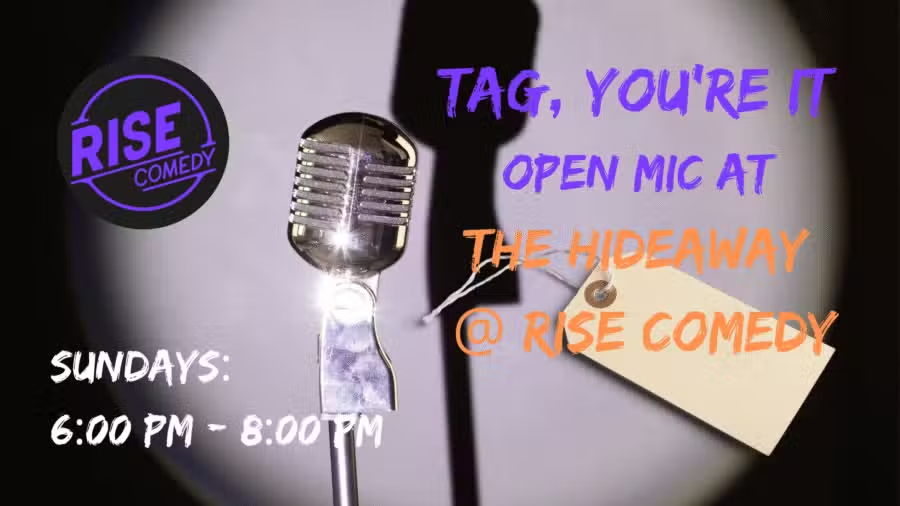
There's also the matter of finding a room to actually test this in. Tag, You're It! Open Mic at RISE Comedy in Denver (formerly the Voodoo Comedy Playhouse, 1260 22nd St), held Sunday evenings for a dollar, pay-what-you-can through Venmo, invites audience members to suggest taglines mid-set. That structure makes it a live laboratory for checking whether a rhetorical question's implied answer actually matches what the room is thinking, rather than what the performer hoped they were thinking.
None of this is subjective once it's broken down this way. Getting a room of strangers to silently answer yes, hold a pause on cue, and follow the logic from an opening question to a closing callback is a measurable skill, not a matter of charisma or luck. Either the room answered the question the way the bit needed, or it didn't. How to practice writing and delivering rhetorical questions before getting on stage: SOURCE PAGES (what the pages behind the outline's links say).