The One-Week Speaking Confidence Plan for Professionals With an Interview on the Calendar
Record your actual speaking voice to hear what interviewers will judge.

Speaking confidence before an interview comes from practicing answers aloud, recording them, and correcting what the recording reveals. This seven-day plan goes from a cold baseline to a realistic mock, so professionals can measure how they sound. The goal is not a flawless performance but answers whose sound matches their substance.
Why most interview prep leaves candidates exposed
A candidate knows every answer cold, then plays back a recording and hears something they did not expect. The opening wanders, the pace falters, and the strongest accomplishment arrives after a long runway of context. The knowledge is there. The delivery obscures it. That gap between the answer in the candidate’s head and the one reaching the interviewer is easy to miss when preparation happens entirely on a page.
Standard preparation rewards researching the company, scripting answers, and listing accomplishments. Those are useful tasks, but none trains the voice. Interviewers increasingly evaluate communication quality and business-context awareness as well as whether an answer is correct, so delivery is part of the assessment. A well-researched answer still has to survive being spoken.
What verbal disfluency actually signals to the person across the table
West et al. (2025) found that verbal disfluency predicts listeners’ judgments of answer accuracy and speaker confidence. The signals include fillers such as “umm” and “uhh,” hedges such as “maybe,” and pauses before speech begins. Listeners hear more than the literal answer. They also assess how certain the speaker seems, whether or not that impression reflects the speaker’s knowledge.
The difficulty is that low-confidence moments also produce more fillers and longer speech onsets, linking the feeling to the habit. Under pressure, the two can reinforce each other. An interviewer may read uncertainty into a delivery pattern before the substantive point arrives. Yet a habitual filler is not a verdict on competence, and its being a habit is precisely what makes replacement possible.
Why the anxiety that drives disfluency is physiological, not a character flaw
Interview nerves are a version of the fight-or-flight response. Deep breathing can steady the voice by calming the nervous system, while practicing again and again works in a different way, through stress habituation. A week of rehearsal therefore prepares more than answers. It gives the body repeated exposure to the situation that makes speaking difficult.
Why fluency and confidence build each other — but only with a feedback loop
Szyszka et al. (2026) studied advanced second-language learners and treated linguistic self-confidence and communication confidence as related but distinct constructs. Linguistic self-confidence alone predicted speech rate and mean length of run, while both constructs jointly predicted filler frequency. The study concerns language learning. It shows a link between confidence and features of speech that can be measured, but gives no proof that a week of practice guarantees a job offer.
That distinction gives practice a useful direction. Fluency and confidence can reinforce each other, but fear of mistakes, shyness, and low self-esteem can suppress the spoken engagement that helps fluency develop. Skipping a recording avoids the discomfort but also cuts off the feedback. The corrective is repeated speech that gets observed and scored, so improvement becomes something visible. Daily recording and self-audit are the engine of this plan.
How to use the seven days: the logic of the sequence before the daily tasks
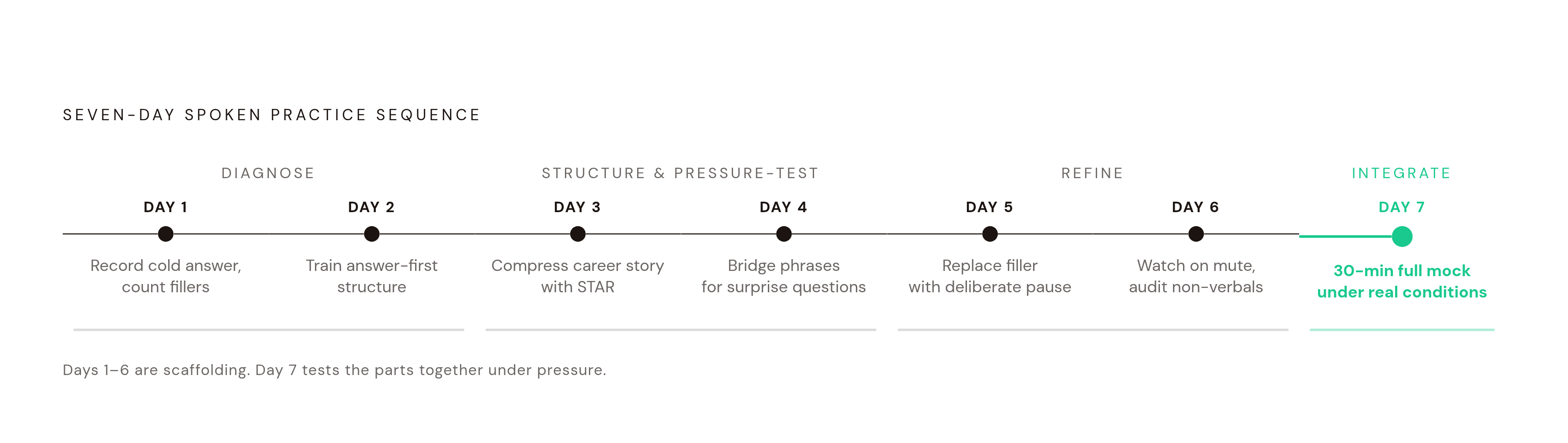
The sequence moves from diagnosis to structure, then pressure-testing and refinement. Each stage depends on the one before it. Days 1–2 establish how you sound and whether your answers bury the point, while Days 3–4 compress your stories and test your response to surprise. Days 5–6 isolate a verbal habit and then examine the non-verbal signals an interviewer sees at the same time. Day 7 brings those parts together in a setting like the real interview, to see whether the changes stick when the focus moves from practicing a technique to answering a person.
Day 1: recording a cold answer to find out what you actually sound like
To begin the practical work, record a two-minute answer to “tell me about yourself” without preparing it first. Resist the urge to replace the recording immediately. The cold take is the data, including the parts that make you want to negotiate with the playback button.
Listen for filler density, a backstory-heavy opening, changes in pace during the first seconds, and a voice that drops at the end of important sentences. Count fillers and note where the pace falls away, then write down the two habits that appear most often. “Too nervous” describes an impression. A repeated filler or a buried conclusion identifies something the next recording can test.
Day 2: training the answer-first structure that interviewers reward
An interviewer should not have to excavate the answer. Starting with background before getting to the point can sound unsure even when the answer itself is strong. Answering first and explaining afterward gives the listener a conclusion against which the supporting details can make sense.
For today’s practice, take three interview answers and rewrite each opening sentence so that it delivers the main point in the first breath. Speak the answers aloud and record them, paying particular attention to whether the opening actually answers the question. Leave the supporting explanation after that first sentence. The target is narrow, because fixing an opening is more useful than making several answers vaguely smoother.
Day 3: compressing a career story to the length an interviewer can hold
A career story with clear details gives an interviewer evidence to ask about, remember, and use, while a vague claim gives them little to look at. But specificity does not require the complete history. Without a structure, a story can get so full of background that the listener loses the thread before hearing what you did. The STAR method, which consists of Situation, Task, Action, and Result, gives each part a job.
Choose one key career story and time its current version, then shorten it using that scaffold. Cut every sentence that does not advance one of those four elements, including details you are proud of but that this answer does not need. Pride is not an editing criterion here. The aim is a concise, complete account that keeps the listener oriented and leaves clear evidence available for follow-up questions. Compression trains delivery because it forces you to distinguish the story’s substance from its scenery.
Day 4: practicing the one skill that buys time without sounding evasive
Surprise questions expose habits that a memorized answer can conceal. They call for listening to the question being asked instead of hearing a cue and starting a speech prepared ahead of time. Preparing key points instead of scripts leaves room to change your answer as needed, while acknowledging the question gives you time without pretending you already have an answer.
For today’s practice, introduce questions you have not rehearsed and try a short bridging phrase before answering. Examples to say aloud include “A moment to choose the most relevant example” and “That question has two parts; the first is about the decision.” Use the second only when the question genuinely has two parts, so the phrase reflects listening. Then pause and answer the question that was asked.
Day 5: replacing the filler word with a pause that works harder
Identify the dominant filler from Day 1 and replace it with a deliberate one-second pause. Do not attempt to remove every verbal habit at once, because that would turn a single practice target into constant surveillance of your speech. One filler, one replacement, one day is enough to keep the task clear.
Practice the replacement in a dedicated recording as well as in phone calls, conversations, and other live exchanges. An appropriate pause can sound thoughtful and credible because it leaves space for choosing words. That is different from the long, hesitant speech onset that listeners may read as uncertainty. The goal is not maximum silence but a brief, controlled substitute for an automatic sound.
Day 6: watching yourself on mute to audit what words can't fix
Words do not get the interview room to themselves. Posture, hand movement, eye-line, and facial engagement send signals alongside the voice that can back it up or work against it. Listening alone cannot show whether those signals match the answer, so today you look at the image apart from the sound. This is a five-minute audit.
Record an answer and watch it with the sound completely off, noting posture, gestures, eye-line stability, and whether your face appears engaged or flat. For a video interview, practice looking into the camera rather than at the interviewer’s face on-screen, since the camera creates the impression of direct eye contact at the other end. Choose one specific note to take into the mock. If the interview is by phone, the voice becomes the primary instrument, so the format determines which signals the interviewer can actually receive.
Day 7: running a full mock under conditions as close to real as possible
Run a thirty-minute interview with a friend or colleague, or record yourself to camera, using the same clothes, room setup, and device as the real interview. Bring the note from the silent-video audit into this run. Realistic conditions give the brain practice with the environment as well as the answers, helping reduce the anxiety spike and support recall under pressure.
When you stumble, use “let me rephrase that” and continue. Recovery is part of the performance being assessed. Afterward, review the recording for the two habits you found on Day 1 and ask whether they changed or came back under pressure. That comparison gives you a concrete success marker and identifies where the remaining preparation time belongs. Finishing the mock is also a confidence event, because you have now spoken through the experience once more than before, imperfectly and all the way to the end.
Why a week of spoken practice compounds beyond the interview
The same delivery skills have work to do after the hiring decision. Answer-first structure helps in meetings, concise stories support a pitch, and controlled pauses remain useful when negotiating a salary. None depends on an interviewer being present. The week’s lasting value is the habit of treating delivery as a trainable skill rather than a personality trait that either arrived at birth or failed to turn up.
To sustain that practice, keep the daily format small, with one prompt, one recording, and one score. The feedback should remain tied to something observable, such as the filler count or whether the answer begins with its point. Short practice is easier to repeat, while the recording preserves the evidence needed to adjust. An interview supplies the deadline. It need not supply the expiry date.
Sources
- Assessing English-speaking proficiency among secondary school students in Pakistan: a quantitative cross-sectional study
- Exploring L2 speech fluency of advanced learners from the perspective of linguistic self-confidence and communication confidence - Magdalena Szyszka, Pekka Lintunen, Mirosław Pawlak, 2026
- Do Young Children Use Verbal Disfluency as a Cue to Their Own Confidence? - West - 2025 - Developmental Science - Wiley Online Library