What a Real Delivery Score Actually Measures and Why Generic Feedback Misses It
Specific behaviors drive better practice feedback than overall impressions ever can.

A real delivery score measures separate speaking behaviors instead of giving a number to the listener’s overall impression. Useful AI speech scoring and feedback for everyday practice identifies what to change, where it happened, and whether it improves over time. Yapp offers a short daily loop of practice and scoring, but its composite score does not show a breakdown of every delivery dimension.
Why a listener's impression is a single signal built from many independent behaviors
A listener hears a presentation and offers “great job” or “speak up.” The speaker leaves with a verdict but no clear assignment for the next rehearsal. Was the point buried, the pace uneven, or the language too hesitant? The listener may have registered all of those things without separating them.
On a recording, the behaviors behind that impression include the rate in words per minute, the filler the speaker repeatedly reaches for, the words before the first claim, and the hedging around declarative sentences. Those behaviors can move independently, so controlled pace can coexist with frequent fillers, just as strong structure can coexist with hesitant delivery. Listeners form a single impression of those combinations while processing a message.
The six dimensions that sit beneath any single impression of delivery
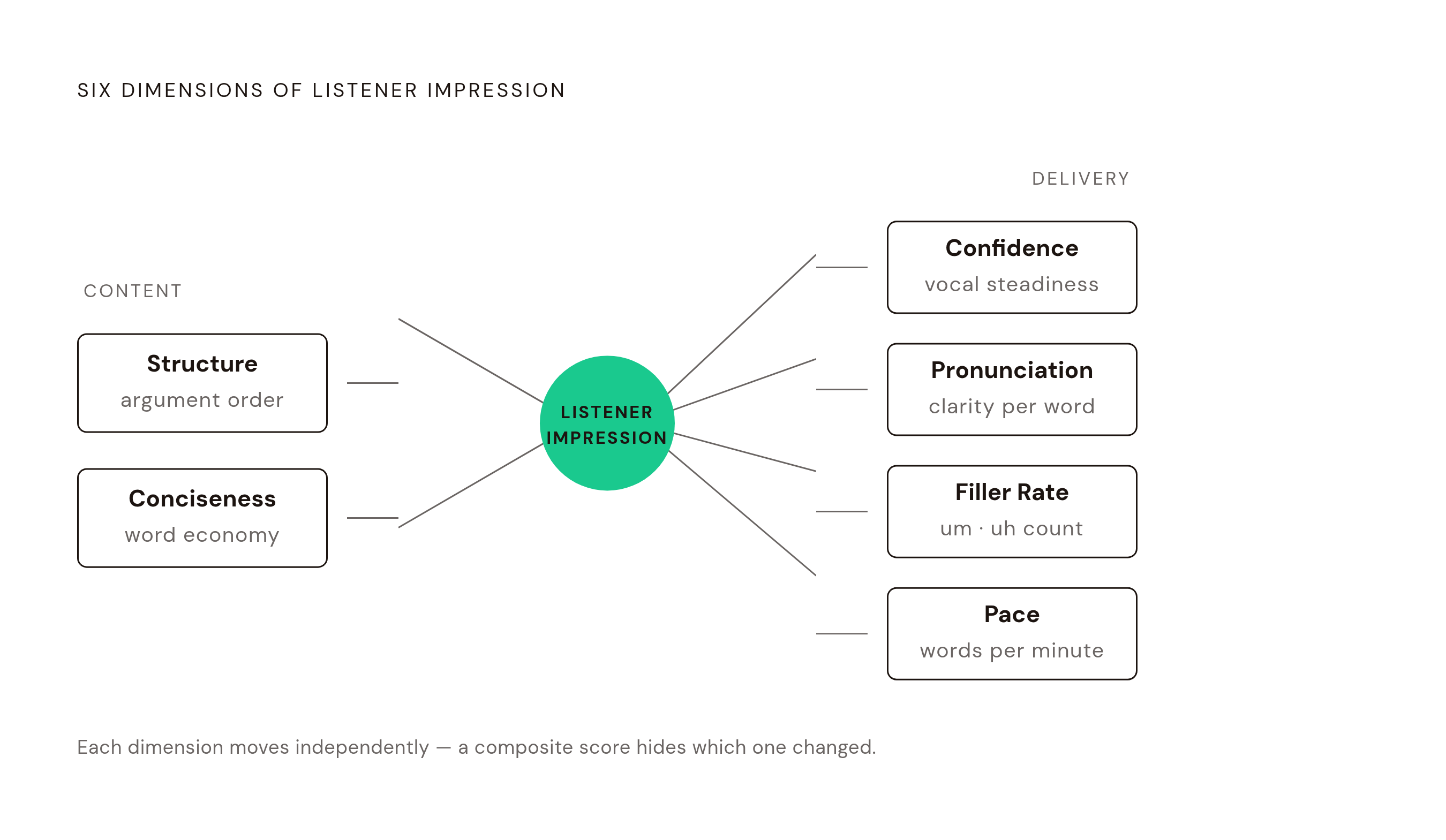
A useful framework separates at least six dimensions, namely structure, conciseness, confidence, pronunciation, filler rate, and pace. Structure concerns the main point, its supporting evidence, and the conclusion. Conciseness is how directly the speaker gets to that point, including how many words come before the first claim. These are the content-side dimensions, although measuring their visible features is not the same as judging the intellectual worth of the argument. An answer can be neatly arranged and still have little to say.
The delivery-side dimensions describe how the words are spoken. Confidence concerns whether declarative sentences are asserted or hedged, while pronunciation concerns whether the words are intelligible. Filler rate shows which hesitation sounds the speaker makes and how often. Pace includes both words per minute and where the speaker pauses. None of these measures, on its own, explains the whole experience of listening.
A structured answer format can address weak structure without doing anything for an uncontrolled pace. Likewise, fewer fillers do not show that the speaker has got to the point sooner. A number out of ten for delivery may summarize performance, but it cannot tell the speaker which of these problems needs attention unless its components are visible.
What peer-reviewed research says AI scoring reliably captures — and where it stops
A May 2025 study in the Journal of English for Academic Purposes evaluated an AI speaking assessment tool against human expert raters. The study used both Adaptive Comparative Judgment and traditional rubric scoring for a controlled reading task and an uncontrolled presentation task. AI scores showed strong concordance with human judgments on the reading task. All recordings in the presentation task were consistently judged, so agreement held when speakers presented as well as when they read. That distinction matters when describing what the study actually found.
Still, EAP Talk did less well overall on the uncontrolled task, where speakers had to speak spontaneously and develop ideas. High agreement on scoring does not establish that a tool judges intellectual substance as well as it judges acoustic fluency. The practical boundary is therefore between assessing how speech is delivered and assessing the quality of the thinking it carries. The study supports the usefulness of AI delivery assessment without making it a substitute for human judgment about an argument.
The human raters’ think-aloud scoring for the reading task treated delivery as distinct criteria: articulation accuracy, speech smoothness and fluidity, intonation, rhythm, intelligibility, articulation clarity, speech naturalness, and speaking rate. Those criteria support a multi-dimensional approach, though they do not validate every product or every proposed scoring category. The credible claim is that AI can capture useful acoustic and fluency signals. The overclaim is that those signals amount to a complete judgment of a speaker.
Why generic feedback — "speak up," "great job" — cannot change behavior even when the speaker wants it to
Generic feedback fails as a practice instruction because it leaves no specific action available. Positive reinforcement still has a place, because it can give someone credit for trying without turning every conversation into a test. But “great job” does not identify which choices worked, so the speaker cannot deliberately repeat them. The same gap appears in criticism such as “you need to work on your delivery.” Wanting to improve does not tell the speaker what went wrong.
Critical feedback can also add a stress response to that uncertainty. When criticism is experienced as a threat, higher-order thinking can become harder precisely when the recipient needs to interpret the note. That is a reason to make feedback specific. The speaker has been told that something is wrong without being told what to change.
Chiviacowsky & Drews (2014) found that participants receiving non-generic feedback during practice outperformed the generic-feedback group on a retention test the following day. The difference appeared after a scripted negative statement, independently of participants’ actual performance level. That motor learning finding sharpens the distinction between feedback about a particular performance and a general judgment. Specificity matters especially when the message is unwelcome.
The objection that any feedback is better than none confuses acknowledgment with instruction. A speaker who hears “speak up” and responds by speaking louder has changed something, but has not established that volume caused the original problem. The result can look like a practice loop while lacking the information that would make practice productive. This is why dimension-based feedback exists, and why a daily-practice app such as Yapp must be considered on both its repeatable routine and the specificity of its feedback.
How can a real delivery score show exactly what to practice next?
A useful score shows each dimension on its own line. The speaker can see that pace held steady while conciseness dropped, rather than trying to interpret a change in an overall grade. That separation supplies a defined target for the next recording. Instead of intending to “do better,” the speaker knows to address how long the answer takes to reach its first claim.
Timestamped feedback makes that target concrete. A marker at the exact filler or the sentence where hedging replaced assertion gives the speaker something to hear again. The recording then gives the speaker evidence to work with, rather than another chance to dislike the sound of their own voice. A coaching tool goes further by connecting the observed pattern to a specific drill.
Context must also shape the assessment. A presentation depends on a clear argument and transitions, whereas a difficult workplace conversation also depends on listening and responding to concerns. Using one generic score for both can hide what each situation calls for. Across repeated sessions, separate scores can then form trendlines showing which dimensions are improving and which are plateauing. That history helps the speaker choose what to practice next while allowing for some dimensions to matter more than others in a given setting.
What current tools actually measure and how Yapp fits the scoring framework
Yapp is a practical option for students and young professionals who want speaking to become a daily habit. Its format is a single prompt each day, a recorded response, and a score of 0–100. That creates a short, repeatable routine for people who suspect their ideas are better than their ability to express them. Repetition gives the score a history. Its clearest fit is daily practice with a measurable result.
The important limitation is that Yapp’s score is a single composite number. It therefore should not be described as showing all six dimensions independently. A composite trendline can show whether the overall result is changing, but it cannot on its own show whether pace, conciseness, or another dimension caused the change. Yapp is worth considering for the habit and repeatability it provides. For a reader whose main requirement is a separate score for every dimension, that distinction is material.
Wellspoken suits speakers who want to pinpoint what to work on. It scores six dimensions on a 1000-point index and gives the speaker specific drills for each one. It also records and scores real meetings, connecting assessment to actual work calls as well as rehearsal recordings. That makes it relevant to professionals who want to identify delivery patterns in their working day.
EchoPitch addresses situations where listeners also judge what they see. It reads vocal and facial signals through 44 FACS Action Units and scores confidence, composure, clarity, and persuasion with timestamped moments. Its fit is high-stakes delivery, including investor pitches, interviews, and sales presentations where facial expression and composure matter. Pricing includes a small bundle of sessions, followed by a monthly rate or other plan options. Those scores show how the tool rates a speaker within its own framework, but they do not prove that a given audience will be persuaded.
For interactive practice with Insight7’s AI Speaking Coach, the user describes a scenario, and the tool runs a live, adaptive conversation before scoring clarity, empathy, structure, and persuasion. Highlights are tied to specific moments, and a free tier and Premium paid plans are available. Its fit is preparation for an interview, sales call, or difficult workplace exchange in which the next response depends on what was just said. That conversational requirement is different from the daily prompt routine Yapp provides.
VirtualSpeech is relevant when the room itself is part of the problem. It combines presentation rehearsal with optional VR environments, including conference halls, meeting rooms, and public-talk stages. Its scores are tied to the exercise rather than applied generically, and it works in a browser with optional VR headset support. It fits speakers who need exposure practice as well as delivery assessment. Across these tools, the useful comparison is not simply which produces a score, but which measures the behavior and setting the speaker actually needs to practice.
Why chasing a score is not the point — and what the score is actually for
The strongest objection to scored speaking is that a person can optimize pace and filler rate while losing spontaneity and warmth. Even a perfect score across six dimensions would not guarantee that a message was persuasive or appropriate to its audience. Communication has a listener and a purpose, neither of which disappears because a dashboard is available. A score therefore earns its place as a diagnostic instrument by revealing a behavior that stands between the speaker and the message landing.
That frame also preserves the research boundary. Strong acoustic fluency cannot save a weak argument, and a speaker who works on fillers while ignoring what they have to say may be fixing the wrong problem. The speaker must weigh the audience, purpose, and context to decide which dimensions to work on. The proper role of a daily scored loop, including the one Yapp offers, is to build automaticity through practice scored out of 100. When speakers have to think less about pace and filler rate, they can think more about the argument.
Short daily practice helps build that automaticity through repeated, low-stakes work instead of only preparing now and then for a high-stakes event. Feedback makes the repetition productive by showing what needs to change. The speaker who understands the separate dimensions and practices them daily has a clear route forward.