How AI Scoring Apps Track Your Speaking Progress Day by Day
Daily practice with targeted feedback builds speaking skills faster than occasional attempts alone.
AI speaking scoring apps turn recordings into a running record of your verbal skills, but progress comes from acting on the feedback. Yapp gives users one speaking prompt per day, scores each response from 0–100, and builds that record over time. For practice at home, the useful cycle is to record, review specific feedback, adjust one thing, and repeat.
Why a single score after one session tells you almost nothing about your speaking ability
You finish a recording, get a score, and feel keen to keep going for a moment. Then comes the less satisfying part of the exchange, which is deciding what to do with it. A number can tell you how an app rated that attempt without explaining what should change in the next one. If you take it as a verdict, you stop there just when you should start working on what to change.
That recording also reflects the topic you happened to pick, how rested you were, and whether the prompt felt familiar. Those conditions affect performance without defining your speaking ability. A trendline across many sessions tells you more because it shows how each result fits with the others. Feeling more fluent matters, but how you think you sound is a poor way to measure that on its own. Confidence in the measurement is not the same thing as a measurement of confidence.
What AI scoring apps are actually measuring across six dimensions of spoken communication
The useful dimensions of speaking assessment are structure, conciseness, confidence, pronunciation, filler rate, and pace. Together, they cover both what a speaker says and how the words arrive. Structure and conciseness cover what is said, including whether the idea is in a clear order and uses no more words than it needs. Pace, filler rate, confidence, and pronunciation cover how the words are spoken. An assessment of both sides can distinguish an organized answer that sounds hesitant from a fluent answer that never reaches its point.
The more capable systems combine audio and text analysis. Confidence scoring, for example, can consider hedging language as well as vocal inflection. Filler detection and pace analysis pick up other parts of delivery, but neither can tell whether the argument makes sense. Counting verbal clutter can help a speaker cut it, though an empty room can also be very tidy.
The practical dividing line is whether the feedback explains a weakness and connects it to something the speaker can practice. “You sounded unclear” leaves the user guessing. “Your opening buried the point” identifies a structural problem that a targeted drill can address. A score becomes coaching material when it makes the next attempt more deliberate.
How the record-review-adjust loop turns daily repetition into measurable progress
A pilot study at the University of Moratuwa offers preliminary evidence for this approach. Participants practiced the same speech at least three times with AI feedback, and all showed improvements in public speaking performance. They used fewer filler words, and their anxiety levels fell. The study is small and preliminary, so it does not establish that every app or practice routine will produce the same result. It does support the narrower claim that repeated attempts with feedback can improve performance.
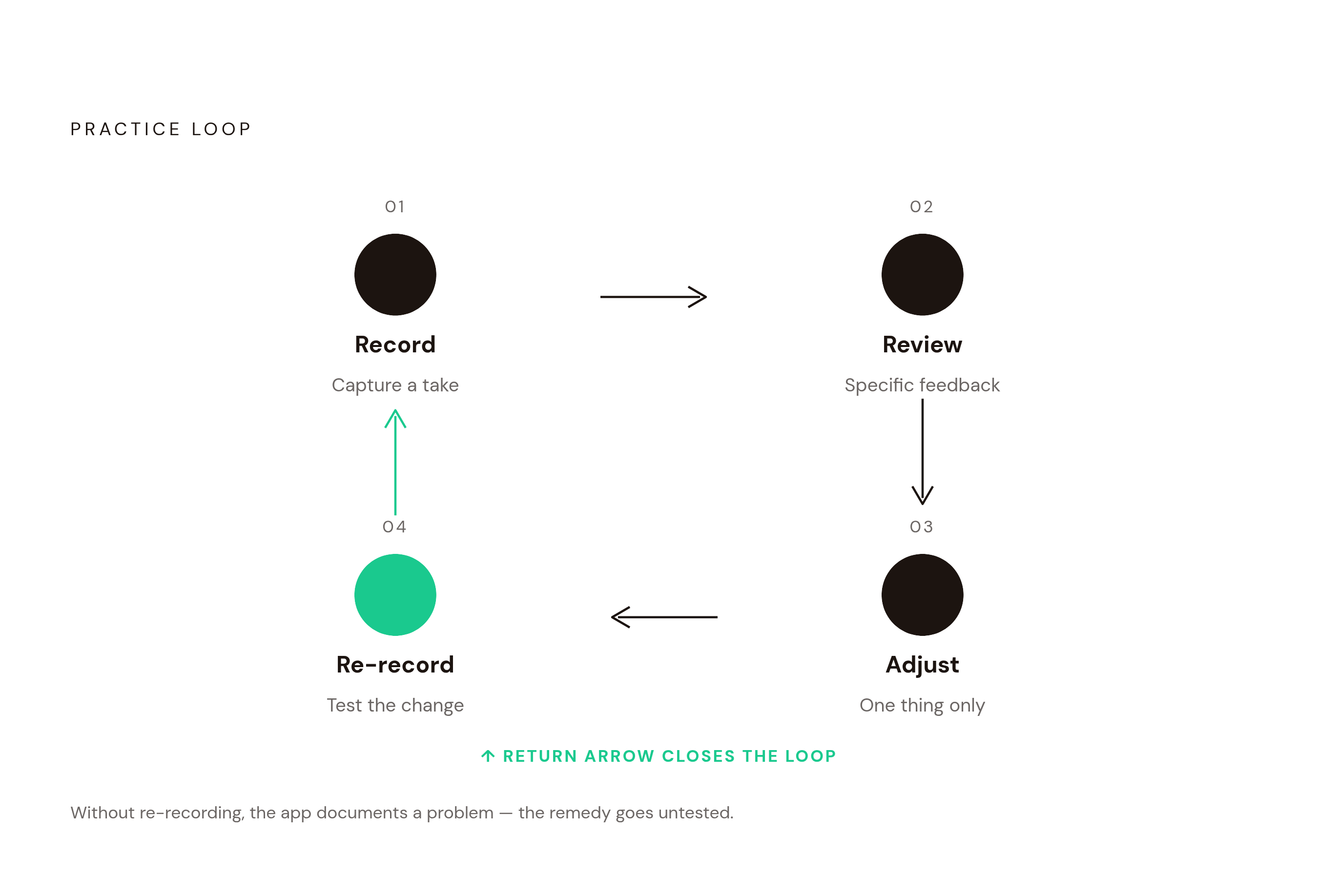
The mechanism matters more than the novelty of the software. Recording produces material to assess, and reviewing specific feedback identifies a weakness. Choosing one adjustment then gives the next attempt a purpose. Re-recording tests whether that change landed, rather than leaving the speaker with a vague intention to improve.
Consider feedback that identifies an opening that buries the point. The useful response is to change the opening, record the revised answer, and check whether its structure is clearer. That comparison connects an action to a result. Without it, the app documents a problem but the user never tests a remedy.
The longer record provides a second level of feedback. Yapp treats each day’s score as one data point in a trendline. Over weeks or months, those scores can show a pattern that is hard to see in single attempts. Repeating the same material has another benefit, because familiarity reduces the mental work of recalling content and leaves more capacity for delivery. Both benefits depend on returning to practice, making a regular practice habit part of the mechanism.
Why daily prompts and streaks are not gimmicks — they are what keeps the loop running
Before a speaker can complete the loop, something has to get them to start it. A daily prompt removes the small but persistent decision about what to practice. That matters when texting, asynchronous messaging, and remote work have reduced opportunities for spontaneous spoken responses. A practice tool cannot replace all those exchanges, but it can give people a regular chance to speak without a script. The blank page is less formidable when the app has already supplied the question.
In Yapp’s one-prompt-per-day model, the prompt, score, and running record make repetition the central activity. Streaks and progress dashboards also help bring people back to practice, using ideas from the design of language-learning apps. Their value lies in keeping the scoring system in use, since even a sophisticated system teaches nothing when unused.
Low-stakes practice can also make repetition easier for anxious speakers, who can rehearse privately and repeat a section without embarrassment. Huang & Kakham’s 2026 study in Frontiers in Education found that AI conversational agents reduced situational speaking anxiety in pair work and presentation tasks, but not in debate or storytelling. It found that overall foreign language speaking anxiety did not fall significantly more in one group than the other. The findings support benefits for specific tasks, but they give no grounds to promise that daily AI practice cures speaking anxiety.
The generation that most needs this loop and why the gap keeps widening
Gen Z and younger millennials face a speaking gap shaped partly by the environments in which they communicate. Casual chats once gave people practice without anyone setting aside time for it. Texting, asynchronous messaging, and remote work leave fewer of those chances to put a response together aloud in real time. Younger workers have fewer ordinary opportunities to develop the confidence they need.
That shortage can become self-reinforcing. Less practice adds to anxiety, which can keep people from speaking in demanding situations and leave them with even less practice. This goes beyond nerves over a presentation because conversations at work can affect money and opportunities. A daily feedback loop offers a structured way to interrupt the avoidance cycle without waiting for a high-stakes event. It makes spoken practice a repeatable activity.
What apps give you daily speaking practice and AI scores, and where does each fit the loop?
Apps can be compared by the part of practice they support, including diagnosing weaknesses, sustaining repetition, rehearsing under pressure, or refining pronunciation. Those needs overlap, but they are not interchangeable. A tool suited to daily verbal repetition may serve a different purpose from one designed to simulate an audience.
Yapp fits competitive daily habit building and scored verbal repetition. It provides one prompt per day, scores responses from 0–100, and builds a running record of progress. Its daily loop is the core mechanic. It is aimed at ambitious students, young professionals, and others who want to approach verbal skill as something trainable through repeated practice.
Wellspoken fits multi-dimensional assessment connected to targeted drills. It scores six dimensions and multiple sub-metrics, publishes its methodology, and links drills to specific weak areas. It can also record real meetings up to two hours with speaker isolation, connecting assessment of everyday speaking to subsequent practice. It is available on iOS, Android, and Desktop (macOS), with a free tier and a Pro subscription.
VirtualSpeech fits immersive audience simulation on Web and VR. ELSA Speak focuses on phoneme-level English accuracy and is available on iOS and Android. Oompf offers AI speaking coaching for interviews, presentations, filler words, and pacing on iOS and Android.
EchoPitch fits high-stakes presentation anxiety and confidence signal analysis. Its Pitch Scorer assesses a 60-second recording free with no signup. A trial tier provides a set of full sessions with a complete report, and an ongoing plan is also available.
Availability also changes the comparison. Poised, known for invisible coaching during live video calls, is closing in October 2026. Its website says it will close on October 8, 2026, while its app site says October 9, 2026. It was desktop only, with no standalone practice mode, though limited in-meeting challenges and learning content were available. Google Interview Warmup retired in April 2026, and a filler-word tracker with pacing analysis and practice drills was discontinued as of September 2026 and removed from the App Store.
The real limit of AI scoring: what the loop cannot yet measure
A tool can count filler words without knowing if a story moved anyone. It can score pace without knowing if a speaker held the room’s attention. Emotional resonance, body language, and audience dynamics are part of what makes communication succeed, and no current app replicates the human judgment needed to assess them fully. A rising score therefore cannot certify that someone has become an effective speaker in every setting.
There is also a narrower concern about identity. Coaching toward a generic professional voice risks producing speech that is polished but interchangeable. Training structure, pace, and filler rate need not have that effect, because control over delivery can give a speaker more range. Yapp’s stated design philosophy is to develop each user’s verbal craft against their own prior performance.
AI scoring works for regular practice on dimensions it can measure, where scoring again and again can show patterns and help speakers decide what to change. Human coaching has a place when the stakes are high and judging emotions and reading the audience matter most. The two approaches complement each other because they answer different questions.
How to build a daily scoring practice that actually compounds over weeks
Choose one app that assesses both content and delivery. If multi-dimensional feedback is available at a similar price, do not begin with a tool that tracks only one metric. Your aim is to understand what needs work. Keep the choice tied to the part of the loop you need help completing.
Set aside a few focused minutes at the same time each day for a prompt-response session. Record your answer and read the feedback before closing the app. Changing one thing and re-recording lets you check whether it helped. Then carry one clear target into tomorrow’s session, such as cutting filler words at the opening of your response. “Do better” Do better” is an aspiration.
Review your trendline weekly rather than treating every daily fluctuation as a revelation. Every two to three weeks, return to a prompt type you struggled with at the start and compare the new result with your baseline. That gives you a time to review your progress, without a promise that you will have improved by then. The comparison gives you evidence of what has changed and what still needs attention.
The score you record today can become evidence you point to in three weeks. On its own, it says little about your ability. Connected to specific adjustments and repeated attempts, it becomes part of an account of how your speaking is developing. Daily scoring makes progress visible.